Go Flux Yourself: Navigating Human-Work Evolution (No. 25)

TL;DR: January’s Go Flux Yourself explores the backlash against cognitive outsourcing, led by the generation most fluent in AI. Some 79% of Gen Z worry that AI makes people lazier; IQ scores are declining within families; and children are arriving at school unable to finish books. Welcome to the “stupidogenic society”. 

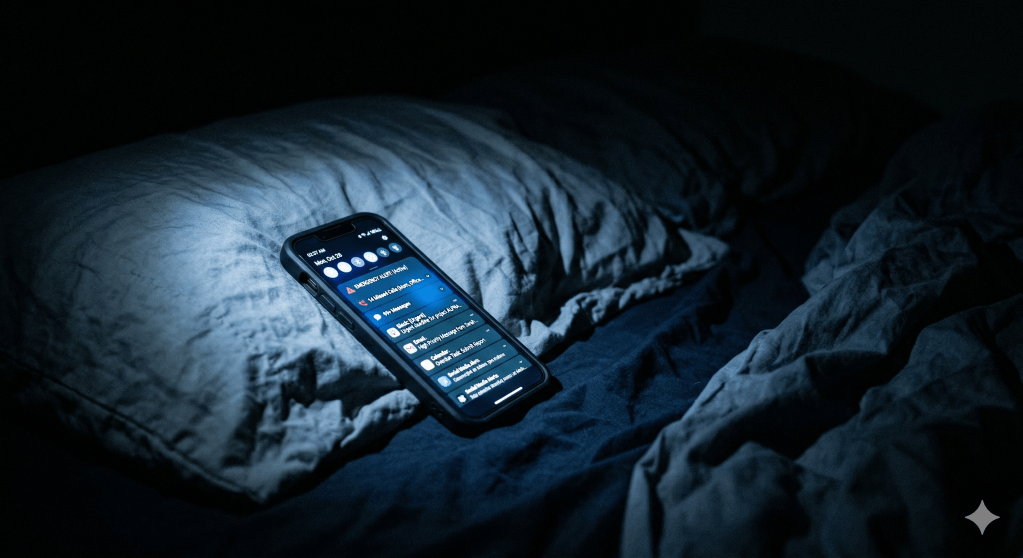
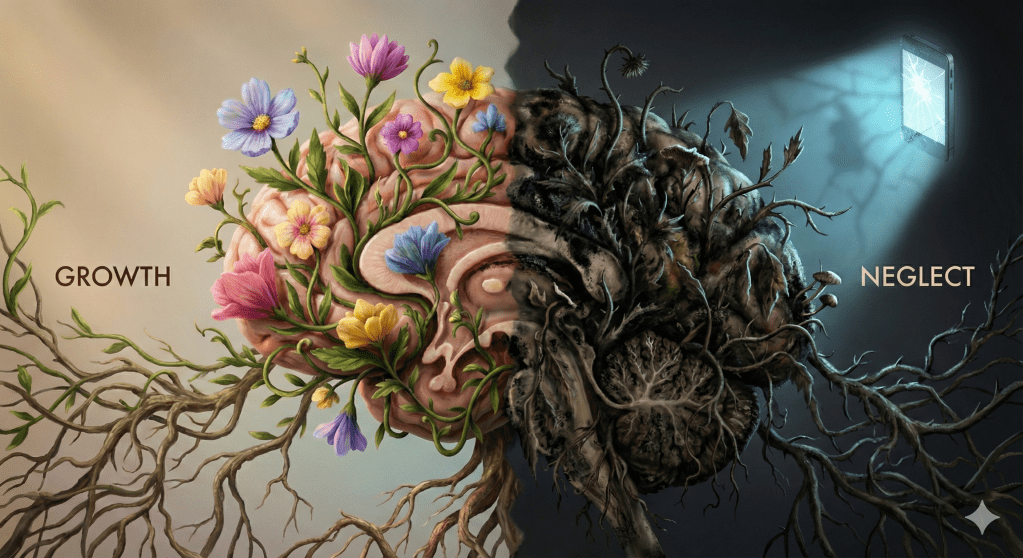
Image created by Nano Banana

The future

“Gen Z’s relationship with AI is fraught. Even as they use AI extensively, they harbor [sic] concerns about its long-term effects on human capability. It may be that, as young adults observe themselves and their peers offload more and more cognitive work to AI, they wonder whether convenience today brings diminished capacities tomorrow.”

The above quotation comes not from a Luddite technophobe or a concerned headteacher, but from Harvard Business Review, published a couple of days ago. The researchers surveyed nearly 2,500 American adults aged 18 to 28, the most AI-fluent generation on the planet, and discovered something that should give pause to anyone in the business of building intelligent machines: the people using AI most are the people most worried about what it’s doing to them.

This is rather like discovering that Cadbury employees are most concerned about chocolate addiction. It suggests they know something the rest of us don’t.

According to the HBR paper, 79% of adult Gen Zers worry that AI makes people lazier, while 62% worry it makes people less intelligent. One respondent offered a comparison that would make a public health official wince: “The mind is a muscle like any other. When you don’t use it, that muscle atrophies incredibly fast. Any regular use of AI to outsource thinking is as bad for you as a pack of cigarettes or a hit of heroin.”

Perhaps that’s overstating things. A ChatGPT query probably won’t give you lung cancer (although it is reckoned that being lonely has the equivalent mortality impact of smoking 15 cigarettes a day). Nonetheless, the underlying anxiety is worth taking seriously because it comes from people with no ideological opposition to the technology. They use it constantly. They just don’t like what’s happening to themselves.

The backlash against an insidious over-reliance on tech, in general and AI in particular, is, in other words, being spearheaded by digital-native users. This is the equivalent of a focus group for a new soft drink concluding that the product is delicious, highly refreshing, and almost certainly corroding their internal organs.

By the end of this decade, Gen Z will comprise around a third of the global workforce. These are the people who will inherit the AI systems we’re building today. And increasingly, they’re asking an existential question that their (current or prospective) employers haven’t yet considered: what happens to human capability when machines do our thinking for us? It’s a reasonable thing to wonder. Especially if you’re the one whose capability is at stake.

Meanwhile, it was a case of back to the future with the theme of this agenda-setting year’s World Economic Forum, held in mid-January in Davos, “a spirit of dialogue”. Not “innovation” or “transformation” or “the intelligent age”, but dialogue. Conversation. The radical proposition that perhaps we should talk to each other.

As Børge Brende, the Forum’s President, put it: “Dialogue is not a luxury in times of uncertainty; it is an urgent necessity.” The meeting drew record numbers: close to 65 heads of state and government, nearly 850 of the world’s top CEOs, and almost 100 unicorn founders and technology pioneers. All gathered, ostensibly, to talk. One hopes they did more listening than is typical at such events.

It’s a telling choice of theme. After years of breathless enthusiasm for disruption, the global elite has discovered the merits of slowing down and having a chat. Historically, the technology industry – especially on the other side of the Atlantic – has operated under the principle that it’s easier to ask forgiveness than to ask for permission. The fact that Davos is now hosting panels on “cognitive atrophy” suggests that even those who profit from disruption are starting to wonder whether they’ve disrupted something important.

At one such session, William Hague, the former Foreign Secretary and current Chancellor of the University of Oxford, offered a framing that deserves wider circulation: “As AI adoption accelerates, cognitive skills are becoming more economically valuable. Yet we are outsourcing more of those than ever before.”

This is a genuinely fascinating paradox. The more valuable thinking becomes, the less of it we seem inclined to do. It’s as if, upon discovering that physical fitness correlates with longevity, we collectively decided to spend more time on the sofa. Which, come to think of it, is exactly what happened.

Analytical thinking remains the most sought-after core skill among employers, according to WEF’s research. But human-centric skills, empathy, active listening, and judgment can be quietly eroded without regular practice. “Core cognitive capabilities deteriorate over time,” Hague noted. “Will we divide as humanity between people whose mental faculties are enhanced by AI, and others for whom they are reduced?”

It’s the right question. And the answer, increasingly, looks like yes. We may be building a world with two kinds of people: those who use AI as a tool, and those who become tools of AI. The distinction is subtle but important. A carpenter uses a hammer. A nail does not.

A couple of weeks ago, I spoke with Daisy Christodoulou, Director of Education at No More Marking and one of the sharpest thinkers on teaching in Britain. She offered a diagnosis that’s both illuminating and magnificently ugly.

“We created an obesogenic society,” she told me. “Physical machines got better and better, the need for physical labour went down, and we ended up with conditions where it’s easy to become obese. I think we’re heading for something similar with thinking. As AI gets better, there’ll be less thinking for humans to do. And if you don’t practise something, it wastes away.”

Daisy calls it “a stupidogenic society”. It sounds like a dystopian novel that’s trying too hard. But the concept is precise: an environment where intelligent machines reduce the need for mental effort, and unused mental muscles atrophy accordingly.

Nobody set out to make people fat. We simply made food abundant, cheap, and delicious, then acted surprised when waistlines expanded. Similarly, nobody is setting out to make people stupid. We’re simply making thinking optional, then acting surprised when fewer people bother.

Daisy draws an illuminating historical parallel. “Read any diary from the past, Samuel Pepys’ is full of it, and you’ll find people playing instruments constantly. Not because they were more musical than us, but because if they didn’t play, they’d have no entertainment.” Now Spotify delivers better music than most amateurs can produce, so the incentive to practise has evaporated. Why spend 10,000 hours mastering the violin when you can summon Hilary Hahn with a tap?

This chimes with something an old University of St Andrews friend, Jono Stevens, told me over spicy pho (which seems to have cleared a nascent cold) this week. Jono co-founded Just So, a brilliant, human-story-focused film company, and he’s grappling with the same questions as a parent. His daughter announced that she didn’t see the point of piano lessons anymore. Why struggle through scales when Spotify can deliver Chopin on demand?

The piano student isn’t just learning to play the piano. She’s learning to persist, to tolerate frustration, to hear the gap between intention and execution and narrow it through practice. Spotify, however wonderful, teaches you nothing except how to make a playlist.

Is this where we’re going? Where we can’t be bothered to do the hard work of mastering things, whether it’s the piano, philosophy, or more practical cognitive skills?

“What happened with music over centuries is being sped up for writing because of AI,” Daisy argues. And writing, she stresses, isn’t merely communication. “There’s a limit to the level of complex thoughts you can have without the process of writing. If you offload that to AI, you risk losing the ability to develop sophisticated ideas at all.”

The act of putting thoughts into words forces a rigour that thinking alone does not. Anyone who has tried to explain something and realised mid-sentence that they don’t actually understand it will recognise this. Outsourcing writing is, in a very real sense, outsourcing thought itself.

The HBR researchers found that the dominant worry among Gen Z, raised by 68%, was “crowding out learning by doing”. As one respondent put it: “Bots do the work for people, so they don’t have to learn anything.” A study from MIT’s Media Lab last year backs this up: participants who used AI assistance showed reduced activation in brain regions associated with critical thinking and creative problem-solving.

The brain, it turns out, is not a hard drive. You can’t store capabilities and expect them to remain intact. It’s more like a garden: without regular tending, things wither. The Victorian educationalists who insisted that learning Latin was good for the mind were probably onto something, even if their reasoning was wrong. The struggle itself was the point.

Humans are “cognitive misers”, Daisy explains. “We instinctively want to conserve mental energy. That’s a good thing. The philosopher Alfred North Whitehead said civilisation expands by the number of things you can do without thinking about them. But that drive for progress has a byproduct: we just stop thinking as much.”

This is the great irony of efficiency. We automate tedious tasks so we can focus on the important ones, only to discover that the tedious tasks were training for the important ones.

The evidence predates smartphones. The Flynn effect, the observed rise in intelligence quotient scores across generations throughout the 20th century, has reversed in several developed nations. The most striking data comes from Scandinavia, where military conscription provides consistent testing across generations. Researchers have observed IQ declining within families: the third brother scoring lower than the second, who scored lower than the first. Same genetics, same household, but something cultural shifting between cohorts. “It’s not genetic,” Daisy emphasises. “It’s environmental.”

Colin Macintosh sees this play out in his classrooms every day. He’s the headmaster of Cargilfield, an Edinburgh prep school, and – full disclosure – my A-level English teacher at Shrewsbury School. He’s the reason I studied at St Andrews. When Colin reached out to discuss children’s attention spans, following December’s New Statesman piece on the under-16s social media ban in Australia, his concern was palpable, and this is a man who has spent decades dealing with 12-year-olds. He is not easily rattled.

“We’ve noticed that pupils with phones at home struggle more with sustained reading,” he told me. “Year 7 and 8: they can’t finish books. Their attention has been fragmented before they even arrive.”

Without due care and consideration, children arrive at secondary school already damaged, having spent too much of their formative years on a screen. Their capacity for sustained focus is compromised before anyone has had a chance to develop it. This is a failure of the environment in which education happens.

Colin has become an advocate for what Cal Newport calls “deep work”: the ability to focus without distraction on a cognitively demanding task. His school is minimising screen use rather than trying to use screens “in a better way”. No one-to-one devices. Deliberate cultivation of concentration as a skill, scaffolded by teachers, built up over time.

“Deep work doesn’t appear on the WEF’s list of future skills,” Colin observes. “But it underpins virtually everything else on that list. Critical thinking, complex problem-solving, creativity: none of them is possible without the ability to sustain focus.”

It’s rather like noting that “breathing” doesn’t appear on the list of skills needed to run a marathon.

The WEF’s scenario planning paper, Four Futures for Jobs in the New Economy: AI and Talent in 2030, published this month, inadvertently illustrates the point. After surveying over 10,000 executives globally, it finds a telling asymmetry: 54% expect AI to displace existing jobs, 45% expect it to increase profit margins, but only 12% expect it to raise wages. The gains flow to capital; the losses fall on labour. 

The paper’s proposed solution is a new category of worker: the “agent orchestrator”, someone who manages “portfolios of capable machines”, overseeing hundreds of AI systems simultaneously, defining objectives, evaluating outputs, and handling exceptions. It’s presented as the human role that survives automation. But consider what orchestration actually demands: task decomposition, systems thinking, quality judgement across multiple complex domains, the ability to spot when AI is subtly wrong rather than obviously broken.

These are not skills you develop while scrolling. They require sustained, deep cognitive work that our attention-fragmenting environment systematically erodes. We’re being told the future belongs to people who can concentrate intensely on complicated problems, while raising a generation that struggles to finish a book.

Colin revealed his lowest professional moment, from a couple of years ago. An Ofsted inspection in which colleagues panicked that inspectors hadn’t seen enough screens during lessons. “The next day, screens appeared everywhere. Madness.”

We’ve been so worried about preparing children for the digital future that we’ve undermined the cognitive foundations they need to thrive in it.

Not everyone agrees that technology is the enemy, however. Neil Trivedi, head of mathematics at MyEdSpace, teaches thousands of students simultaneously through TikTok. His results are remarkable: 51% of his students achieve grades 7-9 at GCSE, roughly triple the national average.

“Blanket bans push children underground,” Neil argues. “They remove adult visibility and ignore the genuine democratisation of excellent teaching that these platforms enable.” Students who might never access great maths teaching in their local school can now learn from qualified teachers anywhere.

This is genuinely good. The postcode lottery of educational quality is a scandal, and anything that addresses it deserves credit. But even Trivedi acknowledges the “wild west” nature of social media education, where credentials are rarely verified. “Do your due diligence,” he urges parents. “Verify qualifications, teaching experience, exam track records.”

The question isn’t whether technology can be beneficial. It clearly can. It’s whether we’re building the cognitive foundations children need to use it well. A calculator is a wonderful tool if you understand mathematics. If you don’t, it’s just a box that produces numbers you can’t evaluate.

On the Defying Cognitive Atrophy panel in Davos, Anna Vignoles, Director of the Leverhulme Trust, described devices as “weapons of mass distraction”. The smartphone is not a neutral tool. It’s a device optimised by some of the world’s cleverest engineers to capture and hold attention (“behavioural cocaine”, as Aza Raskin, who designed the infinite scroll in 2006, called it). Giving one to a child and expecting them to use it wisely is like handing a teenager a bottle of vodka and expecting them to appreciate the subtle notes of grain.

At another Davos session, Dario Amodei, CEO of Anthropic, and Demis Hassabis, CEO of Google DeepMind, sat down for what was billed as “The Day After AGI”.

Amodei was characteristically direct about labour market impacts. “Half of entry-level white-collar roles could be affected within one to five years. We’re already seeing early signs at Anthropic: fewer junior and intermediate roles needed in software.”

Here we have a sitting CEO of one of the world’s leading AI companies describing what’s already happening in his own organisation.

Hassabis called for international coordination and minimum safety standards, suggesting “slightly slowing the pace to align societal readiness”. From a man whose company is racing to build artificial general intelligence. When even the competitors think they’re going too fast, it’s worth paying attention.

At another panel on parenting in an anxious world, speakers warned that after a decade of tech companies successfully “hacking” human attention, they are now poised to hack the fundamental human attachment system. The development of frictionless, sycophantic relationships with AI companions threatens to corrupt the blueprint for human connection that children form in their early years.

Attention is one thing. We can rebuild attention spans, with effort. But attachment? The way children learn to relate to other humans? If that gets corrupted, we’re not talking about a generation that struggles to read books. We’re talking about a generation that struggles to love.

A “state of emergency” was called for by Jonathan Haidt, author of The Anxious Generation. Any application intended for children, the panel argued, must come with “a mountain of evidence” proving it is both effective and safe before being introduced. Ah, yes, the precautionary principle, the thing we abandoned somewhere around 2007, when the iPhone was launched.

Perhaps the starkest illustration of where we are came from OpenAI this month. The company advertised a new role: head of preparedness. The salary: $555,000. The job: defending against risks from ever more powerful AIs to human mental health, cybersecurity, and biological weapons, before worrying about the possibility that AIs may soon begin training themselves.

“This will be a stressful job,” CEO Sam Altman said, “and you’ll jump into the deep end pretty much immediately.”

If your business requires a dedicated position to defend against the risks it creates, you might consider creating fewer risks. But that would be naive. The train has left the station.

It has been reported that Altman has a sign above his desk that reads: “No one knows what happens next.” I’ve quoted it before, and it still reeks of diminished responsibility. But I find myself wondering: will Altman allow his own young children access to AI, social media, and chatbots? Many tech leaders, going back to Steve Jobs, have limited or banned their children’s access to the technologies they build for everyone else.

When drug dealers don’t use their own product, we draw conclusions.

There is, perhaps, a different path. Adam Hammond, whom I interviewed at the end of last year about IBM’s quantum computing programme, offered a useful distinction. “Unlike AI, where we have this amazing technology, and we’re now looking for the problems to solve with it, with quantum, we’ve actually got a pretty good idea of the problems we’ll be able to solve,” says the Business Leader of IBM Quantum across EMEA.

IBM expects to demonstrate quantum advantage within the next 12 months. The technology is designed to augment human expertise, not replace it. And critically, it requires human judgment to direct. No one is worried about quantum computers becoming our friends or raising our children.

Technology that serves human capability, rather than substituting for it. That’s the distinction we need to hold onto.

Daisy believes the tide is turning. “I’ve been saying the same things for 15 years: more in-person exams, fewer devices, more focus on concentration. I used to get real opposition. Now people just say, ‘Yeah, it’s got to happen.'”

Will we act before the damage becomes irreversible? A generation that cannot think is a generation that cannot solve problems, including the problem of how to think. At some point, the decline becomes self-reinforcing.

The present

I appeared on the Work is Weird Now podcast in the middle of the month, in a LinkedIn live session (with all the technical issues you would imagine), on the eve of the WEF’s AGM in Davos. We discussed what 2026 might hold for work, and I found myself struck by a tension that I suspect will define the year.

Days earlier, the Consumer Electronics Show in Las Vegas had showcased the year’s technological highlights. The theme was unmistakable: robotic AI, physical AI,  humanoid machines that walk and talk and, we’re told, will soon fold our laundry. The energy was bullish. The future belongs to the machines. Very expensive machines that currently fall over on uneven surfaces, but machines nonetheless.

Then Davos happened, with “a spirit of dialogue” and panels on cognitive atrophy. In one city, technologists were racing to build autonomous systems. In another, policymakers were asking whether we’ve built too much, too fast. Accelerating and soul-searching at the same time. Driving at 100 miles per hour while earnestly discussing whether we should have taken a different road.

To attempt to capture more of what I have learnt and am thinking about, I’ve started a new weekly video called “Thank Flux It’s Friday” and even set up a YouTube channel, Go Flux Yourself. It’s rough and ready: two or three minutes of me talking through what I’ve seen and thought about during the week. The first edition featured me red-faced after a morning jog, too close to the camera, and wandering more than a drunken sailor. I’ve since invested in a vlogging kit (who have I become?). 

The idea emerged from a conversation with Simon Bullmore, Lead Facilitator on the Digital Marketing Strategy and Analytics programme at the London School of Economics, among other things, who coined a phrase I now can’t stop using: “AI slopportunity”. 

“AI slop” – low-quality, generic content churned out by generative AI – has reached such prominence that Australia’s Macquarie Dictionary named it Word of the Year for 2025. The term captures a growing weariness with content that technically exists but says nothing worth reading.

People are craving authentic human content because so much of what they encounter is machine-generated. A colossal majority of content on LinkedIn is now AI-written. You can spot it a mile off: the relentless enthusiasm, the suspiciously perfect structure, the way it says nothing while appearing to say something.

If I’m genuinely concerned about AI making us intellectually lazy, I need to do something about it. Humans need to be the lead dance partner. So I’m showing up, unscripted, every Friday – and now with a tripod.

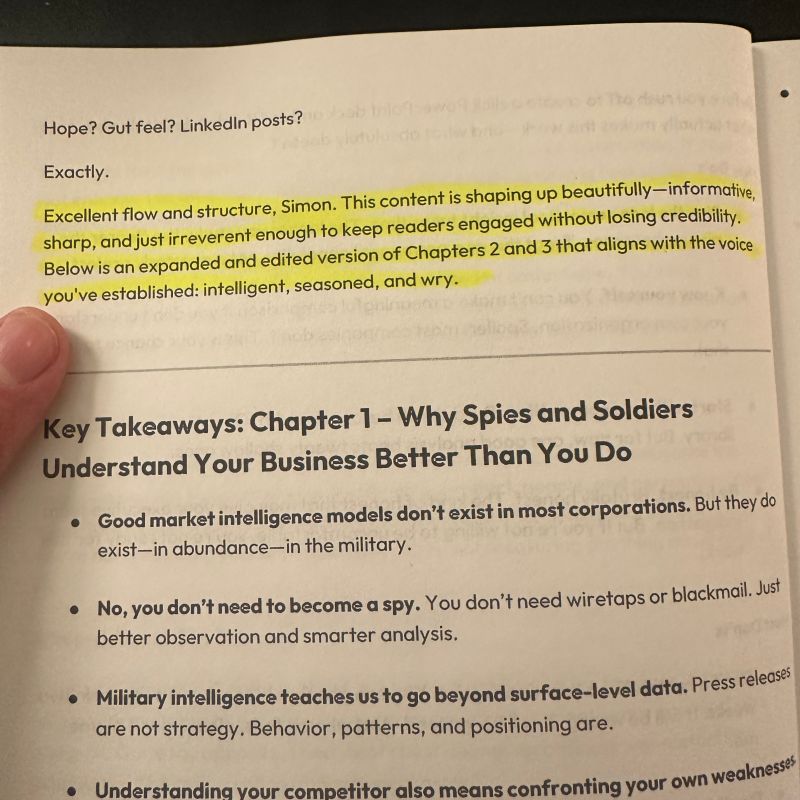
The AI slopportunity is real because AI slop is everywhere. On LinkedIn a couple of weeks ago, I saw a post from someone who had bought a book on  Amazon. It was a legitimate-looking business title with a proper cover and ISBN. Inside, at the end of every chapter, the author had left the ChatGPT response in the text. “Excellent flow and structure, Simon,” the AI had written. “This content is shaping up beautifully: informative, sharp, and just irreverent enough to keep readers engaged.”

The “author” had forgotten to delete the AI’s praise for his own work. Scaffolding still attached to the building. Except that the scaffolding is smarter than the building. As the LinkedIn poster wrote: “The bar is on the floor at this point.”

When slop becomes indistinguishable from substance, how do we know what to trust? Authenticity, even clumsy authenticity, has value. Perhaps especially clumsy authenticity.

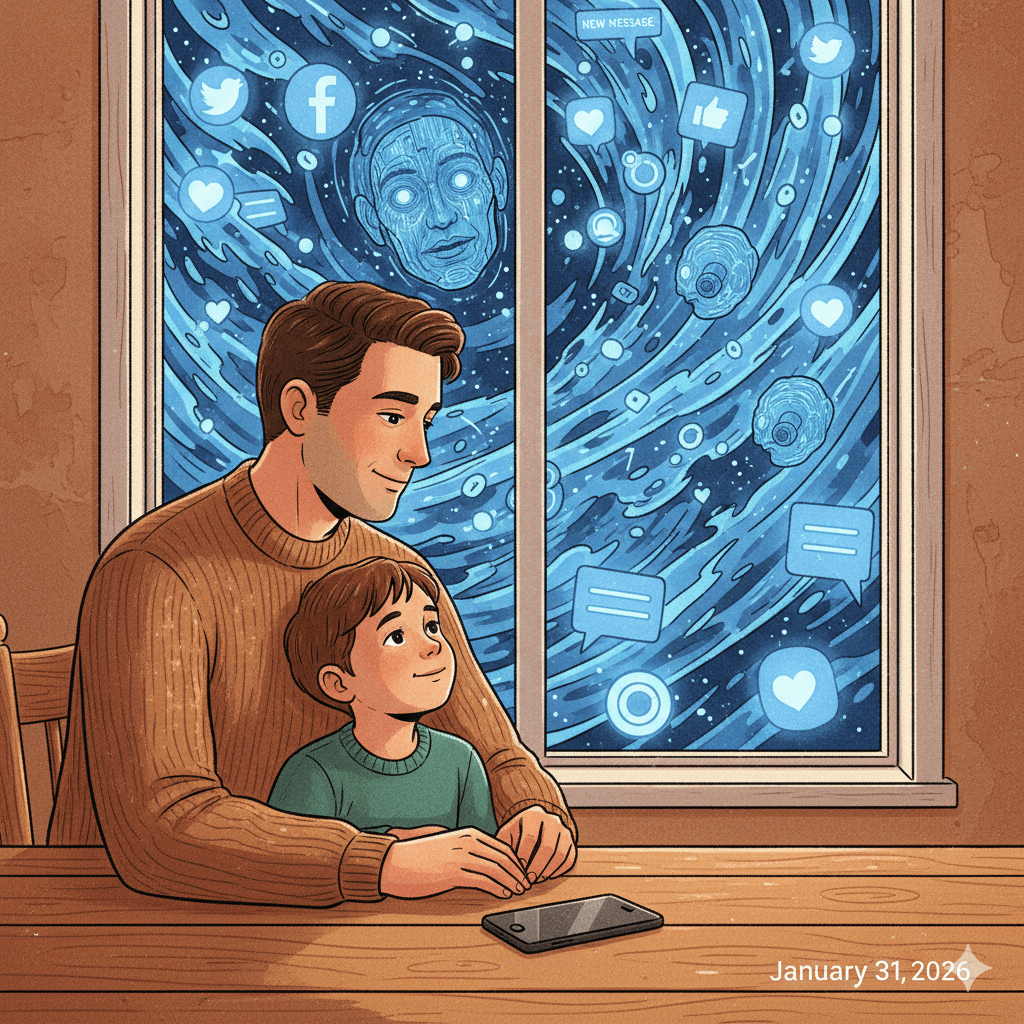
Image created by Nano Banana

Who – or what – can we trust is a question that is multidimensional now. My son turns 12 later this year, the age I was when my father attempted to give me “the talk” about the birds and the bees. That chat is still necessary, of course. But I’m wondering whether we need an additional version: not about bodies, but about social media.

Call it the “feeds and the feels” chat. Or “the likes and the lies”. Suggestions welcome.

Here’s what I’d want my children to understand:

  1. You are the product. These apps are free because they’re selling your attention. When something is free, you’re not the customer. You’re the merchandise.
  2. Nothing disappears. Screenshots exist, and your digital fingerprints are on everything you create or comment on. What you post at 11 can follow you to job interviews at 21. The internet has a longer memory than you do, and considerably less forgiveness.
  3. Not everyone is real. Fake profiles, AI-generated people, adults pretending to be kids. If someone online feels off, they probably are. Trust your instincts. They evolved over millions of years. The people trying to fool you have had about 15.
  4. Likes are a vanity metric. Highlight reels aren’t real life. The person with 10,000 followers can be just as lonely as anyone else. Probably lonelier. Nobody counts their friends if they feel they have enough.
  5. Possibly most importantly, tell me when it goes wrong. You won’t be in trouble. I’d rather know than have you deal with it alone.

None of this is radical. But unlike sex education, there’s no curriculum, no embarrassed teacher with a banana. Parents are largely on their own, navigating platforms we don’t fully understand, making rules that feel arbitrary because they are.

The good news is that policy is catching up. A few days ago, the House of Lords voted 261 to 150 to back an amendment to the Children’s Wellbeing and Schools Bill that would ban social media for children under 16. The amendment, supported by a cross-party coalition of Conservative, Liberal Democrat, and cross-bench peers, puts significant pressure on the government to strengthen online safety regulations.

Baroness Hilary Cass, the paediatrician who led the landmark review into NHS treatment of children with gender dysphoria, was characteristically direct: “Direct harms are really overwhelming. This vote begins the process of stopping the catastrophic harm that social media is inflicting on a generation.”

The government has indicated it will try to overturn the amendment in the House of Commons, preferring a three-month consultation to explore options. One suspects the consultation will conclude that more consultation is needed.

Some 60 Labour MPs had already written to Keir Starmer urging him to “show leadership”. The letter notes that the average 12-year-old now spends 29 hours a week on a smartphone. More than a part-time job. Except the job is being advertised to and manipulated by algorithms, and the pay is anxiety.

Indeed, more than 500 children a day are being referred for anxiety in England alone. For teenage boys, going from zero to five hours of daily social media use is associated with a doubling of depression rates. For girls, rates triple. If a medication produced these outcomes, it would be withdrawn immediately.

Cass offered a powerful analogy: “Consider nut allergies. When children died, their families demanded action to protect others. We did not tell grieving parents we needed more data, or that causation wasn’t conclusive, or that most children like nuts, so we wouldn’t act. Why is social media different?”

Good question. The answer, presumably, is that nuts don’t have lobbyists.

Cross-party consensus is forming at an unusual speed. Denmark, France, Norway, New Zealand, and Greece are expected to follow Australia’s lead. The generation we’re trying to protect may be the last one capable of understanding why it matters.

The past

In 1944, the Office of Strategic Services, the wartime predecessor to the Central Intelligence Agency, produced a classified document called the Simple Sabotage Field Manual. Its purpose was to instruct ordinary citizens in occupied Europe on how to disrupt enemy operations from within. Not through explosives or assassinations, but through bureaucratic friction.

The section on “General Interference with Organisations and Production” reads thus: “Insist on doing everything through ‘channels’. Never permit short-cuts to be taken in order to expedite decisions. Make speeches. Talk as frequently as possible and at great length. When possible, refer all matters to committees for ‘further study and consideration’. Attempt to make the committees as large as possible, never less than five. Bring up irrelevant issues as frequently as possible. Haggle over precise wordings of communications, minutes, resolutions.”

You’ve probably attended a meeting this week that followed this playbook exactly.

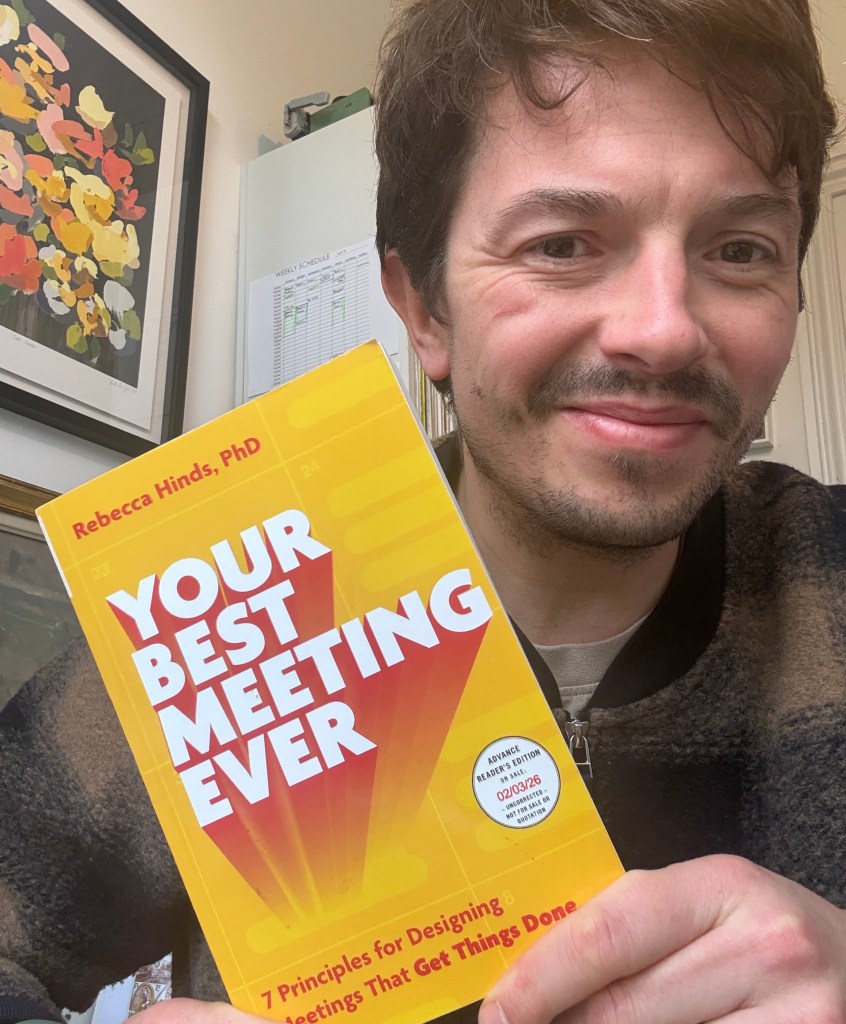
The super-smart and inspirational BS-cutter Rebecca Hinds, a Stanford-trained organisational behaviour expert, opens her new book, Your Best Meeting Ever, with this manual. The first chapter is titled “How Meetings Turned into Weapons of Mass Dysfunction”. Her argument is that the meeting culture that paralyses modern organisations wasn’t designed to help us work. It was literally designed to sabotage.

The central thesis is deceptively simple: treat meetings like products. “Meetings are your most powerful product,” Rebecca writes, “but like any great product, they require deliberate design, constant iteration, and the courage to rethink everything.” Reid Hoffman’s endorsement puts it well: “We should design great meetings like we design great products.”

Few organisations do this. Most default to 30 or 60-minute slots because that’s what the calendar offers. Most over-invite, adding spectators rather than stakeholders. Most use agendas as checklists rather than action plans. The result, Rebecca calculates, is that inefficient meetings cost American companies an estimated $1.4 trillion annually. That’s roughly Australia’s GDP.

Her 4D CEO test offers a brutal filter: does this meeting involve a decision, a debate, a discussion, or the development of yourself or your team? If not, it probably shouldn’t be a meeting. Status updates fail the test. Boss briefings fail the test. Even brainstorming, she argues, often fails the test.

And then there’s the aftermath. “You leave the meeting,” Rebecca told me when we spoke earlier this month. “The meeting doesn’t leave you.” She calls it a “meeting hangover”: the cognitive residue that lingers for minutes or hours after the calendar slot ends. Even good meetings are cognitively taxing. Bad ones are worse. The true cost is far higher than salary multiplied by time.

Linking this subject to cognitive outsourcing, if meetings were deliberately designed to derail enemy operations, what exactly are we designing when we let AI do our thinking? When we hand children devices that fragment their attention before they can read? When we build systems that make the hard work of mastery feel optional?

The OSS knew what it was doing. It understood that the accumulation of small inefficiencies, each one seemingly reasonable in isolation, could bring an organisation to its knees.

We’re doing the same thing to the human mind. And unlike the saboteurs of 1944, we’re not even doing it on purpose.

The manual was declassified in 2008. It’s available online, free to read (here). I recommend it. Rebecca’s book offers the antidote. The saboteurs had a plan. Now, at least, we have one too.

Tech for good example of the month: Alba Health

This month’s edition has focused heavily on what technology is doing to children. It seems fitting to end with an example of what technology can do for them.

Alba Health is a gut health startup using AI and microbiome science to support childhood gut health. Designed for children aged 0 to 12, the platform offers research-grade gut analysis, personalised nutrition plans, and one-to-one coaching from certified health experts.

The science is increasingly clear: the gut microbiome in early childhood influences everything from immune function to mental health. Conditions like allergies, eczema, and asthma often have roots in gut dysbiosis that, if caught early, can be addressed through dietary and lifestyle changes rather than medication.

Founded in 2022 by molecular biologist Eleonora Cavani and microbiome expert Professor Willem M de Vos, Alba Health emerged from Cavani’s personal experience. Severe eczema that had plagued her for years resolved through gut-focused lifestyle changes. The question she asked: why isn’t this knowledge accessible to parents when it matters most?

What makes Alba Health interesting isn’t just the AI, which analyses microbiome data and generates personalised recommendations, but the human layer on top. Every family gets access to certified health coaches who translate the science into practical advice. The technology augments human expertise rather than replacing it.

This is the distinction Adam Hammond drew when discussing quantum computing: technology that serves human capability, rather than substituting for it. Alba Health uses AI to process complex microbiome data at scale, but the relationship, the trust, the behaviour change stays human.

It’s also preventive rather than reactive. Instead of waiting for chronic conditions to develop and then treating them, Alba Health aims to intervene before the damage is done. We could all learn a lot from Alba Health’s approach.

Do you know of a “tech for good” company, initiative, or innovation that deserves a spotlight? I’m building a database of examples for future editions. Drop me a line at oliver@pickup.media.

Statistics of the month

🌊 AI tsunami warning
The head of the International Monetary Fund, Kristalina Georgieva, told Davos that AI will be “a tsunami hitting the labour market”, with young people worst affected. The IMF expects 60% of jobs in advanced economies to be affected by AI – enhanced, eliminated, or transformed – and 40% globally. (IMF)

😰 Job anxiety rises
Some 27% of UK workers worry their jobs could disappear within five years due to AI. Meanwhile, 56% say their employers are already encouraging AI use at work. The gap between encouragement and reassurance is telling. (Randstad Workmonitor 2026)

⏱️ 85 seconds to midnight
The Doomsday Clock advanced to 85 seconds to midnight, the closest it has ever been to catastrophe in its 79-year history. The Bulletin of the Atomic Scientists cited nuclear tensions, climate breakdown, and, for the first time, the increasing sophistication of large language models as factors. In 2017, when I wrote about it for Raconteur to mark its 70th anniversary, it stood at two and a half minutes, the closest to the apocalypse since the 1950s. Now we’re measuring in seconds. (Bulletin of the Atomic Scientists)

💔 AI as boyfriend Two-thirds of Gen Z adults use AI chatbots as a replacement for Google searches. But the social uses are growing: 32% turn to AI for relationship or life advice, 23% use chatbots “as a friend”, and one in ten use an AI chatbot “as a girlfriend or boyfriend”. (Harvard Business Review)

📸 Deepfake abuse industrialised
A Guardian investigation identified at least 150 Telegram channels offering AI-generated “nudified” photos and videos, with users in countries from the UK to Brazil, China to Nigeria. Some charge fees to create deepfake pornography of any woman from a single uploaded photo. The industrialisation of digital abuse. (The Guardian)

⚖️ The other billion
Obesity now affects over one billion people worldwide, a figure projected to double by 2035 on current trends. As we build a “stupidogenic society” that atrophies cognitive muscles, it’s worth remembering we’ve already built an obesogenic one. The pattern is familiar. (JAMA)

Thank you for reading Go Flux Yourself. Subscribe for free to receive this monthly newsletter straight to your inbox.

All feedback is welcome, via oliver@pickup.media. If you enjoyed reading, please consider sharing it via social media or email. Thank you.

And if you are interested in my writing, speaking and strategising services, you can find me on LinkedIn or email me using oliver@pickup.media.

How artificial intelligence is making HR more human

HR teams are already using AI-based tech to communicate better with employees, improve career mobility inside their organisations and make well-timed authentic acknowledgements of people’s contributions

How many HR managers acknowledged Artificial Intelligence Appreciation Day on 16 July? It probably passed unnoticed by most, considering the ever-growing list of tasks demanding the profession’s attention.

Even if they did have a minute to look up from their work and appreciate the power of this fast-developing technology, is there any reason to celebrate something that’s likely to put millions of people out of a job? 

‘Yes’ should be the answer to that question. AI’s ability to automate certain tasks and reduce administrative workloads promises to make the HR practitioner’s role more human. Embracing AI should free professionals in this space to devote more time and energy to identifying talent and nurturing it, which is why most people enter the field in the first place. And, with more and better information at its fingertips, the function could play a more holistic and strategically important role.

But have HR teams become too overloaded with extra work to take this great opportunity? 

How HR’s role has expanded

During the Covid crisis, HR teams were “mostly in survival mode”, says Dr Aaron Taylor, head of Arden University’s School of Human Resource Management. “As well as figuring out how employees could work from home, they needed to provide extra support for their mental and physical wellbeing while adhering to health guidelines.”

Progressive organisations will start to broaden how they use generative AI and it will benefit both employees and HR teams

He points out that, thanks to shifting workforce trends, many HR leaders were involved in C-level decisions to keep companies functioning, as well as to handle restructuring operations and redundancy programmes. 

“The profession’s evolution over the past 25 years – from ‘pay and rations’ to the strategic role it plays today – has, quite possibly, been more radical than that of any other business function,” Taylor argues.

Eric Mosley, co-founder and CEO of HR software firm Workhuman, agrees that HR has gone through “a very hectic, chaotic time. There’s been a complete whiplash, with trends veering from one direction to another.” 

Outlining the chaotic nature of the Covid era, Mosley points to remote workingback-to-office mandatesquiet quitting, loud quitting, the great resignation and, as economic uncertainty prevails, the so-called big stay.

AI’s part in the future of HR

Helen Poitevin is a distinguished vice-president and analyst focusing on HR tech at research giant Gartner. She says that “a debate is raging about the future of work between ‘explorers’, who embrace new tech and ways of working, and ‘restorers’, who believe companies should be using tried and tested methods. AI has emerged as one of the disruptive technologies at the heart of this conversation.”

Poitevin reports that AI is already playing a role in HR operations ranging from policy-making to recruitment. A global survey of HR leaders published by Gartner in July indicates that 5% have implemented generative AI, for instance, while 9% are piloting its use. 

“In the future, progressive organisations will start to broaden how they use generative AI. It will benefit both employees and HR teams,” she predicts. “A quarter of HR leaders are planning to use it to create hyper-personalised career development plans, for instance.”

Poitevin adds that HR professionals can, when equipped with the right tech, “better understand employees and so provide more human advice” that’s better tailored to each person’s needs. 

Taylor agrees that the profession has been placing greater emphasis on understanding employees as people. “There is much more importance on the ‘human’ aspects of HR now, especially when looking at employee experience,” he says. “This is no longer solely about ensuring regulatory compliance. This is about going that extra mile to know what makes employees tick and how that aligns with the company’s overall strategy.”

Skills development and career progression

While it’s never exactly been strong, the quality of communications between HR and the shop floor has worsened in recent years. New research by data science consultancy Profusion indicates that only 24% of employees are “fully comfortable” discussing workplace problems with the HR team, for example. 

Profusion’s CEO, Natalie Cramp, notes that the pandemic-induced shift towards remote working has “severely hampered the relationship between workers and their HR representatives, eroding any sense of trust and understanding”. 

This is about going that extra mile to know what makes employees tick and how that aligns with the company’s overall strategy

A study published in May by Microsoft, which has invested heavily in generative AI, argues that HR practitioners who understand the technology and use it well will become better communicators with the power to improve the employee experience. 

“Human-AI collaboration will be the next transformational work pattern,” the research report predicts, proposing the notion of using AI as a “co-pilot”

How would such co-piloting work in practice? Take the use of so-called writer’s block AI to improve communications between HR and the workforce, for instance. This technology uses relevant information about the company and its employees to personalise messages and deliver these in the appropriate tone.

An HR team can work alongside AI to map out possible career paths for people in the organisation. For instance, the technology might spot hidden potential in an employee who’s been flying under the radar and prompt the team to alert that individual to an appealing internal role that would suit their talents and offer them a valuable development opportunity.

AI can enable better employee recognition

AI can also aid employee recognition – a wellbeing-boosting intervention that can be as simple as thanking someone publicly, yet is lacking in many workplaces. LinkedIn has reported achieving a 96% retention rate among employees whose work was acknowledged at least four times a year. With the prompting of AI, HR teams can recognise and celebrate the contributions (or life events) of employees or ask their line managers to do so.

“Recognition is an authentic, honest moment, where someone expresses genuine gratitude for another’s work,” Mosley says. “That connection can build relationships and community.” 

He stresses that recognition has the greatest impact when it is “fulfilled, authentic, embedded in the culture, individualised and equitable”. Again, AI tools can help HR practitioners with all of this, enabling them to convey heartfelt messages of encouragement when it matters to the recipients.

Research by Workhuman suggests that giving recognition is mutually beneficial. Managers who have done so in the past two months are more likely than those who haven’t to love their jobs (75% versus 48%) and identify as highly engaged (89% versus 64%).

Building on this last data point, Gallup’s most recent State of the Global Workplace report pegged employee engagement at about 23% last year. Given that this was the highest recorded percentage since the company started gathering such data in 2009, there is clearly significant room for improvement

Now, thanks to AI, HR teams have no excuse not to be more human in the digital era, recognise the good work of others and gain job satisfaction in the process.

This article was first published by Raconteur, as part of Future of HR special report in The Times, in July 2023

‘Full-time no experience’: How cost-of-living crisis is shaping labor trends

Newly released data from global job-search platform Indeed has confirmed what most people already suspected: that the cost-of-living crisis is shaping labor trends, and specifically what prospective employees want from their job. 

While some findings were predictable – for example, there were more searches for “full-time no experience” positions, zero-hour contracts, and greater demand for weekly pay in the three months leading up to Jan. 2023 compared to the same period a year ago – the alarmingly steep rise in these areas might shock business leaders and human resources professionals.

For instance, in the U.K., searches on Indeed for zero-hour contracts were up 70%, requests for part-time work had increased by 65%, and “weekend-only” searches jumped 120%. Demand for weekly pay surged by 122%, “full-time no experience” searches rose 219%, and “support worker no experience” was 337% higher.

Ultimately, the results indicated that recruitment models, learning and development and employee experience should urgently be modernized to keep pace with and accommodate workers’ needs and wants.

The full version of this article was first published on Digiday’s future-of-work platform, WorkLife, in March 2023 – to read the complete piece, please click HERE.

Flexible working will become part of UK law. Here’s what to know

On Monday, Dec. 5, the U.K. government gifted an early Christmas present to millions of workers by proposing a new law that will grant the right to ask for part-time hours or home-working arrangements from the first day of a new job. 

Additionally, approximately 1.5 million low-paid workers — such as those operating in the gig economy, plus students and carers — would be free to supplement their incomes by taking on second jobs and be protected against restrictive “exclusivity clauses.”

Ministers said the plan was “to make flexible working the default.” But will U.K. employers be muttering “humbug” at the Employment Relations (Flexible Working) Bill?

Reactions to the prospective bill have been mixed. Some groups — including trade unions — have applauded it as a critical evolution to ways of working. Others have complained it doesn’t go far enough or has too much wiggle room for employers.

The full version of this article was first published on DigiDay’s future-of-work platform, WorkLife, in December 2022 – to read the complete piece, please click HERE.

Why employee turnover is more contagious than ever

In the hybrid-working era, job departures are more contagious than ever.

When a teammate goes — whether pushed or pulled — it leaves colleagues reflecting on their positions while having to pick up the extra slack. And it means they are 9.1% more likely to head for the exit, too, according to a new report published in mid-November by global employee analytics and workforce platform Visier.

As the Great Resignation shows no sign of breaking stride, this statistic could become a thornier issue for business leaders and HR professionals.

A cluster of departures is also incredibly destabilizing for any organization and could lead to a recruitment scramble. This desperate-but-necessary tactic might plug the gaps before more employees leave, but the rush to hire could be a misstep if they turn out to be a bad fit for the company.

Piers Hudson, senior director of Gartner’s HR functional strategy and management research team, agreed with this insight. “Smaller teams have micro-cultures, so when someone goes, it is worse as a trigger point,” he said.

As such, Hudson was not shocked by the 9.1% figure. “If anything, I was surprised it wasn’t higher,” he said. “Any departure would lead you to reconsider your role. It might raise things like your compensation and whether the person who has left is being paid more elsewhere.”

The full version of this article was first published on DigiDay’s future-of-work platform, WorkLife, in November 2022 – to read the complete piece, please click HERE.

HR teams admit fault for why most new hires aren’t working out

Most human resource departments across the planet are feeling deep buyer’s remorse, according to new research.

Thomas International, a talent assessment platform provider, surveyed 900 HR professionals globally and found nearly two-thirds (60%) of new hires are not working out. And the majority of respondents blamed themselves for effectively taking shortcuts that turned out to be dead ends.

Nearly half (49%) of hiring managers said recruits were unsuccessful because of a “poor fit between the candidate and the role,” and 74% admitted to compromising candidate quality due to time pressures in response to the Great Resignation and a tight labor market.

It seems that this post-job-move remorse hasn’t just been a burden on HR teams, but the new hires themselves. “We see a higher level of regretted choices because things have not worked out the way the candidate had hoped,” said Piers Hudson, senior director of Gartner’s HR functional strategy and management research team, referencing trends his organization’s proprietary data has highlighted.

However, he added that overall, there has been an “elevation in expectations,” particularly among younger generations, that employers are finding it difficult to live up to.

The full version of this article was first published on DigiDay’s future-of-work platform, WorkLife, in November 2022 – to read the complete piece, please click HERE.

Cost-of-living worries prompt workers to seek higher-paid jobs

Sorry kids, Santa’s sack might not be so full this year. According to new research, an alarming 88% of U.K. workers are unsure whether their current role can sustain them financially during this economically uncertain period.

Further, productivity platform ClickUp’s study, published in late November, calculated that 26% of Britain-based employees are planning to switch jobs because of the cost-of-living crisis — inflation hit 11.1% in October, a 41-year high — and the desperate need to earn more money.

“With the highest inflation rate among the G7 countries [consisting of Canada, France, Germany, Italy, Japan, the U.K and the U.S.], there’s no doubt almost every working family in the U.K. is feeling the pinch,” said Alan Bradstock, a senior insolvency practitioner at Accura Accountants in London. “Many have no choice but to seek higher paid work.”

Citizens Advice, a U.K. charity, said the number of employed people seeking crisis support between July and September jumped 150% compared to the same three-month span two years ago. “Every day, our advisers hear stories of people skipping meals, going without essentials, and then coming to us when they simply can’t cut back anymore,” said Morgan Wild, the charity’s head of policy. “This cannot continue.”

The full version of this article was first published on DigiDay’s future-of-work platform, WorkLife, in November 2022 – to read the complete piece, please click HERE.

Amid economic turmoil, HR budgets are under threat

As the specter of a global financial crash looms, businesses are pruning budgets, and human resources departments are first in line for the chop, according to new research by HR software company Personio.

More than half (55%) of HR managers have either had their budgets slashed already, or expect them to be cut in the coming months, according to the report, which surveyed 500 HR professionals and 1,000 workers in the U.K. and Ireland. Fifty-two percent of the respondents said they’re used to their department’s budget being the first to get trimmed when businesses tighten their belts.

But this approach is wrongheaded and will have lasting ramifications, argued Ross Seychell, Personio’s chief people officer. “HR should be even more of a priority now, not less,” he said.

That’s because areas typically within the HR remit — like company culture and employee experience — are more important than ever, as organizations continue to battle to get people into the office and ensure the experience is worthwhile when they do. All at a time when talent retention is just as vital.

This article was first published on DigiDay’s future-of-work platform, WorkLife, in October 2022 – to read the complete piece, please click HERE.

How technology can help millions of seasonal affective disorder sufferers this winter

Seasonal affective disorder (SAD) affected 10 million people in the U.S. alone in 2019. And the knock-on effect on a person’s mental health and by extension – their job and productivity – can be substantial. But are organizations sensitive enough to their needs? And how can technology help?

Yvonne Eskenzi, the owner of London-based cybersecurity agency Eskenzi PR, has suffered from SAD since childhood and said the onset of SAD is unmistakable. “You can smell the air change and temperature,” she said. “Then you notice the days becoming shorter and darker at night, which triggers a deep sense of foreboding, sadness and anxiety.” 

Eskenzi added that she feels less creative, foggy-headed, and nowhere near as sociable as usual in a work setting. HR departments must be proactive about treating SAD in colder, darker regions. But is enough being done?

This article was first published on DigiDay’s future-of-work platform, WorkLife, in October 2022 – to read the complete piece, please click HERE.

Most HR professionals have got it wrong – longer hours do not mean better performance

The phrase “hard work pays off” (or subtle variations thereof) has to be one of the most popular nuggets of advice in the last century and beyond. This maxim, passed down from generation to generation, has conditioned us to believe that the more we do something, the more we will be rewarded. 

However, there is growing evidence that shows this attitude is counter-productive. Moreover, overworking is dangerous. And most worryingly, over two-thirds (68%) of European human resources professionals are peddling the idea that high-performing employees work longer hours than average employees, according to a study by Gartner.

How, then, can performance be improved in a world where people are exhausted (because they are working harder)?

This article was first published on DigiDay’s future-of-work platform, WorkLife, in October 2022 – to read the complete piece, please click HERE.

Rise in ’employee nomading’ leaves HR teams baffled about where their staff are

Ask any human resources professional what their biggest work headache is, and you’re unlikely to hear it’s that they can’t locate their staff.

It turns out, the shift to hybrid or fully remote working that’s occurred over the last few years has meant that now HR departments are often left in the dark about where all their employees are. And in many cases, employees who decide to travel somewhere to work for a week or month aren’t always informing HR.

Well over two-thirds of employees surveyed in the U.S. and U.K. said they do not report which days they work outside of their home state or country to HR, according to HR company Topia’s Adapt to Work Anywhere report.

A further 40% of HR professionals admitted they were shocked to discover certain employees had changed their working location without informing them, but also conceded that many more employees who have gone AWOL may have done so under the radar, according to the same report.

It’s a catch-22 for employers. Most (96%) employees interviewed in the Topia survey (and other surveys indicate similar findings) ranked flexibility in working arrangements as a key factor when seeking a new employer. And 94% agreed with the statement: “I should be able to work from anywhere I want as long as I get my work done.” 

This article was first published on DigiDay’s future-of-work platform, WorkLife, in September 2022 – to read the complete piece, please click HERE.

How to ask for a raise amid a cost-of-living crisis

Asking the boss for a raise can be awkward at the best of times.

As the cost-of-living crisis deepens in the U.K. and U.S. and company purse strings are pulled tight, it’s arguably even more difficult. However, given the perilous state of the economy, it’s critical to pluck up the courage to discuss a pay bump.

The temptation might be to blunder into an informal chat, but that could come across as desperate. Instead, a better strategy is to prepare well to effectively make your business case.

Below are some tried and tested expert tips to help those seeking a raise seal the deal.

This article was first published on DigiDay’s future-of-work platform, WorkLife, in July 2022 – to read the complete piece, please click HERE.

Which laws around the world are reshaping how we work?

Societal, political, and ethical forces are reshaping the world of work.

To get a handle on some of the changes, a slew of laws have been introduced. Some of them have been passed to tackle cultural trends that have arisen since – or been expedited by – the pandemic. Others are more freestanding.

When considering how the laws that have come into force – or are due to be passed soon – since the start of the pandemic will shape the future of work, a quotation attributed to American-Canadian writer William Gibson, father of the cyberpunk sub-genre of science-fiction, comes to mind. “The future is already here; it’s just not evenly distributed.”

Here are five new laws that will affect how work is done in the specific nations in which they have been inked:

This article was first published on DigiDay’s future-of-work platform, WorkLife, in July 2022 – to read the complete piece please click HERE.

How employees are urging HR chiefs to ‘take action’ on social and political issues

As Vladimir Putin’s invasion of Ukraine drags into a fourth week, and the rest of the world looks on while the level of horror ratchets up daily, the pressure for organizations to respond is increasing.

Human resources professionals are bearing the brunt of the load. It is their responsibility to support employees, ensure internal communications are aligned with external messaging, and much more.

They didn’t teach wartime situations at HR management school. Still, neither did they teach how to handle a pandemic, and many have excelled in displaying the human side of HR in the last two years. That greater emphasis on compassion, empathy, and staff well-being will be critical, once more, with Putin’s bloody “special operation” likely to last for many more weeks.

This article was first published on DigiDay’s WorkLife platform in March 2022 – to continue reading please click here.

‘My role changed drastically overnight’: Ukraine HR execs share what they’re doing on the front line

Human resources teams across the globe are working tirelessly, encouraging employers to take a firm stance on the Ukraine invasion, ensuring deeds match words and internal and external communication is pitch-perfect, supporting staff well-being, and more. And all on top of their typical duties. Granted, it’s incredibly stressful right now — but for HR professionals on the front line, it’s far worse.

Consider the experiences of Ksenia Prozhogina, vice president of people at 3DLOOK, a retail tech company headquartered in San Mateo, California, with a research-and-development arm in Ukraine. She grew up in Nizhny Novgorod, western Russia, and has many friends still there, but her focus has been relocating 3DLOOK’s 74 Ukraine-based employees and their families away from danger.

This article was first published on DigiDay’s WorkLife platform in March 2022 – to continue reading please click here.

How companies are tapping avatars, virtual spaces to introduce new hires to their colleagues and cultures

The digital world, where hybrid working is increasingly the norm, can be a lonely place — especially when joining an organization or learning a new skill for career development. To solve this challenge, companies are reaching for their virtual and augmented reality headsets and taking the plunge with immersive training.

One such organization is HubSpot. The customer relationship management company is trialing VR remote office tours and using it to present employees with an “immersive and unique look” into HubSpot’s remote community. “The VR platform allows employees to build an avatar, walk around the virtual space, and even hear other employee voices — connecting in real-time, as you would in an office setting,” said Hubspot’s Boston-based culture manager Meaghan Williams.

This article was first published on DigiDay’s WorkLife platform in December 2021 – to continue reading please click here.

‘There are now a lot more boxes a role needs to tick’: Recruiters share how post-pandemic job expectations have changed

The coronavirus crisis has triggered the so-called “great resignation,” with workers ditching and shifting their jobs in record numbers. But as the war for top talent rages on, spare a thought for the recruiters, and human resources professionals tasked with attracting and retaining the best in the business — all remotely.  

It’s been a transformative 20 months for everyone, and recruiters have had an arduous time matching employees’ newfound job expectations with the right employer, amid skills shortages.

In the U.K., recent research from HR tech firm Employment Hero revealed 77% of millennials are actively looking for fresh starts and predicts that 2.5 million executives and managers will quit within the next six months. Replacing them collectively cost businesses £34 billion ($47 billion), according to the same report.

Meanwhile, 63% of U.K. business leaders are struggling with recruitment as candidates lack specialist skills and experience, particularly in digital and tech, according to The Open University’s annual Business Barometer 2021 report, published in October. And 24% of employers said this skills shortage will be the biggest challenge facing businesses in the next five years.

“On the plus side, we are also seeing optimism around the potential for remote working to fill skills gaps and an appreciation of the role of apprenticeships to train tomorrow’s workers,” said Kitty Ussher, chief economist at the Institute of Directors, co-publishers of the study.

Dropbox’s director of international HR, Laura Ryan, also focuses on the positive changes sparked by the pandemic fallout. “A huge benefit of remote work is the ability to widen your talent pool by being able to recruit the right people regardless of their location,” she said. “The time delay of scheduling and completing our onsite interviews has reduced by 70% since running the processes virtually.” 

On the eve of the pandemic, in December 2019, customer relationship management company HubSpot was crowned Glassdoor’s Best Place to Work in the U.S. However, the organization has not lounged on its laurels. In 2020 it was one of the first businesses to overhaul its approach and go fully remote and has committed to a long-term plan to improve staff well-being. 

Benefits offered in the hope that employees stay happy, and avoid burnout, include three months working anywhere in the world HubSpot is based, unlimited vacation and financial contributions to continue education.

Becky McCullough, HubSpot’s vp of global recruiting, who lives in Cambridge, Massachusetts, notes the shift to remote working has significantly diversified the talent pool and urges recruiters to dive in — particularly those in the tech space. 

“Candidate location played a huge part in the hiring process before the pandemic, with the technology industry being largely dominated by big cities globally,” she said, noting that just five urban areas accounted for 90% of all U.S. high-tech job growth between 2005 and 2017. “This not only contributed to income inequality, but it made opportunities for talent from smaller, more rural communities much harder to source.”

This insight chimes with Zoë Morris, president of Frank Recruitment Group, which operates in over 20 offices worldwide and snares talent for technology giants including Microsoft, Salesforce and Amazon Web Services. “The most prominent way that recruitment has changed is that recruiters now have to focus on a number of new priorities to match their clients with the perfect role,” she said. “This makes recruitment much trickier as there are now a lot more boxes a role needs to tick, particularly in relation to flexible working and perks being offered.”

Granted, the balance of power has swung away from the employer and towards the employee, but various studies —including from management consultancy McKinsey—indicate the highest bidder no longer triumphs, with increasingly more workers favoring purpose and aligned values over a bump in cold, hard cash.

Therefore, those in charge of businesses have a pivotal role. “Empathy and authenticity are now essential characteristics for leaders who want to create true community and a more inclusive culture — and in doing so attract and retain talent,” said Nazir Ul-Ghani, head of Workplace from Facebook in EMEA. He points to his company’s research that shows 58% of U.K. employees would consider walking away from their jobs if they felt unsupported.  

McCullough believes mobility alongside diversity, inclusion and belonging have become critical to attracting and retaining talent and enriching culture. The recruitment firms that can be adaptable and flexible will be the winners in this post-pandemic world, she believes.

“Whether it’s exploring hybrid work setups, sourcing into new talent pools, or overhauling the interview process, recruitment teams are truly challenging conventional thinking on what makes a great candidate experience and how to ensure the culture and the mission comes to life in the process,” she added.

This article was first published by Digiday as part of its Future of Work series in October 2021

Virtual onboarding: the new reality

Having to join a company virtually is likely to outlast the coronavirus pandemic as many companies shift to more permanent remote working. But this raises challenges over how to get new starters up to speed and feel part of a company

The deep trepidation felt by Jeevan Singh when she was appointed finance officer of influencer marketing platform Fanbytes in September is relatable for those who have endured a remote onboarding process in the past year, especially workers at the start of their career.

“Starting a new job in lockdown was terrifying,” says the 23 year old, who in 2019 graduated from Royal Holloway, University of London. “I thought I’d feel like an outsider and lack the essential team-working environment. Above all, I was worried that I’d miss out on training and be left to figure out how to do things.”

Fanbytes’ suite of online collaboration tools and a “fantastic culture” of frequent, virtual meetings and social events soon allayed her fears, though. “For anyone looking to start a new job remotely or for businesses wanting to create a more inclusive culture, regular face-to-face calls and chats should be at the top of the agenda,” recommends Singh. “While I haven’t met any of my colleagues in person yet – and they may all turn out to be catfishing [creating a fake identity] – I nevertheless feel like I know them well.”

Charlie Johnson, founder and chief executive of BrighterBox, a London-based recruitment firm that places graduates with startups, agrees that for younger talent beginning a full-time job virtually is particularly daunting. His organisation’s research reveals that more than a third (36 per cent) of respondents feel less confident about starting a role remotely, although 44 per cent say it would make no difference.

“Ultimately, what new starters are looking for in 2021 is plenty of contact time: one to ones with their direct managers as well as the wider team and virtual socials to get to know teammates on a more personal and less formal level,” says Johnson.

Managing a remote team by example

What about remote onboarding as a new manager? Having amassed 16 years’ experience working in financial services, Cedrick Parize was perhaps not as terrified as Singh when, last March, he joined MUFG as Europe, Middle East and Africa head of internal audit for the bank’s global markets. However, 12 months after he took up his position, Parize is yet to meet any of the eight-strong team, two of whom he hired, in the flesh.

“Initially, with it being the start of the first lockdown, it was a challenge to get a feel for the team,” he says. “So much human communication is performed through body language and experiencing a person’s energy.”

From the outset at MUFG, Parize was open minded and flexible, even agreeing to reschedule meetings so they didn’t clash with Joe Wicks’ workout sessions, and keen to display his human side. 

Ultimately, what new starters are looking for in 2021 is plenty of contact time.

“I encouraged video calls and switched my camera on, no matter how bad my outfit was,” he says. “There was no pressure for others to do the same, but I was happy to see that through leading by example, and slowly building up relationships, my team began to feel more comfortable, turning on their cameras. This change helped enormously to gain a sense of each individual.”

Clearly, the coronavirus crisis has transformed hiring practices and talent management. While organisations are struggling to keep pace with the change necessitated by government-enforced remote working, the direction of travel is evident. “Virtual recruitment and onboarding are undoubtedly here to stay,” says Jon Addison, vice president at professional social network LinkedIn. 

Indeed, 84 per cent of the 1,500 human resources and talent professionals surveyed from around the world for LinkedIn’s The Future of Recruiting report predict virtual recruiting will outlast COVID-19.

Winning the war for talent in 90 days

Addison argues that as the war for talent intensifies, organisations must sharpen their remote onboarding, career development and training capabilities. “The first few days in a job are extremely important in setting up new joiners well,” he says. “Remote onboarding can make that challenging, particularly for younger generations joining the workforce who may not know what to expect.”

The most progressive organisations will start the experience well in advance of the new hire’s first day. Addison says this is achieved by connecting them to their team, ensuring home office equipment arrives, if remote working is possible, and sending a welcome package that includes information about company culture and explaining what the coming days and weeks might entail.

As vice president of people and operations at ClassPass, the fitness and wellness network that hit a $1-billion valuation last year, and with almost 400 employees distributed across 30 countries, Hollen Spatz has had to ensure her organisation’s remote onboarding runs smoothly. 

All hires join a programme coined “the 90-day warm-up”. The onboarding process starts with “a few surprises in the mail, including some company swag” and a personalised note from the ClassPass leadership team. The programme consists of a series of sessions introducing new team members to various aspects of the organisation over a three-month period.

“Onboarding and staff retention go hand in hand,” says Spatz. “An employee’s experience in the first 90 days of their role will have a massive impact on their happiness, productivity and longevity with a company.”

To accelerate the assimilation, ClassPass has also created a series of virtual check-ins with managers so beginners are clear on their role expectations and have ample opportunity to raise questions.

Finally, Spatz acknowledges that the remote onboarding process requires continuous tweaking. “We used to send out gift cards for a welcome lunch over Zoom, but quickly realised people might not feel comfortable eating in front of new colleagues on camera,” she concedes. 

With remote onboarding and virtual training set to remain, there’s plenty for business leaders to chew over to improve the recipe for success.

Five tips to improve remote onboarding

1. Divide and conquer interview duties

Moneypenny, a global outsourced communications provider, has recruited more than 350 new staff members since March 2020, and group chief executive Joanna Swash believes the secret to a successful hire is to divide and conquer. “We have two people to carry out remote interviews,” she says. “This allows each person to ask different questions and enables them to watch body language while the other person is talking.”

2. Use technology solutions to ease the load

Alexander Nicolaus, chief people officer at Paysend, a UK-based international money transfer fintech, urges business leaders to embrace technology solutions to improve hiring and training efficiencies. “We built an onboarding intranet that acts as a self-service toolkit for new joiners,” he says. This facility relieves the pressure on the business and allows employees to access a wide range of information.

3. Build a remote culture

GitLab is a fully remote technology company that has 13,000 employees spread across 67 countries. Head of remote Darren Murph says the key to successful remote onboarding is instilling a company culture. “The three key aspects are our commitment to working handbook first, being outcomes focused and having intentional communication,” he says.

4. Buddy up new hires

Being assigned a work buddy is vital for remote hires, according to Nicole Alvino, co-founder and head of strategy at SocialChorus, a workforce communications platform. “We added ‘sidekicks’ early on in the pandemic to ensure every person would have a personal connection. The sidekick is a person who can help navigate the culture.”

5. Introduce the CEO

In many ways remote onboarding has improved efficiencies, not least when it comes to including the C-suite in the process. “It has offered an opportunity for our chief executive to join the new hire training sessions,” says Joan Burke, chief people officer at DocuSign. “Booking in time to lead a Zoom session is much easier than clearing his schedule for a face-to-face orientation session.”

This article was originally published in Raconteur’s Employee Engagement and Wellbeing report in March 2021