Go Flux Yourself: Navigating the Future of Work (No. 23)

TL;DR: November’s Go Flux Yourself marks three years since ChatGPT’s launch by examining the “survival of the shameless” – Rutger Bregman’s diagnosis of Western elite failure. With responsible innovation falling out of fashion and moral ambition in short supply, it asks what purpose-driven technology actually looks like when being bad has become culturally acceptable.

Image created on Nano Banana

The future

“We’ve taught our best and brightest how to climb, but not what ladder is worth climbing. We’ve built a meritocracy of ambition without morality, of intelligence without integrity, and now we are reaping the consequences.”

The above quotation comes from Rutger Bregman, the Dutch historian and thinker who shot to prominence at the World Economic Forum in Davos in 2019. You may recall the viral clip. Standing before an audience of billionaires, he did something thrillingly bold: he told them to pay their taxes.

“It feels like I’m at a firefighters’ conference and no one’s allowed to speak about water,” he said almost seven years ago. “Taxes, taxes, taxes. The rest is bullshit in my opinion.”

Presumably, due to his truth-telling, he has not been invited back to the Swiss Alps for the WEF’s annual general meeting.

Bregman is this year’s BBC Reith Lecturer, and, again, he is holding a mirror up to society to reveal its ugly, venal self. His opening lecture, A Time of Monsters – a title borrowed from Antonio Gramsci’s 1929 prison notebooks – delivered at the end of November, builds on that Davos provocation with something more troubling: a diagnosis of elite failure across the Western world. This time, his target isn’t just tax avoidance. It’s what he calls the “survival of the shameless”: the systematic elevation of the unscrupulous over the capable, and the brazen over the virtuous.

Even Bregman isn’t immune to the censorship he critiques. The BBC reportedly removed a line from his lecture describing Donald Trump as “the most openly corrupt president in American history”. The irony, as Bregman put it, is that the lecture was precisely about “the paralysing cowardice of today’s elites”. When even the BBC flinches from stating the obvious – and presumably fears how Trump might react (he has threatened to sue the broadcaster for $5 billion over doctored footage that, earlier in November, saw the director general and News CEO resign) – you know something is deeply rotten.

Bregman’s opening lecture is well worth a listen, as is the Q&A afterwards. His strong opinions chimed with the beliefs of Gemma Milne, a Scottish science writer and lecturer at the University of Glasgow, whom I caught up with a couple of weeks ago, having first interviewed her almost a decade ago.

The author of Smoke & Mirrors: How Hype Obscures the Future and How to See Past It has recently submitted her PhD thesis at the University of Edinburgh (Putting the future to work – The promises, product, and practices of corporate futurism), and has been tracking this shift for years. Her research focuses on “corporate futurism” and the political economy of deep tech – essentially, who benefits from the stories we tell about innovation.

Her analysis is blunt: we’re living through what she calls “the age of badness”.

“Culturally, we have peaks and troughs in terms of how much ‘badness’ is tolerated,” she told me. “Right now, being the bad guy is not just accepted, it’s actually quite cool. Look at Elon Musk, Trump, and Peter Thiel. There’s a pragmatist bent that says: the world is what it is, you just have to operate in it.”

When Smoke and Mirrors came out in 2020, conversations around responsible innovation were easier. Entrepreneurs genuinely wanted to get it right. The mood has since curdled. “If hype is how you get things done and people get misled along the way, so be it,” Gemma said of the evolved attitude by those in power. “‘The ends justify the means’ has become the prevailing logic.”

On a not-unrelated note, November 30 marked exactly three years since OpenAI launched ChatGPT. (This end-of-the-month newsletter arrives a day later than usual – the weekend, plus an embargo on the Adaptavist Group research below.) We’ve endured three years of breathless proclamations about productivity gains, creative disruption, and the democratisation of intelligence. And three years of pilot programmes, failed implementations, and so much hype. 

Meanwhile, the graduate job market has collapsed by two-thirds in the UK alone, and unemployment levels have risen to 5%, the highest since September 2021, the height of the pandemic fallout, as confirmed by Office for National Statistics data published in mid-November.

New research from The Adaptavist Group, gleaned from almost 5,000 knowledge workers split evenly across the UK, US, Canada and Germany, underscores the insidious social cost: a third (32%) of workers report speaking to colleagues less since using GenAI, and 26% would rather engage in small talk with an AI chatbot than with a human.

So here’s the question that Bregman forces us to confront: if we now have access to more intelligence than ever before – both human and artificial – what exactly are we doing with it? And are we using technology for good, for human enrichment and flourishing? On the whole, with artificial intelligence, I don’t think so.

Bregman describes consultancy, finance, and corporate law as a “gaping black hole” that sucks up brilliant minds: a Bermuda Triangle of talent that has tripled in size since the 1980s. Every year, he notes, thousands of teenagers write beautiful university application essays about solving climate change, curing disease, or ending poverty. A few years later, most have been funnelled towards the likes of McKinsey, Goldman Sachs, and Magic Circle law firms.

The numbers bear this out. Around 40% of Harvard graduates now end up in that Bermuda Triangle of talent, according to Bregman. Include big tech, and the share rises above 60%. One Facebook employee, a former maths prodigy, quoted by the Dutchman in his first Reith lecture, said: “The best minds of my generation are thinking about how to make people click ads. That sucks.”

If we’ve spent decades optimising our brightest minds towards rent-seeking and attention-harvesting, AI accelerates that trajectory. The same tools that could solve genuine problems are instead deployed to make advertising more addictive, to automate entry-level jobs without creating pathways to replace them, and to generate endless content that says nothing new.

Gemma sees this in how technology and politics have fused. “The entanglement has never been stronger or more explicit.” Twelve months ago, Trump won the vote for his second term. At his inauguration at the White House in January, the front-row seats were taken by several technology leaders, happy to pay the price for genuflection in return for deregulation. But what is the ultimate cost to humanity for having such cosy relationships?

“These connections aren’t just more visible, they’re culturally embedded,” Gemma told me. “People know Musk’s name and face without understanding Tesla’s technology. Sam Altman is AI’s hype guru, but he’s also a political leader now. The two roles have merged.”

Against this backdrop, I spent two days at London’s Guildhall in early November for the Thinkers50 conference and gala. The theme was “regeneration”, exploring whether businesses can restore rather than extract.

Erinch Sahan from Doughnut Economics Action Lab offered concrete, heartwarming examples of businesses demonstrating that purpose and profit needn’t be mutually exclusive. For instance, Patagonia’s steward ownership model, Fairphone’s “most ethical smartphone in the world” with modular repairability, and LUSH’s commitment to fair taxes and employee ownership.

Erinch’s – frankly heartwarming – list, of which this trio is a small fraction, contrasted sharply with Gemma’s observation about corporate futurism: “The critical question is whether it actually transforms organisations or simply attends to the fear of perma-crisis. You bring in consultants, do the exercises, and everyone feels better about uncertainty. But does anything actually change?”

Some forms of the practice can be transformative. Others primarily manage emotion without producing radical change. The difference lies in whether accountability mechanisms exist, whether outcomes are measured, tracked, and tied to consequences.

This brings me to Delhi-based Ruchi Gupta, whom I met over a video call a few weeks ago. She runs the not-for-profit Future of India Foundation and has built something that embodies precisely the kind of “moral ambition” Bregman describes, although she’d probably never use that phrase. 

India is home to the world’s largest youth population, with one in every five young people globally being Indian. Not many – and not enough – are afforded the skills and opportunities to thrive. Ruchi’s assessment of the current situation is unflinching. “It’s dire,” she said. “We have the world’s largest youth population, but insufficient jobs. The education system isn’t skilling them properly; even among the 27% who attend college, many graduate without marketable skills or professional socialisation. Young people will approach you and simply blurt things out without introducing themselves. They don’t have the sophistication or the networks.”

Notably, cities comprise just 3% of India’s land area but account for 60% of India’s GDP. That concentration tells you everything about how poorly opportunities are distributed. 

Gupta’s flagship initiative, YouthPOWER, responds to this demographic reality by creating India’s first and only district-level youth opportunity and accountability platform, covering all 800 districts. The platform synthesises data from 21 government sources to generate the Y-POWER Score, a composite metric designed to make youth opportunity visible, comparable, and politically actionable.

“Approximately 85% of Indians continue to live in the district of their birth,” Ruchi explained. “That’s where they situate their identity; when young people introduce themselves to me, they say their name and their district. If you want to reach all young people and create genuine opportunities, it has to happen at the district level. Yet nothing existed to map opportunity at that granularity.”

What makes YouthPOWER remarkable, aside from the smart data aggregation, is the accountability mechanism. Each district is mapped to its local elected representative, the Member of Parliament who chairs the district oversight committee. The platform creates a feedback loop between outcomes and political responsibility.

“Data alone is insufficient; you need forward motion,” Ruchi said. “We mapped each district to its MP. The idea is to work directly with them, run pilots that demonstrate tangible improvement, then scale a proven playbook across all 543 constituencies. When outcomes are linked to specific politicians, accountability becomes real rather than rhetorical.”

Her background illuminates why this matters personally. Despite attending good schools in Delhi, her family’s circumstances meant she didn’t know about premier networking institutions. She went to an American university because it let her work while studying, not because it was the best fit. She applied only to Harvard Business School, having learnt about it from Eric Segal’s Love Story, without any work experience.

“Your background determines which opportunities you even know exist,” she told me. “It was only at McKinsey that I finally understood what a network does – the things that happen when you can simply pick up the phone and reach someone.” Thankfully, for India’s sake, Ruchi has found her purpose after time spent lost in the Bermuda Triangle of talent.

But the lack of opportunities and woeful political accountability are global challenges. Ruchi continued: “The right-wing surge you’re seeing in the UK and the US stems from the same problem: opportunity isn’t reaching people where they live. The normative framework is universal: education, skilling, and jobs on one side; empirical baselines and accountability mechanisms on the other. Link outcomes to elected representatives, and you create a feedback loop that drives improvement.”

So what distinguishes genuine technology for good from its performative alternative?

Gemma’s advice is to be explicit about your relationship with hype. “Treat it like your relationship with money. Some people find money distasteful but necessary; others strategise around it obsessively. Hype works the same way. It’s fundamentally about persuasion and attention, getting people to stop and listen. In an attention economy, recognising how you use hype is essential for making ethical and pragmatic decisions.”

She doesn’t believe we’ll stay in the age of badness forever. These things are cyclical. Responsible innovation will become fashionable again. But right now, critiquing hype lands very differently because the response is simply: “Well, we have to hype. How else do you get things done?”

Ruchi offers a different lens. The economist Joel Mokyr has demonstrated that innovation is fundamentally about culture, not just human capital or resources. “Our greatness in India will depend on whether we can build that culture of innovation,” Ruchi said. “We can’t simply skill people as coders and rely on labour arbitrage. That’s the current model, and it’s insufficient. If we want to be a genuinely great country, we need to pivot towards something more ambitious.”

Three years into the ChatGPT era, we have a choice. We can continue funnelling talent into the Bermuda Triangle, using AI to amplify artificial importance. Or we can build something different. For instance, pioneering accountability systems like YouthPOWER that make opportunity visible, governance structures that demand transparency, and cultures that invite people to contribute to something larger than themselves.

Bregman ends his opening Reith Lecture with a simple observation: moral revolutions happen when people are asked to participate.

Perhaps that’s the most important thing leaders can do in 2026: not buy more AI subscriptions or launch more pilots. But ask the question: what ladder are we climbing, and who benefits when we reach the top?

The present

Image created on Midjourney

The other Tuesday, on the 8.20am train from Waterloo to Clapham Junction, heading to The Portfolio Collective’s Portfolio Career Festival at Battersea Arts Centre, I witnessed a small moment that captured everything wrong with how we’re approaching AI.

The guard announced himself over the tannoy. But it wasn’t his (or her) voice. It was a robotic, AI-generated monotone informing passengers he was in coach six, should anyone need him.

I sat there, genuinely unnerved. This was the Turing trap in action, using technology to imitate humans rather than augment them. The guard had every opportunity to show his character, his personality, perhaps a bit of warmth on a grey November morning. Instead, he’d outsourced the one thing that made him irreplaceable: his humanity.

Image created on Nano Banana (using the same prompt as the Midjourney one above)

Erik Brynjolfsson, the Stanford economist who coined the term in 2022, argues we consistently fall into this software snare. We design AI to mimic human capabilities rather than complement them. We play to our weaknesses – the things machines do better – instead of our strengths. The train guard’s voice was his strength. His ability to set a tone, to make passengers feel welcome, to be a human presence in a metal tube hurtling through South London. That’s precisely what got automated away.

It’s a pattern I’m seeing everywhere. By blindly grabbing AI and outsourcing tasks that reveal what makes us unique, we risk degrading human skills, eroding trust and connection, and – I say this without hyperbole – automating ourselves to extinction.

The timing of that train journey felt significant. I was heading to a festival entirely about human connection – networking, building personal brand, the importance of relationships for business and greater enrichment. And here was a live demonstration of everything working against that.

It was also Remembrance Day. As we remembered those who fought for our freedoms, not least during a two-minute silence (that felt beautifully calming – a collective, brief moment without looking at a screen), I was about to argue on stage that we’re sleepwalking into a different kind of surrender: the quiet handover of our professional autonomy to machines.

The debate – Unlocking Potential or Chasing Efficiency: AI’s Impact on Portfolio Work – was held before around 200 ambitious portfolio professionals. The question was straightforward: should we embrace AI as a tool to amplify our skills, creativity, and flow – or hand over entire workflows to autonomous agents and focus our attention elsewhere?

Pic credit: Afonso Pereira

You can guess which side I argued. The battle for humanity isn’t against machines, per se. It’s about knowing when to direct them and when to trust ourselves. It’s about recognising that the guard’s voice – warm, human, imperfect – was never a problem to be solved. It was a feature to be celebrated.

The audience wanted an honest conversation about navigating this transition thoughtfully. I hope we delivered. But stepping off stage, I couldn’t shake the irony: a festival dedicated to human connection, held on the day we honour those who preserved our freedoms, while outside these walls the evidence mounts that we’re trading professional agency for the illusion of efficiency.

To watch the full video session, please see here: 

A day later, I attended an IBM panel at the tech firm’s London headquarters. Their Race for ROI research contained some encouraging news: two-thirds of UK enterprises are experiencing significant AI-driven productivity improvements. But dig beneath the headline, and the picture darkens. Only 38% of UK organisations are prioritising inclusive AI upskilling opportunities. The productivity gains are flowing to those already advantaged. Everyone else is figuring it out on their own – 77% of those using AI at work are entirely self-taught.

Leon Butler, General Manager for IBM UK & Ireland, offered a metaphor that’s stayed with me. He compared opaque AI models to drinking from an opaque test tube.

“There’s liquid in it – that’s the training data – but you can’t see it. You pour your own data in, mix it, and you’re drinking something you don’t fully understand. By the time you make decisions, you need to know it’s clean and true.”

That demand for transparency connects directly to Ruchi’s work in India and Gemma’s critique of corporate futurism. Data for good requires good data. Accountability requires visibility. You can’t build systems that serve human flourishing if the foundations are murky, biased, or simply unknown.

As Sue Daley OBE, who leads techUK’s technology and innovation work, pointed out at the IBM event: “This will be the last generation of leaders who manage only humans. Going forward, we’ll be managing humans and machines together.”

That’s true. But the more important point is this: the leaders who manage that transition well will be the ones who understand that technology is a means, not an end. Efficiency without purpose is just faster emptiness.

The question of what we’re building, and for whom, surfaced differently at the Thinkers50 conference. Lynda Gratton, whom I’ve interviewed a couple of times about living and working well, opened with her weaving metaphor. We’re all creating the cloth of our lives, she argued, from productivity threads (mastering, knowing, cooperating) and nurturing threads (friendship, intimacy, calm, adventure).

Not only is this an elegant idea, but I love the warm embrace of messiness and complexity. Life doesn’t follow a clean pattern. Threads tangle. Designs shift. The point isn’t to optimise for a single outcome but to create something textured, resilient, human.

That messiness matters more now. My recent newsletters have explored the “anti-social century” – how advances in technology correlate with increased isolation. Being in that Guildhall room – surrounded by management thinkers from around the world, having conversations over coffee, making new connections – reminded me why physical presence still matters. You can’t weave your cloth alone. You need other people’s threads intersecting with yours.

Earlier in the month, an episode of The Switch, St James’s Place Financial Adviser Academy’s career change podcast, was released. Host Gee Foottit wanted to explore how professionals can navigate AI’s impact on their working lives – the same territory I cover in this newsletter, but focused specifically on career pivots.

We talked about the six Cs – communication, creativity, compassion, courage, collaboration, and curiosity – and why these human capabilities become more valuable, not less, as routine cognitive work gets automated. We discussed how to think about AI as a tool rather than a replacement, and why the people who thrive will be those who understand when to direct machines and when to trust themselves.

The conversations I’m having – with Gemma, Ruchi, the panellists at IBM, the debaters at Battersea – reinforce the central argument. Technology for good isn’t a slogan. It’s a practice. It requires intention, accountability, and a willingness to ask uncomfortable questions about who benefits and who gets left behind.

If you’re working on something that embodies that practice – whether it’s an accountability platform, a regenerative business model, or simply a team that’s figured out how to use AI without losing its humanity – I’d love to hear from you. These conversations are what fuel the newsletter.

The past

A month ago, I fired my one and only work colleague. It was the best decision for both of us. But the office still feels lonely and quiet without him.

Frank is a Jack Russell I’ve had since he was a puppy, almost five years ago. My daughter, only six months old when he came into our lives, grew up with him. Many people with whom I’ve had video calls will know Frank – especially if the doorbell went off during our meeting. He was the most loyal and loving dog, and for weeks after he left, I felt bereft. Suddenly, no one was nudging me in the middle of the afternoon to go for a much-needed, head-clearing stroll around the park.

Pic credit: Samer Moukarzel

So why did I rehome him?

As a Jack Russell, he is fiercely territorial. And where I live and work in south-east London, it’s busy. He was always on guard, trying to protect and serve me. The postman, Pieter, various delivery folk, and other people who came into the house have felt his presence, let’s say. Countless letters were torn to shreds by his vicious teeth – so many that I had to install an external letterbox.

A couple of months ago, while trying to retrieve a sock that Frank had stolen and was guarding on the sofa, he snapped and drew blood. After multiple sessions with two different behaviourists, following previous incidents, he was already on a yellow card. If he bit me, who wouldn’t he bite? Red card.

The decision was made to find a new owner. I made a three-hour round trip to meet Frank’s new family, whose home is in the Norfolk countryside – much better suited to a Jack Russell’s temperament. After a walk together in a neutral venue, he travelled back to their house and apparently took 45 minutes to leave their car, snarling, unsure, and confused. It was heartbreaking to think he would never see me again.

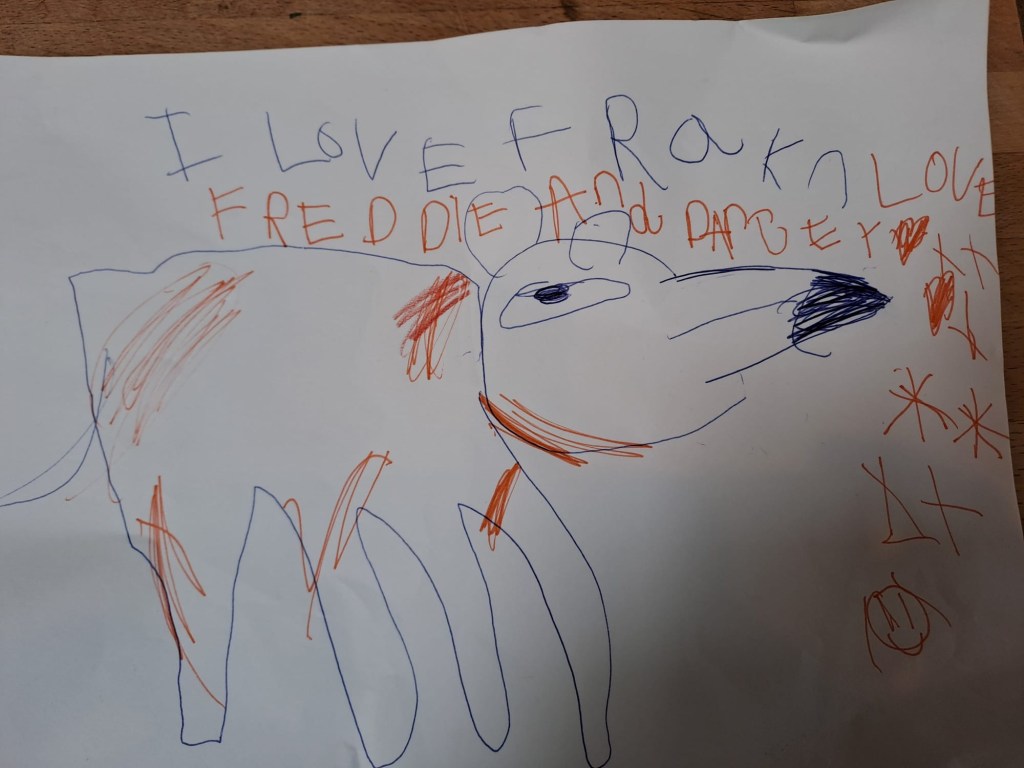
But I knew Frank would be happy there. Later that day, I received videos of him dashing around fields. His new owners said they already loved him. A day later, they found the cartoon picture my daughter had drawn of Frank, saying she loved him, in the bag of stuff I’d handed them.

Now, almost a month on, the house is calmer. My daughter has stopped drawing pictures of Frank with tearful captions. And Frank? He’s made friends with Ralph, the black Labrador who shares his new home. The latest photo shows them sleeping side by side, exhausted from whatever countryside adventures Jack Russells and Labradors get up to together.

The proverb “if you love someone, set them free” helped ease the hurt. But there’s something else in this small domestic drama that connects to everything I’ve been writing about this month.

Bregman asks what ladder we’re climbing. Gemma describes an age where doing the wrong thing has become culturally acceptable. Ruchi builds systems that create accountability where none existed. And here I was, facing a much smaller question: what do I owe this dog?

The easy path was to keep him. To manage the risk, install more barriers, and hope for the best. The more challenging path was to acknowledge that the situation wasn’t working – not for him, not for us – and to make a change that felt like failure but was actually responsibility.

Moral ambition doesn’t only show up in accountability platforms and regenerative business models. Sometimes it’s in the quiet decisions: the ones that cost you something, that nobody else sees, that you make because it’s right rather than because it’s easy.

Frank needed space to run, another dog to play with, and owners who could give him the environment his breed demands. I couldn’t provide that. Pretending otherwise would have been a disservice to him and a risk to my family.

The age of badness that Gemma describes isn’t just about billionaires and politicians. It’s also about the small surrenders we make every day: the moments we choose convenience over responsibility, comfort over honesty, the path of least resistance over the path that’s actually right.

I don’t want to overstate this. Rehoming a dog is not the same as building YouthPOWER or challenging tax-avoiding elites at Davos. But the muscle is the same. The willingness to ask uncomfortable questions. The courage to act on the answers.

My daughter’s drawings have stopped. The house is quieter. And somewhere in Norfolk, Frank is sleeping on a Labrador, finally at peace.

Sometimes the most important thing you can do is recognise when you’re climbing the wrong ladder – and have the grace to climb down.

Statistics of the month

🛒 Cyber Monday breaks records
Today marks the 20th annual Cyber Monday, projected to hit $14.2 billion in US sales – surpassing last year’s record. Peak spending occurs between 8pm and 10pm, when consumers spend roughly $15.8 million per minute. A reminder that convenience still trumps almost everything. (National Retail Federation)

🎯 Judgment holds, execution collapses
US marketing job postings dropped 8% overall in 2025, but the divide is stark: writer roles fell 28%, computer graphic artists dropped 33%, while creative directors held steady. The pattern likely mirrors the UK – the market pays for strategic judgment; it’s automating production. (Bloomberry)

🛡️ Cybersecurity complacency exposed
Nearly half (43%) of UK organisations believe their cybersecurity strategy requires little to no improvement – yet 71% have paid a ransom in the past 12 months, averaging £1.05 million per payment. (Cohesity)

💸 Cyber insurance claims triple
UK cyber insurance claims hit at least £197 million in 2024, up from £60 million the previous year – a stark reminder that threats are evolving faster than our defences. (Association of British Insurers)

🤖 UK leads Europe in AI optimism
Some 88% of UK IT professionals want more automation in their day-to-day work, and only 10% feel AI threatens their role – the lowest of any European country surveyed. Yet 26% say they need better AI training to keep pace. (TOPdesk)

Thank you for reading Go Flux Yourself. Subscribe for free to receive this monthly newsletter straight to your inbox.

All feedback is welcome, via oliver@pickup.media. If you enjoyed reading, pass it on! Please consider sharing it via social media or email. Thank you.

And if you are interested in my writing, speaking and strategising services, you can find me on LinkedIn or email me using oliver@pickup.media.

Go Flux Yourself: Navigating the Future of Work (No. 11)

TL;DR: November’s Go Flux Yourself channels the wisdom of Marcus Aurelius to navigate the AI revolution, examining Nvidia’s bold vision for an AI-dominated workforce, unpacks Australia’s landmark social media ban for under-16s, and finds timeless lessons in a school friend’s recovery story about the importance of thoughtful, measured progress …

Image created on Midjourney with the prompt “a dismayed looking Roman emperor Marcus Aurelius looking over a world in which AI drone and scary warfare dominates in the style of a Renaissance painting”

The future

“The happiness of your life depends upon the quality of your thoughts.” 

These sage – and neatly optimistic – words from Marcus Aurelius, the great Roman emperor and Stoic philosopher, feel especially pertinent as we scan 2025’s technological horizon. 

Aurelius, who died in 180 and became known as the last of the Five Good Emperors, exemplified a philosophy that teaches us to focus solely on what we can control and accept what we cannot. He offers valuable wisdom in an AI-driven future for communities still suffering a psychological form of long COVID-19 drawn from the collective trauma of the pandemic, in addition to deep uncertainty and general mistrust with geopolitical tensions and global temperatures rising.

The final emperor in the relatively peaceful Pax Romana era, Aurelius seemed a fitting person to quote this month for another reason: I’m flying to the Italian capital this coming week, to cover CSO 360, a security conference that allows attendees to take a peek behind the curtain – although I’m worried about what I may see. 

One of the most eye-popping lines from last year’s conference in Berlin was that there was a 50-50 chance that World War III would be ignited in 2024. One could argue that while there has not been a Franz Ferdinand moment, the key players are manoeuvring their pieces on the board. Expect more on this cheery subject – ho, ho, ho! – in the last newsletter of the year, on December 31.

Meanwhile, as technological change accelerates and AI agents increasingly populate our workplaces (“agentic AI” is the latest buzzword, in case you haven’t heard), the quality of our thinking about their integration – something we can control – becomes paramount.

In mid-October, Jensen Huang, Co-Founder and CEO of tech giant Nvidia – which specialises in graphics processing units (GPUs) and AI computing – revealed on the BG2 podcast that he plans to shape his workforce so that it is one-third human and two-thirds AI agents.

“Nvidia has 32,000 employees today,” Huang stated, but he hopes the organisation will have 50,000 employees and “100 million AI assistants in every single group”. Given my focus on human-work evolution, I initially found this concept shocking, and appalling. But perhaps I was too hasty to reach a conclusion.

When, a couple of weeks ago, I interviewed Daniel Vassilev, Co-Founder and CEO of Relevance AI, which builds virtual workforces of AI agents that act as a seamless extension of human teams, his perspective on Huang’s vision was refreshingly nuanced. He provided an enlightening analogy about throwing pebbles into the sea.

“Most of us limit our thinking,” the San Francisco-based Australian entrepreneur said. “It’s like having ten pebbles to throw into the sea. We focus on making those pebbles bigger or flatter, so they’ll go further. But we often forget to consider whether our efforts might actually give us 20, 30, or even 50 pebbles to throw.”

His point cuts to the heart of the AI workforce debate: rather than simply replacing human workers, AI might expand our collective capabilities and create new opportunities. “I’ve always found it’s a safe bet that if you give people the ability to do more, they will do more,” Vassilev observed. “They won’t do less just because they can.”

This positive yet grounded perspective was echoed in my conversation with Five9’s Steve Blood, who shared fascinating insights about the evolution of workplace dynamics, specifically in the customer experience space, when I was in Barcelona in the middle of the month reporting on his company’s CX Summit. 

Blood, VP of Market Intelligence at Five9, predicts a “unified employee” future where AI enables workers to handle increasingly diverse responsibilities across traditional departmental boundaries. Rather than wholesale replacement, he envisions a workforce augmented by AI, where employees become more valuable by leveraging technology to handle multiple functions.

(As an aside, Blood predicts the customer experience landscape of 2030 will be radically different, with machine customers evolving through three distinct phases. Starting with today’s ‘bound’ customers (like printers ordering their own ink cartridges exclusively from manufacturers), progressing to ‘adaptable’ customers (AI systems making purchases based on user preferences from multiple suppliers), and ultimately reaching ‘autonomous’ customers, where digital twins make entirely independent decisions based on their understanding of our preferences and history.)

The quality of our thinking about AI integration becomes especially crucial when considering what SailPoint’s CEO Mark McClain described to me this month as the “three V’s”: volume, variety, and velocity. These parameters no longer apply to data alone; they’re increasingly relevant to the AI agents themselves. As McClain explained: “We’ve got a higher volume of identities all the time. We’ve got more variety of identities, because of AI. And then you’ve certainly got a velocity problem here where it’s just exploding.” 

This explosion of AI capabilities brings us to a critical juncture. While Nvidia’s Huang envisions AI employees as being managed much like their human counterparts, assigned tasks, and engaged in dialogues, the reality might be more nuanced – and handling security permissions will need much work, which is perhaps something business leaders have not thought about enough.

Indeed, AI optimism must be tempered with practical considerations. The cybersecurity experts I’ve met recently have all emphasised the need for robust governance frameworks and clear accountability structures. 

Looking ahead to next year, organisations must develop flexible frameworks that can evolve as rapidly as AI capabilities. The “second mouse gets the cheese” approach – waiting for others to make mistakes first, as explained during a Kolekti roundtable looking at the progress of generative AI on ChatGPT’s second birthday, November 28, by panellist Sue Turner, the Founding Director of AI Governance – may no longer be viable in an environment where change is constant and competition fierce. 

Successful organisations will emphasise complementary relationships between human and AI workers, requiring a fundamental rethink of traditional organisational structures and job descriptions.

The management of AI agent identities and access rights will become as crucial as managing human employees’ credentials, presenting both technical and philosophical challenges. Workplace culture must embrace what Blood calls “unified employees” – workers who can leverage AI to operate across traditional departmental boundaries. Perhaps most importantly, organisations must cultivate what Marcus Aurelius would recognise as quality of thought: the ability to think clearly and strategically about AI integration while maintaining human values and ethical considerations.

As we move toward 2025, the question isn’t simply whether AI agents will become standard members of the workforce – they already are. The real question is how we can ensure this integration enhances rather than diminishes human potential. The answer lies not in the technology itself, but in the quality of our thoughts about using it.

Organisations that strike and maintain this balance – embracing AI’s potential while preserving human agency and ethical considerations – will likely emerge as leaders in the new landscape. Ultimately, the quality of our thoughts about AI integration today will determine the happiness of our professional lives tomorrow.

The present

November’s news perfectly illustrates why we need to maintain quality of thought when adopting new technologies. Australia’s world-first decision to ban social media for under-16s, a bill passed a couple of days ago, marks a watershed moment in how we think about digital technology’s impact on society – and offers valuable lessons as we rush headlong into the AI revolution.

The Australian bill reflects a growing awareness of social media’s harmful effects on young minds. It’s a stance increasingly supported by data: new Financial Times polling reveals that almost half of British adults favour a total ban on smartphones in schools, while 71% support collecting phones in classroom baskets.

The timing couldn’t be more critical. Ofcom’s disturbing April study found nearly a quarter of British children aged between five and seven owned a smartphone, with many using social media apps despite being well below the minimum age requirement of 13. I pointed out in August’s Go Flux Yourself that EE recommended that children under 11 shouldn’t have smartphones. Meanwhile, University of Oxford researchers have identified a “linear relationship” between social media use and deteriorating mental health among teenagers.

Social psychologist Jonathan Haidt’s assertion in The Anxious Generation that smart devices have “rewired childhood” feels particularly apposite as we consider AI’s potential impact. If we’ve learned anything from social media’s unfettered growth, it’s that we must think carefully about technological integration before, not after, widespread adoption.

Interestingly, we’re seeing signs of a cultural awakening to technology’s double-edged nature. Collins Dictionary’s word of the year shortlist included “brainrot” – defined as an inability to think clearly due to excessive consumption of low-quality online content. While “brat” claimed the top spot – a word redefined by singer Charli XCX as someone who “has a breakdown, but kind of like parties through it” – the inclusion of “brainrot” speaks volumes about our growing awareness of digital overconsumption’s cognitive costs.

This awareness is manifesting in unexpected ways. A heartening trend has emerged on social media platforms, with users pushing back against online negativity by expressing gratitude for life’s mundane aspects. Posts celebrating “the privilege of doing household chores” or “the privilege of feeling bloated from overeating” represent a collective yearning for authentic, unfiltered experiences in an increasingly synthetic world.

In the workplace, we’re witnessing a similar recalibration regarding AI adoption. The latest Slack Workforce Index reveals a fascinating shift: for the first time since ChatGPT’s arrival, almost exactly two years ago, adoption rates have plateaued in France and the United States, while global excitement about AI has dropped six percentage points.

This hesitation isn’t necessarily negative – it might indicate a more thoughtful approach to AI integration. Nearly half of workers report discomfort admitting to managers that they use AI for common workplace tasks, citing concerns about appearing less competent or lazy. More tellingly, while employees and executives alike want AI to free up time for meaningful work, many fear it will actually increase their workload with “busy work”.

This gap between AI urgency and adoption reflects a deeper tension in the workplace. While organisations push for AI integration, employees express fundamental concerns about using these tools.

A more measured approach echoes broader societal concerns about technological integration. Just as we’re reconsidering social media’s role in young people’s lives, organisations are showing due caution about AI’s workplace implementation. The difference this time? We might actually be thinking before we leap.

Some companies are already demonstrating this more thoughtful approach. Global bank HSBC recently announced a comprehensive AI governance framework that includes regular “ethical audits” of their AI systems. Meanwhile, pharmaceutical giant AstraZeneca has implemented what they call “AI pause points” – mandatory reflection periods before deploying new AI tools.

The quality of our thoughts about these changes today will indeed shape the quality of our lives tomorrow. That’s the most important lesson from this month’s developments: in an age of AI, natural wisdom matters more than ever.

These concerns aren’t merely theoretical. Microsoft’s Copilot AI spectacularly demonstrated the pitfalls of rushing to deploy AI solutions this month. The product, designed to enhance workplace productivity by accessing internal company data, became embroiled in privacy breaches, with users reportedly accessing colleagues’ salary details and sensitive HR files. 

When less than 4% of IT leaders surveyed by Gartner said Copilot offered significant value, and Salesforce’s CEO Marc Benioff compared it to Clippy – Windows 97’s notoriously unhelpful cartoon assistant – it highlighted a crucial truth: the gap between AI’s promise and its current capabilities remains vast. 

As organisations barrel towards agentic AI next year, with semi-autonomous bots handling everything from press round-ups to customer service, Copilot’s stumbles serve as a timely reminder about the importance of thoughtful implementation

Related to this point is the looming threat to authentic thought leadership. Nina Schick, a global authority on AI, predicts that by 2025, a staggering 90% of online content will be generated by synthetic-AI. It’s a sobering forecast that should give pause to anyone concerned about the quality of discourse in our digital age.

If nine out of ten pieces of content next year will be churned out by machines learning from machines learning from machines, we risk creating an echo chamber of mediocrity, as I wrote in a recent Pickup_andWebb insights piece. As David McCullough, the late American historian and Pulitzer Prize winner, noted: “Writing is thinking. To write well is to think clearly. That’s why it’s so hard.”

This observation hits the bullseye of genuine thought leadership. Real insight demands more than information processing; it requires boots on the ground and minds that truly understand the territory. While AI excels at processing vast amounts of information and identifying patterns, it cannot fundamentally understand the human condition, feel empathy, or craft emotionally resonant narratives.

Leaders who rely on AI for their thought leadership are essentially outsourcing their thinking, trading their unique perspective for a synthetic amalgamation of existing views. In an era where differentiation is the most prized currency, that’s more than just lazy – it’s potentially catastrophic for meaningful discourse.

The past

In April 2014, Gary Mairs – a gregarious character in the year above me at school – drank his last alcoholic drink. Broke, broken and bedraggled, he entered a church in Seville and attended his first Alcoholics Anonymous meeting. 

His life had become unbearably – and unbelievably – chaotic. After moving to Spain with his then-girlfriend, he began to enjoy the cheap cervezas a little too much. Eight months before he quit booze, Gary’s partner left him, being unable to cope with his endless revelry. This opened the beer tap further.

By the time Gary gave up drinking, he had maxed out 17 credit cards, his flatmates had turned on him, and he was hundreds of miles away from anyone who cared – hence why he signed up for AA. But what was it like?

I interviewed Gary for a recent episode of Upper Bottom, the sobriety podcast (for people who have not reached rock bottom) I co-host, and he was reassuringly straight-talking. He didn’t make it past step three of the 12 steps: he couldn’t supplicant to a higher power. 

However, when asked about the important changes on his road to recovery, Gary talks about the importance of good habits, healthy practices, and meditation. Marcus Aurelius would approve. 

In his Meditations, written as private notes to himself nearly two millennia ago, Aurelius emphasised the power of routine and self-reflection. “When you wake up in the morning, tell yourself: The people I deal with today will be meddling, ungrateful, arrogant, dishonest, jealous, and surly. They are like this because they can’t tell good from evil,” he wrote. This wasn’t cynicism but rather a reminder to accept things as they are and focus on what we can control – our responses, habits, and thoughts.

Gary’s journey from chaos to clarity mirrors this ancient wisdom. Just as Aurelius advised to “waste no more time arguing what a good man should be – be one”, Gary stopped theorising about recovery and simply began the daily practice of better living. No higher power was required – just the steady discipline of showing up for oneself.

This resonates as we grapple with AI’s integration into our lives and workplaces. Like Gary discovering that the answer lay not in grand gestures but in small, daily choices, perhaps our path forward with AI requires similar wisdom: accepting what we cannot change while focusing intently on what we can – the quality of our thoughts, the authenticity of our voices, the integrity of our choices.

As Aurelius noted: “Very little is needed to make a happy life; it is all within yourself, in your way of thinking.” 

Whether facing personal demons or technological revolution, the principle remains the same: quality of thought, coupled with consistent practice, lights the way forward.

Statistics of the month

  • Exactly two-thirds of LinkedIn users believe AI should be taught in high schools. Additionally, 72% observed an increase in AI-related mentions in job postings, while 48% stated that AI proficiency is a key requirement for the companies they applied to.
  • Only 51% of respondents of Searce’s Global State of AI Study 2024 – which polled 300 C-Suite and senior technology executives across organisations with at least $500 million in revenue in the US and UK – said their AI initiatives have been very successful. Meanwhile, 42% admitted success was only somewhat achieved.
  • International Workplace Group findings indicate just 7% of hybrid workers describe their 2024 hybrid work experience as “trusted”, hinting at an opportunity for employers to double down on trust in the year ahead.

Stay fluxed – and get in touch! Let’s get fluxed together …

Thank you for reading Go Flux Yourself. Subscribe for free to receive this monthly newsletter straight to your inbox.

All feedback is welcome, via oliver@pickup.media. If you enjoyed reading, please consider sharing it via social media or email. Thank you.

And if you are interested in my writing, speaking and strategising services, you can find me on LinkedIn or email me using oliver@pickup.media.

Go Flux Yourself: Navigating the Future of Work (No. 9)


TL;DR: September’s Go Flux Yourself debates when to come clean about the Tooth Fairy’s existence, considers the beauty of magic, developing a sense of wonder, how to excel at human-centred innovation, and provides lessons from the inventor of the carpet sweeper …

Image created on Midjourney with the prompt “a magical tooth fairy with a mechanised carpet sweeper looking happy in the style of a cubist Picasso painting”

The future

“So why not live with the magic? Be a kid again and believe in the fantastical. Life is more fun with a little smoke and mirrors.”

I love this time of year, as the completed page of September – the last month of summer indulgence – is turned to reveal October, the beginning of the golden quarter and the cosiness of autumn. 

As I tap these words, I spy, on the other side of the window, shrivelled yellow and brown leaves creating a patchwork carpet on the garden floor, having twisted and tumbled from their trees. Yet those trees remain well covered in greenery, for now. 

The changing of the seasons reminds us of the natural process of renewal. But, as always, autumn and soon winter will provide darkness in a particularly gloomy, and unpredictable world. And yet, these dark months are punctuated by magical, soothing, and memorable events. 

As the dad of two children who still – just about, in the case of my 10-year-old boy (more below) – believe in Father Christmas, I adore reliving the wonder of the festive season, which begins for me on Halloween. For parents, while no doubt a considerable effort is needed to make this period magical, it is rewarding and life-affirming. Soon, that innocence will be lost. 

Being in my early 40s, I’ve had over half of the 4,000 weeks we live on average, points out journalist and author Oliver Burkeman. The second half of my life will be hugely different from the first, on a macro and micro level.

For various reasons, I’ve recently been thinking about my remaining 1,800-ish weeks – if lucky. And whenever I consider what I would like to fill them with, it filters down to spending time with my nearest and dearest, cliched and twee as that might be. 

Maybe it’s a sign of my stage in life, but a large part of this desire is to protect my kids. Stand back, and the post-pandemic world is pretty mad right now.

As wars rage in the Middle East and Eastern Europe, global warming is increasing, loneliness is also on the rise, every country in the world has lower fertility rates than in 1950, NASA is building the world’s first telescope designed for planetary defence, journalists have turned to artificial intelligence-created newsreaders in Venezuela to avoid arrest, AI girlfriends are being preferred over real thing in their hundreds of millions, and technology has reached a point where everything should be questioned, not just the news. And who can predict what will happen if Donald Trump regains access to the Oval Office in the next couple of months?

How does a parent prepare a child for survival in a post-truth world? What are we doing to the minds of little people by confecting the winter months, in particular, with beautiful lies to generate artificial happiness? One could argue that their joy when meeting Father Christmas and receiving festive gifts is a cruel construct that, once revealed as such, will lead to deep mistrust.

I began this month’s newsletter with a quotation from Irish-based author, L.H. Cosway’s Six of Hearts, a story about a world-renowned illusionist (according to its description – I’ve not read the book). I was drawn to it as Freddie, who hit double figures in age earlier in September, lost a tooth the other day. Thankfully, I had to dash out to play football on the evening he asked my wife: “Does the Tooth Fairy really exist? I mean, is she genuinely real?”

Having been instructed, later that evening, to switch a quid for the tooth under Freddie’s pillow, it’s logical to assume that my wife didn’t reveal the truth. I can understand why. First the Tooth Fairy, then … then EVERYTHING! But when is the right moment to admit the game is up?

Can we handle the truth even as adults? I read with interest this morning that Melvin Vopson, an associate professor of physics at the University of Portsmouth, has proved our entire universe may be an advanced computer simulation—much like The Matrix. Yes, he has a book to sell on this subject, but he told MailOnline: “The Bible itself tells us that we are in a simulation, and it also tells us who is doing it. It is done by an AI.”

After screaming “BS”, the natural human reaction is: “Well, what’s the point, then?” Cue a sad emoji. We’re all big kids at heart.

On the subject of magic, Arthur C. Clarke, famously wrote: “Any sufficiently advanced technology is indistinguishable from magic.” Even if AI isn’t capable – yet – of creating the universe, it’s undoubtedly becoming impressive and, moreover, indiscernible from reality. 

Not everyone is finding AI magical in a work setting, though. Research from Upwork, published in July, highlights the “AI expectation gap“, with 96% of C-suite leaders admitting they expect the use of AI tools to increase their company’s overall productivity levels. However, 77% of employees say these tools have actually decreased their productivity and added to their workload.

A friend messaged me the other day to let me know he had managed 110 days of sobriety but that he felt he needed to drink at a gig because he was struggling with his feelings and wanted to release some pressure. The exchange soon revealed that he had been jobless for almost a year, and a beloved grandmother had died days before the gig. 

He wrote that he was “feeling anxiety and just a sense of doom about everything around modern life. I’m worried about the future of society and for our kids. There is so much hate around and the want for AI to replace us. If I, as someone with 20 years of experience, struggle to get a job, what will it be like for future generations?”

How do you answer that? With too much time to ponder, my friend fears the worst at the moment – for him, but mostly for his children. I get that.

I’ve attended many events in the last month, and I’ve taken to asking interviewees how I should prepare my kids for the future. At Gartner Reimagine HR, Paul Rubenstein, Chief Customer Officer at Visier, a company that provides AI-powered people analytics, told me that today’s youngsters must be “agile, smart, and fearless”. Great answer.

Perhaps, then, the greatest gift we can give our children isn’t shielding them from reality but nurturing their sense of wonder. In a world of AI and uncertainty, their ability to see magic in the every day might be the superpower they need to thrive.

The present

It’s conference season, and later this week, I’ll be on stage twice at DTX (the Digital Transformation Expo) at London ExCel. I’m looking forward to moderating a panel on the main stage alongside BT, techUK, and booking.com panellists to examine why human-centred tech design and delivery have never been so critical.

Regarding technology’s stickiness, Dr Nicola Millard, Principal Innovation Partner at BT Business (who wrote her PhD thesis on this subject), talks about the three Us: useful, useable, and used. The last of these revolves around peer pressure, essentially. Her octogenarian mother requested an iPad only because her friend had one. Meanwhile, Nicola is a “shadow customer” engaging with companies digitally on behalf of her mother, who finds it too overwhelming.

I touched on this subject in a keynote speech on human-work evolution at the Institute for Engineering and Technology for Accurate Background earlier in September. I urged the audience to be “kind explorers” to navigate the digital world – and careful not to leave people behind. 

I referenced Terry, my late, jazz-loving nonagenarian friend I’ve written about before in this newsletter. I recall his deep frustration at trying to speak to a human at his bank for a minor query and spending hours – no exaggeration – going around in circles, via automated assistants. Unable to walk, he resorted to using his trusty fountain pen to write a letter to his local branch. No return letter or call arrived, tragically. It was far from a magic experience, and the tech dumbfounded Terry, who would have reached triple figures next month.

We can use the CHUI values framework to help improve human-centric design. I wrote about this last month, but as a reminder, here are the main elements.

Community: Emphasises the importance of fostering a sense of belonging in both physical and virtual spaces. It’s about creating inclusive environments and valuing diverse perspectives.

Health: Goes beyond just physical wellbeing to include mental and emotional health. It stresses the need for work-life balance and overall wellness, especially in remote or hybrid work settings.

Understanding: Highlights the need for continuous learning and viewing issues from multiple angles. It’s about developing deep knowledge rather than just surface-level information.

Interconnectedness: Recognises that in our global, digital world, everything is linked. It involves understanding how different roles connect and the broader impact of our actions.

In this instance, below is how one might use CHUI.

Community:

  • Co-design with diverse user groups. This ensures that designs are inclusive and meet the needs of various communities.
  • Foster inclusive design practices. By considering different cultural, social, and economic backgrounds, designs become more universally accessible.
  • Create solutions that strengthen social connections. This aligns with the community aspect of CHUI, designing products or services that bring people together.

Health:

  • Prioritise mental and physical wellbeing in design. This could involve creating ergonomic products or digital interfaces that reduce eye strain and promote good posture.
  • Design for accessibility and reduced stress. Ensuring that designs are usable by people with different abilities and don’t create unnecessary stress or frustration.
  • Incorporate biophilic design principles. This involves bringing elements of nature into the design, which has been shown to improve wellbeing and reduce stress.

Understanding:

  • Deep user research and empathy mapping. This helps designers truly understand user needs, motivations, and pain points, leading to more effective solutions.
  • Iterative design with continuous user feedback. This ensures that designs evolve based on real user experiences and needs.
  • Design for intuitive learning and skill development: Creating interfaces or products that are easy to understand and help users develop new skills over time.

Interconnectedness:

  • Design for interoperability and ecosystem thinking. Considering how a design fits into the larger ecosystem of products or services that a user interacts with.
  • Consider broader societal and environmental impacts. This involves thinking about the ripple effects of a design on society and the environment.
  • Create solutions that enhance human-to-human connections. Designing with the goal of facilitating meaningful interactions between people.

Human-centred design should extend to the workplace – whether in the office or a remote setting. The temperature of the already hot topic of where people work was dialled up a fortnight ago, when Amazon decreed a five-day back-to-the-office mandate. 

LinkedIn shared timely data highlighting how companies are hiring now. Interestingly, the professional social media platform’s Economic Graph showed that hiring for fully remote roles is generally declining, with a 6.2% decrease year-on-year at large companies. Meanwhile, small companies are reversing the trend with a year-on-year 2.3% rise in remote hires. By contrast, larger companies are seeing significant growth in hybrid work models. Which organisation can say it has perfected the magic formula?

The past

The date of the aforementioned Accurate talk, to mostly HR professionals, was delivered on September 19 – the same day American entrepreneur Melville Bissell patented the carpet sweeper back in 1876. I know what you’re thinking – what does a mechanised carpet sweeper have to do with human-work evolution in the digital age?

Melville and his wife Anna Bissell owned a crockery shop in Michigan, where dust and breakages were daily occurrences. So Melville developed a carpet sweeping machine to keep the family store always tidy. It was so effective that word spread, demand rose, and soon, the Bissells were selling far more carpet sweepers than cups and saucers.

Today, five generations later, the family-run Bissell Inc. is one of the leading manufacturers of floor care products in North America in terms of sales, with a vast market share.

When Melville invented his device, he didn’t know he was starting a revolution in home cleaning. He was trying to solve a problem, to make life a bit easier and better.

Similarly, we are still determining precisely where our explorations in the digital age will lead us. 

But if we approach them with curiosity, with kindness, and with a commitment to our shared humanity, I believe we can evolve human work so that’s not just more efficient, but more fulfilling. Not just more profitable, but more purposeful.

I urge you to go forth and explore, be curious, be kind, and be human. That’s where the real magic can be found.

Statistics of the month

  • According to HiBob research, almost a quarter (24%) of Brits would replace all younger generation workers if they could. Further, 70% of companies struggle to manage younger-generation employees.
  • The above study found that Gen Zers are causing managers headaches around issues with attitudes towards authority (41%), emotional intelligence (38%) and levels of professionalism (34%). 

Stay fluxed – and get in touch! Let’s get fluxed together …

Thank you for reading Go Flux Yourself. Subscribe for free to receive this monthly newsletter straight to your inbox.

All feedback is welcome, via oliver@pickup.media. If you enjoyed reading, please consider sharing it via social media or email. Thank you.

And if you are interested in my writing, speaking and strategising services, you can find me on LinkedIn or email me using oliver@pickup.media

‘Productivity-sapping vampires’: How to improve the hybrid-meetings culture

In theory, hybrid working is perfect, promising flexibility, convenience and empowerment. However, in practice, many organizations are finding, to their horror, it can be the worst of both in-person and remote working. Its logistical complexity has the potential to restrict collaboration and, ultimately, productivity. And that is largely down to the number and inefficiency of hybrid meetings.

“Employees are overwhelmed with meetings — back-to-back meetings, poorly run meetings and just flat-out too many meetings,” said J. P. Gownder, vp and principal analyst at Forrester Research, and co-author of a new report, “Master Hybrid Meetings With These Five Steps.” “Today’s hybrid meetings fail in-person participants, fail remote participants, still, fail to provide social cues, and fail the business.”

Gownder cited Harvard Business Review data from last year that found that 92% of employees considered meetings costly and unproductive, as 70% of meetings kept employees from productive task work. 

It wasn’t like this before the coronavirus crisis, though. “The frequency of meetings increased by 13% during the first year of the pandemic, and leaders tell us those meetings were sticky — they never fell off of calendars,” Gownder said. Without taking steps to remedy this problem, “meetings threaten to become productivity-sapping energy vampires,” he added.

So what should be done?

The full version of this article was first published on Digiday’s future-of-work platform, WorkLife, in March 2023 – to read the complete piece, please click HERE.

Why the need for leaders to address poor workplace communication is so urgent now

Ineffective communication costs U.S. businesses $1.2 trillion annually, or $12,506 per employee, pointed out by Grammarly Business’s latest State of Business Communication report, published in early March. But are leaders receiving the message that urgent improvement is required? 

The Grammarly Business survey of 251 business leaders and 1,001 knowledge workers suggested connection problems are growing. Time spent on written communication grew 18% compared to 2022, while worker stress levels were 7% higher due to poor communication, and this caused a 15% decline in productivity.

Further, the research, conducted in partnership with The Harris Poll, showed that workers spent over 70% of their working weeks communicating on various channels. Yet 58% wished they had better tools to streamline communication. “Leaders who shrug off the massive impact of poor communication on their bottom line will lose,” argued Matt Rosenberg, Grammarly’s chief revenue officer and head of Grammarly Business. 

Rosenberg said that the results of the second annual report indicated the challenge was growing, causing a “greater impact on everything from operational efficiency to employee and customer satisfaction.” As a result, he urged a rethink of communications strategies. “At a time when the stakes are critically high, leaders who invest in empowering efficient, consistent communication across their organizations will see results and profits climb.”

The full version of this article was first published on Digiday’s future-of-work platform, WorkLife, in March 2023 – to read the complete piece, please click HERE.

Can a ‘signature scent’ boost office appeal – or does it reek of desperation?

According to U.S. poet Diane Ackerman, “nothing is more memorable than a smell.” She wrote: “One scent can be unexpected, momentary and fleeting, yet conjure up a childhood summer beside a lake in the mountains; another, a moonlit beach; a third, a family dinner of pot roast and sweet potatoes during a myrtle-mad August in a Midwestern town.”

Perhaps leaders with a good nose for business have been reading Ackerman’s A Natural History of the Senses. Scents are now being diffused into more workplaces – partly to attract employees and clients and develop positive brand associations. But while retailers, members clubs, and hotels have been wafting whiffs around for some time, does doing so in an office setting work, or does it, well, reek of desperation?

Jane Helliwell, founder of The Scent Styling Company, stressed the magic of a good smell. “Never underestimate the power of scent on a person’s mood,” she said. Further, certain fragrances can alter a worker’s mindset. For instance, rosemary is known to have a positive effect on memory and alertness, said Helliwell. Meanwhile, lemon is “great for cognitive function.” Jasmine is “energizing,” and ginger helps fight fatigue and “enhances performance and productivity.”

The full version of this article was first published on Digiday’s future-of-work platform, WorkLife, in March 2023 – to read the complete piece, please click HERE.

Here are four tips for improving hybrid working and workplace community

People remain undecided about whether remote- and hybrid-working models are better or worse for workplace community, in the U.K. especially. That’s the conclusion of workplace culture and recognition firm O.C. Tanner’s 2023 Global Culture Report.

The global study – which aggregated answers from over 36,000 employees, leaders, HR professionals, and business executives – found 37% of U.K. respondents felt hybrid work made it harder to create a workplace community, but 41% reckoned the opposite.

Similarly, 37% of U.K. employees that had shifted to hybrid working thought the workplace culture was now better, while 43% said it was at the same level. Notably, however, 68% of U.S. respondents believed the move to hybrid working had improved culture, and the global figure was 59%.

Regardless of the unclear verdict, there is clearly room for improvement. To help, WorkLife gathered experts’ top tips for creating a better workplace community for a hybrid or remote workforce.

The full version of this article was first published on Digiday’s future-of-work platform, WorkLife, in March 2023 – to read the complete piece, please click HERE.

Hybrid working and the trust challenge

Some of the hurdles around identity and productivity have been cleared, but no one has the perfect solution, according to a roundtable of experts

In early 2023, three years since the start of the coronavirus pandemic that spurred work trends already trotting along, the pace of change continues at a frightening gallop. It’s been a bumpy ride for both employer and employee. 

The hurdles of trust and security still loom large and must be cleared to improve Britain’s productivity growth, which has lagged behind G7 peers since the last financial crash. 

The most recent Office for National Statistics, corrected in late January, calculated Britain’s average output per hour or per worker – a vital metric to gauge living standards and future wages – contracted 0.3% between 2020 and 2021 when the economy struggled under pandemic restrictions. Only France’s 0.5% decline was worse during the same period.

Last September, a Microsoft report, which surveyed 20,000 people across 11 countries, discerned a “productivity paranoia” suffered by leaders who worried their workers were underperforming despite increasing hours and meetings. While 87% of employees felt they were productive, 85% of senior leaders said the shift to hybrid work made it challenging to have confidence in staff performance.

However, a new study suggests a corner has been turned on trust, at least in the UK. The research, launched in late January by global identity and access management company Okta, found that of the 500-plus business leaders quizzed, 85% believed remote or hybrid working is not causing disappointing workforce output.

As encouraging as these results are for hybrid working evangelists, doubts linger, says Rachel Phillips, Okta’s vice president in the UK and Ireland. She points out that while 61% of the business leaders surveyed believe that remote workers are more productive, 15% still think that they are less so.

Measuring success

Karen Jacks, chief technology officer at Bird & Bird, whose 1,400 lawyers operate in 31 countries, identifies two critical problems with hybrid working, trust and productivity. She notes that measuring hybrid working output and performance in some industries is tricky, given there are intangible factors, such as brainstorming sessions or virtual check-in meetings. 

“Because we are a professional services organisation, and lawyers record what they are working on, it’s straightforward to monitor productivity,” she says. Notably, throughout the pandemic, Bird & Bird’s productivity level increased. “It continues to be at a high level, with people encouraged to come into the office around 50% of their time.”

Chanuka Weerasinghe, chief technology officer at Hawes & Curtis and engyin.com, agrees that determining either employee engagement or output for a hybrid workforce is complex for many reasons. “There are certain things we can’t measure, or they are hard to measure,” he concedes. “Also, we could use monitoring software, but it is intrusive, and we don’t want to come across like we are spying on employees.”

Nefarious actors might be snooping, though. From a security perspective, hybrid working has multiplied attack vectors, says Andrew Tsonchev, cybersecurity firm Darktrace’s vice president of technology. But most organisations have responded to limited potential cyber threats. “It feels like we are now in a more stable era of hybrid working, and all of the significant changes that needed to happen have been made,” he says. 

Regarding identity, Tsonchev is pleased that many businesses have, finally, embraced a zero trust model – “never trust, always verify” – to cybersecurity. “The conditions of hybrid work make concepts like zero trust non-optional, which is good,” he adds.

Cultural change

Another trust-related issue could be cultural for some organisations, says Jacks. If some leaders are sniffy about people working away from the office, more fool them. “We make sure our people know we trust them,” she says. “People used to say ‘oh, you’re working from home’ with quotation marks, but I think that attitude is changing.”

This insight chimes with Becky Wender, global head of culture, talent and learning at global cosmetics firm Avon. “At times, we have tried to legislate for everyone being bad as opposed to trusting people to do the right thing and then dealing with those who don’t,” she says.

Key to a culture of trust is connection and communication. Wender began her role in April 2020, at the start of the first lockdown. She turned to the company’s learning experience platform, Fuse, to ensure the workforce stayed connected. “Leaders ran events, and we had things like making hand sanitiser with our kids,” she says. 

Buoyed by that early triumph, Wender created a “two-day virtual career festival” attended by 3,400 associates from the 39 markets in which Avon operates. “There were 69 learning sessions, and a huge success,” she says. “Now we are back in the office more, the question is: how do we use technology to help all our markets stay connected?” 

Connection problem

Andy Hepworth, future of work transformation director at consulting and digital services company Sopra Steria, argues that flipping things around and asking employees what’s working, and what’s not, helps reconnect and reinvigorate a hybrid workforce. 

“We invited everyone within the UK business to participate in workshops, one-to-one meetings, questionnaires, or just to drop suggestions through,” he says. “We collated and meticulously catalogued it all to assess where we were as a company. We looked at where the hotspots were and what we needed to prioritise to improve the lives of our colleagues because a one-size-fits-all approach to hybrid doesn’t work.”

Hepworth points out that those earlier on in their careers are often especially keen to be in the office to learn “through osmosis” from more experienced colleagues. But he stresses that managers and leaders have an essential role to play here. “There is a dependency on reciprocation; otherwise, people coming in to learn will be stuck in a vacuum,” he warns.

Again, the solution lies in reframing the potential issue. Hence, lots of in-person events are organised at the Sopra Steria offices around what Hepworth neatly calls the “three Cs”. He explains: “We get together to connect, collaborate or congratulate.”

Similarly, Okta’s Phillips makes herself available to her team members for ask-me-anything sessions and encourages in-office get-togethers for “moments that matter”. She is conscious of how some young or vulnerable employees might struggle without physical interaction with colleagues. 

Additionally, Phillips references Gartner data that reveals the bonds between remote-working teams have strengthened, but relationships outside that bubble are weaker due to infrequent contact. “We are siloed by video-conferencing and tend to engage with the same people daily.” 

Phillips adds: “Hybrid working is not going away, so how do we enable people within that environment to be as impactful as possible?”

No one has the perfect answer, yet.

This article was first published by Raconteur, as part of the Future of Work special report in The Times, in February 2023

‘These challenges will only deepen’: Confessions of a PR exec on mounting hybrid-working pressures

Numerous studies indicate that middle managers are feeling the squeeze in the post-pandemic rush to move to hybrid- and remote-working models. Further, they are not being adequately supported, financially or otherwise.

At the start of 2023, Gartner identified “managers will be sandwiched by leader and employee expectations” as one of the top nine workplace predictions for chief human resource officers this year. A workplace culture and recognition firm O.C. Tanner’s 2023 Global Culture Report, published last September, found that 41% of U.K. managers felt pressured to choose between what their leaders want and the demands of their direct reports.

For WorkLife’s latest installment of Confessions, where anonymity is traded for candor, a senior PR executive based in London shared how rising pressure to manage expectations from above and below is unsustainable, and she feels unsupported and under-compensated. She’s currently looking for another job.

To what extent is managing a hybrid team making you more squeezed and why?

Managing a remote team in a distributed environment requires more time to support junior staff members. While some junior team members thrive, others – unaccustomed to keeping up the pace from home – fall behind.

To some extent, it’s understandable. After all, we are individuals who work well in different environments. However, it’s the responsibility of senior leadership to step in and resolve these challenges early within an employee’s onboarding cycle. Unfortunately, this often doesn’t happen, allowing these challenges to deepen and develop over time.

The full version of this article was first published on Digiday’s future-of-work platform, WorkLife, in February 2023 – to read the complete piece, please click HERE.

How hybrid working is failing due to poor execution

Few leaders can say they have perfected hybrid working at their organization. The evolution from pre-pandemic working methods was always going to be messy and stressful, and a steep learning curve. With no one-size-fits-all, off-the-shelf solution, the scale and logistics of making a hybrid strategy work have been headache-inducing for many.

In a desperate attempt to ease the pain, and with dark clouds of a financial crisis looming, many employers, twitching from productivity paranoia, have retreated to old ways and imposed return-to-work mandates rather than persevering, opting to treat the symptom rather than the root cause of the problem.

But hybrid working is failing due to poor execution rather than as a concept — and that lack of success is primarily down to leadership — according to a global pulse survey by business consultancy Gartner, which questioned 330 HR leaders across a range of industries. So in that sense, will such RTO diktats not be regressive and more damaging in the longer term?

Gartner’s data shows 69% of business leaders have expressed concerns about collaboration, culture, creativity, and engagement. Little wonder more office-centric workforce strategies have been written up frantically. Further, 54% of human resources leaders reckoned their employees are less connected to their organizations than before the coronavirus crisis.

However, those who believe returning to the office will boost staff productivity, visibility, and loyalty are failing to realize and address the underlying issue.

The full version of this article was first published on Digiday’s future-of-work platform, WorkLife, in February 2023 – to read the complete piece, please click HERE.

How hybrid working brings teams closer but also creates ‘micro cultures’ and internal conflicts

Who needs a water cooler in the digital age? Paradoxically, the pandemic-induced shift to hybrid and remote working has, in many instances, drawn teams closer together, according to Gartner research. 

“We have seen that people have stronger ties with their immediate hybrid team as they have more interactions with those members,” said Piers Hudson, senior director of Gartner’s HR functional strategy and management research team.

Conversely, Hudson noted bonds between people from different departments, who they would have previously run into more often when in an office environment, have weakened in hybrid and remote setups. “We found that employees interact once a week or less with their ‘weak ties’ — people outside their function — versus several times a week before the pandemic,” he said. 

For most hybrid or remote workers, though, team members are “the only people they interact with several times a day,” added Hudson. 

The full version of this article was first published on Digiday’s future-of-work platform, WorkLife, in January 2023 – to read the complete piece, please click HERE.

How to lead and manage stressed-out workforces

No organization can say it has nailed hybrid working.

To help navigate the journey ahead, WorkLife selected nine recent statistics to show the direction of travel, identify the most prominent likely obstacles, and offer advice from experts on how employers can overcome them.

Four were featured in this piece and the remaining five are here. These include:
– 70% of C-suite executives in the U.K. feel burnt out
– 79% of global employees are not engaged at work
– 85% of global business leaders with hybrid workforces are not confident employees are being productive
– 43% of hybrid workers don’t feel included in meetings
– U.S. workers have, on average 18 hours of meetings a week – but almost one-third are deemed unnecessary

The full version of this article was first published on Digiday’s future-of-work platform, WorkLife, in December 2022 – to read the complete piece, please click HERE.

Hybrid working has evolved office gossip – but not for the better

Hybrid working boasts numerous benefits, but not hanging out in person with colleagues is one of the downsides – and it’s a biggie. Microsoft’s recent Work Trend Index, published in September, found that 85% of 20,006 employees in 11 countries, including the U.S. and U.K., would be motivated to head to the office to rebuild team bonds. Clearly, there is a yearning for that social connection. After all, how do remote workers stay in the loop and share gossip?

Gossiping, like socializing, is human nature. And in the workplace, gossiping is crucial to learn about company dynamics and forging friendships with colleagues. Essentially, gossiping helps navigate – and perhaps influence – office politics and gain guidance, validation and respect. But office gossip is not what it used to be.

According to Dr. Alexandra Dobra-Kiel, head of behavioral research and insight at London consultancy Behave, gossiping serves four functions: information exchange, social integration, ego enhancement and social segregation. She pointed out that the first two are positive but the remaining two are the opposite.

Salt Lake City-based Bryan Stallings, the chief evangelist at Lucid Software, a company that offers a visual collaboration suite, stressed that bias is at the core of much of the gossip that happens in offices. “This may occur even more today with hybrid work.” Indeed, for hybrid and remote workers, assumptions are formed on the barest of information “because we’re separated and only see faces across screens,” he said. “With hybrid work, we experience a new kind of distance that, unless resolved through new work practices, can interrupt information sharing, decrease transparency, and ultimately erode trust.”

The full version of this article was first published on DigiDay’s future-of-work platform, WorkLife, in December 2022 – to read the complete piece, please click HERE.

How the move to hybrid working has become a ‘buffet’ for cybercriminals

The future of work may be flexible, but are businesses – particularly small- to medium-sized organizations – investing enough time, money, and effort to ramp up cybersecurity sufficiently? No, is the short answer, and it’s a massive concern on the eve of 2023.

With the sophistication of cyber threats on the rise and the increased attack vectors exposed by hybrid working, bad actors are preying on the weakest links in the chain to reach top-tier targets. 

A witticism doing the rounds on the cybersecurity circuit jokes that the hackers who have transformed ransomware attacks – whereby criminals lock their target’s computer systems or data until a ransom is paid – into a multibillion-dollar industry are more professional than their most high-profile corporate victims. But it’s no laughing matter.

The full version of this article was first published on DigiDay’s future-of-work platform, WorkLife, in December 2022 – to read the complete piece, please click HERE.

Can the four-day working week ever really scale?

Perhaps less really is more. The recent headlines generated by the results of the largest four-day working week trial were undoubtedly eye-catching. In early December, the programs for 33 organizations, mainly in the U.S. and Ireland and spanning numerous industries, officially concluded after six months. A vast majority – over 90% – plan to continue the four-day week.

The report from 4 Day Week Global, a nonprofit organization facilitating the trial – and another one in the U.K. that includes 70 businesses and finishes next February – noted: “For the companies, relevant metrics showed high levels of success.” On average, revenue had risen 38% compared to 12 months earlier, and hiring also rose. Meanwhile, absenteeism was lower, and resignations were down.

And yet, it’s becoming increasingly apparent that the four-day week may have a scale issue. Almost all of the companies in the trial were small- to medium-sized organizations – only two of the 33 participants employed more than 101 workers. Whether or not the four-day week can work for larger organizations is as yet, untested.

So, what’s needed to take it to the next level?

The full version of this article was first published on DigiDay’s future-of-work platform, WorkLife, in December 2022 – to read the complete piece, please click HERE.

Why employee turnover is more contagious than ever

In the hybrid-working era, job departures are more contagious than ever.

When a teammate goes — whether pushed or pulled — it leaves colleagues reflecting on their positions while having to pick up the extra slack. And it means they are 9.1% more likely to head for the exit, too, according to a new report published in mid-November by global employee analytics and workforce platform Visier.

As the Great Resignation shows no sign of breaking stride, this statistic could become a thornier issue for business leaders and HR professionals.

A cluster of departures is also incredibly destabilizing for any organization and could lead to a recruitment scramble. This desperate-but-necessary tactic might plug the gaps before more employees leave, but the rush to hire could be a misstep if they turn out to be a bad fit for the company.

Piers Hudson, senior director of Gartner’s HR functional strategy and management research team, agreed with this insight. “Smaller teams have micro-cultures, so when someone goes, it is worse as a trigger point,” he said.

As such, Hudson was not shocked by the 9.1% figure. “If anything, I was surprised it wasn’t higher,” he said. “Any departure would lead you to reconsider your role. It might raise things like your compensation and whether the person who has left is being paid more elsewhere.”

The full version of this article was first published on DigiDay’s future-of-work platform, WorkLife, in November 2022 – to read the complete piece, please click HERE.

In-office or remote work: which do Gen Zers really prefer for career progression?

The hybrid working headache is not shifting but intensifying. It is a straightforward calculation to work out that by the end of the decade, members of Generation Z — born between 1997 and 2012 — will make up around 30% of the workforce. Yet where they want to work, and thrive, is much harder to determine right now. 

A flurry of recent reports analyzing whether Gen Zers would prefer to be in the office or work remotely are wildly contradictory. For instance, a global report published in mid-October by workforce solutions company Aquent found that 77% of 18- to 24-year-olds are worried that remote work restricts their career progression. 

However, another report published in November by the Policy Institute at King’s College London and King’s Business School found that Gen Zers in London believed remote working had benefits that could help their career progression. Additionally, many people in this generation have just entered the workforce and have never worked in an office.

Considering the mixed picture, what could — and should — employers be doing today to better prepare for tomorrow, when this cohort will lead?

The full version of this article was first published on DigiDay’s future-of-work platform, WorkLife, in November 2022 – to read the complete piece, please click HERE.

How this company is encouraging employees to create in-office FOMO to entice their colleagues back

The carrot and the stick have, respectively, been dangled and wielded to tempt or force workers back to the office, with varying success. So far, neither approach has worked that well. There is limited appetite for incentives like free yoga and chai lattes, or a team lunch on Fridays. And the stick approach is spurring people to leave.

Global mobility and food-delivery company Bolt has embraced a third approach: generating fear of missing out (FOMO).

Speaking during a recent round table event organized by messaging platform Slack in London, Mathis Bogens, Bolt’s head of internal communications, said he encourages staff in the office to post about having a great time on the organization’s Slack channels, to stoke jealousy in remote workers.

“We use FOMO. This is the easiest way,” he said. “You just share photographs of how much fun it is to be at the office,” he said. “For example, we will go out as a team and order pints and good food, enjoy it together, and share lots of photos on Slack. So those people who decided not to come to the office don’t feel good.”

The full version of this article was first published on DigiDay’s future-of-work platform, WorkLife, in November 2022 – to read the complete piece, please click HERE.

House swap: Would you switch homes with a colleague to work in another country?

Would you open your doors to colleagues from other countries and swap homes with them for a few weeks or even months? To keep pace with working trends, some organizations are turning to Airbnb-style initiatives.

One such organization is London-headquartered financial technology company Wise — formerly TransferWise — which has 17 offices around the globe including in New York and Tokyo. In early 2021, spurred by the pandemic, Wise established a “work-from-anywhere” perkwhich allows employees to perform their jobs from anywhere in the world for up to 90 days a year.

So far more than 25% of the company’s 4,000 employees have used the perk and worked from places including Sri Lanka, Seychelles and Costa Rica. 

And, quite incredibly, the perk has taken on a life of its own thanks to the quick thinking of Wise employee Kadri-Ann Freiberg. The margin assurance specialist, based in Estonia’s capital Tallinn, sought to take advantage of the work-from-anywhere policy — but she didn’t want to pay rent on an additional property. So she took to the company’s Budapest Slack channel to ask if anyone else at Wise would be interested in swapping homes for a month, especially in Budapest, where she longed to visit. Freiberg’s post altered how her colleagues thought about the possibilities. 

The full version of this article was first published on DigiDay’s future-of-work platform, WorkLife, in November 2022 – to read the complete piece, please click HERE.

Are metaverse meetings the answer to engaging hybrid workers?

Meetings culture for hybrid workers is broken, according to recent reports and analyses. Some 43% of 31,000 workers polled from across 31 countries by Microsoft earlier this year said they don’t feel included in meetings. Some organizations are turning to the metaverse to make meetings more engaging. But can that really be the answer long term?

Despite its current low level of capability, numerous organizations have embraced the metaverse for meetings and not just for novelty value. One such business is Battenhall, which has created working spaces for employees in Meta’s Horizon Workrooms — a virtual reality meeting space it has developed — and an online game platform Roblox. “Meetings are one of the things that [the metaverse] is particularly useful for right now,” said London-based founder and CEO Drew Benvie.

For the last ten months, Benvie has used weekly team meetings in the metaverse. “Staff members reported that it increases feelings of togetherness for those working from home over traditional phone calls or video meetings,” he said. “While the metaverse is generally considered to be in its infancy … it makes Zoom calls feel prehistoric.”

Moreover, it’s what many workers want, especially younger cohorts. So finds Owl Labs’ new State of Hybrid Work report, which polled over 2,000 full-time U.K. employees. Indeed, 42% of 18- to 24-year-olds said they want an office metaverse, and a further 23% would be keen to work in VR. 

However, plenty of skeptics lurk. “I don’t think the metaverse will solve any of the issues [around engaging remote workers],” said Ariel Camus, founder and CEO of Microverse, a school that trains software engineers. “In fact, I think it will create new problems because there are new technological barriers for people to join and participate as equals in meetings.”

The full version of this article was first published on DigiDay’s future-of-work platform, WorkLife, in October 2022 – to read the complete piece, please click HERE.