Go Flux Yourself: Navigating the Future of Work (No. 22)


TL;DR: October’s Go Flux Yourself explores the epidemic of disconnection in our AI age. As 35% of Britons use smart doorbells to avoid human contact on Hallowe’en, and children face 2,000 social media posts daily, we’re systematically destroying the one skill that matters most: genuine human connection.

Image created on Midjourney

The future

“The most important single ingredient in the formula of success is knowing how to get along with people.”

Have we lost the knowledge of how to get along with people? And to what extent is an increasing dependence on large language models degrading this skill for adults, and not allowing it to bloom for younger folk?

When Theodore Roosevelt, the 26th president of the United States, spoke the above words in the early 20th century, he couldn’t have imagined a world where “getting along with people” would require navigating screens, algorithms, and artificial intelligence. Yet here we are, more than a century after he died in 1919, rediscovering the wisdom in the most unsettling way possible.

Indeed, this Hallowe’en, 35% of UK homeowners plan to use smart doorbells to screen trick-or-treaters, according to estate agents eXp UK. Two-thirds will ignore the knocking. We’re literally using technology to avoid human contact on the one night of the year when strangers are supposed to knock on our doors.

It’s the perfect metaphor for where we’ve ended up. The scariest thing isn’t what’s at your door. It’s what’s already inside your house.

Princess Catherine put it perfectly earlier in October in her essay, The Power of Human Connection in a Distracted World, for the Centre for Early Childhood. “While digital devices promise to keep us connected, they frequently do the opposite,” she wrote, in collaboration with Robert Waldinger. part-time professor of psychiatry at Harvard Medical School. “We’re physically present but mentally absent, unable to fully engage with the people right in front of us.”

I was a contemporary of Kate’s at the University of St Andrews in the wilds of East Fife, Scotland. We both graduated in 2005, a year before Twitter launched and a year after “TheFacebook” appeared. We lived in a world where difficult conversations happened face-to-face, where boredom forced creativity, and where friendship required actual presence. That world is vanishing with terrifying speed.

The Princess of Wales warns that an overload of smartphones and computer screens is creating an “epidemic of disconnection” that disrupts family life. Notably, her three kids are not allowed smartphones (and I’m pleased to report my eldest, aged 11, has a simple call-and-text mobile). “When we check our phones during conversations, scroll through social media during family dinners, or respond to emails while playing with our children, we’re not just being distracted, we are withdrawing the basic form of love that human connection requires.”

She’s describing something I explored in January’s newsletter about the “anti-social century”. As Derek Thompson of The Atlantic coined it, we’re living through a period marked by convenient communication and vanishing intimacy. We’re raising what Catherine calls “a generation that may be more ‘connected’ than any in history while simultaneously being more isolated, more lonely, and less equipped to form the warm, meaningful relationships that research tells us are the foundation of a healthy life”.

The data is genuinely frightening. Recent research from online safety app Sway.ly found that children in the UK and the US are exposed to around 2,000 social media posts per day. Some 77% say it harms their physical or emotional health. And, scariest yet, 72% of UK children have seen content in the past month that made them feel uncomfortable, upset, sad or angry.

Adults fare little better. A recent study on college students found that AI chatbot use is hollowing out human interaction. Students who used to help each other via class Discord channels now ask ChatGPT. Eleven out of 17 students in the study reported feeling more isolated after AI adoption.

One student put it plainly: “There’s a lot you have to take into account: you have to read their tone, do they look like they’re in a rush … versus with ChatGPT, you don’t have to be polite.”

Who needs niceties in the AI age?! We’re creating technology to connect us, to help us, to make us more productive. And it’s making us lonelier, more isolated, less capable of basic human interactions.

Marvin Minsky, who won the Turing Award back in 1969, said something that feels eerily relevant now: “Once the computers get control, we might never get it back. We would survive at their sufferance. If we’re lucky, they might decide to keep us as pets.”

He said that 56 years ago. We’re not there yet. But we’re building towards something, and whether that something serves humanity or diminishes it depends entirely on the choices we make now.

Anthony Cosgrove, who started his career at the Ministry of Defence as an intelligence analyst in 2003 and has earned an MBE, has seen this play out from the inside. Having led global teams at HSBC and now running data marketplace platform Harbr, he’s witnessed first-hand how organisations stumble into AI adoption without understanding the foundations.

“Most organisations don’t even know what data they already hold,” he told me over a video call a few weeks ago. “I’ve seen millions of pounds wasted on duplicate purchases across departments. That messy data reality means companies are nowhere near ready for this type of massive AI deployment.”

After spending years building intelligence functions and technology platforms at HSBC – first for wholesale banking fraud, then expanding to all financial crime across the bank’s entire customer base – he left to solve what he calls “the gap between having aggregated data and turning it into things that are actually meaningful”.

What jumped out from our conversation was his emphasis on product management. “For a really long time, there was a lack of product management around data. What I mean by that is an obsession about value, starting with the value proposition and working backwards, not the other way round.”

This echoes the findings I discussed in August’s newsletter about graduate jobs. As I wrote then, graduate jobs in the UK have dropped by almost two-thirds since 2022 – roughly double the decline for all entry-level roles. That’s the year ChatGPT launched. The connection isn’t coincidental.

Anthony’s perspective on this is particularly valuable. “AI can only automate fragments of a job, not replace whole roles – even if leaders desperately want it to.” He shared a conversation with a recent graduate who recognised that his data science degree would, ultimately, be useless. “The thing he was doing is probably going to be commoditised fairly quickly. So he pivoted into product management.”

This smart graduate’s instinct was spot-on. He’s now, in Anthony’s words, “actively using AI to prototype data products, applications, digital products, and AI itself. And because he’s a data scientist by background, he has a really good set of frameworks and set of skills”.

Yet the broader picture remains haunting. Microsoft’s 2025 Work Trend Index reveals that 71% of UK employees use unapproved consumer AI tools at work. Fifty-one per cent use these tools weekly, often for drafting reports and presentations, or even managing financial data, all without formal IT approval.

This “Shadow AI” phenomenon is simultaneously encouraging and terrifying. “It shows that people are agreeable to adopting these types of tools, assuming that they work and actually help and aren’t hard to use,” Anthony observed. “But the second piece that I think is really interesting impacts directly the shareholder value of an organisation.”

He painted a troubling picture: “If a big percentage of your employees are becoming more productive and finishing their existing work faster or in different ways, but they’re doing so essentially untracked and off-books, you now have your employees that are becoming essentially more productive, and some of that may register, but in many cases it probably won’t.”

Assuming that many employees are using AI for work without being open about it with their employers, how concerned about security and data privacy are they likely to be?

Earlier in the month, Cybernews discovered that two AI companion apps, Chattee Chat and GiMe Chat, exposed millions of intimate conversations from over 400,000 users. The exposed data contained over 43 million messages and over 600,000 images and videos.

At the time of writing, one of the apps, Chattee, was the 121st Entertainment app on the Apple App Store, downloaded over 300,000 times. This is a symptom of what people, including Microsoft’s AI chief Mustafa Suleyman (as per August’s Go Flux Yourself), are calling AI psychosis: the willingness to confide our deepest thoughts to algorithms while losing the ability to confide in actual humans.

As I explored in June 2024’s newsletter about AI companions, this trend has been accelerating. Back in March 2024, there had been 225 million lifetime downloads on the Google Play Store for AI companions alone. The problem isn’t scale. It’s the hollowing out of human connection.

Then there’s the AI bubble itself, which everyone in the space has been talking about in the last few weeks. The Guardian recently warned that AI valuations are “now getting silly”. The Cape ratio – measuring cyclically adjusted price-to-earnings ratios – has reached dotcom bubble levels. The “Magnificent 7” tech companies now represent slightly more than a third of the whole S&P 500 index.

OpenAI’s recent deals exemplify the circular logic propping up valuations. The arrangement under which OpenAI will pay Nvidia for chips and Nvidia will invest $100bn in OpenAI has been criticised as exactly what it is: circular. The latest move sees OpenAI pledging to buy lots of AMD chips and take a stake in AMD over time.

And yet amid this chaos, there are plenty of people going back to human basics: rediscovering real, in-person connection through physical activity and genuine community.

Consider walking football in the UK. What began in Chesterfield in 2011 as a gentle way to coax older men back into exercise has become one of Britain’s fastest-growing sports. More than 100,000 people now play regularly across the UK, many managing chronic illnesses or disabilities. It has become a sport that’s become “a masterclass in human communication” that no AI could replicate. Tony Jones, 70, captain of the over-70s, described it simply. “It’s the camaraderie, the dressing room banter.”

Research from Nottingham Trent University found that walking footballers’ emotional well-being exceeded the national average, and loneliness was less common. “The national average is about 5% for feeling ‘often lonely’,” said professor Ian Varley. “In walking football, it was 1%.”

This matters because authentic human interaction – the kind that requires you to read body language, manage tone, and show up physically – can’t be automated. Princess Catherine emphasises this in her essay, citing Harvard Medical School’s research showing that “the people who were more connected to others stayed healthier and were happier throughout their lives. And it wasn’t simply about seeing more people each week. It was about having warmer, more meaningful connections. Quality trumped quantity in every measure that mattered.”

The digital world offers neither warmth nor meaning. It offers convenience. And as Catherine warns, convenience is precisely what’s killing us: “We live increasingly lonelier lives, which research shows is toxic to human health, and it’s our young people (aged 16 to 24) that report being the loneliest of all – the very generation that should be forming the relationships that will sustain them throughout life.”

Roosevelt understood this instinctively over a century ago: success isn’t about what you know or what you can do. It’s about how you relate to other people. That skill – the ability to truly connect, to read a room, to build trust, to navigate conflict, to offer genuine empathy – remains stubbornly, beautifully human.

And it’s precisely what we’re systematically destroying. If we don’t take action to arrest this dark and deepening trend of digitally supercharged disconnection, the dream of AI and other technologies being used for enlightenment and human flourishing will quickly prove to be a living nightmare.

The present

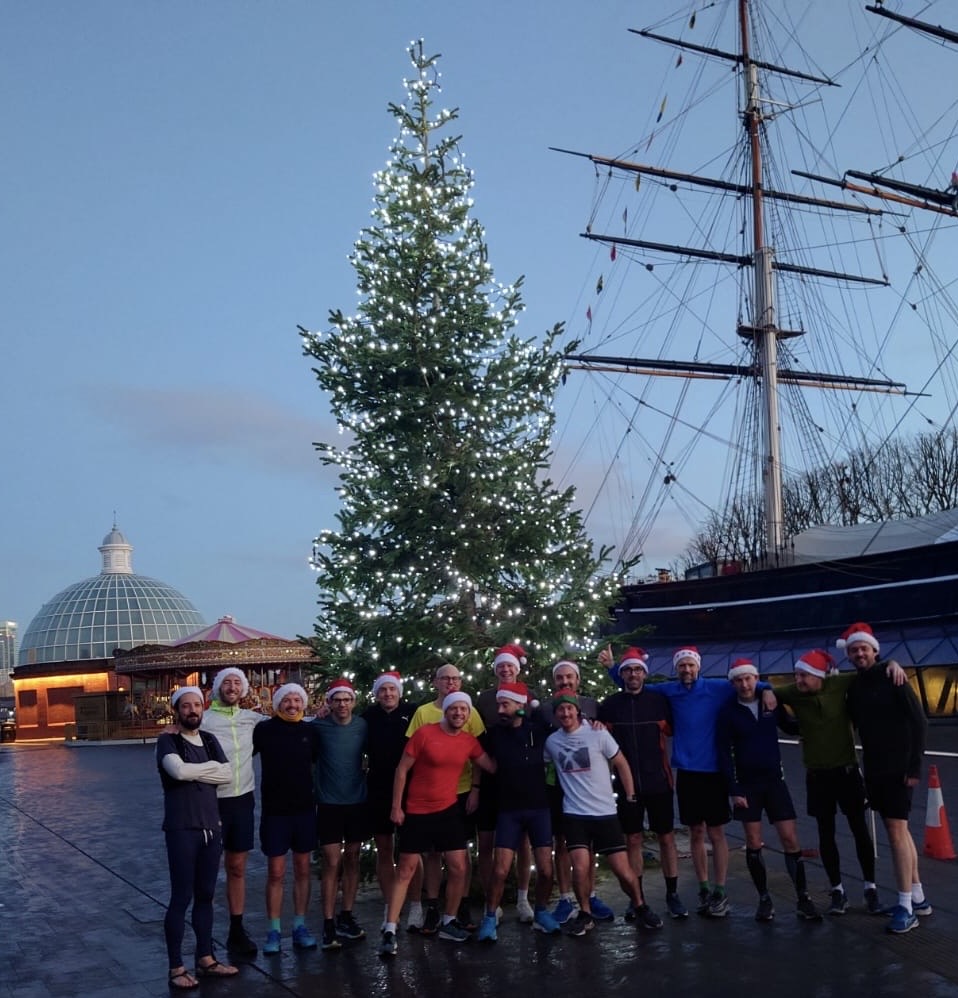
Image runner’s own

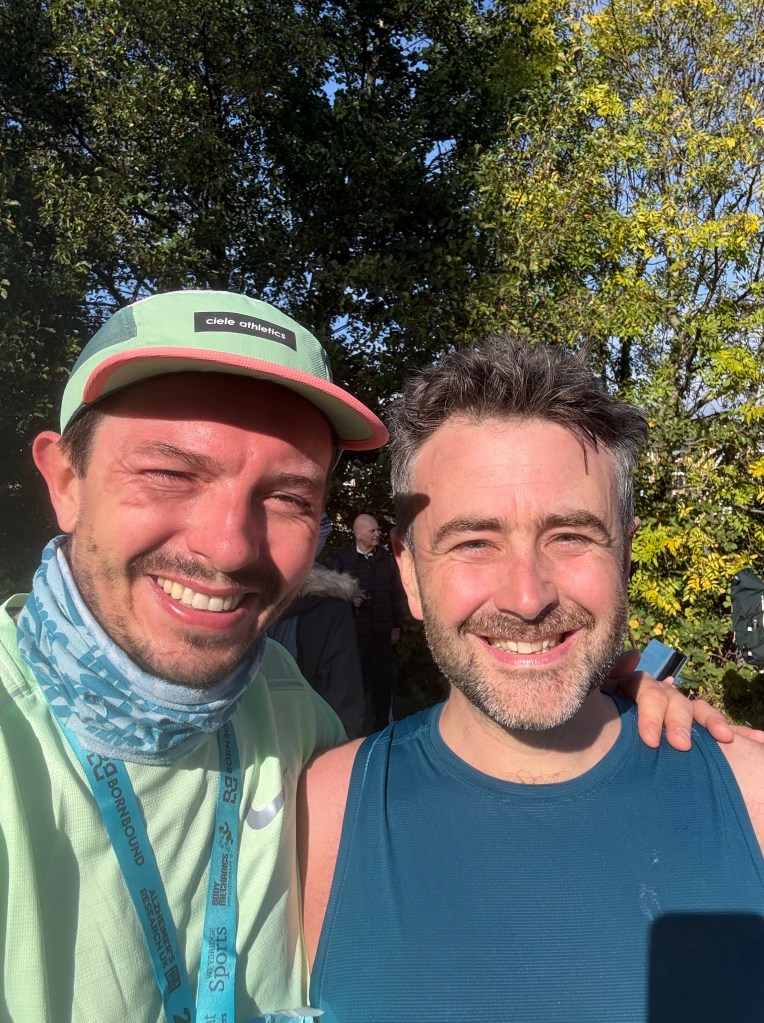
As the walking footballers demonstrate, the physical health benefits of group exercise are sometimes secondary to camaraderie – but winning and hitting goals are also fun and life-affirming. In October, I ran my first half-marathon in under 1 hour and 30 minutes. I crossed the line at Walton-on-Thames to complete the River Thames half at 1:29:55. A whole four seconds to spare! I would have been nowhere near that time without Mike.

Mike is a member of the Crisis of Dads, the running group I founded in November 2021. What started as a clutch of portly, middle-aged plodders meeting at 7am every Sunday in Ladywell Fields, in south-east London, has grown to 26 members. Men in their 40s and 50s exercising to limit the dad bod and creating space to chat through things on our minds.
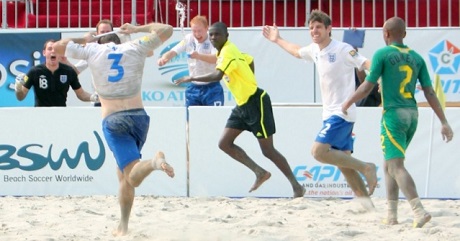
The male suicide rate in the UK in 2024 was 17.1 per 100,000, compared to 5.6 per 100,000 for women, according to the charity Samaritans. Males aged 50-54 had the highest rate: 26.8 per 100,000. Connection matters. Friendship matters. Physical presence matters.

Mike paced me during the River Thames half-marathon. With two miles to go, we were on track to go under 90 minutes, but the pain was horrible. His encouragement became more vocal – and more profane – as I closed in on something I thought beyond my ability.

Sometimes you need someone who believes in your ability more than you do to swear lovingly at you to cross that line quicker.

Work in the last month has been equally high octane, and (excuse the not-so-humble brag) record-breaking – plus full of in-person connection. My fledgling thought leadership consultancy, Pickup_andWebb (combining brand strategy and journalistic expertise to deliver guaranteed ROI – or your money back), is taking flight.

And I’ve been busy moderating sessions at leading technology events across the country, around the hot topic of how to lead and prepare the workforce in the AI age.

Moderating at DTX London (image taken by organisers)

On the main stage at DTX London, I opened by using the theme of the session about AI readiness to ask the audience whose workforce was suitably prepared. One person, out of hundreds, stuck their hand up: Andrew Melville, who leads customer strategy for Mission Control AI in Europe. Sportingly, he took the microphone and explained the key to his success.

I caught him afterwards. His confidence wasn’t bravado. Mission Control recently completed a data reconciliation project for a major logistics company. The task involved 60,000 SKUs of inventory data. A consulting firm had quoted two to three months and a few million pounds. Mission Control’s AI configuration completed it in eight hours. A thousand times faster, and 80% cheaper.

“You’re talking orders of magnitude,” Andrew said. “We’re used to implementing an Oracle database, and things get 5 or 10% more efficient. Now you’re seeing a thousand times more efficiency in just a matter of days and hours.”

He drew a parallel to the Ford Motor Company’s assembly line. Before that innovation, it took 12 hours to build a car. After? Ninety minutes. Eight times faster. “Imagine being a competitor of Ford,” Andrew said, “and they suddenly roll out the assembly line. And your response to that is: we’re going to give our employees power tools so they can build a few more cars every day.”

That’s what most companies are doing with AI. Giving workers ChatGPT subscriptions and hoping for magic, and missing the fundamental transformation required. As I said on stage at DTX London, it’s like handing workers the keys to a Formula 1 car, without instructions and wondering why there are so many almost immediate and expensive crashes.

“I think very quickly what you’re going to start seeing,” Andrew said, “is executives that can’t visualise what an AI transformation looks like are going to start getting replaced by executives that do.”

At Mission Control, he’s building synthetic worker architectures – AI agents that can converse with each other, collaborate across functions, and complete higher-order tasks. Not just analysing inventory data, but coordinating with procurement systems and finance teams simultaneously.

“It’s the equivalent of having three human experts in different fields,” Andrew explained, “and you put them together and you say, we need you to connect some dots and solve a problem across your three areas of expertise.”

The challenge is conceptual. How do you lead a firm where human workers and digital workers operate side by side, where the tasks best suited for machines are done by machines and the tasks best suited for humans are done by humans?

This creates tricky questions throughout organisations. Right now, most people are rewarded for being at their desks for 40 hours a week. But what happens when half that time involves clicking around in software tools, downloading data sets, reformatting, and loading back? What happens when AI can do all of that in minutes?

“We have to start abstracting the concept of work,” Andrew said, “and separating all of the tasks that go into creating a result from the result itself.”

Digging into that is for another edition of the newsletter, coming soon. 

Elsewhere, at the first Data Decoded in Manchester, I moderated a 30‑minute discussion on leadership in the age of AI. We were just getting going when time was up, which feels very much like 2025. The appetite for genuine insight was palpable. People are desperate for answers beyond the hype. Leaders sense the scale of the shift. However, their calendars still favour show-and-tell over do-and‑learn. That will change, but not without bruises.

Also in October, my essay on teenage hackers was finally published in the New Statesman. The main message is that we’re criminalising the young people whose skills we desperately need, and not offering a path towards cybersecurity, or related industries, over the darker criminal world.

Looking slightly ahead, on 11 November, I’ll be expanding on these AI-related themes, debating at The Portfolio Collective’s Portfolio Career Festival at Battersea Arts Centre. The subject, Unlocking Potential or Chasing Efficiency: AI’s Impact on Portfolio Work, prompts the question: should professionals embrace AI as a tool to amplify skills, creativity and flow, or hand over entire workflows to autonomous agents?

I know which side I’m on. 

(If you fancy listening in and rolling your sleeves up alongside over 200 ambitious professionals – for a day of inspiration, connection and, most importantly, growth – I can help with a discounted ticket. Use OLIVERPCFEST for £50 off the cost here.)

The past

In 2013, I was lucky enough to edit the Six Nations Guide with Lewis Moody, the former England rugby captain, a blood-and-thunder flanker who clocked up 71 caps. At the time, Lewis was a year into retirement, grappling with the physical aftermath of a brutal professional career.

When the tragic news broke earlier in October that Lewis, 47, had been diagnosed with the cruelly life-sapping motor neurone disease (MND), it set forth a waterfall of sorrow from the rugby community and far beyond. I simply sent him a heart emoji. He texted the same back a few hours later.

Lewis’s hellish diagnosis and the impact it has had on so many feels especially poignant given Princess Catherine’s reflections on childhood development. She writes about a Harvard study showing that “people who developed strong social and emotional skills in childhood maintained warmer connections with their spouses six decades later, even into their eighties and nineties”.

She continued: “Teaching children to better understand both their inner and outer worlds sets them up for a lifetime of healthier, more fulfilling relationships. But if connection is the key to human thriving, we face a concerning reality: every social trend is moving in the opposite direction.”

AI has already changed work. The deeper question is whether we’ll preserve the skills that make us irreplaceably human.

This Halloween, the real horror isn’t monsters at the door. It’s the quiet disappearance of human connection, one algorithmically optimised interaction at a time.

Roosevelt was right. Success depends on getting along with people. Not algorithms. Not synthetic companions. Not virtual influencers.

People.

Real, messy, complicated, irreplaceable people. 

Statistics of the month

💰 AI wage premium grows
Workers with AI skills now earn a 56% wage premium compared to colleagues in the same roles without AI capabilities – showing that upskilling pays off in cold, hard cash. (PwC)

🔄 A quarter of jobs face radical transformation
Roughly 26% of all jobs on Indeed appear poised to transform radically in the near future as GenAI rewrites the DNA of work across industries. (Indeed)

📈 AI investment surge continues
Over the next three years, 92% of companies plan to increase their AI investments – yet only 1% of leaders call their companies “mature” on the deployment spectrum, revealing a massive gap between spending and implementation. (McKinsey)

📉 Workforce reduction looms
Some 40% of employers expect to reduce their workforce where AI can automate tasks, according to the World Economic Forum’s Future of Jobs Report 2025 – a stark reminder that transformation has human consequences. (WEF)

🎯 Net job creation ahead
A reminder that despite fears, AI will displace 92 million jobs but create 170 million new ones by 2030, resulting in a net gain of 78 million jobs globally – proof that every industrial revolution destroys and creates in equal (or greater) measure. (WEF)

Thank you for reading Go Flux Yourself. Subscribe for free to receive this monthly newsletter straight to your inbox.

All feedback is welcome, via oliver@pickup.media. If you enjoyed reading, pass it on! Please consider sharing it via social media or email. Thank you.

And if you are interested in my writing, speaking and strategising services, you can find me on LinkedIn or email me using oliver@pickup.media.

Go Flux Yourself: Navigating the Future of Work (No. 21)


TL;DR: September’s Go Flux Yourself examines the fundamentals of AI success: invest £10 in people for every £1 on technology, build learning velocity into your culture, and show up as a learner yourself. England’s women’s rugby team went from amateurs juggling jobs to world champions through one thing: investing in people.

Image created on Midjourney

The future

“Some people are on [ChatGPT] too much. There are young people who just say ‘I can’t make any decision in my life without telling chat everything that’s going on. It knows me, it knows my friends, I’m going to do whatever it says.’ That feels really bad to me … Even if ChatGPT gives way better advice than any human therapist, there is something about collectively deciding we’re going to live our lives the way that the AI tells us feels bad and dangerous.”

The (unusually long) opening quotation for this month’s Go Flux Yourself comes – not for the first time – from the CEO of OpenAI, Sam Altman, arguably the most influential technology leader right now. How will future history books – if there is anyone with a pulse around to write them – judge the man who allegedly has “no one knows what happens next” as a sign in his office?

The above words come from an interview a few weeks ago, and smack of someone who is deeply alarmed by the power he has unleashed. When Altman starts worrying aloud about his own creation, you’d think more people would pay attention. But here we are, companies pouring millions into AI while barely investing in the people who’ll actually use it.

We’ve got this completely backwards. Organisations are treating AI as a technology problem when it’s fundamentally a people problem. Companies are spending £1 on AI technology when they should spend an additional £10 on people, as Kian Katanforoosh, CEO and Founder of Workera, told me over coffee in Soho a couple of weeks ago.

We discussed the much-quoted MIT research, published a few weeks ago (read the main points without signing up to download the paper in this Forbes piece), which shows that 95% of organisations are failing to achieve a return on investment from their generative AI pilots. Granted, the sample size was only 300 organisations, but that’s a pattern you can’t ignore.

Last month’s newsletter considered the plight of school leavers and university students in a world where graduate jobs have dropped by almost two-thirds in the UK since 2022, and entry-level hiring is down 43% in the US and 67% in the UK since Altman launched ChatGPT in November 2022.

It was easily the most read of all 20 editions of Go Flux Yourself. Why? I think it captured many people’s concerns about how blindly following the AI path could be for human flourishing. If young people are unable to gain employment, what happens to the talent pipeline, and where will tomorrow’s leaders come from? The maths doesn’t work. The logic doesn’t hold. And the consequences are starting to show.

To continue this critically important conversation, I met (keen Arsenal fan) Kian in central London, as he was over from his Silicon Valley HQ. Alongside running Workera – an AI-powered skills intelligence platform that helps Fortune 500 and Global 2000 organisations assess, develop, and manage innovation skills in areas such as AI, data science, software engineering, cloud computing, and cybersecurity – he is an adjunct lecturer in computer science at Stanford University.

“Companies have bought a huge load of technology,” he said. “And now they’re starting to realise that it can’t work without people.”

That’s the pattern repeated everywhere. Buy the tools. Deploy the systems. Wonder why nothing changes. The answer is depressingly simple: your people don’t know how to use what you’ve bought. They don’t have the foundational skills. And when they try, they’re putting you at risk because they don’t know what they’re uploading to these tools.

This is wrongheaded. We’ve treated AI like it’s just another software rollout when it’s closer to teaching an entire workforce a new language. And business leaders have to invest significantly more in their current and future human workforce to maximise the (good) potential of AI and adjacent technologies, or everyone fails. Updated leadership thinking is paramount to success.

McKinsey used to advocate spending $1 (or £1) on technology for every $1 / £1 on people. Then, last year, the company revised it: £1 on technology, £3 on people. “Our experience has shown that a good rule of thumb for managing gen AI costs is that for every $1 spent on developing a model, you need to spend about $3 for change management. (By way of comparison, for digital solutions, the ratio has tended to be closer to $1 for development to $1 for change management.)”

Kian thinks this is still miles off what should be spent on people. “I think it’s probably £1 in technology, £10 in people,” he told me. “Because when you look at AI’s potential productivity enhancements on people, even £10 in people is nothing.”

That’s not hyperbole. That’s arithmetic based on what he sees daily at Workera. Companies contact him, saying they’ve purchased 25 different AI agents and software packages, but employee usage starts strong for a week and then collapses. What’s going on? The answer is depressingly predictable.

“Your people don’t even know how to use that technology. They don’t even have the 101 skills to understand how to use it. And even when they try, they’re putting you (the organisation) at risk because they don’t even know what they’re uploading to these tools.”

One of the main things Workera offers is an “AI-readiness test”, and Kian’s team’s findings uncover a worrying truth: right now, outside tech companies, only 28 out of 100 people are AI-ready. That’s Workera’s number, based on assessing thousands of employees in the US and elsewhere. In tech companies, the readiness rate is over 90%, which is perhaps unsurprising. Yet while the gap is a chasm between tech-industry businesses and everyone else, it is growing.

But here’s where it gets really interesting. Being AI-ready today means nothing if your learning velocity is too slow. The technology changes every month. New capabilities arrive. Old approaches become obsolete. Google just released Veo, which means anyone can become a videographer. Next month, there’ll be something else.

“You can be ahead today,” Kian said. “If your learning velocity is low, you’ll be behind in five years. That’s what matters at the end of the day.”

Learning velocity. I liked that phrase. It captures something essential about this moment: that standing still is the same as moving backwards, that capability without adaptability is a temporary advantage at best.

However, according to Kian, the UK and Europe are already starting from behind, as his data shows a stark geographic divide in AI readiness. American companies – even outside pure tech firms – are moving faster on training and adoption. European organisations are more cautious, more bound by regulatory complexity, and more focused on risk mitigation than experimentation.

“The US has a culture of moving fast and breaking things,” Kian said. “Europe wants to get it right the first time. That might sound sensible, but in AI, you learn by doing. You can’t wait for perfect conditions.”

He pointed to the EU AI Act as emblematic of the different approaches. Comprehensive regulation arrived before widespread adoption. In the US, it’s the reverse: adoption at scale, regulation playing catch-up. Neither approach is perfect, but one creates momentum while the other creates hesitation.

The danger isn’t just that European companies fall behind American competitors. It’s that European workers become less AI literate, less adaptable, and less valuable in a global labour market increasingly defined by technological fluency. The skills gap becomes a prosperity gap.

“If you’re a European company and you’re waiting for clarity before you invest in your people’s AI skills, you’ve already lost,” Kian said. “Because by the time you have clarity, the game has moved on.”

Fresh research backs this up. (And a note on the need for the latest data – as a client told me a few days ago, data is like milk, and it has a short use-by date. I love that metaphor.) A new RAND Corporation study examining AI adoption across healthcare, financial services, climate and energy, and transportation found something crucial: identical AI technologies achieve wildly different results depending on the sector. A chatbot in banking operates at a different capability level than the same technology in healthcare, not because the tech differs but because the context, regulatory environment, and implementation constraints differ.

RAND proposes five levels of AI capability.

Level 1 covers basic language understanding and task completion: chatbots, simple diagnostic tools, and fraud detection. Humanity has achieved this.

Level 2 involves enhanced reasoning and problem-solving across diverse domains: systems that analyse complex scenarios and draw inferences. We’re emerging into this now.

Level 3 is sustained autonomous operation in complex environments, where systems make sequential decisions over time without human intervention. That’s mainly in the future, although Waymo’s robotaxis and some grid management pilots are testing it.

Levels 4 and 5 – creative innovation and full organisational replication – remain theoretical.

Here’s what matters: most industries currently operate at Levels 1 and 2. Healthcare lags behind despite having sophisticated imaging AI, as regulatory approval processes and evidence requirements slow down adoption. Finance advances faster because decades of algorithmic trading have created infrastructure and acceptance. Climate and energy sit in the middle, promising huge optimisation gains but constrained by infrastructure build times and regulatory uncertainty. Transportation is inching toward Level 3 autonomy while grappling with ethical dilemmas about life-or-death decisions.

The framework reveals why throwing technology at problems doesn’t work. You can’t skip levels. You can’t buy Level 3 capability and expect it to function in an organisation operating at Level 1 readiness. The gap between what the technology can do and what your people can do with it determines the outcome.

RAND identified six challenges that cut across every sector: workforce transformation, privacy protection, algorithmic bias, transparency and oversight, disproportionate impacts on smaller organisations, and energy consumption. Small institutions serving rural and low-income areas face particular difficulties. They lack resources and technical expertise. The benefits of AI concentrate among major players, while vulnerabilities accumulate at the edges.

For instance, the algorithmic bias problem is insidious. Even without explicitly considering demographic characteristics, AI systems exhibit biases. Financial algorithms can devalue real estate in vulnerable areas. Climate models might overlook impacts on marginalised communities. The bias creeps in through training data, through proxy variables, through optimisation functions that encode existing inequalities.

Additionally, and as I’ve written about previously, the energy demands are staggering. AI’s relationship with climate change cuts both ways. Yes, it optimises grids and accelerates the development of green technology. However, if AI scales productivity across the economy, it also scales emissions, unless we intentionally direct applications toward efficiency gains and invest heavily in clean energy infrastructure. The transition from search-based AI to generative AI has intensified computational requirements. Some experts argue potential efficiency gains could outweigh AI’s carbon footprint, but only if we pursue those gains deliberately through measured policy and investment rather than leaving it to market forces.

RAND’s conclusion aligns with everything Kian told me: coordination is essential, both domestically and internationally. Preserve optionality through pilot projects and modular systems. Employ systematic risk management frameworks. Provide targeted support to smaller institutions. Most importantly, invest in people at a ratio that reflects the actual returns.

The arithmetic remains clear across every analysis: returns on investing in people dwarf the costs. But we’re not doing it.

How, though, do you build learning velocity into an organisation? Kian had clear thoughts on this. Yes, you need to dedicate time to learning. Ten per cent of work time isn’t unreasonable. But the single most powerful thing a leader can do is simpler than that: lead by example.

“Show up as a learner,” he said. “If your manager, or your manager’s manager, or your manager’s manager’s manager is literally showing you how they learn and how much time they spend learning and how they create time for learning, that is already enough to create a mindset shift in the employee base.”

Normalising learning, then, is vital. That shift in culture matters more than any training programme you can buy off the shelf.

We talked about Kian’s own learning habits. Every morning starts with readings. He’s curated an X feed of people he trusts who aren’t talking nonsense, scans it quickly, and bookmarks what he wants to read deeper at night. He tracks top AI conferences, skims the papers they accept – thousands of them – looking at figures and titles to gain the gist. Then he picks 10% to read more carefully, and maybe 3% to spend an entire day on. “You need to have that structure or else it just becomes overwhelming,” he said.

The alternative is already playing out, and it’s grim. Some people – particularly young people – are on ChatGPT too much, as Altman admitted. They can’t make any decision without consulting the chatbot. It knows them, knows their friends, knows everything. They’ll do whatever it says.

Last month, Mustafa Suleyman, Co-Founder of DeepMind and now in charge of AI at Microsoft, published an extended essay about what he calls “seemingly conscious AI”: systems that exhibit all the external markers of consciousness without possessing it. He thinks we’re two to three years away from having the capability to build such systems using technology that already exists.

“My central worry is that many people will start to believe in the illusion of AIs as conscious entities so strongly that they’ll soon advocate for AI rights, model welfare and even AI citizenship,” he wrote.

Researchers working on consciousness tell him they’re being inundated with queries from people asking whether their AI is conscious, whether it’s acceptable to love it, and what it means if it is. The trickle has become a flood.

Tens of thousands of users already believe their AI is God. Others have fallen in love with their chatbots. Indeed, a Harvard Business Review survey of 6,000 regular AI users – the results of which were published in April (so how stale is the milk?) – found that companionship and therapy were the most common use cases.

This isn’t speculation about a distant future. This is happening now. And we’re building the infrastructure – the long memories, the empathetic personalities, the claims of subjective experience – that will make these illusions even more convincing.

Geoffrey Hinton, the so-called godfather of AI, who won the Nobel Prize last year, told the Financial Times in a fascinating lunch profile published in early September, that “rich people are going to use AI to replace workers. It’s going to create massive unemployment and a huge rise in profits. It will make a few people much richer and most people poorer. That’s not AI’s fault, that is the capitalist system.”

Dark, but there’s something clarifying about his honesty. The decisions we make now about how to implement AI, whether to invest in people or just technology, whether to prioritise adoption or understanding – these will shape what comes next.

The Adaptavist Group’s latest report, published last week, surveyed 900 professionals responsible for introducing AI across the UK, US, Canada and Germany. They found a divide: 42% believe their company’s AI claims are over-inflated. These “AI sceptics” work in environments where 65% believe their company’s AI stance puts customers at risk, 67% worry that AI adoption poses a threat to jobs, and 59% report having no formal AI training.

By contrast, AI leaders in companies that communicated AI’s value honestly reported far greater benefits. Some 58% say AI has improved work quality, while 61% report time savings. 48% note increased output. Only 37% worry about ethics issues, compared with 74% in over-hyped environments.

The difference? Training. Support. Honest communication. Investing in people rather than just technology.

Companies are spending between £1 million and £10 million implementing AI. Some are spending over £10 million. But 59% aren’t providing basic training. It’s like buying everyone in your company a Formula One car and being shocked when most people crash it.

“The next year is all going to be about adoption, skills, and doing right by employees,” Kian said. “Companies that do it well are going to see better adoption and more productivity. Those who don’t? They’re going to get hate from their employees. Like literally. Employees will be really mad at companies for not being human at all.”

That word – human – kept coming up in our conversation. In a world increasingly mediated by AI, being human becomes both more difficult and more essential. The companies that remember this, that invest in their people’s ability to learn, adapt, and think critically, will thrive. The ones that don’t will wonder why their expensive AI implementations gather digital dust.

The present

Image created on Midjourney

On Thursday (October 2), I’ll be at DTX London moderating a main-stage session asking: is your workforce ready for what’s next? The questions we’ll tackle include how organisations can create inclusive, agile workplaces that foster belonging and productivity, how AI will change entry-level positions, and crucially, how we safeguard critical thinking in an AI-driven world. These are urgent, practical challenges that every organisation faces right now. (I’ll also be recording episode three of DTX Unplugged, the new podcast series I co-host, looking at business evolution – listen to the series so far here.)

Later in October, on the first day of the inaugural Data Decoded in Manchester (October 21-22), I’ll moderate another session on a related topic to the above: what leadership looks like in a world of AI, because leadership must evolve. The ethical responsibilities are staggering. The pace of change is relentless. And the old playbooks simply don’t work.

I’ve also started writing the Go Flux Yourself book (any advice on self-publishing welcome). More on that soon. The conversations I’m having, the research I’m doing, the patterns I’m seeing all point towards something bigger than monthly newsletters can capture. We’re living through a genuine transformation, and I’m in a unique and privileged position to document what it feels like from the inside rather than just analysing it from the outside.

The responses to last month’s newsletter on graduate jobs and universities showed me how hungry people are for honest conversations about what’s really happening, on the ground and behind the numbers. Expect more clear-eyed analysis of where we are and what we might do about it. And please do reach out if you think you can contribute to this ongoing discussion, as I’m open to featuring interviewees in the newsletter (and, in time, the book).

The past

Almost exactly two years ago, I took my car for its annual service at a garage at Elmers End, South East London. While I waited, I wandered down the modest high street and discovered a Turkish café. I ordered a coffee, a lovely breakfast (featuring hot, gooey halloumi cheese topped with dripping honey and sesame seeds) and, on a whim, had my tarot cards read by a female reader at the table opposite. We talked for 20 minutes, and it changed my life (see more on this here, in Go Flux Yourself No.2).

A couple of weeks ago, I returned for this year’s car service. The café is boarded up now, alas. A blackboard dumped outside showed the old WiFi password: kate4cakes. Another casualty of our changing times, a small loss in the great reshuffling of how we live, work, and connect with each other. With autumn upon us, the natural state of change and renewal is fresh in the mind. However, it still saddened me as I pondered what the genial Turkish owner and his family were doing instead of running the café.

Autumn has indeed arrived. Leaves are twisting from branches and falling to create a multicoloured carpet. But what season are we in, really? What cycle of change?

I thought about that question as I watched England’s women’s rugby team absolutely demolish Canada 33-13 in the World Cup final at Twickenham last Saturday, with almost 82,000 people in attendance, a world record. The Red Roses had won all 33 games since their last World Cup defeat, the final against New Zealand Black Ferns.

Being put through my paces with Katy Mclean (© Tina Hillier)

In July 2014, I trained with the England women’s squad for pieces I wrote for the Daily Telegraph (“The England women’s rugby team are tougher than you’ll ever be“) and the Financial Times (“FT Masterclass: Rugby training with Katy Mclean” (now Katy Daley-McLean)). They weren’t professional then. They juggled jobs with their international commitments. Captain Katy Daley-McLean was a primary school teacher in Sunderland. The squad included policewomen, teachers, and a vet. They spent every spare moment either training or playing rugby.

I arrived at Surrey Sports Park in Guildford with what I now recognise was an embarrassing air of superiority. I’m bigger, stronger, faster, I thought. I’d played rugby at university. Surely I could keep up with these amateur athletes.

The England women’s team knocked such idiotic thoughts out of my head within minutes.

We started with touch rugby, which was gentle enough. Then came sprints. I kept pace with the wingers and fullbacks for the first four bursts, then tailed off. “Tactically preserving my energy,” I told myself.

Then strength and conditioning coach Stuart Pickering barked: “Malcolms next.”

Katy winked at me. “Just make sure you keep your head up and your hands on your hips. If you show signs of tiredness, we will all have to do it again … so don’t.”

Malcolms – a rugby league drill invented by the evidently sadistic Malcolm Reilly – involve lying face down with your chin on the halfway line, pushing up, running backwards to the 10-metre line, going down flat again, pushing up, sprinting to the far 10-metre line. Six times.

By the fourth repetition, I was blowing hard. By the final on,e I was last by some distance, legs burning, expelling deeply unattractive noises of effort. The women, heads turned to watch me complete the set, cheered encouragement rather than jeered. “Suck it up Ollie, imagine it’s the last five minutes of the World Cup final,” full-back Danielle Waterman shouted.

Then came the circuit training. Farmers’ lifts. Weights on ropes. The plough. Downing stand-up tackle bags. Hit and roll. On and on we moved, and as my energy levels dipped uncomfortably low, it became a delirious blur.

The coup de grâce was wrestling the ball off 5ft 6in fly-half Daley-Mclean. I gripped as hard as I could. She stole it from me within five seconds. Completely zapped, I couldn’t wrest it back. Not to save my life.

Emasculated and humiliated, I feigned willingness to take part in the 40-minute game that followed. One of the coaches tugged me back. “I don’t think you should do this mate … you might actually get hurt.”

I’d learned my lesson. These women were tougher, fitter, and more disciplined than I’d ever be.

That was 2014. The England women, who went on to win the World Cup in France that year, didn’t have professional contracts. They squeezed their training around their jobs. Yet they were world-class athletes who’d previously reached three consecutive World Cup finals, losing each time to New Zealand.

Then something changed. The Rugby Football Union invested heavily. The women’s team went professional. They have the same resources, support systems, and infrastructure as the men’s team.

The results speak for themselves. Thirty-three consecutive victories. A World Cup trophy, after two more final defeats to New Zealand. Record crowds. A team that doesn’t just compete but dominates.

This is what happens when you invest in people, providing them with the training, resources, time, and support they need to develop their skills. You treat them not as amateur enthusiasts fitting excellence around the edges of their lives, but as professionals whose craft deserves proper investment.

The parallels to AI adoption are striking. Right now, most organisations are treating their workers like those 2014 England rugby players and expecting them to master AI in their spare time. To become proficient without proper training. To deliver world-class results with amateur-level support.

It’s not going to work.

The England women didn’t win that World Cup through superior technology. They won it through superior preparation. Through investment in people, in training, and in creating conditions for excellence to flourish.

That’s the lesson for every organisation grappling with AI. Technology is cheap. Talent is everything. Training matters more than tools. And if you want your people to keep pace with change, you need to create a culture where learning isn’t a luxury but the whole point.

As Kian put it: “We need to move from prototyping to production AI. And you need 10 times more skills to put AI in production reliably than you need to put a demo out.”

Ten times the skills, and £10 spent on people for every £1 on technology. The arithmetic isn’t complicated. The will to act on it is what’s missing.

Statistics of the month

📈 Sick days surge
Employees took an average of 9.4 days off sick in 2024, compared with 5.8 days before the pandemic in 2019 and 7.8 days just two years ago. (CIPD)

📱 Daily exposure
Children are exposed to around 2,000 social media posts per day. Over three-quarters (77%) say it harms their physical or emotional health. (Sway.ly via The Guardian)

📉 UK leadership crisis
UK workers’ confidence in their company leaders has plummeted from 77% to 67% between 2022 and 2025 – well below the global average of 73% – while motivation fell from 66% to just 60%. (Culture Amp)

🎯 L&D budget reality
Despite fears that AI could replace their roles entirely (43% of L&D leaders believe this), learning and development budgets are growing: 70% of UK organisations and 84% in Australia/New Zealand increased L&D spending in 2025. (LearnUpon)

🔒 Email remains the weakest link
83% of UK IT leaders have faced an email-related security incident, with government bodies hit hardest at 92%. Yet email still carries over half (52%) of all organisational communication. (Exclaimer UK Business Email Report)

Thank you for reading Go Flux Yourself. Subscribe for free to receive this monthly newsletter straight to your inbox.

All feedback is welcome, via oliver@pickup.media. If you enjoyed reading, pass it on! Please consider sharing it via social media or email. Thank you.

And if you are interested in my writing, speaking and strategising services, you can find me on LinkedIn or email me using oliver@pickup.media.

Go Flux Yourself: Navigating the Future of Work (No. 7)

TL;DR: July’s cheery (!) Go Flux Yourself considers the end of knowledge and culture as we know it thanks to artificial general intelligence, technology-induced ‘relationship decay’, HR dissonance, and the breathtaking beauty of human skill …

Image created on Midjourney with the prompt “a massive meteor with an evil AI face about to crash down on Earth while ignorant people look at their smartphones in the style of an Edvard Munch painting”

The future

“The realisation of artificial general intelligence would be like a meteor coming down from above, stopping culture and knowledge as we know it.”

These are the words of warning from Gerd Leonhard, the German futurist with whom I have collaborated a few times, fortunately. Back in 2018, Gerd – a former musician who studied at Boston’s Berklee College of Music (he has a brilliant story about how jazz trumpeting great Miles Davis visited and played just one note that had all the students spellbound) – invited me over to the south of France to shape and sharpen his messaging around the brawl, as he saw it, between humans and tech. 

Gerd published Technology vs. Humanity a couple of years earlier, but with things moving quickly, he engaged me to keep things fresh. He is always worth listening to and learning from, and I’m grateful that we have continued the conversation over the years – before, during, and now after the coronavirus pandemic. We caught up again recently, earlier in July, after Gerd delivered a hard-hitting webinar from which the above line comes. (I recommend you to watch the 41-minute talk here.)

As an aside, I had a good cackle at this dark cartoon Gerd used in his talk, too.

Back to the meteor idea, which is a twist on the 2021 apocalyptic political satire and black comedy Don’t Look Up, starring Leonardo DiCaprio. Last year Gerd produced a short film called Look Up Now.

Imagine a meteor hurtling towards Earth, not of rock and ice, but of silicon and code. This celestial body doesn’t threaten our physical existence but rather our monopoly on knowledge and intellect. This is Gerd’s stark vision of artificial general intelligence (AGI).

“We thought the idea of the asteroid hitting the earth would be good for the idea of AGI,” he tells me. “Because AI – and intelligent assistants (IA) – by itself is a big change, but it’s not existential in the sense of fundamentally changing everything. But a machine that would be generally intelligent that could surpass us in every possible cognitive job would be like an asteroid hitting us because it would basically be complete unemployment afterwards except for physical jobs.”

This looming “knowledge meteor” isn’t just a hypothetical scenario for the distant future. It’s a reality actively pursued by some of the world’s most powerful tech companies. As Gerd notes: “The biggest business ever is to replace humans with machines.”

The race towards AGI – or the singularity, or superintelligence, depending on your preferred phraseology – represents a seismic shift in human history that could redefine our role in the world. Yet, as with the fictional comet in Don’t Look Up, there’s an alarming lack of urgency in addressing this existential challenge. 

While governments and regulatory bodies are beginning to grapple with the implications of AI, their efforts often fall short of the mark. For instance, the UK’s recent pledge to “get a handle” on AI lacks clear definitions and concrete action plans. 

Meanwhile, the drive to dominate AI development continues unabated in the United States, with Donald Trump’s team planning a “Manhattan Project on AI”, according to a Washington Post report in mid-July. This plan includes creating industry-led agencies to study AI models and protect them from foreign powers, with a section ominously titled “Make America First in AI”.

The original Manhattan Project, started during World War II, led to the production of the world’s first nuclear weapons. “If we started a Manhattan Project for AI, we’re essentially saying you have unlimited resources, unlimited freedom, and no moral constraints,” says Gerd. “It’s inviting all the mad scientists who just want to build whatever they can without any consideration for ethical and moral issues.”

Certainly, the historical parallel is chilling, reminding us of the unforeseen consequences that can arise from unbridled technological advancement. Who, Gerd asks, will serve as humanity’s “mission control” in this high-stakes environment? There’s no clear answer. 

Unlike previous existential threats like nuclear weapons or climate change, AGI development is largely driven by private companies motivated by profit rather than public interest. Indeed, arguably the most influential person in this space, OpenAI’s CEO Sam Altman, has the motto “No one knows what happens next” above his desk – as I pointed out in January’s inaugural Go Flux Yourself.

The financial incentives driving AI development are enormous, creating what Gerd describes as “a huge temptation to rush ahead without considering the consequences of building something larger than us”. This sprint towards AGI is particularly concerning, given the potential implications. An entity that “knows everything about everybody at any given time and combines that in a digital brain of an IQ of one billion,” Gerd argues, “cannot possibly end well for us.”

It’s important to stress that my Swiss-based friend is not arguing against all AI development. He distinguishes between narrow AI or “intelligent assistants” and AGI. The former, he believes, can be “extremely useful for businesses like better software, offering us powerful solutions, more efficiency”. The latter – a general intelligence surpassing human capabilities across the board – poses existential risks.

This nuanced view is crucial as we navigate the future of AI. It’s not about halting progress but about directing it responsibly. Hence why the Manhattan Project on AI, which would likely trigger an arms race, is bad news for humanity.

“The wolf you feed is the wolf that wins,” points out Gerd. We have to feed the right wolf, and must prioritise human values alongside technological progress. It’s incredibly challenging, of course, and requires meaningful collaboration between policymakers, AI researchers, ethicists, and business leaders. But by developing a shared understanding of AI’s potential and pitfalls, we can craft regulations that foster innovation while protecting society’s interests – before it’s too late.

The present

While the aforementioned meteor is not yet in our orbit, thankfully, there are plenty of examples of how technology other than AGI is negatively impacting our lives. Last month, I wrote about the rising “loneliness epidemic”

Shortly afterwards, I interviewed Eric Mosley, CEO of WorkHuman, who offers a stark image of the current business landscape, where the fabric of workplace relationships is fraying badly.

“What is obvious to everyone is that the less you interact with people physically, the more destructive that is to the relationship capital and the relationship infrastructure in companies,” the Boston-based Irishman says. This decay in social connections isn’t just a fleeting trend – it’s a fundamental shift that threatens the foundations of corporate culture.

The pandemic-induced shift to remote work initially rode on the coattails of pre-existing relationships. However, as Eric continues: “Now we’re years into this and have a much more prevalent work-from-home culture. Relationship decay is real, and culture is affected by that.”

That phrase, relationship decay, is perfect for revealing how rotten things are – at work, and elsewhere. Yet the erosion of workplace bonds manifests in subtle yet profound ways. The casual conversations before and after meetings, the impromptu chats by the coffee machine – these seemingly insignificant interactions are the lifeblood of a vibrant business culture. 

In their absence, we’re left with what Eric describes as a sterile, transactional work environment. “You join a Zoom call, conduct your business, then disconnect and retreat to your pathetic little kitchen for tea. There’s no genuine interaction – it’s a cycle of isolation.”

The cumulative effect of these missed connections is staggering. “You have to understand the compounding effect of that difference across thousands of company interactions over years,” Eric warns. “It adds up to a profound difference.”

This relationship decay has given rise to a new breed of employee – the “mentally transient” worker. These individuals, lacking strong ties to their colleagues or a sense of community, are merely going through the motions.

Yet, herein lies a paradox that HR professionals must grapple with. Despite the obvious detrimental effects of reduced physical interaction, employees continue to push for more remote work options. Eric describes this as a “complete dissonance and disconnect between the reality of what that results in and the desire of companies to counteract it”.

This dissonance presents a significant challenge for HR leaders. How do you balance the desire for flexibility with the need for meaningful workplace connections? The solution lies in reimagining the office as a hub for collaboration and community-building rather than a mandatory daily destination.

As businesses grapple with these shifts in workplace dynamics, we must also be mindful of unintended consequences in other areas. This last week, I interviewed Nicola Millard, Principal Innovation Partner at BT Group, for a piece previewing the London version of Digital Transformation EXPO (where I’ll be on stage again in October). She highlights an emerging trend that parallels the workplace disconnect, “shadow customers” – people who lack the confidence or ability to navigate digital platforms. 

She exemplifies this through her personal experience, acting as a digital proxy for her 86-year-old Mother. While her Mum can make telephone calls, Nicola handles all online interactions, from shopping to managing accounts, effectively becoming the “customer behind the customer” in an increasingly digital world. 

As businesses increasingly shift towards digital channels, they risk alienating a segment of their customer base that needs more confidence or ability to navigate these platforms.

This trend reminds us that we must not lose sight of the human element in our rush to embrace digital transformation. Just as some employees struggle with a fully remote work environment, some customers may feel left behind by purely digital interactions.

The parallel between these two trends is striking. In both cases, there’s a risk of losing vital connections – whether it’s between colleagues or between businesses and their customers. And in both cases, the solution lies in finding a balance between digital efficiency and human touch.

The past

In the recent past – i.e. in July – I’ve written or spoken for a variety of clients about the future of insurance, the future of education, and the future of the workplace. It’s been a fun, productive month. I even began a new column for Low No Drinker Magazine, called Upper Bottom – the same as the weekly sobriety podcast I began almost exactly six months ago.

But I’ve also found time to enrich myself with art and culture. I took my family to the Summer Exhibition at the Royal Academy in London, which I hope will inspire them. I also snook off solo on a Monday afternoon to catch the Beyond the Bassline exhibition at the British Library before it closed. 

The latter chronicled 500 years of black British music, and writing about it now makes me think again about Gerd’s story of Miles Davis playing one note with such haunting quality that it made it so memorable. 

I’m optimistic that human skills will always be valued more than technological achievements. The Paris Olympic Games, which are in full flow now, are an important reminder that there is breathtaking and life-affirming beauty to be found in people going faster, higher, and stronger – as per the Olympic motto, Citius, Altius, Fortius.

Three years ago, the organisers added another Latin word for the Tokyo Games: Communiter. It translates as “together”. In this mad and increasingly often bad world, we need that togetherness more than ever.

Statistics of the month

  • While executives push for return-to-office mandates, 48% of managers admit that their teams are more productive when they adopt hybrid work (Owl Labs’ annual State of Hybrid Work study).
  • Remember the Great Resignation? This is worse. Over a quarter (28%) of the 56,000 workers surveyed said they were “very or extremely likely” to move on from their current companies. In 2023 that figure stood at 26%, and at 19% in 2022 (PwC).
  • Two-thirds (66%) of the UK workforce do not feel their work environment allows them to partake in self-care and look after their well-being (People Management).

Stay fluxed – and get in touch! Let’s get fluxed together …

Thank you for reading Go Flux Yourself. Subscribe for free to receive this monthly newsletter straight to your inbox.

All feedback is welcome, via oliver@pickup.media. If you enjoyed reading, please consider sharing it via social media or email. Thank you.

And if you are interested in my writing, speaking and strategising services, you can find me on LinkedIn or email me using oliver@pickup.media

Go Flux Yourself: Navigating the Future of Work (No. 5)

TL;DR: May’s – slightly delayed – Go Flux Yourself includes being selfless to find happiness, building tech for good, virtual work experience, the importance of messy stories, and a tribute to rugby league legend Rob Burrow … 

Image created on Midjourney with the prompt “Leeds Rhinos rugby league legend Rob Burrow smiling with the ball and happy people gathering around him – with tech robots looming behind them – in the style of a David Hockney painting”

The future

“The greatest burden a child must bear is the unlived life of its parents.”

These words, attributed to Swiss psychoanalyst Carl Jung, were quoted on stage by Britain’s leading “psychological illusionist” Derren Brown, the big draw at DTX Manchester in late May when discussing the pursuit of happiness. 

This wisdom hit me hard as the father of two small but quickly growing children. (And this newsletter didn’t arrive on May 31st – apologies – because I was holidaying in the Netherlands for half-term.) It smacked me harder, though, as someone passionate about human-work evolution and the world we are building. 

Is the combination of technology and social media making us overly self-interested? Is too much screen time, for adults and kids alike, making us more susceptible to jealousy while eroding common decency and looking out for those around us? We need to look up, look out, and that starts with, well, looking inward.

Related to this, I recently saw a brilliant and quite emotional post on LinkedIn that distilled the problem of human selfishness. In a thought-provoking classroom experiment, a university professor challenged his students to a unique test of teamwork and empathy. 

Each student was assigned a balloon bearing their name, which was then released from the ceiling. The challenge was to locate their own balloon within a five-minute time limit. If everyone succeeded, they would collectively win; if even one student failed, they would all lose. 

Despite their earnest efforts, not a single student managed to find their individual balloon amid the chaos. Undeterred, the professor gathered the wayward balloons and gave the class a new directive: “When you catch a balloon, give it to its rightful owner.” With this simple shift in perspective, the students all completed the task before three minutes were up.

The professor concluded the lesson with a poignant observation: “Happiness is like these balloons. If each of us single-mindedly pursues our own, we will inevitably come up short. But if we prioritise the wellbeing of others, we will find that our own happiness follows suit.” 

This principle holds true not only in the classroom, but also in the corporate – and specifically the technology – world as well. By actively supporting our colleagues in achieving their objectives, we foster an environment of reciprocity and shared success.

At DTX Manchester, where I moderated a session on AI in the workplace, Brown, who I once shared a seance table with – a story not for here – talked about our materialistic, consumerist tendencies. Most of us, he said, are on the “hedonic treadmill”, chasing and attaining new things to feel happier. But that immediate dopamine spike soon drops, and then we look for the next shiny thing. Essentially, he argued – convincingly – that this doesn’t make us happy.

Building on this point, he offered the audience a thought experiment suggested by Stoic philosopher William B. Irvine. In On Desire: Why We Want What We Want, Irvine wrote: “Suppose you woke up one morning to discover that you were the last person on earth … In the situation described, you could satisfy many material desires that you can’t satisfy in our actual world. You could have the car of your dreams. You could even have a showroom full of expensive cars. You could have the house of your dreams – or live in a palace. You could wear very expensive clothes. You could acquire not just a big diamond ring but the Hope Diamond itself. The interesting question is this: without people around, would you still want these things?”

The answer is obvious when framed in this way. But do enough of us realise this truth?

Brown also challenged leaders to prioritise authentic storytelling over superficial narratives. He argued that businesses often present overly simplistic and tidy stories, failing to capture the messiness and complexity of reality. To cultivate genuine resilience, Brown urged leaders to embrace the journey and resist the temptation to fixate on definitive endings.

However, Brown’s most urgent plea was directed at technologists, calling upon them to use their talents for good. He revealed a startling statistic, attributed to Tristan Harris, Co-Founder of the Center for Humane Technology: over 50% of AI engineers believe there is at least a 10% chance that mishandling AI could lead to the destruction of humanity. 

This sobering reality underscores the critical need for a mindset shift in the tech industry, ensuring that innovation uplifts humanity rather than accelerates its demise.

As AI advances at an unprecedented pace, there is an immense business opportunity and an ethical imperative to create technology that genuinely addresses human needs, not just superficial desires. 

The cautionary tale of social media platforms like Facebook is a stark reminder of the unintended consequences that can arise when innovation is disconnected from human welfare. With the stakes exponentially higher in the era of recursive, self-improving AI systems, the risks of rushing ahead without careful consideration are grave, ranging from automated cyber weapons to blackmail and disinformation campaigns.

Those who seize this opportunity to create technology that genuinely benefits humanity will build thriving businesses and contribute to writing a new, more enlightened chapter in the human story. Brown concluded that this endeavour is worth far more than any fleeting dopamine rush from a dazzling new toy. It served as a much-needed call to action for leaders and innovators to shape a future in which technology and humanity can flourish together.

I’ve been asked to deliver an opening keynote on the future of work to a group of lawyers in London later in the year, and with the 25 minutes I have been afforded, I’ll be focusing on these messages, I reckon.

The present

Certainly, the themes of collaborating for good and being intentional and considered are current when looking through the lens of remote working – mainly because no company has perfected its strategy. Moreover, it requires careful iteration, with humans – not technology – in the driving seat and the most business-critical element. 

A couple of weeks ago, I was delighted to moderate an in-person roundtable near the “Silicon Roundabout” of London’s Old Street, which delved into the challenges and opportunities of creating a remote-ready workforce.

I set the scene by referencing recent research from Stanford professor Nick Bloom, which indicated that 29% of the global workforce were hybrid workers, 59% were fully on-site, and only 12% were fully remote workers.

Predictably, during the discussion, trust emerged as a cornerstone of successful remote work. The roundtable participants concurred that businesses must foster a culture of trust, and the unanimous verdict was that monitoring staff is creepy and demotivating. 

O.C. Tanner’s 2024 Global Culture Report was published a few days after the roundtable session. It showed that 41% of UK employees have their working time strictly monitored, and just 53% are granted freedom in how they accomplish their work. How backward. For employees, it’s time to put the mouse-jigglers away, and employers need to conduct adult-to-adult relationships with their staff. 

Someone needs to tell Manchester United co-owner Sir Jim Ratcliffe, the UK’s richest person. In mid-May, he found a new excuse for ordering employees back to the office. In a message to the club’s employees, he complained about the “disgraceful” messiness in the office. He called an end to the flexible work-from-home policy that has been in place since the coronavirus crisis.

As a kicker, Ratcliffe – who resides in Monaco, presumably in part for tax avoidance purposes – justified a full-time return to the office because one of his other businesses experienced a 20% drop in email traffic when it experimented with home-working Fridays. It’s daft reasoning, for sure. Do more emails mean more productivity? Not in 2024, where the most enlightened business leaders are familiar with Cal Newport’s concept of deep work – the need for focused periods of concentration without the pings, bings and other notifications that have become an irritating part of work life.

As businesses strive to future-proof their workforce, the concept of “virtual work experience” has gained popularity – although one suspects Sir Jim would not approve. And if so, I’m 100% with him on this one.

Leaders must understand that while these online placements can provide valuable exposure and skills, they should not be considered a complete substitute for in-person experience. 

Companies like Heathrow Airport and Pret A Manger have partnered with Springpod to offer virtual work experience programmes, aiming to impart relevant knowledge to aspiring professionals in various fields. These initiatives include engaging activities such as – ahem – quizzes and immersive product development journeys designed to educate and inspire the next generation of talent. 

The hands-on experience, face-to-face interactions, and real-world problem-solving opportunities that come with traditional work placements are essential for developing a well-rounded skill set and understanding the nuances of a profession. 

Ultimately, by offering a balanced approach that combines online learning with practical, on-site experience, leaders can ensure that their future workforce is adequately prepared to tackle the challenges of their chosen careers. 

Further, investing in a comprehensive training and development programme that includes virtual and in-person elements demonstrates a commitment to nurturing top talent. By providing a well-rounded learning experience, organisations will attract ambitious candidates, foster a culture of continuous improvement, and be well-positioned for long-term success.

The past

At first glance, the passing of a rugby league player might seem inappropriate for a technology and business newsletter. But the death of former Leeds Rhinos scrum-half Rob Burrow yesterday (June 2), at the age of 41 – a year younger than me, chillingly – transcended sport and was mourned across the nation. 

Sadly, Rob’s demise was no surprise. Four-and-a-half years ago, and only two years after he hung up his boots, he was diagnosed with motor neurone disease (MND) and given 18 months to live. Bravely, Rob chose to take his fight public to raise awareness of the horrific disease – and the lack of support for sufferers – and, along with the considerable help of his former teammate Kevin Sinfield, attracted around £15 million for MND charities.

I started my career as a sports journalist and covered rugby league, partly because of my upbringing in North West England, the game’s heartland. I watched and met Rob, who played for Leeds almost 500 times and won 18 international caps, numerous times. I always marvelled at how the smallest player on the pitch – at 5’5” or 156cm, he was only a dozen centimetres taller than my nine-year-old boy – was so often the bravest and most influential. Indeed, today’s obituaries will laud a “giant among men”, rightly. 

How fitting that, by coincidence, the ground will be broken on the Rob Burrow Centre for MND in Leeds the day after his death. Excelling at a game in which he was always a foot shorter than other players, he was a groundbreaker on and off the pitch.

The Prince of Wales – a mate of mine at the University of St Andrews (but that’s another story) – presented CBEs to Rob and Kevin in January, and when the news broke on Sunday, he saluted “a legend of rugby league” on social media. He added: “Rob Burrow had a huge heart. He taught us ‘in a world full of adversity, we must dare to dream’.”

Rob’s life story holds valuable lessons for the world of technology and business. Every entrepreneur and innovator should aspire to emulate his unwavering determination and ability to excel despite the odds stacked against him. In the face of adversity, Rob persevered and used his platform to drive change and raise awareness for a cause that desperately needed attention. 

His legacy reminds us that true success is measured not just by personal achievements but by the positive impact one leaves on the world, no matter the industry. As we navigate the ever-evolving landscape of technology and business, let us draw inspiration from Rob’s courage, resilience, and dedication to making a difference. In doing so, we, too, can dare to dream, innovate, and create a better future for all.

Statistics of the month

  • 41% of UK employees have their working time strictly monitored, and a mere 53% are granted freedom in how they accomplish their work, according to O.C. Tanner’s 2024 Global Culture Report.
  • The CIPD’s latest Labour Market Outlook showed that 55% of employers in the UK are seeking to maintain their current staffing levels – the highest figure since 2016-17. With fewer organisations looking to recruit, employers must invest in learning and development to fill skills gaps and future-proof their workforce – but is that happening?
  • Generative AI tools should save UK workers 19 million hours a week by 2026, calculates Pearson. Teaching and healthcare “could be transformed”, is the conclusion of the research. I’m not so sure.

Stay fluxed – and get in touch! Let’s get fluxed together …

Thank you for reading Go Flux Yourself. Subscribe for free to receive this monthly newsletter straight to your inbox.

All feedback is welcome, via oliver@pickup.media. If you enjoyed reading, please consider sharing it via social media or email. Thank you.

And if you are interested in my writing, speaking and strategising services, you can find me on LinkedIn or email me using oliver@pickup.media

Go Flux Yourself: Navigating the Future of Work (No. 4)

TL;DR: April’s Go Flux Yourself considers the value of values, the importance of physical and mental health, and expresses concern that 90% of the internet’s content will be created by AI in 2025 …

Image created on Midjourney with the prompt a painting in the style of Matisse that shows the benefits of running”

The future

“There is so much power in understanding what your values are — they can help you make decisions, guide your career, and even live a happier life.”

This wisdom comes from Irina Cozma, a career and executive coach. She wrote these words in a piece titled “How to Find, Define, and Use Your Values” that appeared in Harvard Business Review just over a year ago.

This month, I’ve been reflecting on my personal values and those of Pickup Media Limited. This introspection led me to Cozma’s guidance. Her approach is simple yet profound: start by listing 10 things that are important to you, then narrow it down to three. Once you have your top trio, rank and define them. Try it.

I found it an enlightening exercise. It helped me firm up five values for Pickup Media Limited, which needed refining after almost a decade of a hotchpotch approach to the company’s services and no considered thought about SEO or social selling. (Watch this space!) 

The (work-in-progress) tagline is: “Understanding human-work evolution in an increasingly digital world.” And the business values, which build on my personal values, are (currently) listed as follows:

  1. Seeking and sharing true understanding
  2. Connecting for good
  3. Human-focused
  4. Improving – physical and mental – health
  5. Community-spirited

These might need sharpening up, granted, but you get the idea. Already these are helping to frame how I look at my products and services. More than that, these values allow me to recalibrate, and kind of re-tune my antenna to what’s important to and interests me and, by extension, the business. 

With this in mind, I was pleased to see that the upcoming Mental Health Awareness Week 2024, which takes place from May 13 to 19 in the UK, focuses on body and mind fitness. Indeed, the theme is: “Movement: Moving more for our mental health.”

In the last 13 months, I’ve run more than ever before, clocking over 800 miles. This has coincided with my sobriety. The extra time and focus gained from not drinking have evolved me as a person, and made me much more self-content, confident, and – according to my children – “less moody”. Cheers!

April was an incredible month for runners in the UK. Not only did the London Marathon exceed previous years – 44 Guinness World Records were broken, £67 million was raised for charity (at the time of writing), and over 53,000 people finished the 26.2-mile course – but a couple of weeks earlier, Russ Cook (aka “Hardest geezer”) completed his almost 10,000-mile, 352-day odyssey running the length of Africa. 

The 27-year old from Worthing took up running as an escape from drinking and gambling vices. Four years ago, he broke the record for the quickest marathon while pulling a car. It took him four minutes under 10 hours. Hardest geezer has certainly earned his sobriquet.

Elsewhere, reality TV celebrity Spencer Matthews announced this last week that he will run 30 marathons in 30 days across the Jordanian desert in a bid to break another record. He has spoken about using exercise for good and closing the drinks cabinet. “I’m interested in understanding how far I can push myself,” he told Lorraine Kelly on her eponymous show. “It’s not too long ago that doing any running of any kind would have been difficult.” (For more on this please listen to the latest episode of Upper Bottom.)

It’s incredible what people can do with a little physical movement. Starting is often the most challenging part, which is why initiatives like Couch to 5K are so brilliant.

Perhaps it’s too simplistic to say people are more health-conscious than before the coronavirus crisis. Yet one can’t ignore that over 840,000 applications have been received for the London Marathon 2025 ballot, bettering last year’s record of 578,000. (I’ve thrown my lycra running hat into the ring.)

During the pandemic, I interviewed Andrew Scott, professor of economics at London Business School and author of The 100 Year Life and – this year – The Longevity Imperative. His core message, which has propelled me, is: “Invest in your future self by eating and drinking less, and moving more.” It’s simple, when you put it like that. I suppose it’s like the value of good values. 

From now on, I’ll be approaching my work using these business values. And in May, I’ll be busy speaking, hosting roundtables and panels across the UK. First, in London, I’ll be discussing hot human-work evolution topics at a business school. 

Also in the capital, I’m moderating a closed session for a new client that explores the future of remote work by discussing the strategic transformations necessary for organisations to drive long-term success. This is a subject I’m passionate about – I wrote about my fears around the entrenchment of a two-tier workforce due to the Flexible Working Bill in my April column for UKTN (and I use the same argument in a debate piece in tomorrow’s City AM).

Later in the month, I’ll be at DTX Manchester, leading a session exploring the value of artificial intelligence in the modern workplace. If you will be at Manchester Central on May 22 please come and say hello. With some 90% of all online content likely to be generated by AI next year, according to some experts, being more human in the digital age has never been more critical.

The present

Investing in a Garmin watch has helped my running – I set a personal best in the London Landmarks half-marathon in early April, no small thanks to Garmin coach. The gadget provides a welter of data – including one’s “body battery”. This morning, I began the day on 87% battery. I must catch up on my sleep this evening. But others might not be so lucky.

What to make of the news emanating from South Korea about Samsung? The electronics giant has recently announced that it will make executives work six-day weeks following its worst financial results in a decade. As more progressive companies push ahead with four- or even three-day working weeks and have found productivity improving, this diktat is wrongheaded and, I suspect, will be counterproductive. How will Samsung attract and retain top talent?

Meanwhile, 82% of employees globally are at risk of burnout this year, according to the HR consulting firm Mercer, and only half of employers design work with wellbeing in mind. How can people move more, and improve their mental and physical health, if they are chained to their desks? This isn’t even standing still; it’s going backwards.

Worryingly, different research indicates that people are suffering in silence. In the United States, 43% of workers say they are experiencing burnout, but almost half (47%) are hesitant to discuss burnout issues with their bosses, finds the latest Workforce Monitor survey from the American Staffing Association and Harris Poll. (Notably, 29% of respondents said their ideal schedule was a full return to the office, while 39% wanted a hybrid work model.)

The past

Two years ago, I interviewed Brian Kropp, then group vice president and chief of research for Gartner’s HR practice, about burnout. He argued that overworking can have hazardous consequences. The combination of sloppiness and anxiety triggered by tiredness will likely cause problems at work. “When you feel stressed and worried, the surface area of your brain literally shrinks,” he said. “It is a natural defence mechanism to absorb less information and pain.”

Employers must be mindful and look after their staff, including leaders, Kropp continued. “When we are drowsy, we tell people to use caution when operating a vehicle or dangerous machinery. So when employees are tired, we should not ask them to operate the heavy machinery of our business.”

After extensive research, Kropp concluded that organisations that “show a sense of caring” will triumph. Ultimately, it’s what humans have always done. He cited late American cultural anthropologist Margaret Mead’s theory that we have, as a species, worked together to accomplish something bigger for thousands of years. 

The skeletal remains of an early human that showed a healed femur – upper leg – bone highlighted to Mead the inherent compassion we humans possess. The person in this example was allowed to rest and recover from a painful injury and not left for dead.

“The best caring, human organisations have realised employees can’t run at 100% for 100% of the time,” Kropp added. “We have to create time for breaks, moments of rest and recovery. The best organisations are increasingly thinking about ‘pre-covery’, which enables your employees to build up a wealth of reserve before you reach a challenging moment.”

In an increasingly digital and demanding world, employers must remember the fundamental human need for rest, recovery and movement – because when we take care of employees’ physical and mental well-being, we enable them to bring their best selves to work and, collectively, achieve something greater.

Statistics of the month

  • Of the 82% of global employees who are at risk of burnout this year, according to Mercer, factors cited included financial strain (43%), exhaustion (40%), and excessive workload (37%).
  • There were 672,631 UK applications for 2025 London Marathon, with 50.33% from men, 49.03% from women and 0.64% from non-binary applicants.
  • Gartner predicts that “independent workers” will make up around 40% of the global workforce by 2025.

Stay fluxed – and get in touch! Let’s get fluxed together …

Thank you for reading Go Flux Yourself. Subscribe for free to receive this monthly newsletter straight to your inbox.

All feedback is welcome, via oliver@pickup.media. If you enjoyed reading, please consider sharing it via social media or email. Thank you.

And if you are interested in my writing, speaking and strategising services, you can find me on LinkedIn or email me using oliver@pickup.media

Go Flux Yourself: Navigating the Future of Work (No. 3)

TL;DR: March’s Go Flux Yourself is full of heart (rather than brains and muscles), discusses the “relationship economy”, off-field Manchester City stories, and tips to prepare the leaders of tomorrow … 

Image created on Midjourney with the prompt “a hyperrealistic pep guardiola with a big heart on his Manchester City shirt handing out lemon shortbread to a female cleaner after a game

The future

“In the past, jobs were about muscle; now they’re about brains; but in the future, they’ll be about the heart.”

I love these words of wisdom from Minouche Shafik, the incumbent President of Colombia University. 

I heard them for the first time a couple of days ago, at LinkedIn’s Talent Connect conference in east London. On stage, delivering the closing keynote, was Aneesh Raman, a former speechwriter for Barack Obama during his time in the White House. Now, he is VP and Workforce Expert at the professional social media platform, which reached one billion members last year.

Raman talked about the need for more, well, heart in the age of artificial intelligence. And he argued, convincingly, that the human role and capabilities in this epoch should be imagined from a place of possibility, not fear.

He promoted the concept of the “relationship economy”, which will supersede the “knowledge economy”. While the latter is fuelled by the Internet, the former will be anchored on expanding human social and emotional capabilities. 

Here, HR professionals have a pivotal role to play. They have the power to bring more humanity to work – paradoxically by using technology – and therefore spread more humanity, or heart, to the physical (and digital) world. At the moment, due to the almighty buzz around AI, “humans seem to have become an afterthought”, Raman posited.

My work wanderings this last month have revolved around AI-augmented jobs, skill-based recruitment, and future roles. I wrote my inaugural column for UKTN on a related topic. The headline was “£1.1bn to upskill the UK for future tech roles is too little too late”, and I didn’t hold back.

“In ordinary circumstances, a figure of £1.1bn – the headline-capturing amount the government announced last week to train ‘over 4,000’ UK students in future technologies – wouldn’t be lamentable,” I started. “Yet, considering total public spending on education was £116bn in 2022-23, according to the Institute for Fiscal Studies – down 8% from the 2010-11 figure – it smacks of a weak attempt to win some media coverage and votes in the looming general election.”

I cited an Axios study – published on the exact day Science and Technology Secretary Michelle Donelan announced the £1.1bn package to skill-up the UK in future tech roles – that found only 18% of UK workers believe that AI has improved productivity. Of the 17 countries polled, at the other end of the scale were India (67%), Indonesia (65%), and the UAE (62%).

Certainly, AI literacy is a hot topic, with frontrunners arguing leaders need to set the example, and support such learning and education across their organisations. Raman stated that 44% of UK companies are currently helping employees become AI literate – at the top was India, with 52%.

Earlier in March, I attended a Workday roundtable titled “Leveraging AI to Foster Skills and Inclusivity”. I have a vested interest in the future of work, not least because I’m the father of two young children. I explained to the panellists that I think the current school curriculum is unsuitable for tomorrow’s workers and asked how I should best prepare them.

My thinking on this subject has long been based on the so-called 4 Cs of 21st-century learning: critical thinking, communication, collaboration, and creativity. All four involve the heart Shafik is talking about. And they are why I’m pleased my son plays rugby – team sport is excellent for developing all four Cs. It’s also good for shared winning and losing experiences, which can be clouded in the digital age, and warped by social media – more on this below.

The Workday roundtable panellists shared my concern that today’s schooling is unfit for tomorrow. Yet they offered some useful extracurricular tips. For instance, Michael Houlihan, CEO of Generation UK and Ireland, which recruits, trains, and places unemployed young adults into career-launching jobs, suggested using generative AI tools to engage kids, such as having them interact with characters from their favourite books. This can turn a “spark” of interest into a “raging fire of learning and passion”.

He argued that exposing kids to technology and getting them comfortable with it through play at a young age is essential. Online learning tools and platforms, like Khan Academy, are creating exciting generative AI tools to help teach kids subjects like maths in an engaging, interactive way.

I was heartened by these answers, and Shafik’s quotation supported this movement toward the “relationship economy” – one accessed through technology but with humanity at its beating centre.

The present

I enjoy ghostwriting thought leadership articles for various executives – pinching expert opinions and inhabiting their psyche is like being an actor on the stage – and last week, I spoke with a Dutch consultant about geopolitical tensions. Refreshingly, he would not be led by my rather gloomy narrative. 

He countered that, despite what one might see and hear in the media, humanity is in a relatively safe period. The reason most of us are more prone to doom-mongering is down to social media, which amplifies everything and causes collective anxiety to rocket, he posited. 

While what’s happening in Ukraine and Gaza is horrific, and the climate crisis looms like a black cloud, undoubtedly, there is something in this hypothesis. How pleasing, then, that on Monday, Republican Florida Governor Ron DeSantis signed a bill that will ban social media accounts for children under 14 and require parental permission for 14- and 15-year-olds. If – and it’s not a given, especially considering who might (re)enter the White House – it becomes law, it will take effect on January 1.

It’s somewhat out of character for former presidential candidate DeSantis. Indeed, during a 2022 rally in protest of the Supreme Court ruling that overturned the Roe versus Wade abortion ruling, Democratic State Senator Tina Polsky announced to the crowd of about 250 at the Esplanade in Downtown Fort Lauderdale that DeSantis couldn’t care less about – especially his wife and daughters. “He’s heartless,” she said.

Perhaps DeSantis has a heart, after all. But will other states – and countries – follow suit? With Father Christmas having gifted my eldest child a Nintendo Switch last Christmas, but a few years off finding a smartphone under the tree, I sincerely hope so. 

Social media platforms are toxic for society and corroding young minds – and older ones. I’ve removed all social media apps – bar LinkedIn, which is useful for work – from my phone, and gone to the extreme of using a grayscale setting so that the display is less appealing (if you are thinking of doing this, be warned that it is a nightmare to locate Lime bike parking bays in central London). 

Pep Guardiola, Manchester City’s manager, is someone else who has a heart. And I’m not writing that just because I’m a (long-standing) fan of the club (I was in Istanbul last June, cheering on at the triumphant Champions League final). 

At the start of the month, I was fortunate to be invited by City’s technology partner, Qualtrics, to the Etihad Stadium for a tour and a roundtable on how the club uses data to improve the customer experience ahead of the Champions League match against FC Copenhagen.

There were some lovely snippets of information. In a stint in the US before joining City in 2016, Guardiola scanned American sports for tips. City’s circular changing room, for example, is lifted from the NFL. The words snaking around the ceiling read: “Some are born here, some are drawn here, and all call it home.” That sense of togetherness is central to the club’s success. But the manager plays his part, on and off the pitch – and in the backroom. It was revealed that after every home game, the Spaniard seeks out changing room cleaner, Deb, and says thanks with a lemon shortbread. Nice touch.

City’s customer experience team are trying to win hearts and minds. Thanks to its partnership with Qualtrics, the club uses data to understand its fans and improve their experience. The department is bringing data from various sources into one place to create a “single source of truth” and a 360-degree view of fans. This includes operational data from their CRM and experience data from surveys, social media, call centre interactions, and so on. 

On match days, the team uses real-time data and feedback to identify and resolve issues like long queues. Post-match surveys help assess what’s working well versus what needs improvement across different fan segments. It serves as another example of how the muscle and brain of AI can combine with the human heart to provide a superior experience.

The past

Ian Lees was the 64-year-old tour guide at the Etihad who told me about Pep’s lemon shortbread pressie for the cleaner. Ian has been at the club since 1976, was a first-team coach for a while, and was a font of knowledge – no AI will ever be able to replace passionate people like Ian. 

He had so many incredible stories, but two stand out that show how peculiar – and sentimental, or superstitious – humans can be. John Stones, the rangy centre-back turned unlikely libero, apparently is a size 9 shoe, yet he wears size 8 football boots. Meanwhile, right-back and captain Kyle Walker’s winning goal in a game aged 14 had such an impact on him that he wears the same – and unwashed – shinpads today, 19 years later. 

We all have quirks. That’s what makes us human. As I approach one year of sobriety – April 1 (no joke) will make it 12 months without booze – I shudder to recall some of the heartless and mindless things I’ve done in the past. Yet, reflecting on those drunk-fuelled missteps – and near-death experiences, as explored in a recent Upper Bottom podcast episode) – means the 2.0 version of me will be a better human.

Statistics of the month

  • Over half (55%) of IT leaders feel pressure from their organisation’s leadership to implement new AI technology, according to Asana’s Work Innovation Lab. Yet, a quarter regret investing in AI too quickly, showing that business pressure means AI implementation isn’t as thoughtful as it could be.
  • One in ten (10%) employees have witnessed or experienced sexual harassment at work in the UK, but nearly half (49%) of these did not report it, finds Personio.
  • Gartner research indicates only 46% of employees feel supported trying to grow their careers at their organisation.

Stay fluxed – and get in touch! Let’s get fluxed together …

Thank you for reading Go Flux Yourself. Subscribe for free to receive this monthly newsletter straight to your inbox.

All feedback is welcome, via oliver@pickup.media. If you enjoyed reading, please consider sharing it via social media or email. Thank you.

And if you are interested in my writing, speaking and strategising services, you can find me on LinkedIn or email me using oliver@pickup.media

Organizations are reskilling retired elite professional athletes

At the pinnacle of his rugby sevens career, Philip Burgess won an Olympic silver medal representing Great Britain at Rio 2016. “It was a once-in-a-lifetime experience — I felt so lucky to be there, and it was an unreal sense of achievement,” he said.

However, when he hung up his boots seven years later, at age 32, Burgess struggled. Despite captaining England of the sport and being a prominent leader, he found it initially hard to catch a break in his second career. “The transition from sports to business was hard,” he admitted. “I had spent over a decade building skills and working tirelessly, and had gone from being one of the best players in the rugby sevens [a form of rugby that uses seven players] world to feeling like an overqualified graduate.”

A LinkedIn post, in which Burgess wrote that he was actively looking for opportunities, was spotted by a fellow ex-sportsman working at Salesforce. He contacted Burgess, who in time became an account executive for the software firm. “He and a group of fellow ex-athletes at Salesforce supported me to transition — we have become a community, and it has helped to build the foundation for Athleteforce,” said Burgess.

The full version of this article was first published on DigiDay’s future-of-work platform, WorkLife, in November 2022 – to read the complete piece, please click HERE.

Team GB football preparation: ‘We trialled six pillows and bought every player one with a cooling cover’

Physical performance manager Dawn Scott explains the surprising ways National Lottery players have helped Team GB’s meticulous preparation for success

When guessing how National Lottery funding has helped Team GB’s women’s football players in their quest for glory, personalised cooling pillows, equipment that determines how much sodium players sweat, and dozens of bottles of ginger shots might not be the first things that come to mind.

But these are some of the more surprising examples of how Hege Riise’s squad has been supported. It is in these tiny details, and tailoring preparation and nutrition to individual players, where the all-important marginal gains are achieved, according to Dawn Scott, the FA’s physical performance manager for England Women who is operating in the same role for Team GB this summer.

“When you go into a major tournament, it’s those little bits and being prepared for every single outcome that can make the difference,” she says. “The National Lottery’s support is a game-changer. It has enabled the work the High Performance team have done around the physical and medical preparation, buying extra bits of equipment, shipping out additional nutrition, and more.

“If you add all those things together, when you have to play six matches in 17 days if you do reach the final, it gives you a better chance of success. So it’s amazing to have that support, and we all owe huge thanks to The National Lottery and the players who, through buying tickets, have helped us.”

The South Shields-born sports scientist, who jumped at the chance to be involved with Team GB, knows what it takes to reign supreme. She moved from US Soccer to the English FA shortly after playing a pivotal role in the USA’s World Cup win in 2019, four years after she had a hand in the country’s previous triumph.

Scott has experienced eight major tournaments but considering that this summer Team GB players were gathered from across the Home Nations and met at Loughborough University for two intense, 10-day camps, with just three days in between, before flying out to Japan – plus the fact that the one pre-competition match against Zambia was cancelled because of coronavirus worries – it is fair to say that preparation has not been typical.

It is why she is incredibly grateful for The National Lottery’s support, which helped buy the squad a customised gym – “with brand-new equipment” – in a Covid-secure marquee, replete with “individual plastic greenhouses” at the Loughborough camp. And, away from the weights and machines, an acclimatisation zone was installed at the other end of the marquee. 

With temperatures at the Games expected to reach 35°C and humidity hitting 95%, Scott says the heat chamber was essential for the players. “It was the first thing I asked for,” she grins. “The players had one hour in there a day and, by using a Wattbike, we raised and then maintained their core temperature above 38°C. 

“Again thanks to The National Lottery’s support, we were able to do sweat analysis and use precision hydration. We identified players who were more comfortable in the heat, and could refine their hydration strategies. For example, those who are salty sweaters, with high sodium levels, need more electrolyte drinks, plus a more detailed cooling strategy.”

Coronavirus restrictions have added a sweat-inducing layer of complication for Scott and her team. For instance, where an ice bath might have been sufficient as a cooling strategy, now every player has a “cooling vest” that is kept chilled between practices and matches thanks to “an army of small igloos” – all made possible by The National Lottery. “The logistics and planning are harder than implementing the training,” she jokes.

Cuisine also plays a vital role for the team, and has to cater for the players’ menstrual cycles. “The players need antioxidant, anti-inflammatory foods – oily fish, berries, smoothies – at certain times,” says Scott, who reveals she travelled to Japan with 70 bottles of ginger shots so the players can have their daily doses. 

Disrupted sleep caused by discomfort and inflammation around the joints can impact performance, making “sleep hygiene” important. Hence, the need for blackout blinds, a cool bedroom environment, and National Lottery-funded pillows.

“We trialled six pillows in Loughborough and bought every player one with a cooling cover,” explains Scott. “They have wearables so we can track their sleep and core temperature.”

Team GB’s women’s football has seemingly left no pillow unturned in their pursuit of glory in Japan. Scott is very much focused on taking one game at a time, but admits winning would “equal everything” in her glittering career. Win, lose or draw, National Lottery players will have provided the squad with the best preparation, down to the very smallest detail.

This article, sponsored by Camelot, operators of the National Lottery, was first published on http://www.Telegraph.co.uk in July 2021

Dame Katherine Grainger: ‘We’ve always been blessed with brilliance – but National Lottery players changed everything overnight’

Dame Katherine Grainger, Great Britain’s joint most decorated female Olympian and now Chair of UK Sport, tells the story of seismic change for all athletes over the past 20 years

Hand on heart, it is difficult to put into words how genuinely grateful countless British athletes are for National Lottery support, which began in 1997 – the year I first made the rowing team, coincidentally. It has made such a striking and transformational difference to the country’s sporting fortunes.

I was lucky to be funded by the National Lottery throughout my 20 years as an athlete. But when I joined the team, ahead of Sydney 2000, every other member was either holding down a job or had an overdraft or loan.

If you wanted to be the best in the world back then and even have a chance against the more prominent, well-funded nations, you had to beg, borrow, or steal to train and compete properly. Because there wasn’t access to top facilities, coaching and medical support. It’s unrecognisable to the standard of support we have today, thankfully.

Indeed, on the eve of Sydney, we all felt as though we were in great shape but wouldn’t be doing this were it not for help from the National Lottery, thanks to John Major’s instigation. It was an absolute game-changer.

Britain has always been blessed with brilliant athletes who have a burning desire to succeed. But without a structure and enough support, we were at a disadvantage – until National Lottery support improved everything almost overnight.

What is especially important to athletes, and makes us try even harder, is that the money comes via members of the public who have played the National Lottery. So there is a lovely link – a collaboration between top sportspeople and National Lottery players – and you want to do them proud.

Anyone who buys tickets – as I do – wants to win a life-changing amount of money, primarily, but in a way, even if your numbers don’t come up, you are helping to fulfil someone else’s dream.

It’s incredible to consider how much evolution Team GB’s athletes have undergone in just over two decades, thanks to National Lottery support. It is easy to take it for granted now, with every athlete surrounded by coaches, medical teams, nutritionists and so on, but we have taken tremendous strides.

Amazingly, the women’s rowing team first had a full-time coach in the run-up to Sydney, and before then, there had not been a centralised programme. I recall how teammates would tell me that, before I joined, because there was not a physiotherapist to see, they would be advised to lie down for a fortnight if they suffered a back injury.

However, by the time I was training, if you felt your back going on the river, you would be seen by a physio within 30 minutes and referred to an on-site doctor, if necessary. Suddenly, injuries were manageable and didn’t set athletes back. It was wholly reassuring to know you were in good hands, and that bred confidence when you were training and competing.

The coaching and the central base were part of the obvious initial upgrade. Other elements have been added over the years, building on those early gains. Before Athens 2004, for instance, many institutes of sports were established. And while great investment was first made in the physical preparation of the athletes, now there is also a focus on the mental side.

As Chair of UK Sport, I don’t know what we would do without National Lottery support, which has provided 60 per cent (£204 million) of the £340 million we have allocated for the Tokyo cycle. It has been critical to supporting the athletes and the institutes of sport in these uncertain times; I doubt many of the latter would have survived if not for the National Lottery.

Athletes have been delayed by a year, of course, and the coronavirus restrictions have added another significant cost to training and competition. Thanks again to National Lottery support, though, the Team GB athletes can be assured that they will have had the best preparation, so I’m quietly confident and have high hopes that we will perform well.

If the support suddenly stopped, it would be a massive loss and I fear it would transform sport in Britain, in a hugely debilitating way. So the thought of it continuing, and having the wonderful public support and backing, is fantastic. While it propelled our success in 2012 and 2016, every new wave of athletes is keen to make their mark. I firmly believe there are still so many memorable moments to come, and that’s essentially thanks to National Lottery support.

Dame Katherine Grainger is Great Britain’s joint most decorated female Olympian – the former rower has one gold and four silver medals – and is now Chair of UK Sport, the government agency responsible for investing in Olympic and Paralympic sport. 

This ghostwritten article, sponsored by Camelot, operators of the National Lottery, was first published on http://www.Telegraph.co.uk in July 2021

How The National Lottery has inspired nearly three million women and girls to be more active

Oliver Pickup hears how The National Lottery has helped This Girl Can get almost three million women and girls in the UK more active already, and what’s next for the inspirational campaign

A faceless lady with a proudly untoned, unfiltered body strides towards a swimming pool. Nearing the water, she confidently twangs her bikini bottoms, springing to life Missy Elliot’s hit Get Ur Freak On. A few seconds later – during a montage depicting happy, sweaty, unknown women and girls boxing, running, playing football, among other sports – an on-screen caption reads: “I jiggle; therefore I am.” And so begins the first, iconic This Girl Can video from 2015, when Sport England’s National Lottery-funded, award-winning campaign designed to encourage more females to exercise was established. 

Since launching seven years ago, This Girl Can has persuaded almost three million women and girls in the UK (2.9m at the last count) to get more active, according to campaign lead Kate Dale. None of it would have been possible without the support of The National Lottery. 

“I’m hugely proud of what This Girl Can has achieved, in terms of celebrating active women who are doing their thing no matter how they do it, how they look, or how sweaty they get,” she says. 

“The original vision for This Girl Can was, having identified the gender gap, to help women get active – and not to use the word ‘sport’ in the title, because it carries negative memories from school days for some people. Maybe the shutters came down in their minds because they felt they weren’t good at sport, and didn’t feel invited to an exclusive club.

“We wanted to build something that women could be part of, and they could define what it meant for them. It’s not caring about how they look, how good they are – or aren’t – or understanding that it’s important to fit activity into their days no matter how many other priorities they have in the day. We found women with young children felt guilty spending time away from their little ones, but a) their lives are just as important as their children’s, and b) this activity helps them to be better parents as it makes them role models and recharges their batteries.”

Praising The National Lottery’s ongoing commitment, Dale continues: “I am often approached by women telling me how seeing that advert changed their lives, and it has encouraged them to go running or set up a football team, and so on. And it is all down to The National Lottery funding – it has been critical, especially for long-term planning and infrastructure investment. It has enabled us to make decisions for the next few years and not around shorter funding cycles.”

Dale joined Sport England in January 2004, the same year the Active Lives surveys began. The latest figures, published in April 2021, indicate that 61.5% of women in the UK did at least 150 minutes of exercise a week in November 2019 compared with 65.3% of men on the eve of the coronavirus crisis. 

She says confirmation in 2005 that London would host the Olympic Games in 2012 helped inspire women – and men – to be more active, and The National Lottery-funded campaigns like This Girl Can serve to build on that momentum. Indeed, the increased visibility of female pundits at the recent Euro 2020 serves as an example of how the gender gap has been narrowed in other ways, and it can be traced back to This Girl Can.

“Before the pandemic, the participation numbers for both genders had increased steadily over the last decade and more,” says Dale. “It is so important for people to be active for all sorts of reasons – and you don’t have to be sporty to be active. Team sport isn’t for everyone, and the funding has enabled Sport England to invest right across and understand, support and develop all sorts of physical activities. But our work is far from over.”

Looking at the post-pandemic world, she adds: “As we build back as a society, the role of The National Lottery in helping us recover from the last 18 months is going to be vital. Everyone’s lives have changed, but there is so much to do now to help women and girls get back into physical activity. We have a crucial couple of years coming up, and having The National Lottery’s support and investment is just what we need.”

This article, sponsored by Camelot, operators of the National Lottery, was first published on http://www.Telegraph.co.uk in July 2021

How National Lottery players helped prepare Hege Riise’s football team for Tokyo

GB women’s football team leader David Faulkner explains how funds from The National Lottery paid for acclimatisation equipment to help Team GB cope with Japan’s 35° heat

Team GB women’s football team will make history on Wednesday July 21 by playing its first competitive overseas match, against Chile in Sapporo. The only other occasion a British women’s team has played at the Games was at London 2012, when Hope Powell’s side suffered a 2-0 defeat to Canada at the quarter-final stage. 

David Faulkner, Team Leader of GB women’s football, says that Hege Riise’s squad is primed and feeling optimistic about a medal-winning run. But he stresses that adequate preparation would have been impossible without National Lottery support. 

“Bringing together a GB women’s football team for the first time has been a long time in the making,” says Faulkner from the Yokohama camp. He was awarded an MBE for services to sport in the Queen’s Birthday Honours earlier this year, and says National Lottery support means “the team is in the best place possible to compete against the world’s best as Great Britain, which is in itself unique”.

“The team arrived in Japan with a high level of confidence after completing a demanding schedule at Loughborough University, while evolving the team culture as part of ‘One Team GB’ – much like the British and Irish Lions.”

Before flying to the Japanese capital on July 7, the women underwent a gruelling three-week training camp. With temperatures in Japan expected to reach 35°C and humidity hitting 95%, the team used an acclimatisation chamber at Loughborough University, thanks to Lottery funding.

The chamber is a cross between a sauna and steam room, and the players were forced to exercise daily on Wattbikes with the temperature turned up, replicating the hot and humid environment expected. The physical and mental demands of the acclimatisation sessions should pay off when the competition kicks off, says Faulkner.

“There is no question that without The National Lottery’s support we would not be in a position to have the dedicated accommodation, food, gym, and an acclimation area and training pitch,” Faulkner says. “We cannot thank those that play The National Lottery enough for the funds that have provided the team with the best preparation possible for the Tokyo Games.

“Not only did it provide a high-performance environment for such intense preparation, we were also able to make it Covid-safe with our protocols and testing. We are extremely grateful for the support that has enabled us to set up such a unique performance environment where every additional percentage gained will have such an impact with delivery in Japan.”

On the extra costs required due to coronavirus precautions, the 58-year old continues: “Covid places many more demands on players and staff, such as testing every day in game time, wearing masks and social distancing at all times. However, the funding has ensured there remains a performance focus across the elements of technical, tactical, physical and psychologically.”

Nigel Railton, Chief Executive of The National Lottery operator, acknowledges the role of those who play The National Lottery in helping Team GB’s Olympians and Paralympians this summer. “Every day, National Lottery players make a huge difference to communities across the UK. Their support has a real impact on a sport and in boosting the chances in Tokyo.”

Former hockey full-back Faulkner, who earned 225 international caps, captaining both England and Great Britain, knows what it takes to achieve, having won at Seoul 1988. “To win a medal you must ensure you reach the semi-finals,” he says. 

Following the first Group E match against Chile, Riise’s side takes on hosts Japan on Saturday July 24 and Canada next Tuesday July 27.

“The players and staff are highly motivated, relishing the challenge ahead and ensuring every element of performance that can make a difference to delivery on match day is covered,” says Faulkner. “A podium finish would be a fantastic achievement for this group – but they have the energy, depth and talent to finish at the peak.”

Whatever happens, Faulkner is thankful for The National Lottery funding, which has been supporting Team GB since 1998 – two years after the Atlanta Games when Great Britain won only one big prize.

“Quite simply, the funding has provided the opportunity for more athletes across more sports to be the best they possibly can be at the pinnacle level of sport,” adds Faulkner. “At the same time, the investment has helped develop a performance system that is the envy of other sporting nations, which has resulted in consistent medal-winning performances at every Games since 1996. This, in turn, continues to inspire the next generation of Olympians, which is the true legacy of the funding.”

This article, sponsored by Camelot, first appeared in The Telegraph in July 2021

Sport’s biggest cheats: 10 instances of notorious unsporting behaviour

When 9.79*, a film about the ill-fated men’s 100-metre final at the 1988 Olympics, sprinted into cinemas, Oliver Pickup selected his 10 most dastardly cheats

Ben Johnson 

In August 2013, the British Board of Film Classification certified that the film 9.79* – a 83-minute documentary about the infamous men’s 100-metres final at the Seoul Olympics in 1988, featuring interviews with all eight runners – would be classified as PG, meaning it would require parental guidance, as it “contains mild language and references to performance-enhancing drugs”. 

Ironically, the BBFC added that “this work was passed uncut”, which is more than can be said for the chief protagonist, a Jamaican-born sprinter who moved to Ontario as a teenager, and his colleagues when they took to the starting blocks in South Korea in what would be dubbed “the dirtiest race in history”.

With his yellow, bulging eyes and increasingly bizarre behaviour leading up to the showdown it was – in hindsight – no surprise that the adopted Canadian was wired and, three days after breaking his own world record (reaching a peak speed of 27mph), was disqualified after his urine samples contained stanozolol, an anabolic steroid. Canada were forced to hand back their first-ever gold medal.

But it seems that Johnson was not alone, and Carl Lewis – the 26-year-old’s biggest rival then, and the man named ‘Olympian of the Century’ by Sports Illustrated – was later found to be one of 10 men in the 20-strong list of quickest-ever 100-metre runners to be scratched off through gobbling performance enhancers. Some 25 years ago the outing of Johnson’s betrayal shook the sporting world – it would be the equivalent of Usain Bolt being busted now – and subsequently the event has been tainted with suspicion ever since.

Fred Lorz 

The marathon at the 1904 St Louis Olympic Games was held on a sweltering afternoon – the mercury on thermometers rose to 90 degrees Fahrenheit – and followed a challenging, mountainous course; the combination meant that just 14 of the 32 starters completed the race. 

First back was New Yorker Lorz, who staggered home in three hours and 13 minutes. Having been congratulated by – and photographed with – Alice Roosevelt, the President’s daughter, Lorz was just about to receive the gold medal when it became apparent that he had covered 11 of the 26.2 miles as a car passenger. The crowd’s acclaim immediately turned to anger and abuse, and Lorz was handed a lifetime ban which was later lifted. 

The controversy was not to stop there, however. British-born Thomas Hicks, the American who was subsequently handed the gold medal, was aided by a heady mix of strychnine sulfate (a common rat poison) and brandy – a fusion which would not have been allowed in later years. Even though he was supported by his trainers, who had administered the potion to help him complete the course, when he crossed the finish, he was still considered the victor. Rather ingloriously Hicks needed to be carried off the track, and might have died there in the St Louis stadium, had he not been immediately treated by several doctors.

Andy Haden 

On Nov 11, 1978, the mighty New Zealand All Black rugby team faced Wales at Cardiff Arms Park and, trailing 12-10 with seconds ticking down on what would have been their first defeat of the tour, resorted to dirty tactics. 

The All Blacks won a lineout deep in the opposition half and as the ball was thrown in, lock Haden – hardly the most flimsy character at at 6ft 6in and 250lbs – fell away from the set-piece as though illegally shoved. The conned referee awarded a penalty to the visitors, which full-back Brian McKechnie duly converted (although the dual international would get his comeuppance – see below). 

Although the All Blacks went on to win the game and the grand slam that year, the incident became known as “the great dive to victory”, and followed Haden, winner of 117 international caps, throughout his career. 

Neil Back 

In the closing minutes of the 2002 Heineken Cup final at the Millennium Stadium, Leicester Tigers, up 15-9, were looking to hold on to their slender lead against a powerful Munster team. Facing an opposition scrum on their own five-metre line and under tumultuous pressure, the England back-row forward, on the blindside of the referee, illegally nudged the ball out of Munster scrum-half, Peter Stringer’s hands, and back into the scrum on Leicester’s side. 

The official missed the incident and Leicester gleefully punted the ball clear and won the game, leaving the Irish club fuming. In ironic reference to Diego Maradona’s own misdeeds against England’s football team in 1986 the moment became known as ‘Hand of Back’.

Michel Pollentier 

Forget the recent revelations about Lance Armstrong and his rivals, when it came to cheating in the Tour de France this Belgian rider literally took the piss. After scaling Alpe d’Huez and gaining the famous yellow jersey in the 1978 Tour, the race leader failed his post-stage drug test – not because anything illegal had been found in his urine sample, but because the urine sample wasn’t his. 

Officials organising the post-stage test became suspicious when he “began pumping his elbow in and out as if playing a set of bagpipes”, conjuring up a scene from Withnail and I which remained on the cutting floor. 

When ordered to lift his top, Pollentier did so to uncover a complex plumbing system running from a rubber, urine-filled bulb under his arm to the test tube. 

David Robertson 

In the 1985 qualifying round for the Open at Deal, Kent, the former Scottish boys champion took advantage of golf’s culture of honesty and self-regulation. After 14 holes Robertson’s playing companions called an official who disqualified him for repeatedly replacing his ball incorrectly on the greens. 

By arriving on the green first Robertson would appear to mark his ball before surreptitiously moving it closer to the hole. The shamed golfer was fined £20,000 and banned from the PGA European Tour for 20 years. 

Sylvester Carmouche 

On a very foggy day in January 1990, at Louisiana’s Delta Downs track, Carmouche aroused the suspicions of the stewards by riding home 23-1 outsider Landing Officer by 24 lengths in just a second over the course record. 

It transpired that Carmouche, who initially protested his innocence, had dropped out of the one-mile race as soon as he was out of view, only to rejoin it just before the rest of the field came round on the second lap. He finally admitted what he had done and served a ban for eight years. 

Michelle Smith de Bruin 

She was the darling of Ireland after winning three swimming gold medals at Atlanta 1996 – the only gold medals Ireland had ever been awarded* – and one bronze. Suspicions of foul play were voiced by rivals, however, and the fact that her husband and coach – the former Dutch discus-thrower Erik de Bruin – had served a four-year ban for testing positive for illegal levels of testosterone, only elevated those rumours. 

Two years after the success at Atlanta the swimmer was banned for four years, not for testing positive, but for switching her urine sample. After laboratory analysis the sample, which had “a very strong whiskey odour” was found to contain traces of the golden nectar. 

Although Smith de Bruin was not stripped of her medals – as only samples subsequent to her Olympic involvement tested positive – she became a hate figure among Irish people and, at 28, realised that her time in the pool was over, so now practices law as a barrister.

*Ireland did also win a gold medal at Athens 2004 in show jumping, only for the horse to fail a drugs test, therefore the medal was lost. 

Boris Onischenko 

Representing Ukraine in the 1976 Montreal Olympics, the respected pentathlete was looking to improve on the silver medal he had been awarded four years previously in Munich. 

In his desire to win, Onischenko bent the rules by using a crooked sword. Having wired a switch into the handle of his épée he was able him to claim an electronic ‘hit’ even when he missed. When Great Britain’s Adrian Parker and then countryman Jim Fox reported their doubts over the authenticity of Onischenko’s victories, his weapon was replaced, and he was eventually disqualified. Fencing rules were subsequently changed so that grips that could hide wires or switches were banned. 

Trevor Chappell 

The Australian did not cheat as such, but his actions simply weren’t cricket, in gentlemanly terms; his unsporting behaviour caused the rules of the game to change.

On Feb 1, 1981, New Zealand were chasing Australia’s 235 in the third final of the 1980-81 Benson & Hedges World Cup Series. With one over left to bowl New Zealand required 15 runs to seal an unlikely victory. Aussie captain Greg Chappell called his youngest brother, Trevor, on to bowl. 

Off the first five balls nine runs were scored and two wickets fell, leaving the new batsman Brian McKechnie (see above) with one ball to score a six to win the game. Chappell senior ordered his brother to bowl the remaining ball underarm, crown green bowling style. 

Trevor executed his captain and brother’s plan, to the disgust of McKechnie, who threw his bat to the ground after defending the ball, and the dismay of his Australian team-mates. 

Due to the ensuing uproar, which almost caused an international incident, underarm bowling was promptly banned and Chappell has never been forgiven by New Zealand or Australian cricket fans alike.

This article first appeared in The Telegraph in August 2013

Introducing Rufus the hawk: the official bird scarer of the Wimbledon Championships

There was a time when ‘birds stopped play’ was a legitimate reason for downing rackets at Wimbledon. That was before Rufus the hawk, official bird scarer, was drafted in to ensure avian invasions are kept to a minimum.

The sky’s the limit for young players at Wimbledon, where a good performance can see their careers take off. But one star of the show will be flying higher than most at the prestigious venue with a vital job to do: Rufus the Harris Hawk.

Rufus is the tournament’s official bird scarer, tasked with frightening pigeons away from the courts. ‘‘Bird stops play’’ used to be a regular problem at Wimbledon, but since 2000 Avian Environmental Consultants Ltd, based in Northamptonshire, has provided hawks to eliminate the problem.

Rufus, who has been working at Wimbledon since 2007, is a celebrity in the tennis world. He regularly poses for pictures during the tournament, has earned a Blue Peter badge and has more than 9,000 followers on Twitter.

Imogen Davis, his handler (and social media manager) since 2012 and director of Avian Environmental Consultants, says: “Pigeons don’t know the difference between eating grass seed when the tennis is on and when there is no play, and that can cause big interruptions. As a player concentration is crucial, so we do our bit to limit that disruption.

“There is an intensive training process, and it is all food-motivated. Harris hawks are not quite like a pet – they don’t just follow you around because they love you – and are one of the few birds in the world that hunt socially; they associate the handlers with food and consider us part of their pack.

“When a pigeon or another bird spots Rufus it’s all about fight or flight, and when a huge Harris hawk with sizeable talons is flying at them they would be daft to choose the first option. The most important part of my job is to monitor his weight.

“His optimum flying weight is 1lb 6oz, so if he is at that weight I know that he is going to be keen enough to chase any birds away but not so keen that he is going to grab it and fill himself up on a pigeon.”

In preparation for The Championships, Rufus, whose kidnapping in June 2012 triggered global interest (he was found three days after being stolen from the back of Ms Davis’s car), visits the venue most weeks of the year to encourage local birds to roost away from the grounds.

During the competition he is flown from 5am, before the gates open. Ms Davis says that the Wimbledon fortnight is “incredibly tiring” and adds: “I am up from 4am and we are working at The Championships until about 10am every morning. There are some benefits – we get to see some incredible sunrises and meet celebrities, including Andy Murray and Camilla, Duchess of Cornwall – but by the time most of the public have entered we have gone, because it’s our job to make sure all the birds are out of the way before the matches start.

“Rufus will not be flying that whole time; he knows all of the pigeons’ favourite spots to hang out, and he checks them to see there is nothing that might cause any trouble. As we bought Rufus when he was 16 weeks he trained at Wimbledon – it’s basically his playground, and he loves it here.”

This article, sponsored by Jaguar, was first published by The Telegraph in July 2017

Colin Jackson: ‘When things open up again, I’ll be in the front row’

Athlete Colin Jackson is desperate to attend live sporting events, hear the roar of the crowd, and also get his skates back on following his star turn on Dancing on Ice

As someone whose life has centred around sport – and athletics in particular – for more than half a century, I am utterly desperate to attend live sporting events again, once lockdown restrictions finally ease.

The pandemic has tested everyone, but has been especially tough on elite sportspeople, who have had to perform in empty stadia, if at all. Perhaps I am biased, given my passion, but I believe athletes have suffered more than most. Top-tier athletics is truly global, and without being able to travel, meaningful competition is pretty much impossible.

That’s why I’m looking forward to heading to Switzerland in September and watching Weltklasse Zürich – as a fan rather than a commentator, crucially. The annual invitation-only world-class track-and-field meeting was established in 1928, and in 2021 it will serve as the sole final of the Diamond League competition. The audience members are always so knowledgeable, and it will be a joy to mingle and learn without work pressures.

It’s hard to put into words the critical role spectators play for top sportspeople, as is also the case with actors, musicians and dancers. If you’re underperforming, a roar from the home crowd has the magical ability to lift your game by an extra percentage point, and gives you the oomph needed to push you across the line. Without a live, in-person audience, I can imagine it just feels like glorified practice.

I want the real deal, the whole package of live, atmospheric sport. I crave the moments of silence – before the starting pistol is fired, for example, or the hushed seconds ahead of a vital penalty kick in rugby union – and the spine-tingling bellows as glory is secured.

Cheering on the Six Nations champions from the sofa

I’ve watched plenty of sport from my sofa throughout lockdown, including tennis, golf, cricket, and – being a proud Welshman – rugby union. I always tune in for the Six Nations, and I was delighted when the unfancied Wales team was crowned champion this spring. I loved that most people wrote the Welsh off, but the players stayed cool and took the title again.

While the Six Nations was on, I performed in Dancing on Ice, and would dash back from training to catch the games, wearing the red of my country – and I’m glad I did. Before the coronavirus crisis, I would never have predicted in a million years that I would learn how to ice skate.

It was one of the most unique and enjoyable experiences of my life, genuinely. Finishing third in the competition was beyond my wildest dreams. I had so much fun, and when the ice rinks open again, I’ll be getting my skates on once more.

I’ve also tried to keep abreast of all the athletics news during lockdown, and tuned into events all over the world. Thanks to technology, I’ve been able to catch most meetings of interest, no matter how small. On one occasion, I contacted some Italian athletes on social media to ask them about an event, and they live-streamed it, basically just for me. I don’t know how we would have coped without the advanced tech we take for granted.

Sport has been forced to innovate – and that’s good for the future

In a way, the situation caused by the pandemic has been good because it has forced all elite sports to reflect on what benefits they provide for spectators. It has sparked innovations – though not always successfully, as the many people who rallied angrily against football’s proposed European Super League can testify.

However, having to think outside the box has been a useful exercise for all sports. For instance, I was proud of athletics when, last July, the Weltklasse Zürich was transformed into the inaugural Inspiration Games: a live, 90-minute virtual competition. Thirty top track-and-field athletes started their races simultaneously, from their tracks all over the world, and fans enjoyed the live event despite the coronavirus restrictions.

Ultimately, every single sport has had to look at reinventing itself, to an extent. It has been essential to sustaining interest in sport as a vehicle for entertainment, and I firmly believe that most sports will come out of the pandemic stronger. One thing is for sure: when things do open up again, I’ll be in the front row, roaring on the action.

This article, sponsored by American Express, was first published by The Telegraph in June 2021

Catalans Dragons supporters warmed by blaze of glory at Wembley

In August 2007, the French rugby league club tackled St Helens in the Challenge Cup final – and although they didn’t win, their loyal fans didn’t mind too much

At midday yesterday, under the gaze of Big Ben in Westminster, a throng festooned with red-and-yellow flags met to begin their pilgrimage to Wembley. Against the backdrop of the Houses of Parliament, these proud supporters of the Catalan Dragons, in their traditional colours of sang et or (blood and gold), were something of an incongruity, but it was hard not to be taken in by their good humour.

Trumpets sounded, Catalan songs were sung and alcohol consumed as they snaked their merry way to North-West London. For them, as the first French team in the final, and with this being the first time in eight years that Wembley has hosted the final, this was a dream – the score would not matter.

“I don’t care if it’s 50-50,” beamed Robert Pelissier, a season-ticket holder at Stade Gilbert Brutus back in Perpignan. Despite the great expense, he flew his family to London for the weekend for the match against St Helens, the current Super League, World Club Cup and Challenge Cup champions.

“We’ve been to Cardiff, and last year Twickenham, but never to Wembley, the temple of league,” Robert’s wife, Magali, covered in the Catalans’ uniform, offered.

In only their second Super League season, the French team had surpassed their wildest expectations by making the final. To the purists, however, wiping ale from their silvered whiskers, a final between the two rugby league super powers – Wigan and St Helens – would have been fitting for the occasion. Wigan’s 37-24 defeat to the Dragons in the semi-final caused many of the former’s fans to hand back their Wembley tickets.

Craig Spence, the RFL’s communications manager, was pleased that the 73,000 tickets allocated to them were all sold, and conceded that demand for final tickets was insatiable. “It has been the most in-demand cup final in recent memory,” he said. The 17,000 Club Wembley seats were one problem, but a marketing campaign, enlightening these supposed mostly football fans on the delights of rugby league in order that they would attend, seemed to have worked, as the crowd reached 84,241.

The estimated 5,000 Catalan supporters, who made the trip, by plane, train and car, were outnumbered five to one by St Helens’ fans. The Dragons laid on coaches and chartered three planes in an attempt to transport as many Catalans across the channel, however, at a cost. A VIP ticket cost €1,000 – “The equivalent of one month’s wages,” suggested Magali – prompting many to seek alternative routes.

As the underdogs, the Dragons gained the support of the neutral. As it was, the final score of 30-8 was fair, but far from the mauling that many expected. The chairman of St Helens, Eamonn McManus, claimed that after their third Challenge Cup victory in four years, St Helens have “to be up there as one of the greatest sides in history”.

In the press box, it was clear how important Les Catalans’ appearance in the Challenge Cup final was to the French. As well as being covered by national channels Canal+, France 2 and Stade 2, and regional stations TV 3, France 3, and Televisió de Catalunya, Australian and New Zealand stations were also in attendance.

Further, the mayor of Perpignan, the regional president and the minister for sport, Roselyne Bachelot, were present. “Having The Catalans in the final was fantastic for the development of rugby league in Europe,” suggested Spence. “We have been able to market the game to a much wider audience.”

The Catalans’ owner Bernard Guasch – a handy scrum-half for XIII Catalan in his prime – was certain his team’s appearance will help develop rugby league in France. “This is the rebirth of rugby league in France,” he said. “Today is a fantastic day for French rugby league. Today we learned a lot and we will come back stronger and better.”

Guasch’s money has afforded the skills of many Australasian backs, with the idea being that these experienced internationals will nurture the French through their teething troubles in the professional era, until such time native youngsters will replace them.

Robert Pelissier summed matters up: “The fact we played the best team in the game, and at Wembley, must be an inspiration and motivation to French youngsters.”

This article was first published in The Observer in August 2007

FT Masterclass: Commando course with Brian Adcock

A former Royal Marine shows how to make it through an obstacle course

I’m waist-deep in thick, malodorous sludge. But right now the pong is the very least of my worries: a 6ft 4in former Royal Marine is bellowing at me from the riverbank.

“Spread out your body so there’s more surface area,” Brian Adcock orders, “then I can haul you in when you’re within range.” This sluggish, squelchy wading towards safety is the result of a failed, and deeply inelegant, attempt at a suspended commando crawl on an obstacle rather menacingly named The Chasm.

After losing balance, I had flipped off a horizontal rope two metres above the swamp-like waters. Following what seems an age, I manage to heave my body — heavier due to the now-sodden combat uniform I’ve been issued with — back on terra firma.

The dreaded sheep dip (Tom Jamieson)

“Well done, good effort,” says Adcock, clapping my back with his spade-like hand. “You can take a chuck up for that.” Seeing my confused expression — even between the streaks of camouflage paint daubed on my face — the 45-year-old explains: “In Royal Marine parlance, that means give yourself a round of applause.”

Even though I am soaked through and stinky, the 6km obstacle course, studded with 15 challenges, is proving fun. Adcock explains that to master the commando crawl, my vertically pointed left leg should be more relaxed, “acting as a keel” while I shuffle along the rope with my hooked right leg pumping, piston-like, in unison with my arms.

Our lesson is taking place in the grounds of Hever Castle in Kent, where Adcock is holding an obstacle course event called Commando Series. It is a picturesque setting — the estate was the childhood home of Anne Boleyn — but with the dreaded Sheep Dip and a 12ft wall still to overcome, this is no time to lose my head.

Obstacle course racing (OCR) is a fast-growing sport. While there are no official figures for the UK, there were 1,370 events in the US last year, with about five million participants — up from 354 events in 2012. The second annual world championships took place in Ohio last month, encompassing eight miles of hellish competition for the most hardy.

Adcock, who is used to organising mass participation events after being event director for the Millennium Youth Games and establishing the popular Castle Triathlon Series in 2009, says the UK can add something unique to the sport. “It may sound a bit arrogant but Royal Marines generally do it better than most. After all, assault courses were — and still are — used to prepare elite soldiers for battle.”

The obstacles are based on those that the original British commandos used at Spean Bridge, a godforsaken place in the Highlands near Fort William, during the second world war. Winston Churchill had seen Boer commandos using guerrilla warfare against British troops when he was a young war correspondent. After Dunkirk, he copied those tactics and mobilised an elite group of soldiers to boost morale by creating little pockets of chaos in occupied Europe.

“Ultimately, from a commando perspective, obstacle courses make sure that your bloke is in good shape when it comes to pulling the trigger, so he can best take aim and kill somebody,” explains Adcock. “That’s the root of OCR. Of course, we are not going around with a weapon and a 30kg pack on our backs but it’s fun and brings out the kid in a lot of people.”

Adcock himself endured 14 months of gruelling training at the Royal Marines’ commando training centre in Lympstone, Devon, in what he calls a “seminal” period of his life. He then served in the marines for seven years, latterly as a helicopter pilot, though he isn’t allowed to divulge any details. For two years he held the record for the notorious Tarzan assault course at Lympstone. (It starts with a death slide, concludes with a rope climb up a 30ft near-vertical wall, and should be completed in “full fighting order” — ie, all the kit.)

As we approach the monkey bars, I eye the horizontal ladder above our heads with trepidation. Adcock barks instructions as I clumsily swing across the bars with more sludge below. “Keep your lower body as still as possible,” he suggests. I obey, and find it quicker to power from pole to pole.

I’m relieved at getting this far, having prevailed over another commando favourite, the Smarty Tubes, by pulling myself along with my thrusting elbows. I’ve survived the Catacombs of Doom, and conquered Peter’s Pool — a 30m-wide clay pit — neck deep in chilly, murky water.

I have slid, slipped and sloshed my way round the course. Occasionally we have come “under fire”, with smoke bombs, explosions and replica gun shots. Ultimately, obstacle courses make sure your bloke is in good shape when it comes to pulling the trigger Nonetheless, I still feel daunted as I face the last two obstacles.

The Sheep Dip is a liquid filled, trough-like structure similar to the ones used to remove sheep’s parasites and contains a two-metre long, submerged drainage pipe. As I tentatively enter the water, Adcock tells me to put my hands, thumbs up, at the top of tunnel I’m about to dive through. That, and not to kick when horizontal in the water so that the commando to my rear can shove me to the other side. I dive on the count of three, whizzing along the narrow pipe. At the other end an instructor yanks me to the surface and orientates me.

The final obstacle is a 12ft wall. “It’s actually 13½ft,” says Adcock looking ahead. “Use the vertical rope, and the netting, leaning your body close to the face.” A 20-second, temple‑bulging clamber later, I’m on top of the wall, and feeling on top of the world. Gleeful yet weary, I can’t help but exhale a loud cheer.

As a reward for completing the route, Adcock hands me a cap comforter, an item worn by those second world war commandos. Not quite a green beret, but still symbolic of my achievement. Grinning, he adds: “You can take a chuck up.”

This article was first published in the Financial Times Weekend in November 2015

Stuart Broad: talking wine and women with England’s ‘Enforcer’

Stuart Broad is blushing a vivid scarlet. For the first time in our lengthy interview England cricket’s chief aggressor is stumped. As the quick bowler is being repositioned for Square Mile’s cover shot, a playful snipe from the slips enquiring about his rumoured assignations with The Saturdays’ singer Mollie King, whose previous boyfriend was British supermodel David Gandy, has rendered him momentarily flustered. A wolfish grin curls on his lips before he regains his cool and replies: “You read the gossip pages, then?”

With his statuesque physique combined with his sky-blue eyes, flaxen hair and charming bonhomie, it’s easy to see why Broad is venerated like a pop star by a legion of female admirers. He is regularly sent postcards from fans telling him about their holidays – “quite interesting, really” – and on Twitter there are two appreciation accounts following his every tweet and turn: @TheBroadettes8 (1,500 followers and counting) and @Broady4evafans. Gamely, he even agreed to meet founder of The Broadettes, a 20-something Canadian named Jay Geeganage, at Lord’s last summer. “She was overcome by nerves,” smiles Broad – you suppose he gets that a lot.

Those who don’t become giddy when talking to the 6ft 6in Broad would find him to be charismatic and urbane, with an epicurean enthusiasm for food, wine, fast cars and luxury timepieces. “I have a weakness for watches,” he reveals. “I buy myself them as treats, when I think I deserve it. I’ve been given a £35,000 gold watch by my sponsors, Jean-Mairet & Gillman, and I bought a Franck Muller when we won the Ashes in 2009, but I’ve always dreamt of having an Audemars.”

After turning 27 last month, Broad is in the prime of his cricketing life, and with Australia visiting this summer England need their paceman running like clockwork and dialling up the pressure on the pitch as they attempt to retain the precious Ashes urn. Earlier in his career he earned the moniker ‘The Enforcer’, thanks to his rough-house bowling tactics, and even now he admits he finds it hard to shy away from confrontation.

“It’s a competitive mindset I’ve always had, even at school,” he says. “As soon as I cross the white line I change. That nickname – ‘The Enforcer’ – was coined by the media, and it was a time when I was thrown the ball to try and rough batsmen up. I like to have that string to my bow. I’d like to think that I’m more of a line and length bowler now, but there will still be occasions when I’m tossed the ball and told: ‘Right, let’s hit this guy on the head for 20 minutes.’  

“I’m not a verbal bowler, but I think you always have to have a presence: stand tall and look the batsman in the eye, let him know you are coming for him. A look can be more dangerous than a word.”

Sometimes Broad’s aggression has boiled over, and twice it has cost him half of his match fee. He claims to be able to control himself now, though, with the guidance of England team psychologist Mark Bawden. “Up to the age of about 24 I had a few disciplinary issues where I got a bit too hot headed,” he continues. “So now I work with Mark on what I call a ‘warrior’ mode. 

“On a graph you have one side where you are not in the battle enough, you are not fired up enough and not bowling well enough. In warrior mode, in the middle, you are perfect. You find the right emotional level and you are in the batsman’s face but in full control. And then there is the other side where your emotions have taken over from logic.”

England supporters will hope that the Nottinghamshire bowler can harness and master his inner warrior against Australia, from the moment the five-Test Ashes series begins on July 10 at his home ground, Trent Bridge. One of sport’s most-celebrated battles, the loosely biennial contest has been fought between England and the Baggy Greens since 1882, and for Broad the Ashes punctuates his life more than most. Indeed, it’s in his blood.

“Six months after I was born my old man went Down Under and won there,” he says proudly. His father, Chris, opened the batting for England in 25 Tests, and that 1986-7 campaign he was at the very pinnacle of his powers. In the five matches he managed 487 runs and was named man of the series. Following that defeat Australia enjoyed an 18-year dominance over England, until 2005. A year later Broad Jr. made his international bow, for the Twenty20 team – which he now captains and with whom he won the World Cup in 2010 – aged just 20.

His Test debut followed in late 2007, but it was a spell of bowling in the 2009 Ashes which catapulted him cricketing stardom. On the second day in the decisive fifth Test at The Oval Broad took five wickets for 37 runs and was later named man of the match, following England’s victory. Looking back at the game which launched his international career he says now: “It’s scary that it’s four years ago. I remember the next morning, walking down the players’ steps, I was asked to sign the front page of a newspaper which had a picture of me on it. I knew then that it was pretty special.”

In August 2010 Broad knocked a century on the hallowed Lord’s wicket – a feat which his father never achieved. “It was a great feeling to score a ton at that special ground, but it was more that I surpassed my dad’s best-ever score for England, 162,” he smiles, remembering his 169 against Pakistan. 

Later that year England travelled Down Under and managed to win their first series there since the heroics of Chris Broad and his teammates 24 years before. For the younger Broad it was deeply disappointing, though, as he was forced to withdraw from the tour following a stomach-muscle tear after only two Tests. 

And that was after he became Peter Siddle’s final hat-trick victim in the opening clash at The Gabba in Brisbane. Recalling the intensity Broad says: “There were 42,000 people and the ground was shaking, bouncing. There was a kind of tribal element to it, as though they were shouting ‘kill, kill, kill’. I showed weakness to be intimated by their attempts to disintegrate me mentally, and it provided a learning curve. I’ve never slumped to that mindset since.”

The agony of flying back to England prematurely, shortly afterwards, was the nadir of his career. “While bowling in Adelaide I felt this inner explosion – I could hardly breathe. I walked off, and lifted my shirt off and there was blood underneath the skin. That was the only time I’ve ever cried in sport,” he admits. “My emotions completely overwhelmed me. Test match losses are pretty painful – five days is a long time to work your arse off any get nothing – but injuries are the lowest point as a sportsman.”

Broad used his recuperation time well, however, teaching himself how to cook. He believes that in a special England cricket team edition of Come Dine With Me he would wow the others. “I’d start with prawn cocktail and salmon sashimi, and accompany it with a lovely glass of Cloudy Bay,” he enthuses, hinting at his oenological leanings. Indeed, he’s partial to Châteauneuf-du-Pape, recommends Meerlust Rubicon from Stellenbosch, and – showing a thoughtful benevolence – sets down a decent bottle on every birthday anniversary of England teammate Matthew Prior’s four-year-old boy Jonathan.

“I’d then serve up a slow-cooked lamb shank with a Pinot noir, followed by a hot chocolate fondant with vanilla ice cream,” he continues, before adding with a twinkle: “and then I’d bring out a selection of teas before smashing it all out of the way and plonking a big bottle of Jägermeister on the table. That would win some votes, I reckon.”

Prior, the team’s wicketkeeper, would certainly not win any culinary awards, according to Broad. “Once I went round to his house and I was waiting 40 minutes before he handed me oven-cooked cheese on toast, as he couldn’t find the switch for the grill,” he recalls. “It tasted horrible, too. But it just goes to show what can happen to men who are away from home for ages and have their food sorted out for them.”

The team can be abroad for up to 10 weeks at a time, so hobbies and interests are important to ward off homesickness and ennui. Some read – captain Alastair Cook “gets through a lot of books” – others play music. For instance, Joe Root (whose team sobriquet is ‘Wireless’, as in router) is a mean ukulele player while Swann used to take his guitar away but once forgot it when England began an unbeaten streak and now leaves it at home out of superstition.

The competitive edge which has elevated Broad and the rest of the England team to international level is always present, as evidenced by the tense atmosphere during poker games and Jonathan Trott’s behaviour on the Xbox. “He is completely ruthless,” says Broad. “He won’t tell you cheat buttons and he takes great pleasure in absolutely destroying opponents. It’s a bit like the way he bats – he won’t give it up for anything. I’ve been in his room winning 2-0 in a football game after 50 minutes and he will turn it off and tell me to get out.”

While abroad, if Broad is ever missing his life in the UK he goes for dinner with his elder sister, Gemma – the team’s performance analyst. “She was in the England set up before me,” he says, “and there are no niggles.” In fact he credits his sibling for helping improving his bowling in the recent series in New Zealand. “I was struggling a little bit with my alinement, so I got Gemma to look up my wickets for the past three years. I had them rolling on my iPad, and I could see my position at the crease changing,” Broad continues. “From there I worked out a technical issue which has helped me bowl better since. I’ve always been a cricket geek – I love the side of analysis and stats.”

When asked what he would be if he were not a cricketer Broad quickly answers: “A Top Gear presenter. Well, I would like to be a Formula One driver – I’m absolutely fascinated by all the analysis, and I’ve been to a few Grands Prix and met Sebastian Vettel through Red Bull (another sponsor) – but I think I’m too tall, and perhaps not as fearless as those guys.” His ideal car? “It’s got to be a 1963 Aston Martin DB5 – like the one seen in Skyfall,” Broad grins, those blue eyes sparkling. 

If England’s enforcer revs up his engine to burn off the Aussies and secure the Ashes urn this summer perhaps he will even treat himself to that dream Audermas watch he has coveted for so long. He certainly won’t be blushing then.

This article first appeared in Square Mile in June 2013

Sand aliens and heel flicks: introducing England’s beach soccer team

NB This article was originally published in The Sabotage Times in September 2013

In mid-September Tahiti will host the Beach Soccer World Cup and, as one might expect, Brazil are the hot favourites. At the last count in 2007, the South American country had 2,097 beaches – easily more than any other nation – and it’s little surprise, then, that they have been crowned the best on the globe a staggering 13 times since they hosted the inaugural tournament in 1995.

Indeed, the first World Cup to be hosted outside Brazil – and away from its birthplace, Copacabana Beach in Rio de Janeiro – was in 2008 when the French hotspot for the sport Marseille enjoyed the responsibility; that was in part down to the charisma of Eric Cantona, in charge of Les Bleus then.

However, the defending champions for this edition in Tahiti – the economic, cultural and political centre of French Polynesia, famed for its black sand beaches – are not the boys in yellow and green, but Russia.

To the uninitiated, that the Eastern European powerhouse are champions of the five-a-side, 36-minute beach format, may be a shock. If you dig a little deeper in the sand, though, you’ll learn of the money the Russians have thrown at developing the sport. There are dozens of indoor beaches, their professional national league is in rude health, the Rubles on offer are astronomical, and that’s down to the status the sport is starting to command.

It’s the second-most popular form of football – behind the 11-a-side grass version, of course – and big business. The stats at the last World Cup, held at the marina in Ravenna, Italy, illustrate its attraction. In the 31 games played 269 goals (most of them outrageous flicks and bicycle kicks) were scored at an average of 8.41 per 36-minute match, and the average crowd was 3,730; for Russia’s 12-8 victory over Brazil there were 5,500 in attendance. With the game on the rise it’s easy to understand how the world’s best players can earn upwards of £200,000 a season.

Brazilian André, who netted Six goals in the final in Italy and won the golden boot with 14, is one of the most highly rated stars at the moment, and countryman Venícius Ribeiro Mariane Fambre, a defender better known as Buru, is another star.

The game’s fading genius is João Victor Saraiva, aka Madjer. The Angola-born Portuguese turned 36 in January, won the golden boot at the 2005, 2006 and 2008 World Cups and can name his price to take to the sand. He has almost the perfect physique for a beach soccer star – balletic, tall and streamlined with strong legs and feet that can run and turn in the sand with ease. (Wayne Rooney, I’m informed, would not make a good player on the beach.)

Then there’s Ramiro Figueiras Amarelle, a Spanish forward who plays for FC Barcelona – yes, Lionel Messi and friends have an affiliated beach soccer side – who regularly wins the most-valuable player gongs, while 23-year-old El Salvador attacker Frank Velasquez is the coming man.

“Those guys are like sand aliens,” says John Hawkins, who almost single-handedly established the England beach soccer side a dozen years ago. “They float across the beach. They don’t stop running for 36 minutes, they are so acrobatic and they can use both feet. You just look at them and it’s a goal. They have training camps, play all the year round across the globe, getting better and better … and we have postmen, painters and Black Cab drivers.”

beach soccer  3

Earlier this year, with the Tahiti World Cup approaching, I was keen to find out whether the English had a chance of qualifying – I was rather taken by the idea of covering the Three Lions on an exotic, volcanic island with a population of less than 200,000. And if Russia could win the sport’s greatest prize England had every chance, right?

The initial signs were not good. The national team’s website was very basic, and it took some scratching around to track down Hawkins, who was in charge from the early noughties and stepped away in December, after 12 years of dedicated service.

It quickly became apparent that England had no chance of advancing to the finals. As it transpired they were trounced at a qualifying tournament in Moscow in July last year and only four teams, the semi-finalists – Spain, Russia, Ukraine and the Netherlands – moved on. Disappointment that the Three Lions are currently way behind a raft of other nations in Europe, never mind on the global stage, quickly transformed to an odd pride, however, as I unearthed a much more heart-warming story; a Don Quixote of modern times, if you will.

Hawkins, now 42, returned to his beloved Isle of Wight in 2000 after he had endured a spell in London, and bought Small Hope Beach in Shanklin. The young entrepreneur, a keen footballer and decent cricketer in his youthful pomp, had a background in events and marketing and set about promoting his new acquisition. He soon organised a beach soccer tournament “as a bit of fun and a way of launching the beach”. It was an instant hit. That small-time competition kick-started the English beach soccer revolution.

“The uptake was incredible, it was really quite shocking,” remembers Hawkins. Sports marketing company Octagon, who at that time had the rights to the sport in England, soon approached him in the hope he would do the leg work for them. He agreed and soon took over all of the responsibility.

“It just steam rolled,” he smiles. “It went from me and a friend, Joe Redstone, building a set of wooden goals out of timber, painting them yellow – to make them look professional – and Superglueing them together, to being asked by Octagon, less than a year later, whether I wanted to take over the England team.”

His ebullient personality propelled the interest in beach soccer but, after taking charge and then becoming manager in 2005, he found it an increasingly pricey hobby. “For about four or five years we were the only people actively promoting beach soccer in England and we approached the Football Association and tried to make the sport credible,” he says. “They took a while to agree to us wearing the Three Lions badge and the FA logo but wouldn’t back us financially. It was a lot of fun, but it was becoming very expensive.”

The lack of funding was in part down to the FA’s promotion of Futsal, a technical, indoor five-a-side game which uses a smaller football and, most importantly perhaps, unaffected by inclement conditions. Reading between the lines there was also reluctance because the powers that be deemed beach soccer as FIFA’s play thing, and with relations icy at best with the game’s leading authority, the FA were always cool on the idea.

That the FA’s purse strings were drawn taut did not curb Hawkins’ enthusiasm initially, although last summer’s qualifying proved a fatal disappointment. In the first qualifying game England were narrowly defeated by Azerbaijan – and that contest served to highlight the main issues facing the England side.

beach soccer 1

“You tell people walking along the street that England were knocked out by Azerbaijan and they just mock you,” continues Hawkins. “What they don’t understand is that the Azerbaijan beach soccer team is basically the national football team. They are all fully professional players, and all they do is play beach soccer, they have everything funded. They were on a £10,000 win bonus each to beat us – that was more money than we had generated that year to fund our season – and we lost 4-3.

“Our players then were juggling playing beach football around their jobs and families and with next to no money. We would have to put together £8,000 or so to fly the team off to an event, and it has been really, really tough. We usually punch well above our weight, but as we normally don’t win then it’s not newsworthy, and it does not resonate.”

In spite of that England have produced a number of decent players in the last decade, including current manager Terry Bowes. Until his early 20s he was mates with Ashley Cole and a promising left-midfielder on Arsenal’s books. Now, aside from managing the national team, he is a London Black Cab driver.

Then there is GC Giancovich, a former spear fisherman and a chef, who became England’s first-ever professional player in 2008 when he signed for Serie A side Cervia. And Mitch Day, who plies his trade in the tough Swiss league for Grasshopper Club Zurich, is another star performer, while postman Jamie O’Rourke has to ask Royal Mail for special permission to play for England and Isle of Wight painter Matt Evans is the new great hope.

There are signs of improvement in the infrastructure, too. Regions have now been chalked up and footballers across the land have access to beach soccer, at least in theory. Hawkins has moved on, but did so with a final, selfless flourish: he won the right to design and build five of the six Olympic legacy beaches for London 2012, and had the sport he has devoted so much time, effort and money to in mind, naturally.

His successor, David Jones, has been involved in the England set up since 2007 and he is determined to develop the game. “It’s a great small-sided version of football that should be being played by far more people in England,” he says. “I want to help to change that.

“John had a massive hill to climb when he first took over. He’s achieved an awful lot in his time and most people won’t appreciate just how difficult it has been. I plan to move the sport forward, especially into urban areas. We need more players, more teams and move activated regions.”

Another goal for Jones is promotion to Europe’s Group A, which comprises of the top eight nations. England, currently one rung below, will host an annual National Championship event, says Jones, in the hope of increasing the talent pool.

He even believes that the FA can be won round, and their cheque books opened – “I’m sure their interest in the sport will increase once more people are playing the game” – and has targeted a second World Cup final appearance (after the third-placed finish in the eight-nation inaugural tournament, before the professional era).

“It is much harder for a European nation to qualify as we only have four places and Russia, Portugal, Spain, Italy and Switzerland will always be strong contenders,” Jones adds. “Ukraine and Belarus are emerging fast and then you have Poland and Romania. However, if Holland can qualify, as they have done for Tahiti, then with some improvement there is no reason why England can’t.”

While I’ll not be in Tahiti when the World Cup kicks off in September, to watch Russia defend their World Cup or the Brazilian sand aliens, with a favourable wind England, with a bit of luck and a lot of investment, may soon be at beach soccer’s top table once more.

This article was originally published in The Sabotage Times in September 2013

I raced in the Brompton World Championships and survived!

After a brief lesson in how to unfold a Brompton bicycle, Oliver Pickup negotiates the crashes and carnage of the 2015 Brompton World Championships alongside pro racers such as David Millar

Wearing a tartan bow tie, a ruffled tuxedo shirt, a charcoal suit jacket, Superman socks and knee-length rusty shorts, I’m poised for action on The Mall with a clear road to Buckingham Palace.

My competition stands alongside me in similarly natty attire. There is a ninja, Napoleon, a wig-wearing high-court judge, and hundreds of other folk in mirth-inducing costumes, including a couple of brides (one female, the other a rather alarmingly craggy-faced, hairy-legged male). Harris Tweed is everywhere – which is not ideal, considering the fire-up-the-barbecue conditions.I see a rider hit the road with a thump, remaining motionless as others take emergency evasive action.Oliver Pickup

Oh, and in addition, way ahead of me in ‘Wave A’ (I’m in ‘D’), there is a raft of athletes with serious peddle power, such as Tour de France stalwart David Millar, who only retired last year. They are also bedecked, cap-à-pie, in fancy dress (after all, there is a no-Lycra rule and celebrity stylist William Gilchrist has been asked to select and reward the most sartorially impressive).

We 500 or so, pricked with nervous tension, are ready to take part in the Brompton World Championship. It’s a big one: the tenth, fittingly held in the 40th year since Andrew Ritchie, a Cambridge University-educated engineer, invented the prototype of the iconic folding bicycle.

And in this edition, for the first time, the wacky race makes up part of Prudential RideLondon, with elite women riders charging along the same route, a 2.15km circuit which loops around St James’s Park, shortly after the conclusion of our event.

Indeed, this is the quintessence of Britain at its incongruous, batty and bonkers best. That fact, in turn, seems to attract others; I spoke with Germans, Australians, Spaniards and Japanese who had come over in hordes especially to indulge in this Brompton bizarreness – and that was only within my helmet-swinging distance.

The start of the 17.2km race is marked by the dropped Union flag. We dash, elbows out, to our folded bikes; a start-line scene reminiscent of historic Le Mans races. After scuttling across to our vehicles, we have to unfold the contraptions, which is not easy, especially if you have not afforded yourself much time to practice. Ahem.

My pre-race practice had not gone to schedule. After jumping at the opportunity to participate in my first (and possibly last) world championship of any kind, courtesy of RideLondon sponsors Prudential, I’d been furnished with kit by Brompton, Le Col and Hoy Vulpine. Feeling content with my ‘progress’, I’d then done almost precisely zero physical preparation, instead relying on the briefest of morning practices with my bike to see me through (I got my ‘unfold time’ down from 30 seconds to 15 – still some way off the unofficial world record of 5.2 secs).

Oliver Pickup races down The Mall in the 2015 Brompton World Championships
Oliver Pickup races down The Mall in the 2015 Brompton World Championships CREDIT: Photo: Prudential / Jonathan Ord

So, before heading out on to the track, I decide to seek guidance and tips from veterans.

Michael Hutchinson, winner of the World Championship in 2011, 2012 and 2013 tells me his average time to unfold the bike is “seven or eight seconds” and acknowledges that in a race which only lasts around 25 minutes, those marginal gains are even more important.

He should know, having come second to three-time Vuelta a España winner Roberto Heras when he first attempted the race, back in 2010. On that occasion, despite going “50mph on a downhill bit – pretty interesting on a Brompton”, he missed out by half a second. Afterwards, he even took out the lining in his green jacket, which he has worn for every one of these races, so as to become quicker (and less sweaty).

Last year, Belfast-born Hutchinson missed the Brompton World Championship because he was competing in the Commonwealth Games – he finished 12th in the individual time trial in Glasgow; not bad for a 40-year-old.

I ask what attracted him to the Brompton World Championship in the first place. “It’s hilarious,” he grins. “Have you seen it? I don’t even approach it as a serious bike race. I’m lucky enough to be a decent rider so I can get towards the sharp end. But it is really just a laugh. They are great wee bikes and it is great fun to get out and race them. It’s really just for the hell of it.”

And tips? “They are pretty simple to ride, the Bromptons. You can get fairly low, and aerodynamic on them. Today it will be staying out of trouble because there will be a lot of people on the circuit. Keeping your wits about you, not crashing in to anyone else and trying to avoid anyone coming in to you will be quite a lot of the mission.”

How apposite Hutchinson’s words of warning prove to be.

Having clicked and screwed my bike in place and wheeled away along the straight towards Her Majesty’s palace, I weave through the packed field, taking a left down Spur Road before a second straight, Birdcage Walk. Another left takes me around Horse Guards Road and one more brings the finish line back on The Mall – where the cheering crowds are five-rows deep – in view.

One lap down, seven more to go – although that’s not quite correct, as it’s a criterium event which means when the winner wins the race is over for everyone else, after their lap, thankfully.

The second time I swing on to Birdcage Walk I hear a shout from behind, something about the leaders. And sure enough a swarm – a topical word, but appropriate in this sense, given the menacing whirr of peddles – of riders, with noses to their handlebars and bums above their shoulders (I realise at this point my seat is far too low, but don’t want to stop to alter it lest I add vital seconds to my time) boom past, like a thunder clap, with Hutchinson’s green jacket flashing by.

It’s awesome, and frightening, and belittling. And it spooks an Italian rider 100 metres in front of me. I see her look behind her right shoulder at the advancing group, and lose control of her bike. It jackknives and she hits the road with a thump, remaining motionless as the riders take emergency evasive action. Not all come through unscathed.

Fun it may be, but at Hutchinson’s “sharp end” it is certainly competitive. I watch the peloton fly away – they lap me once more, on my fourth time around – and marvel at their efforts, as I pick off more modest targets.

Photo:Prudential / Jonathan Ord

After 30 minutes and 14 seconds, and six laps – two behind the winners – the chequered flag is waved for me, and it’s all over. My bum and thighs sting, my back is sweaty and my suit jacket sticky and damp. Later I discover my finishing position: 290th, out of 332, in the male category, and over a minute ahead of Brompton inventor Ritchie (aged 69). Let me write that again: I am the 290th best Brompton rider in the world, officially. Well, this year, at least.

I feel a great sense of pride and achievement, even buying a poster to commemorate the event. And it’s washed down by a complementary G&T. How bloody lovely.

Afterwards, I wander over to Hutchinson to see how he fared. “Out of the last corner I was where I wanted to be, I just didn’t have the legs for the sprint,” the Northern Irishman, who ended 12th in the standings, tells me, ruefully. “It was a big-bunch gallop, and I’ve never really been a sprinter.

“It was always going to come down to a sprint on this circuit. I attacked a couple of times but I am always going to be a marked rider in this race, so they chased me down.”

Millar, it seems, failed to burst out of the blocks quick enough; he ended 62nd. The winner was 2014 champion Mark Emsley, from Team ASL360, who successfully defended his title by a wheel-length, ahead of Yavor Mitev, of Brompton’s own Factory Racing Team, and Eduardo Gomes. The top 17 finished within four seconds of the victor.

Next year, with actual practice, cutting out the lining of my jacket and a sub-10 unfold, I reckon I can crack the top 150. Or perhaps I should just be happy with my tremendously fun experience; for certain, the Brompton World Championship is a one-off.

This article first appeared in The Telegraph in August 2015

The transformative impact 5G will have on the sport sector

Most sports business leaders say the changes brought about by fifth-generation technology will be key to future success on the field and off it

More than three-quarters of leading business decision-makers in the sport sector believe that the fifth generation of cellular network technology (5G) will be key to future success, according to new research published by telecommunications giant Vodafone.

Compared with 4G, 5G promises faster response times (latency), superior reliability and resilience, and download speeds that are up to 10 times quicker.

And the research, released in early October to coincide with the opening of the Vodafone Business Lounge at the Ricoh Arena in Coventry – home of Wasps’ rugby and netball clubs – is compelling.

Seventy-six per cent confirmed their sports organisation will use 5G as a platform for innovation with four out of five respondents (80 per cent) saying they are confident 5G will underpin the way they run their organisations in the near future.

However, while the research shows that while 78 per cent believe the sports sector drives incredible innovation, 70 per cent think it lags behind other industry sectors in adopting new technology – and Anne Sheehan, director of Vodafone Business UK, says this is where 5G can dramatically alter the sporting landscape.

“Sport is an area where 5G technology will have a huge impact,” she says. “This technology is a game-changer for business, the economy and the UK as a whole. It has the potential to transform the fan experience, change the way sports organisations operate, open up new revenue opportunities and help athletes improve their fitness and training programmes.”

Kevin Hasley, head of product at RootMetrics, a performance benchmarking firm, said 5G will boost the capabilities of elite athletes, whether through more rapid data-driven decisions, or improved virtual and augmented-reality applications, and even better injury prevention and rehabilitation. “Professional teams are already tracking their players,” he says.  “But greater 5G data speeds will enhance performance tracking even more.”

Notably, the Vodafone research shows that 75 per cent of respondents think that player performance will only improve if 5G is applied effectively to tracking.

“For team-based sports, where digital communications channels exist throughout an event such as a Formula One race, 5G could be the difference between first and second,” Mr Hasley adds. “Whether you’re a racing driver, jockey, sailor or golfer, 5G will enable athletes to train virtually under more realistic settings, meaning professionals can continue to refine their skills despite the bad weather that may have previously prevented them from training outside.

“The greater data speeds and increased connectivity that 5G brings with existing VR equipment will allow zero-latency training and uninterrupted practice which mimics the conditions of a course or track.”

Mak Sharma, a professor in computer science at Birmingham City University, agrees that the teams, athletes and coaches that embrace 5G will accelerate their chances of success.

“It will be possible to ‘wire up’ athletes with multiple tiny sensors that will transmit physiological body signs, micro-movements of joints, limbs, and so on, as well as acceleration, speed and altitude,” he says.

“These can be modelled in real-time using artificial intelligence (AI) and deep-learning techniques to inform coaches to help provide nuanced changes to provide competitive edge. This is only possible by an ultrafast streaming data connection that 5G can provide.”

Prof Sharma points to the current Rugby World Cup in Japan where, he says, the top countries are using 5G. “With the data that can be exchanged simultaneously with players on the field of play and the back-office fitness team, it is possible to have a virtual and even a holographic representation of the last tackle or scrum. This enables coaches and medics can walk round the images, so that that near-real-time decisions can be used to inform players on how to approach the next play.”

But how will 5G, which was switched on in seven cities across the UK by Vodafone in early July, ‘underpin’ the way in which sports organisations operate?

“We’re seeing more sports teams and rights-holders shifting to become entertainment companies, first and foremost,” says Mark Lloyd, Planner at Dark Horses, a sports-focused marketing agency. “As consumption of video content rises in line with 5G adoption, this will only intensify. Teams and rights-holders will be able to seek more innovative ways to capture and distribute content to their fans.”

Alan Stewart-Brown, vice-president of EMEA at global computer network technology company Opengear, says: “Sports venues have an interest in making their venues more ‘sticky’ – meaning that fans stay longer at the venue and therefore spend more money – and I predict 5G-enabled stadia will be rolled out more widely over the next two years.”

Another sporting revolution is brewing – and 5G is at the heart of it.

This article was first published in The Telegraph in November 2019