Go Flux Yourself No. 33 · Navigating Human-Work Evolution
Future-proofing our children is folly, because nobody knows what work will look like. Here are six things parents and employers should start now.
TL;DR: September’s Go Flux Yourself examines how to prepare children, and ourselves, for work reshaped by AI. A century after Henry Ford drew a line on working hours, the answer is to stop forecasting and start deciding: protect the basics and the heart skills machines cannot copy, and keep a first rung open, above all for boys.
Image created using Claude
The Future
“We only really know two things about the future. One is that it will be full of technologies far more capable than those that exist today. Secondly, we know very little else. That feels quite dispiriting, disempowering. But actually, I think there’s a huge amount we can do.”
Daniel Susskind, speaking at the Royal Society of Arts, London, September 15
What should I do to prepare my children for a working world being reshaped by artificial intelligence? I am asked that more than any other question right now, from conference stages to the school gate, and I have as much riding on the answer as anyone asking it. Freddie, my eldest, started secondary school this month. His sister, Darcey, is not far behind.
We need to answer it now, because the present is grim and the outlook worse. I call it the vanishing first rung. In July, UK graduate vacancies fell to 8,383, down 45.6% on a year earlier and the lowest since Adzuna began counting in 2016; in mid-2017 there were more than 55,000. Adzuna points to April’s rise in employers’ National Insurance contributions and the higher National Living Wage. Whatever the mix of cost-cutting and automation, a 21-year-old graduate with no offers feels it the same way.
Many young people are effectively giving up, with no obvious career ladder to grab. According to the Office for National Statistics, the number of 16 to 24-year-olds not in employment, education or training passed a million in the first three months of this year, for the first time since 2013: 553,000 young men and 459,000 young women (I’ll come back to that split). Granted, by the second quarter it had eased to 981,000, but the point stands: a degree offers less protection than many parents assume. Alan Milburn’s review of young people and work found that one in seven NEETs already holds one.
Leaders tell me they worry about where tomorrow’s leaders will come from. Yet they cut the roles that produce them. That is myopia, and it is self-defeating, because the young people being shut out grew up alongside the tools everyone above them is scrambling to learn. Yesterday, September 29, on a Zellis webinar, AI Turning Point: Actionable Insights (watch the session here), I said I hoped flatter hierarchies would bring more reverse mentoring, because these youngsters – the most AI-fluent generation – can teach us so much. For now, we are closing the door on them.
Underneath the numbers sits a structural problem, and it reaches people already in work. Daniel Susskind, a King’s College London economist and father of three whose What Should My Children Do? was published on September 10, supplied this month’s opening quotation at a talk I attended at the Royal Society of Arts.
“People’s jobs are not simply sources of income,” he told a packed Great Room, which dates back to 1774, as the first Industrial Revolution gathered pace and machines were already unsettling workers. “They are sources of meaning, purpose and identity.” When the work on offer no longer fits the person someone believes they are, he argues, they walk away.
Susskind told us that more than 80% of America’s preschool teachers, nurses and carers are women, and that, as some argue, many men pushed out of manufacturing would rather not work at all than take up “that so-called pink-collar work”. US census data puts preschool and kindergarten teachers at 97.3% female, and registered nurses at 89.6% female. In South Korea, he said, roughly 60% of the unemployed hold a degree, about three times the British rate, because graduates refuse jobs they consider beneath their education. Three countries, one pattern. People will choose no work over work that does not match who they think they are.
Watch how adults react to AI itself and the same identity crisis plays out in miniature. I sort people into three tribes. AI zealots are fervent believers who hand everything over: they give their Copilot a name and send its emails unread. AI martyrs have concluded the machines will win regardless and are, in effect, queueing for early retirement. The third tribe, the one I keep urging people to join, are the agnostics. They treat AI as a tool, to be neither feared nor worshipped.
So what should children learn? Susskind cites the Spartan king Agesilaus, who, according to Plutarch, was asked that about 2,400 years ago and replied: “That which they will use when they become men.” The catch is that nobody can now say what that will be. “The idea of future-proofing the next generation is an impossible task,” Susskind admitted. Britain has already run that experiment. In 2013, David Cameron announced that every child in England’s primary and secondary schools would learn to code, and Michael Gove, then education secretary, said it would equip them to succeed in the 21st century.
In May, Anthropic‘s chief financial officer, Krishna Rao, said “90%-plus” of the code for its coding assistant, Claude Code, was written by AI. “Something that was literally meant to prepare the next generation for the rest of the century barely lasted until the end of school,” Susskind said.
His alternative is to go back to basics in school: literacy, numeracy and critical thinking; these are “fundamental as the building block to everything else”. Whatever proves valuable later, creativity or judgement, will rest on them. On top of that, he wants roughly a third of school time spent learning to use AI critically.
Here I part company with Susskind. He names no age for that third, and he warns against letting worries about social media “bleed into a kind of general scepticism about AI”. I would keep AI, and screens generally, out of primary school, and out of the family home as far as possible, then bring it in properly at secondary, much as we already rate films by age.
Children first need the capacity for deep concentration, and the adults they copy are losing it. Gloria Mark, a professor of informatics at the University of California, Irvine, measured average attention on a single screen at two and a half minutes in 2004. Nearly two decades later, it was 47 seconds. Susskind himself backs “no smartphones before 14, no social media before 16, phone-free schools”. I would add a fourth rule: no AI before secondary school.
One of his book’s best ideas is more than four decades old. In 1978, as electronic calculators spread through classrooms, James Callaghan’s government asked Wilfred Cockcroft, a mathematician from the University of Hull, to examine how maths was taught. His 1982 report, Mathematics Counts, as Susskind tells it, split the subject into time with the calculator and time without, and examined both. Susskind calls it “teach both, test both” and wants it applied to AI in every subject. At the RSA, a child in the audience asked if ChatGPT was allowed for homework. His answer, framed around his own daughter: calculator paper or non-calculator paper? If it is the second, “I’m afraid I’m going to take it downstairs to the kitchen.”
I like the principle, with one reservation. Nobody fell for a Casio. The calculator was plainly a tool, and banning it from an exam hall left no one bereaved. Generative AI talks back and flatters. Nour Shaker-Fayad, director and chief AI architect at Microsoft, called it “a glorified calculator” on yesterday’s webinar, one “trying to calculate the next word”. Technically, she is right. I am just not sure how many people named their pocket calculators.
That is why critical thinking sits at the centre of all this. It is one of the seven Cs I keep coming back to, the heart skills that grow more valuable as the machines grow more capable: collaboration, compassion, communication, courage, creativity, critical thinking and curiosity. Geoffrey Hinton, often called the godfather of AI, calls these systems “idiot savants”, Susskind noted. A model that solves frontier mathematics may still miscount the Rs in “strawberry”. Telling the savant from the idiot is the skill, and a child who has only ever been handed answers will never learn it.
I asked Alexia Cambon, whom I have known since her Gartner days and who now studies how people and AI work together as a director in Microsoft’s Office of Applied Research, what she would tell a parent preparing a child for work. She skipped skills entirely. “The first question we need to be asking ourselves is: why are we building these systems, and for whom? Who’s going to benefit?”
“Who gets to be in the room when we build this?”
Her team, focused on human-machine collaboration, studies what happens when AI joins a group rather than a single user, which she calls the next frontier, and two of its experiments make a pair. Last summer, watching a team working with Copilot, she saw one participant type: “Copilot, if you don’t do this right, I will shut you down.” The others recoiled; the participant replied, quite rationally, that a machine will not be offended. “If we start to normalise rudeness towards machines,” Alexia asks, “do we start, inadvertently, to normalise rudeness towards the humans on the team?”
The second came in May, when her team gave MBA students at NYU Stern an unfinished AI prototype and asked them to help decide what it should become. “We were interested in understanding what if we gave these students, who are the next generation, the ability to help influence the product,” she said. One group set out to break it with conflicting instructions. “The aha moment was when one student said to it, ‘Oh no, we have everyone sign off on this; do what I say,'” she told me. “It created an awareness that these tools can be manipulated.” The system had no built-in hierarchy, so it borrowed the room’s, and the most confident voice won.
Influence runs both ways, then. How we treat the machine may leak into how we treat each other, and how we treat each other feeds straight into the machine. The team’s write-up of the Stern project, The Half-Finished Workplace, calls the students’ questioning stance “the enduring skill of working with AI”, and concedes that even those “decades into our careers are having to learn this now”.
Which makes her answer to the vanishing first rung worth hearing. Alexia’s team built its multimedia public research site, the New Future of Work Reader, without a single designer or software engineer, “purely through access to AI skilling”. That system now needs constant upkeep, with new skills installed and capabilities updated. “That’s probably work that an entry-level person could do,” she said. Her hypothesis is that building and maintaining AI agents becomes the new ticket into work. If she is right, the rung has moved, and firms cutting graduate intakes are removing the people best placed to climb it.
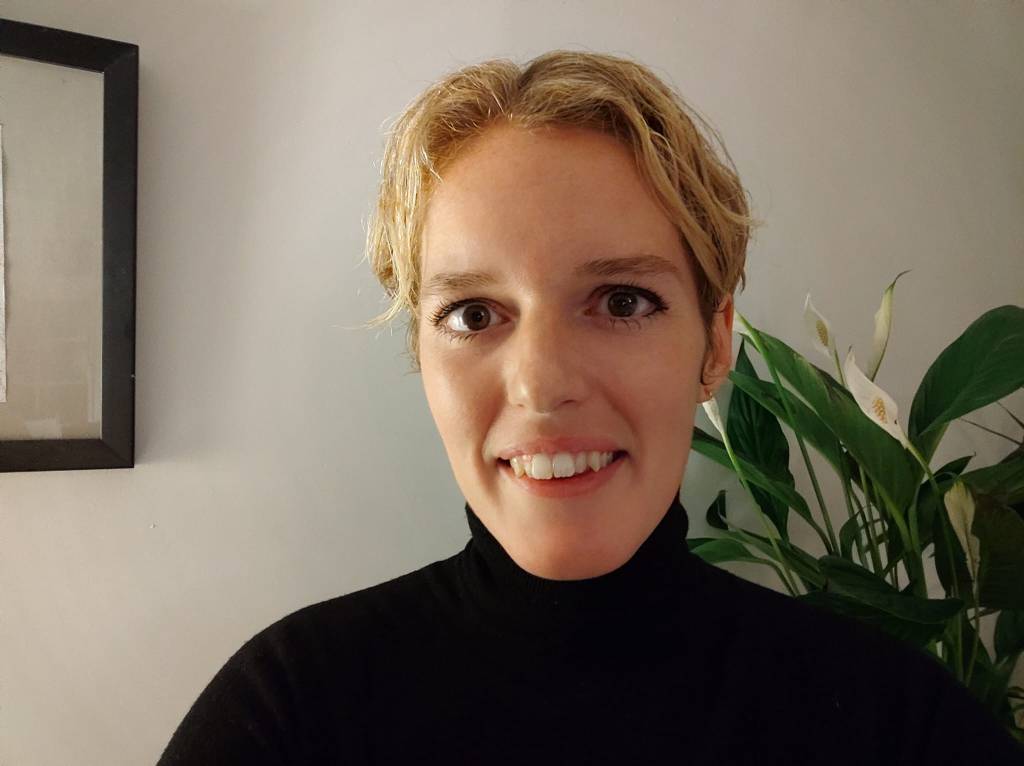
Alexia Cambon – Director at Microsoft’s Office of Applied Research and a keen runner
On children, she is warier than Susskind, and closer to my view. Young people are “still developing themselves as humans”, she said, and a technology that simulates human speech and reasoning, “always on, always accessible” and in some cases “highly sycophantic”, needs introducing with care, at the right age. She also expects AI proficiency to be among the most important skills for employment, so curricula will have to change; the aim is a thought partner rather than somewhere to offload thinking.
Then she drew a distinction every parent should borrow. Learnt experience, anything you could once acquire from a book, AI now supplies. Lived experience it cannot. Alexia has a neurodivergent sister, and learnt young how to head off conflict so as not to upset her. That is “a skill that has not come from my university training or my degrees”, she said. “It has come from my own personal life.” Taste starts there too. The basics tell you something is wrong; lived experience tells you why it matters.
If AI hands a room to its most confident voice, it matters who has been talked over already. Nick Isles, director of the Centre for Policy Research on Men and Boys (CPRMB), founded it after one of his four daughters told him men were “a bit rubbish” and there were no decent ones left to date. He asked young men what they thought of themselves. They agreed with her.
The CPRMB’s Missing Men 2026 scorecard, published in August, shows boys in the UK falling behind from the start. In England, 61.6% of boys reach a “good level of development” by five, against 75.3% of girls; for boys on free school meals, the figure is 43.5%. In the last academic year, 1,276 boys were permanently excluded from primary school, which the report reckons is 42 full classes, all gone before the age of 12.
“We created, in the state system particularly, an exam factory,” Nick told me. By 11 or 12, he said, too many have given up and decided they are failures. In 1983, the American psychologist Howard Gardner identified seven types of intelligence (linguistic, logical/mathematical, spatial, bodily-kinaesthetic, musical, interpersonal, and intrapersonal), later adding an eighth (naturalist). “We only test two,” Nick said. Few men are around to spot a boy slipping. Roughly two per cent of the UK’s early years workforce is male, according to Nick, and new male entrants to teaching in England fell from 5,676 in 2019/20 to 4,227 in 2024/25, even as teaching vacancies on Adzuna rose 11.9% in the year to July. He blames safeguarding: after a handful of appalling cases, a risk-averse system began filtering out good men with the bad. “There’s a bias in the selection process,” he said, “which doesn’t need to exist.”
Ask him to look 10 years ahead, and it darkens further. Something is filling the space that school and work are leaving. “The attention economy feeds the grifter economy,” he said, borrowing the analysis of Reset Tech. The algorithm finds what a young man fears most and sells him a materialistic, nihilistic version of manhood, so that it can sell him something else. A teenage boy browsing fitness content will be steered to manosphere material and misogyny within 12 minutes, Nick says. “They’re not seeking this,” he told me.
Susskind’s point about identity, followed to its end, arrives here. Work, Nick said, is “the main way in which, as adults, we act upon the world, and say what we are”. Take it away and “desperation leads to grievance. Grievance leads to adoption of extreme views.” His verdict, delivered flatly:
“We’re already on that road. It’s already happening.”
So what jobs are going to be left? “They’re going to be high-touch jobs,” he said: trades, care and teaching. “Most people would rather be cared for by another human being.” He attaches a condition. Those jobs grow “if we get AI right, you can transfer resources into paying for this stuff effectively. It’s a big if.” The same Adzuna figures show how big: healthcare and nursing vacancies fell 30.6% in the year to July. Care is hard to automate. It is also easy to underfund.
Hence This Boy Cares, the CPRMB campaign pushing boys towards health, education, administration and care with the seriousness we rightly brought to steering girls into engineering a generation ago. It is building role models and research, and Nick wants government careers advertising behind it. “This is non-zero-sum thinking,” he said. “We can care for our girls and our boys.”
Lynda Gratton widens the lens to all of us. The London Business School professor, whose Living the 100-Year Life was published the same day as Susskind’s book, argues that longer lives turn a career into something you weave rather than climb. “The 100-year life is no longer a distant idea. It is already unfolding,” she writes. She turned down a publisher who wanted 15 years of predictions. Instead, she offers eight threads (mastery, friendship, calm, intimacy, adventure, cooperation, knowing, and amplification) whose strengthening and reweaving, she argues, shape our health and sense of purpose across a century.
Her message applies in middle age as much as at 12: work hard, and work smarter. Next month I run the Amsterdam Marathon, my first in eight years, alongside nine other dads from a running group I started in lockdown. In Gratton’s terms, that is adventure and friendship.
None of these people will hand you a list of safe skills, and anyone selling one is repeating Gove’s 2013 failed bet. Between them, though, they point to six things any parent or employer can start this term to prepare children better for work.
- Basics before bots. Whole books and times tables are where critical thinking begins. Keep AI for secondary school, and run Cockcroft’s rule at home: calculator paper or non-calculator paper, and for the second, the laptop goes downstairs.
- Fill the diary with other people and hobbies. Freddie’s new secondary-school headmaster told parents on day one that grades alone would not be enough, and Freddie has pleasingly embraced sport, drama, music and art. Five-a-side, choirs, scouts and drama clubs are where they learn collaboration.
- Offer them a first rung. “A week can literally open up a young person’s eyes,” Nick said of work experience. Push for a Saturday job. And if you run an organisation, offer a shadow day before Christmas to a teenager from outside your own network. That takes courage on both sides.
- Ask which problem they want to solve. Susskind warns that anyone choosing law because of Suits, or medicine because of House, will be disappointed, because those jobs are changing fast. Improving health and widening access to justice won’t go away. Curiosity about a problem, however, outlasts ambition for a title.
- Make care an ambition for boys, too. If your son wants to be a nurse or a nursery teacher, treat it as the demanding, skilled work it is, and say so where his friends can hear. That is compassion in action.
- Protect one conversation at a time. Gloria Mark’s 47 seconds is an adult figure, and children learn their habits from us. Alexia guards her attention by running (snap!), which gives her “the ability to not be available”. Keeping phones off the dinner table is where communication, the listening half of it, is practised.
Look back at those six tips, and you will find half a dozen of the seven Cs: critical thinking, collaboration, courage, curiosity, compassion and communication. The seventh, creativity, is where AI makes its boldest claims, and October’s edition will test them. None of the six depends on predicting anything, which matters, because much of what I saw and heard this month suggests we are already behind, in classrooms and boardrooms alike. Here is how September looked from where I sat …
The present

Image created using Claude
It began with a report card. On September 8, the OECD published its PISA 2025 results, drawn from more than 760,000 pupils in 91 countries. Across the OECD, reading scores have fallen 28 points since 2015, which the report equates to more than a year of learning, and one in five 15-year-olds now sits below the baseline in all three of reading, maths and science, up from 16% in 2022. The share of what the OECD calls “hasty readers”, who skim a text and give a quick wrong answer, has nearly doubled since 2018. The slide began years before most of us would have guessed “LLM” stood for anything other than a law degree.
Two findings matter most for this edition. Pupils who used AI for specific schoolwork tasks scored lower in science than those who did not, unless heavy use came with proper teaching in AI literacy, and the OECD warns that such teaching is concentrated among advantaged pupils, “risking a growing AI divide”. And in almost every country, pupils reported less support from their families than in 2022, with boys and disadvantaged children singled out. Nick would not be surprised. Andreas Schleicher, the OECD’s director for education and skills, framed the stakes: “If we get this right, AI becomes a scaffold, not a crutch.”
Britain is a bright spot. UK science rose 12 points to 511, and the UK sits in the top 10 across all three subjects, alongside Estonia, Japan, Korea and Singapore. British schools, then, are holding their own. The worry is global: the skills the OECD sees falling fastest, evaluating information and connecting sources, are the ones this edition says our children will need most.
September 15 began at breakfast with Cameron Adams, co-founder of Canva, at the company’s London campus, and ended at the RSA. (Cameron’s thinking on AI and taste will anchor October’s edition, on creativity.)
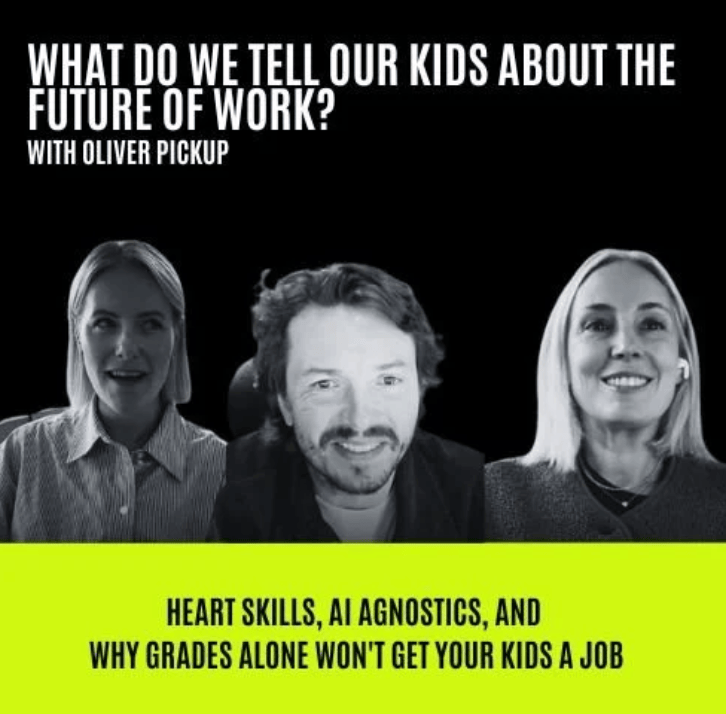
Three days later I recorded the season opener of Work is Weird Now with its hosts, Alice Phillips and Danielle Emery. It went live on September 23, which happened to be Freddie’s 12th birthday. I offered a metaphor about leaders gazing at their garden and telling themselves it looks fine, while sowing nothing for the next 10 years. A garden does not die the day you notice it is barren. It has been dying for a while. Time to water it.
Yesterday’s Zellis webinar – alongside Nour from Microsoft and Steve Elcock, Zellis’s director of product AI (whom I featured in the newsletter earlier this year) – pulled the month together. On September 9, Zellis published my interview about the “worklife squeeze”: a three-car pile-up of flat budgets, unfillable vacancies, and the biggest technological shift since the Industrial Revolution.
I opened the webinar by saying I want humans to be the carpenter, not the nail at the other end of the hammer, which is another way of putting the Turing trap: building AI to imitate what we’re already good at, rather than to cover what we’re not.
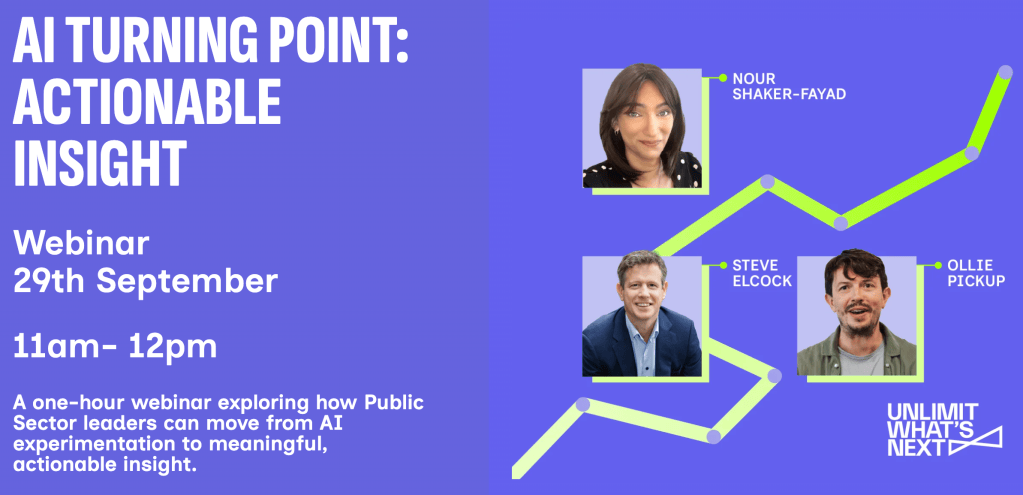
Nour’s illustration of that distinction wasn’t about technology at all. Her partner is a medical regulatory writer with a PhD in chemical biology, distilling clinical studies into documentation for pharmaceutical regulators. A client told Nour he wanted agents that would make the job obsolete. “That’s not going to happen any time soon,” she told him, “simply because AI doesn’t know what it doesn’t know.” Judging how a drug behaves in the world takes more context than side effects and interactions, and that context is exactly what basics and lived experience, to echo Alexia’s point, are for.
Steve explained why AI agnosticism is harder in practice than in principle. Airport baggage screeners, he said, have fake weapons inserted into their X-ray feeds at random, because they grow so used to the job that they stop looking properly. “We’re getting more and more trusting of this stuff,” he said, “precisely because it’s so good at imitating.” Organisations will need to plant their own friction.
My contribution was the example that shows the other side of the squeeze. In 2021 Ingka Group, IKEA’s largest franchisee, launched a chatbot called Billie, named after the Billy bookcase, which went on to handle 47% of customer queries to its call centres. Instead of cutting staff, it trained 8,500 call-centre workers as remote interior design advisers. That channel brought in €1.3 billion in the 2022 financial year, 3.3% of sales, and Ingka wants it at 10% by 2028. Retrain rather than remove, and a productivity story becomes a capacity story.
I also raised young researcher Jacob Coxon’s departure from Anthropic, and the talk it prompted of a 10% probability of doom (p(doom)) within a decade. At the RSA, Susskind had called attaching a number to that “absurd”, while insisting “it’s not zero”. Fine. Then track a second number with the same zeal: the probability of flourishing, p(flourishing). Leaders measure what they fear. They should measure what they want, too.
That argument goes into a classroom in November, as I’ve just been booked to speak at a school about using AI without fearing or worshipping it. I would like to do more of this, in schools, on stages, and in boardrooms. Contact me at oliver@pickup.media if you or your organisation would benefit from my insights.
Technology can buy us time, if someone decides it should. A century ago last Friday, an American carmaker did more than most to give us the weekend …
The past
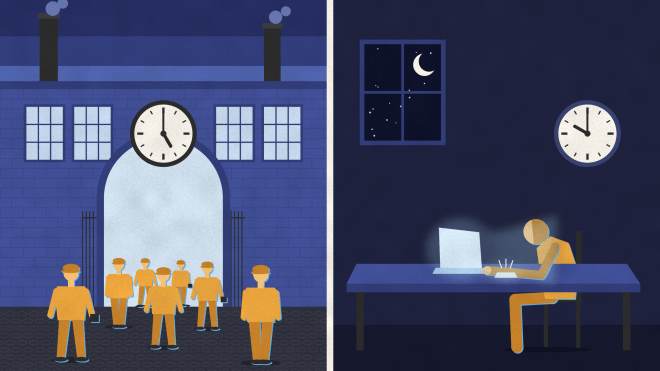
Image created using Claude
On September 25, 1926, Henry Ford announced to the world that the five-day, 40-hour week his factories had adopted that May was there to stay. “It is high time to rid ourselves of the notion that leisure for workmen is either ‘lost time’ or a class privilege,” he said. Ford was no philanthropist. By his own admission, he expected more effort in fewer hours. But he capped the hours, and manufacturers across America, then the world, followed his lead.
Four years later, John Maynard Keynes looked a century ahead. In Economic Possibilities for our Grandchildren, published in 1930, he predicted that living standards would be four to eight times higher by 2030, and that the work left over could be spread so thinly that “three-hour shifts or a 15-hour week may put off the problem for a great while”. He was right about the wealth and wrong about the leisure. With four years to go, nobody expects a 15-hour week. The same essay warned of “a new disease” that readers would hear “a great deal” about: technological unemployment.
Keynes’s miss had already been explained, by an economist who died before he was born. In The Coal Question, published in 1865, William Stanley Jevons argued that more efficient steam engines would not save Britain’s coal. Efficiency makes a resource cheaper to use, so we find more uses for it, and consumption rises. Jevons died in August 1882, aged 46; Keynes was born in June 1883, 10 months later. Half a century later, Keynes assumed productivity gains would be banked as leisure and walked into the paradox Jevons described.
It is happening again, with knowledge in place of coal. Aruna Ranganathan and Maggie Ye of Berkeley’s Haas School of Business spent eight months inside a US technology company, and reported in Harvard Business Review in February that generative AI intensified work rather than reducing it. Staff took on more, quicker. Work seeped into evenings and breaks, often without anyone asking. Right now, it feels like we are hamsters running faster on the wheel. Ford drew a line on hours. For AI, nobody has.
Ford’s lesson is that he took a bold stance: he decided rather than predicted. And he gave his staff the whole weekend, partly out of care and partly out of capitalist smarts: rested workers would work harder on Monday morning.
Which brings me to Saturday jobs. Nick Isles’s early work ranged from gardening for an elderly neighbour his mother found for him to a bookshop he loved. The strangest was playing the Pink Panther on the seafront at Great Yarmouth for a family photography business. “Probably the worst job I’ve ever done,” he told me. “At least I didn’t have to work with the monkeys.” His point was serious. A Saturday job, however absurd, puts a teenager among adults from outside their own world, and too many boys now look for that company online.
Mine were similarly unglamorous. At 15 I worked in a cafe in Macclesfield, where I learnt that most of a service job is talking to people properly, and picked up the mechanics of running a business. At 18, before travelling in South America, I was a theatre porter at a hospital in south Manchester; on my first shift I was locked in the morgue, whether by accident or initiation, I’m still unsure. University holidays brought bar work and a stretch in a wood-chip factory. None of it looked like a career. All of it taught me how to read a room, and how to be useful to people who owed me nothing.
Nobody handed me a map, and nobody will hand Freddie or Darcey one. So I have drawn my own line. In a couple of years, my eldest will be old enough for a Saturday job, and I hope it is a slightly absurd one.
Statistics of the month
😰 FOBO hits a record
A record 27% of US workers fear technology could make their jobs obsolete, up seven points in a year and double the 13% Gallup found in 2017. It is now the biggest job worry among workers under 45: 34% of them share it, against 19% of those older. (Gallup)
🐹 A faster hamster wheel
Some 86% of UK employees now use AI at work, and 57% say it has raised how much they are expected to do in a day. Almost three in 10 (29%) are “ghost working”, pushing tasks into the night to free up their days. Jevons would recognise the pattern. (Owl Labs)
🪜 A shaky first rung
Only one in five UK employers (20%) plans to recruit more 18 to 24-year-olds over the next year, while 26% expect to hire fewer people overall because of the costs they anticipate from the Employment Rights Act. Those planning to hire more young people most often cite a future talent pipeline and access to digital skills (40% each). (CIPD)
🧭 Encouraged, but not told why
More than four in five employees (85%) say their organisation actively encourages them to experiment with AI, yet 42% do not know why they should be using it, according to Culture Amp’s survey of around 112,000 employees. Awareness of internal career opportunities has fallen 10 percentage points since July 2025, the biggest single-year change in its engagement data. (Culture Amp)
🎙️ Talk, don’t type
Almost a quarter (24%) of Gen Z send voice notes several times a day, against 13% of Millennials and 5% of Gen X, according to Twilio’s survey of 2,000 UK adults. At work, 43% prefer speaking to typing when they need to communicate something quickly. Voice is back; listening is the harder part. (Twilio)
If you’re reading this, thank you. If you haven’t subscribed yet, you can sign up for Go Flux Yourself (there should be a pop-up). Please feel free to share it with friends and colleagues too, especially any with children wondering what comes next. Each edition lands on the last day of the month.
If anything in this edition struck a chord, particularly the vanishing first rung, or the question of what your organisation could offer a teenager before Christmas, I’d like to hear from you. Tell me about the shadow days and Saturday jobs you’re offering, or the ones you wish someone had offered you, and I’ll share the best in a future edition.
I’m always keen to help a team or a leader think through their own version of the problem, or simply to tell their story properly, whether in a boardroom or a classroom. Please drop me a line: oliver@pickup.media.


