Go Flux Yourself No. 34 · Navigating Human-Work Evolution
Generative AI has made competent creative work almost free. Great work still depends on taste, which grows slowly, through history, the basics and other people, just as the shortcuts make slowness optional.
TL;DR October’s Go Flux Yourself scrutinises AI’s boldest claim: that it can be creative. Machines now turn out good work for almost nothing, and the taste that turns good into great is still learnt the old-fashioned way – but is this being lost as we take shortcuts?
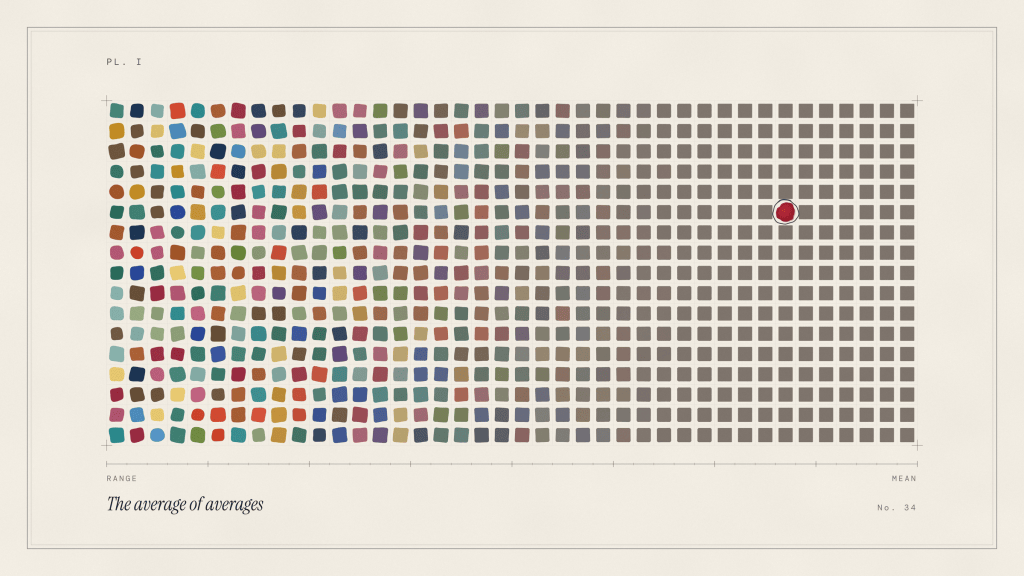
Image created using Claude
The Future
“If someone wants to say ‘the arts don’t matter’, I can feel my fist tightening. It’s entirely what it is to be human. It’s entirely what it is to be compassionate … There must be the imagination to take a risk, to take another path … Out of discussion can suddenly come hope and ambition or an answer to something. All humans have imagination … Look at what we’ve done, and just imagine what we can [do].”
Dame Judi Dench, in The Case for Human Imagination, shown at the Royal Society of Arts, London, September 15
Are we outsourcing the joy of making art, in all its forms, to artificial intelligence? The designer and illustrator Pablo Stanley thinks so. “We’re on the sidelines looking at the robot surf and saying, ‘No, you’re doing the surfing wrong’, but the robot is doing the surfing,” he said last year on Prompted, the podcast hosted by Canva’s co-founder, Cam Adams, whom I spoke with recently. “It’s the fun part, you know?”
Every art form seems to be in the same pickle when it comes to creativity’s present and future. The case for embracing AI in the creative process is real: it expands what is possible and lowers the barrier to entry for anyone with an idea and no training. But if anyone can make anything, what happens to taste, and to the culture we share?
Taste has to be learnt, acquired over time, Stanley says, and “it’s a skill that comes with privilege too”. I agree, and take him to mean exposure: years of looking and listening, music lessons, trips to galleries and a home where people argue about books and music. That access is unevenly shared. In England, 95% of adults in the least deprived areas engaged with the arts in person in 2024/25, against 81% in the most deprived, according to the government’s Participation Survey. Cheaper tools won’t close that gap, any more than a Stratocaster in every bedroom would give us another Nile Rodgers.
I think there’s a yearning for human purity, too. Henry Coutinho-Mason, the futurist author and speaker whose Future Words, written with Rohit Bhargava, is published on November 10, compares it to buying craft beer at a farmers’ market rather than a pint of Heineken. “You’re paying for the flaws,” he told me. “You’re paying for the authenticity of someone who’s made that, and every batch is a bit different.”
This month’s opening quotation belongs to national-treasure actor Dame Judi Dench, who turns 92 on December 9. It comes from The Case for Human Imagination, a short film the agency Baby Teeth cut from an unscripted conversation with her this spring. It relaunched the 272-year-old Royal Society of Arts, and it was shown before Daniel Susskind’s talk there on September 15, the evening that anchored September’s Go Flux Yourself.
Last month, I also promised to test AI’s claims about creativity, one of the seven Cs of heart skills I talk about (alongside collaboration, compassion, communication, courage, critical thinking and curiosity). The past few weeks have supplied plenty of material, and a verdict on where we are now: AI creativity is good, but human creativity can be great. The trouble is telling them apart.
On September 25, the Académie Goncourt removed Thélyson Orélien’s novel C’était ça ou mourir from its first selection, not unanimously. An anonymous account on X had posted AI-detector results, and plagiarism findings followed. Two days before the decision, the academy’s president said he had loved the novel and never suspected AI. Orélien denies using AI and says he began the book in 2017. His publisher, Boréal, is retracing how it was written.
Suspicion alone has cost other writers dearly this year. In March, Hachette cancelled the US publication of Mia Ballard’s horror novel Shy Girl and withdrew the UK edition (Ballard denies using AI). In late July, Jerry Falade’s agents pulled his debut crime novel from a $2m-plus deal with Minotaur after an editor raised doubts (he rejects the claim and has hired a lawyer). Literature looks the twitchiest of the arts, for a simple reason: prose is what chatbots produce most fluently, and anyone can paste a page into a detector and post the result. As the Financial Times put it in August: “The risk of false positives and the stigma of being accused are leading to societal mistrust in the written word.”
Perhaps film will take a different path. In February, at a CNN and Variety town hall in Austin, Matthew McConaughey, who won the Best Actor Oscar for Dallas Buyers Club in 2014, told a room of students that AI is “damn sure going to infiltrate our category”. Then he went further. “Does it become another category? Will we be, in five years, having ‘the best AI film’? ‘The best AI actor’? Maybe.”
Ten weeks later, the Academy of Motion Picture Arts and Sciences went the other way. From the March 2027 Oscars, AI tools are permitted, but only roles “demonstrably performed by humans with their consent” are eligible, and screenplays must be human-authored. Use the tools, honour the humans. Publishers could do with rules this clear.
Consent is McConaughey’s line, too. He has partnered with ElevenLabs on a synthetic version of his voice for a Spanish audio edition of his newsletter, and a month before the town hall he filed to trademark “alright, alright, alright” – his line from 1993 cult classic Dazed and Confused (one of my favourite films) – because, as he told the Wall Street Journal, he wants “consent and attribution the norm in an AI world”.
AI-made screen drama isn’t helping its own case. Last week, Grok Imagine posted the seven-minute first episode of Elon Musk’s AI Odyssey, his promised “historically accurate” answer to Christopher Nolan’s The Odyssey. In a one-star review, the Guardian’s Peter Bradshaw found every dramatic moment “as motiveless and meaningless as the movement of shapes on a laptop screensaver”.
Meanwhile, Castle Walls, made by the Turkish studio Ay Yapım and billed as “the first end-to-end AI-created series to premiere on a major streaming platform”, fared little better when Prime Video recently took it worldwide. Its characters look like “Vaseline-smeared Madame Tussauds creations slowly melting in the sun”, wrote Luke Buckmaster in the same newspaper, even though human writers and voice actors worked on it (Ay Yapım says the series “used AI to amplify” human skill). Judging by the reviews, both are what happens when a machine can generate anything, and nobody decides what to leave out. Taste, once more, and human editing are critical to create great art.
Bradshaw allowed the Odyssey one kind of merit, the financial sort: “In terms of quality, it is a pitiful fraction of the real thing, but a zillionth of a zillionth of a zillionth of the cost.”
And Buckmaster did concede that “the technology powering this is amazing and will profoundly alter the state of motion pictures”. The earliest films, he pointed out, at least offered “carnival-like wonder”, whereas these AI works “tend to evoke a more cynical response”. Viewers, he wrote, “understandably seem less interested in what the technology promises than in what it threatens to take away: art imbued with humanity”.
“Good but cheap, the baseline. For creatives, this is a challenge because great got harder.” – Alex Naghavi
Granted, generative AI does better with still images and words. Some of what it creates is decent, and Cam’s company sells the tools to make it. Canva, launched in Sydney in 2013, now has more than 250 million monthly users, and this spring it released Canva AI 2.0. At a breakfast for journalists at Canva’s London campus in mid-September, Cam, its chief product officer, described the catch. Ask ChatGPT for a spring fair flyer, he said, and you’ll get much the same design as everyone else, one that “gets pumped out 500,000 times a day”. AI, in his phrase, “gives you the average of averages”.
Filmmaker and creative director Alex Naghavi offered a smart summary of the challenge in a short keynote at Canva’s AI Vision event in Sydney in August. She admitted to “pretty much an existential crisis at least once a week”, yet she thinks we are in “this 21st-century Renaissance period”, with some artists “making some incredible work in spite of AI” and others “embracing AI and really unearthing new territory with new mediums”. The “positive tension between the two”, she argued, is “what’s going to raise the bar”.
Naghavi, who notably keeps AI away from concept ideation and art direction altogether, illustrated the core problem artists face: “With AI, the execution and the production of what we create is becoming really cheap. Good but cheap, the baseline. For creatives, this is a challenge because great got harder.”
At the Canva breakfast, I read Cam his own summary of Naghavi’s talk, “Good is cheap, and great is harder”, and asked how the next generation will develop taste if the tension is taken out of making things. “When something new is introduced, people swing hard towards it because it’s the bright, shiny new thing,” he said. In recent years, that has meant image generation. “We swung hard that way, and now everyone can do it … you’re not standing out any more. So increasingly we’re seeing the pendulum swing back the other way.”
The research backs the first half of Naghavi’s formula. In August, Sydney Sears and Deena Skolnick Weisberg of Villanova University published a study called Bot or not, in which 1,682 participants each read one short story, by a published author or by ChatGPT, under labels that were sometimes false. Readers rated the ChatGPT stories as more absorbing and higher in quality, yet a human label raised a story’s score regardless of who wrote it, which the authors call a bias against AI. Most couldn’t tell the two apart: shown one story of each, only 167 of 424 readers, fewer than four in 10, identified ChatGPT’s correctly.
Good, then, and plentiful. This is certainly the case in the music space. By June, Deezer was receiving about 90,000 AI-generated tracks a day, and in July the company said they made up more than half of its daily uploads. In April, by Deezer’s count, such music accounted for less than 3% of listening time, though the company also keeps fully AI-generated tracks out of its recommendations. On one streaming service, at least, machines now make most of the new music, and little of it is consumed.
The AI acts that did break through have struggled to hold on. Unmasking was free publicity at first, possibly driven by curiosity: The Velvet Sundown passed a million monthly Spotify listeners days after admitting, in July 2025, that it was “a synthetic music project”, and Sienna Rose, flagged by Deezer in January with 2.6 million, briefly neared four million. The curiosity didn’t last. By September, she was down to about 438,000, and both now carry Spotify’s new “AI Persona” badge, which keeps them out of its recommendations by default.
Alexia Cambon, a director in Microsoft’s Office of Applied Research who studies how people and AI work together, and featured in last month’s newsletter, has a theory about why the novelty wears off. We caught up at Microsoft’s Frontier Tour at ExCeL London in late October.
Alexia doesn’t doubt AI’s ability to create. “I think AI could produce a great song and a great book,” she told me. Her objection is that a machine has never been through anything. A self-described “massive Swiftie”, she associates “so many of her albums with particular periods of my life”, and her reaction is that Swift has been through it too. “That is just not something you’re ever going to get from AI, because by nature AI is not a human navigating the human experience. It can’t be. So your ability to feel seen by an AI song, I think, is just not there.”
Part of the pull, I suggested, is following an artist over the years and connecting with them through what they go through. “Oh yeah, massively,” she said. Their records end up as the soundtrack to chapters of our own lives: for instance, she can still say exactly where she was when Midnights came out in October 2022.
“Your ability to feel seen by an AI song, I think, is just not there.” – Alexia Cambon
In the same breath, Alexia tested her own theory: “The question is: if we didn’t know it was AI, would that be different?” Villanova University’s figures hint at an uncomfortable answer. AZFamily reported that the highest median ratings went to ChatGPT stories readers believed a person had written.
Maybe it’s the wine-label effect. In a small 2008 study by Stanford and Caltech researchers, volunteers said the same Cabernet tasted better when told it cost $90 rather than $10. A human byline works the same way on prose. That’s an incentive to pass off machine writing as your own, and it’s why anonymous accounts on X have taken to running prize contenders through AI detectors.
When a detector flagged Jamir Nazir’s short story in May, the Commonwealth Foundation examined his drafts, timestamped files, notes and outlines, without using detection software, before naming him the overall winner of its prize at the end of June, from 7,806 entries.
Even so, Granta, which has published the prize’s winning stories, says it won’t do it any more. “At this stage there is really no way of determining whether a piece is authentic or not,” its publisher, Sigrid Rausing, told the FT. I’d take the paper trail over an algorithm’s guess every time, and judges and publishers should ask for it first.
Henry is certain human craft will win out. “Really interesting human creativity will stand out more, and I 100% believe it,” he told me. “I think humans are incredibly finely attuned to perceiving very, very subtle signals of value and effort.” The reverse holds too, he argues. “The minute you realise that it’s AI-generated, you just devalue it. I don’t see that ever changing.”
He pointed to Apple. Its Apple TV ident “could have been generated”, he said, but the London agency MAL built it from real glass and shot it in camera, in a production AdAge called “weeks-long”. Future Words has a word for it, “effortlux”, which Henry glossed for me as “the status derived from doing something the hard way”.
Democratising design has always been Canva’s pitch: before it, Cam told me, design was a workflow “which probably only 1% of the world could do”. AI stretches the same promise to music and fiction, and it splits the voices I most trust on the subject.
Alexia is broadly for it. “Think about all the amazing storytellers who are terrible writers,” she said. “I think about the people who have amazing songs in their head but never had the privilege of being able to pick up an instrument. Do we want to exclude them from the world of creativity because they used a tool to get there?” She expects “a market for both”, with one caveat: “No one’s going to read a 400-page book that’s AI slop.”
When I put it to Henry that AI lowering the barrier for someone with dyslexia deserves applause, he agreed, then added: “But I do think it’s really dangerous.” His worry is whose voice survives. “I think people are becoming much more tolerant of rough edges, and indeed almost embracing them, because I want to know that it’s your thoughts,” he said. “I’d rather have broken English or spelling mistakes but feel I’ve got your unvarnished thoughts.”
Henry continued: “I don’t actually care where the words come from, but I do care where the thinking has come from.” And, borrowing late American historian and author David McCullough, he added: “I really do believe that writing is thinking.”
Zac Engler sits between Henry and Alexia, and has an album to show for it. The Minneapolis-based futurist and AI strategist, chief AI officer at C4 Technical Services, featured in last December’s Go Flux Yourself, when his book, Turning On Machines, had just come out. He is also a trained musician with a degree in classical guitar performance, and he spent several years in a Metallica tribute band.
“If you get out a handsaw or a Skilsaw, there’s really no difference. They both cut the wood.” – Zac Engler
He made the book’s soundtrack, a concept album built mainly with Suno, the AI music generator, singing the melodies himself so the AI voices would copy them. “I spent two months on that album, going back and forth every night, trying to get the exact tones and melodies and flow of the music,” he told me. “Sometimes it was brutal.”
Zac, who helped build his parents’ timber-frame house as a boy, draws his line in woodworking terms. “If you get out a handsaw or a Skilsaw, there’s really no difference. They both cut the wood.” Asking an AI to “write some songs or music ideas for me” is another matter: “it takes you one step away from the creative process”, unless all you want is “a really cool song”. He knew which he desired. “I just wanted an epic soundtrack to my book,” he said. “I was totally fine with the fact that it was AI-generated, because I was able to pull the strings and prompt the machine.”
His question for every creator echoes Stanley’s robot surfer: “Are you the woodworker who wants to chisel away, or are you OK if another person or another robot came in and just did the stuff for you, because you just want a cool house?” It’s the carpenter-and-nail question I ask on stages, put by someone who has actually built a house: I want people to be carpenters, not nails at the other end of the hammer when it comes to AI.
The music industry can’t agree where Zac’s album belongs. TuneCore, whose parent company stopped distributing tracks made on what it calls “pirate studios” in April, took “close to $300” of his money up front, he says, then rejected the album as “AI-generated content”, banned him for life, and still hasn’t delivered a refund. Meanwhile, DistroKid, which asks uploaders to disclose AI use, took it. His summary of its approach: “Hey, do you own the rights? Great, let’s go.”
His test is intent. “If you want to make a pop song or an incredibly articulate song, slop or something poignant, you have to have intent,” he said. Reputation counts too. “I splash some paint on a canvas and call it Democracy, and now everybody has an opinion. If Banksy does it, everybody’s like, ‘Whoa, that’s amazing!’”
I side with Alexia, mostly. More people making things is good news, and I’d rather live with too many songs than too few. As a hobbyist DJ, I’d run Henry’s rule the other way: when songs become abundant, good taste becomes scarce. Reading a room and knowing what to play next is taste at work. But democratised making will create a new kind of culture, personalised to the point of privacy.
A culture of one depends on something no model supplies: the judgement to know when the output is good, and when to stop. Asked by The Rundown in April which design task AI will never do better than a human, Cam said deciding not to do something. AI-filmmakers, and other creatives, take note.
AI abundance, however, has a practical cost. In a Guardian column earlier this month, Gaby Hinsliff argued that AI is clogging public services (“gumming it up”, in her phrase), partly because the public is using it right back. “Shortcuts stop being shortcuts once everyone else is using them too,” she wrote. Her best example is the car: “By 2018, central London daytime traffic was moving on average at just over 7mph – about the same speed as a trotting pony.”
In creative work, the bottleneck is attention. Alexia sees it in Microsoft’s own data. “Based on all the stats we see in Microsoft’s metadata, we’re out of control,” she said. “We’re in far too many meetings. We read far too many emails.” She asks every new member of her team when they last had a great idea, and the answers keep coming back to moments of mental rest. “I think there’s something magical and mystical about where ideas come from in humans. I actually like the fact that we don’t know where or when they might come from.”
Art needs that rest at both ends, in the making and in the taking in. A worthwhile piece takes long, uninterrupted stretches to make, and a novel or a 40-minute album needs the same to be absorbed properly, ideally with your phone in another room. Hinsliff thinks we could eventually work out “what kind of frictions we need to put back in the system”. For anyone who wants to make or appreciate art, the first friction worth putting back is a closed door.
“Shortcuts stop being shortcuts once everyone else is using them too.” – Gaby Hinsliff
Taste, then, has become the scarce skill, and it has to be learnt. I can see three ways to do it. None of them is quick.
- History. You can only spot the average of averages if you know the range. AI music “will only ever be a melange of the past”, my friend Daniel “Cess” Orcese told me (more on him below). “By its very nature, it can’t be novel because it is always the sum of all the past.” The sum of everything recorded so far, he conceded, “is quite a spectacular thing, but it’s only ever looking back”. People who know the originals hear the borrowing first.
- The basics. As last month’s edition argued, basics come before bots. Cam told me he teaches his children “the fundamentals”, and encourages them “to pick up a pencil and sketch something, then maybe take it into technology”. The aim, he said, is that “if you do ask AI for something, you know whether what it comes back with is good”. The novelists Alexia has asked about AI all say the same thing: “I never use it on the first draft.” Henry goes further. “If you haven’t sweated blood and tears over it, you don’t repeat it enough,” he said. “It’s not burned on your brain and on your thinking.”
- Other people. Taste is social, and this is where a personalised culture worries me most. Alexia’s hunch is that “most productive friction comes from humans”, because “AI is not very good at pushing back on your ideas unless you prompt it to play devil’s advocate”. A chatbot is typically tuned to please and will rarely tell you that your chorus is weak. A trusted friend will.
Cess, renowned locally for his sagacity, offered this advice: “You don’t tell your kids what to do. You show them how to do it,” he said. “If they’re in an environment where people are singing, writing poetry, and talking about paintings, they will just do that because it won’t be a strange thing.”
He was recently at a 50th birthday bash in Ireland, where “everyone had a set of songs that they would sing in public, together”. Nobody else knows the words to a song generated for one listener.
The present
Image created using Claude
My October ended, appropriately, with listening to records in an intimate setting alongside close friends – proper human connection, with our heartbeats synchronising. I sat in the awesome OJAS listening room at 180 Studios, off the Strand, for 90-ish minutes while Colleen “Cosmo” Murphy treated about 30 of us to her history of psychedelic music through hand-built horn speakers and valve amplifiers made by Devon Turnbull, the Brooklyn designer and audio engineer behind OJAS.
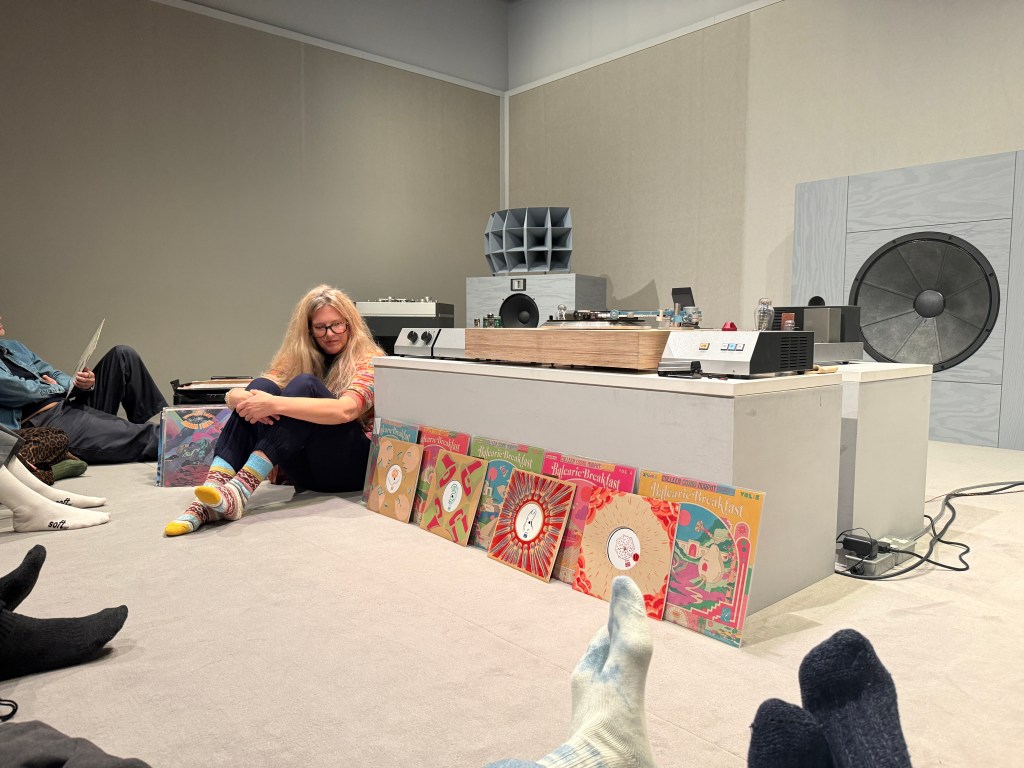
Coleen “Cosmo” Murphy talks through her psychedelic music
On the train home, Nick Scott, Cess and I tried to make sense of AI and creativity. Nick and I host shows on Love Will Save The Day FM (he is DJ Mum and Dad; I am Boat Floaters), and we’ve played vinyl-only Soulful Disco nights at south-east London parties. Cess has been a musician for years and, latterly, a poet. If you want to know where music obsessives stand on AI right now, our conversation is a fair sample. Conclusion: it’s complex.
Nick began with photography. On analogue film, “you’re really careful with those 36 shots”; with digital, “you’ll take 10 of the same thing, and then spend hours trying to decide which one’s best”. In the old days, he said, “it was a technological restriction”, and that restriction drove creativity. “It’s mimicry,” he said of AI music. “It’s very convincing, and may even be enjoyable.” What it won’t do is decide to “randomly insert electric guitar into this otherwise hip hop track” – unless prompted to do so.
Cess was less sentimental about the old days. Albums run to 30 or 40 minutes, he pointed out, because “that was the technology you had at the time”. He continued: “The technology dictated the format, which created the art form.” From sheet music and Tin Pan Alley to the seven-inch single, “the unit of creativity was the song”, and he reckons the album reigned for only 20 or 25 years. “You could consider the album is actually an aberration.”
If Cess is right that technology dictates the format, generative AI’s format is the prompt. It already makes it easy to ape a Katy Perry or Taylor Swift song, and plenty of people are happy to listen. Next, I suggested, the reader or listener will write the thing while consuming it, A/B testing each twist until it pleases an audience of one: “prompt your adventure”, after the old choose-your-own-adventure books. Nick liked the phrase. I’m less sure I’ll like the culture it describes.
If there is now no limit to the length of a piece of music, or the size of an artwork, what then becomes tasteful? Does something made 30, 40 or 50 years ago become even more precious? And is that because of our age, as a trio of middle-aged men? We hadn’t settled it by the time Cess set off to walk down the hill.
Two days later, after reading a draft of this edition, Cess sent me a voice note. His subject was recording on tape, a system he was “very lucky to use” in his friend Marco’s studio. On a four-track machine, “you have to make decisions quite quickly”, committing early to the tracks you keep. Digital recording allows “unlimited tracks … six of this backing vocal, six of that”, and with it the risk that “you never sort of commit because you can go endless”. Forcing the choice early “speeds the process up. But you have to trust your judgement.” Wipe a track by recording over it, and “that’s it. It’s gone.”
The flaws stay in, too. Quite often, he said, you have “the people in the room”, the way Blue Note would have recorded its jazz sessions, and “living with the imperfections is part of the process and part of the joy of it, I suppose”. The imperfection this edition keeps returning to is, in his words, “kind of priced into the whole process”. The alternative is “this search for perfection that you can endlessly try and look for, but can end up quite soulless”. A prompt never runs out of tape.
The corporate version of the same argument ran through two big events this month. At Gartner’s HR Symposium in London on October 6, the opening keynote was titled Productivity Isn’t the Prize. CV Viverito, a Gartner senior director analyst, described an employee who uses AI to turn a three-hour Monday task into one hour, then fills the two hours saved with email. “So by Friday, those hours gained are nowhere to be found,” she said. “AI created the capacity, yes, but as an organisation, we never decided what to do with it.”
“People aren’t using AI judiciously. We’re taking the Lamborghini to the mailbox. You don’t want to be using the fine china for everything.” – Kaelyn Lowmaster, a Gartner director analyst
One standout stat: Gartner predicts that by 2029, 30% of employees laid off because AI replaced them will be rehired, often at significantly higher cost. Viverito’s verdict on AI-driven layoffs was: “You will not shrink your way to growth.”
The AI bills are rising, too. “I hate to break it to you, but AI will never be as cheap as it is today,” Viverito told the audience. Gartner says agentic models need between five and 30 times more tokens per task than a standard chatbot, and it expects overall inference bills to rise even as the price of each token falls.
Kaelyn Lowmaster, a Gartner director analyst, put the waste more colourfully when I interviewed her later that day: “People aren’t judicious about using AI. We’re taking the Lamborghini to the mailbox. You don’t want to be using the fine china for everything.”
David Hsu, chief executive of the San Francisco software company Retool, found that out the expensive way. A colleague used AI to schedule out-of-office email replies, “and it was costing the company $10,000 a day”. The tool was processing millions of tokens a day.
Later in the month, Microsoft brought its Frontier Tour to ExCeL – and it was all about an agentic AI future. During Satya Nadella’s keynote, Faye Abugo, a senior product marketing manager for Copilot, introduced Puck, her AI autopilot, which “even has its own place in our org chart”. Darren Hardman, chief executive of Microsoft UK and Ireland, then presented research showing that four in five UK business leaders believe Britain can become a world-leading AI economy within five years, against two in five employees. “We need to close the gap,” he said, “because we will not bend the curve unless people can see a place for themselves in what comes next.”
This last Monday, Microsoft was in the news after offering voluntary buyouts to about 60,000 employees in the US, Canada, the UK and India, roughly 27% of its 223,000-strong workforce. Its chief people officer, Amy Coleman, called the offer “a new choice to make that transition now with support”. Microsoft hasn’t said AI will do the work of those who leave. It is, though, spending heavily on data centres and AI infrastructure while investors watch its operating costs.
I’ve written and spoken for months about the vanishing first rung: entry-level work disappearing before young people can reach it. Buyouts on this scale belong to the same story. Gartner’s survey of chief HR officers, published on October 6, found organisations hiring fewer entry-level staff while removing layers of middle management. Kaelyn warned that freezing junior hiring means “we’re effectively outsourcing the training of our early career employees to our competitors”. In football terms, that’s closing the academy and planning to buy everyone else’s graduates. Take out the juniors and the managers who would have taught them, and nobody is left to pass on the craft, taste included.
Henry told me too many businesses still see AI “through a very unimaginative lens, which is efficiency and automation, and essentially replacement”. Offering more than a quarter of a workforce the exit, five days after the company’s UK chief told ExCeL that people need to see a place for themselves, looks myopic to me.
Microsoft’s UK research, carried out by Censuswide in early October, found that 57% of employees who use AI at work already worry it will reduce opportunities for young people and new entrants. If Gartner is right, plenty of companies that shrink now will pay twice.
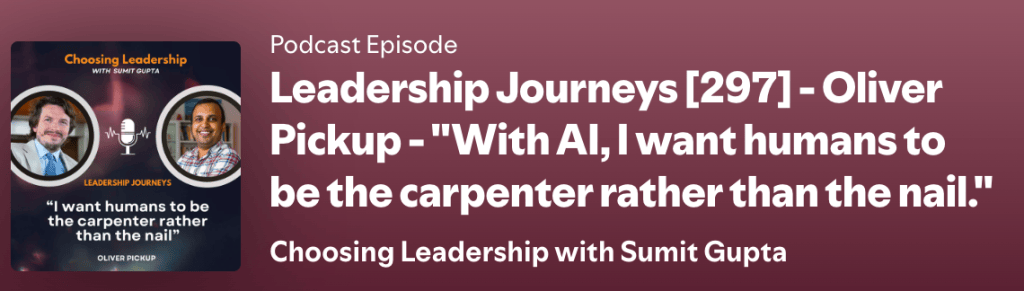
I made a similar case on Sumit Gupta’s Choosing Leadership podcast, in an episode launched in early October. Its title, “With AI, I want humans to be the carpenter rather than the nail”, is about as short as my position gets. We talked about FOBO, the fear of becoming obsolete that ChatGPT’s arrival gave me, and the three tribes we have at the moment: AI zealots, martyrs and agnostics. “Handing staff AI without vision or proper training,” I told Sumit, “is like giving a novice the keys to a Formula 1 car.” No wonder there are so many crashes.
Three days before the Frontier Tour, I ran a marathon. On October 18, I finished the Amsterdam Marathon in 3:16:25, a personal best of 32 minutes over the time I ran as a 26-year-old in 2008. Of my four marathons, it was the first I had trained for properly. Eleven of us from Crisis of Dads, the running group I founded in November 2021, entered. All 11 finished.

The last steps of 26.2 miles to complete the Amsterdam Marathon in the Olympic Stadium
The improvement came from the dull part: four months of long runs, often in the dark and the rain, starting at 7am on Sundays in a south-east London park. During my last marathon in London in 2018, after woeful preparation, I hit the wall and cried at the finish. Then I vowed never to put my body through it again. This time I held an even pace from the first mile to the last. I didn’t hit a wall, and the ugly sprint finish in the Olympic stadium was incredible.
Artists have a name for that slog: practice. It is messy, all binned sketches and rewritten drafts, and generative AI’s great promise is to let us skip it. On the Gartner media panel, Viverito put the objection in gym terms: “You think of it like going to the gym and bringing a robot to lift the weights for you: you’re not going to get any stronger.” Kaelyn went further. “Let the hard things be hard … the lifting of the weights isn’t the point. It’s the struggle to go through it.”
Which brings me to half-term, and a silk mill in a storm …
The past
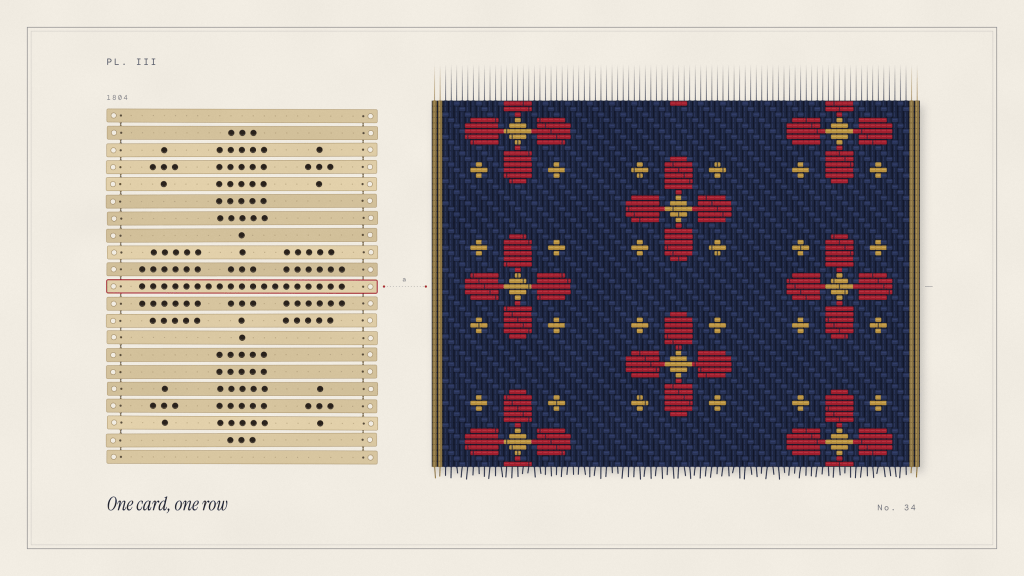
Image created using Claude
Half-term took Darcey, Freddie and me north, to my parents’ home in Cheshire. With the rain lashing down courtesy of Storm Austen, we sheltered in Macclesfield’s Silk Museum. It’s the town where I had my first Saturday job, at 15, in a café.
Macclesfield was once, in the museum’s own words, “the beating heart of the global silk trade”, with a 300-year story. Its Paradise Mill, built in 1860 and run by the tie makers Cartwright and Sheldon until it closed in 1981, still holds 26 restored Jacquard looms, which the museum bills as the world’s finest collection of historic Jacquard silk looms in their original setting.
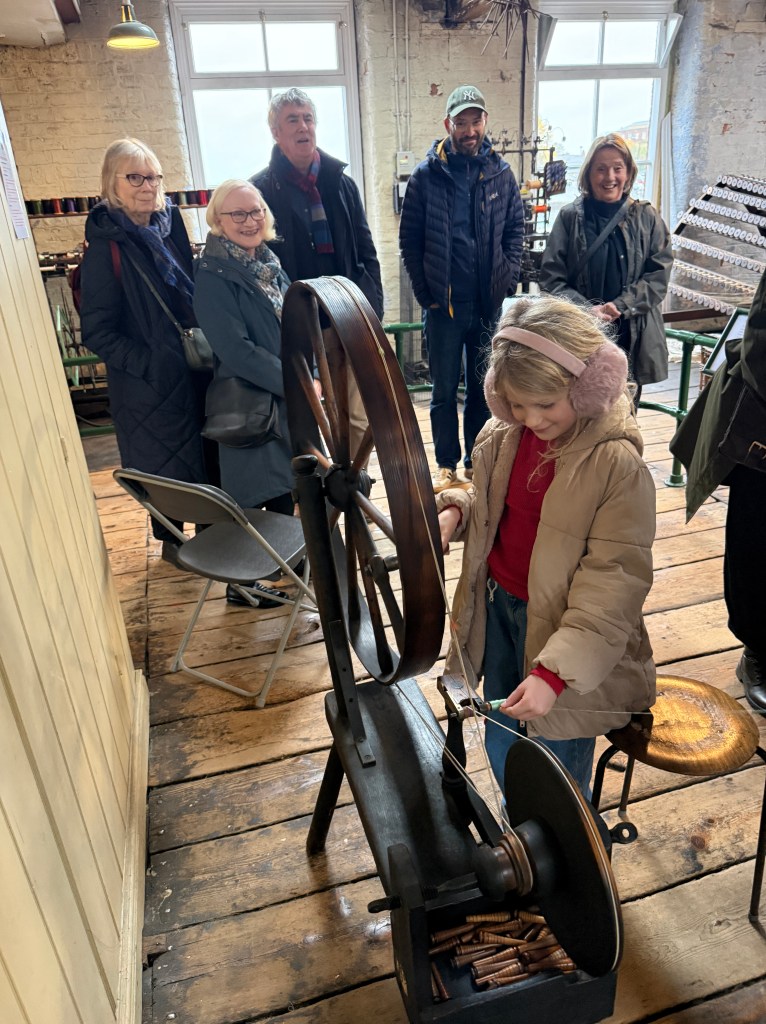
Darcey tries her hand at weaving at Macclesfield Silk Museum
Joseph Marie Jacquard unveiled his loom in 1804. Its trick was a chain of punched cards, one for each row of the pattern. Where a card had a hole, a rod passed through and lifted a warp thread; where it didn’t, the thread stayed down. That did away with the drawboy, the second pair of hands a weaver of figured silk had needed, and the drawboys, the Linda Hall Library notes, “were not happy”. They had good reason. By 1839, a weaver named Michel-Marie Carquillat could produce a silk portrait of Jacquard himself from some 24,000 cards.
In London, Charles Babbage planned to program his Analytical Engine with punched cards and credited Jacquard with the idea. He wanted a copy of that portrait to show off at home. Ada Lovelace, writing about the engine in 1843, made the connection explicit: it “weaves algebraical patterns just as the Jacquard-loom weaves flowers and leaves”. In the same notes, she wrote the sentence that every argument about machine creativity still comes back to: “The Analytical Engine has no pretensions whatever to originate anything.” In 1950, Alan Turing set aside part of his paper on whether machines can think to answer what he called Lady Lovelace’s Objection.
The parallel is obvious. Jacquard’s machine made weaving quicker and more precise; it didn’t choose what to weave. Those choices sit in the Silk Museum’s archive of nearly 1,000 original pattern books, the designs that decided which Macclesfield silks were worth making. The machine took the drudgery, and the drawboy’s job. The taste stayed with the designers.
Generative AI goes a step further than Jacquard’s cards. It proposes the pattern too, which is why Lovelace’s objection is live again, 183 years on. Cess’s “melange of the past” is a modern answer to her: these systems originate, after a fashion, by recombining what they’ve been fed. Choosing which of their designs to keep is still our job.
Statistics of the month
🎨 Daily use, little love
Some 86% of creative professionals now use AI tools in their work, yet only 10% think AI’s overall effect on their industry is positive, according to Creative Boom’s survey of 882 creatives, weighted to the UK and US. Over the past 12 months, 69% say they have experienced burnout. (Creative Boom)
🧮 Forecast versus fact
More than half (52%) of the 66 chief financial officers of large UK companies in Deloitte’s latest survey expect AI to cut their headcount within a year. Yet only 6% of UK businesses with 10 or more staff that already use AI told the Office for National Statistics it had reduced their headcount. (Deloitte; ONS)
🎓 A crowded first rung
UK graduate recruitment rose 4% this year, after an 8% fall the year before, according to the Institute of Student Employers’ survey of 155 employers. But each graduate vacancy drew an average of 141 applications, and 92% of employers reported suspected or confirmed misconduct, up from 85% in 2025 and 78% in 2024; unauthorised AI use in interviews and online assessments was among the most common forms. (HR Review)
🧑💻 Fluent, but wary
Nine in 10 (90%) of 1,003 UK accountancy students and early-career finance professionals aged 18 to 24 believe they are better equipped to use AI than their future managers or senior colleagues, and 87% say they would be slower without it. Yet 77% worry about becoming overly reliant on it. (Intuit QuickBooks)
📈 Usage doubles, clarity lags
The share of UK knowledge workers using work-provided AI daily or weekly has almost doubled in a year, from 28% to 52%, according to HP’s Work Relationship Index of 19,506 workers in 15 countries. While 60% of UK business leaders say their organisation clearly communicates AI’s impact on roles, only 36% of workers agree. (HP)
If you’re reading this, thank you. If you haven’t subscribed yet, you can sign up for Go Flux Yourself (there should be a pop-up). Please share it with friends and colleagues too, especially anyone wondering what AI means for the things they make. Each edition lands on the last day of the month.
Tell me how you’re building taste, in your children or your teams, and about the slow, hard thing you refuse to hand to a machine. I’ll share the best in a future edition.
I’m always keen to help a team or a leader think through their own version of the problem, or simply to tell their story properly, through writing, speaking or strategy. Please drop me a line: oliver@pickup.media.


