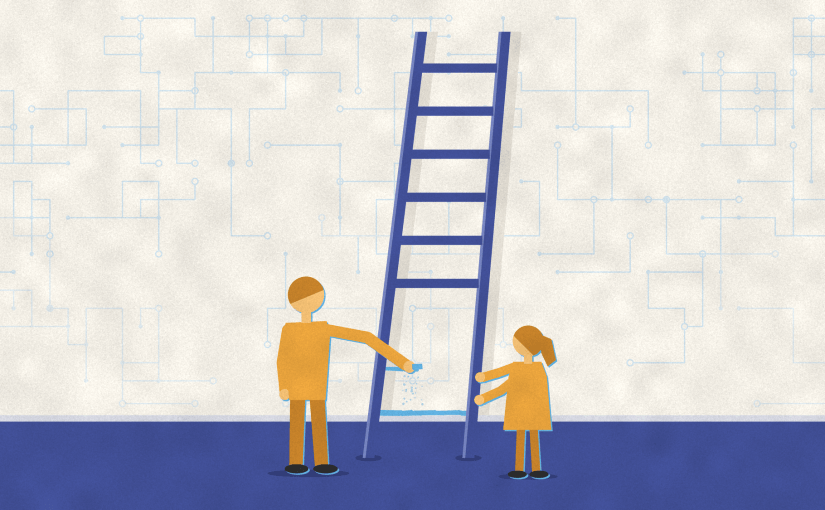
How do I AI-proof my job, and what should my children do?

Go Flux Yourself No. 33 · Navigating Human-Work Evolution

Future-proofing our children is folly, because nobody knows what work will look like. Here are six things parents and employers should start now.

TL;DR: September’s Go Flux Yourself examines how to prepare children, and ourselves, for work reshaped by AI. A century after Henry Ford drew a line on working hours, the answer is to stop forecasting and start deciding: protect the basics and the heart skills machines cannot copy, and keep a first rung open, above all for boys.
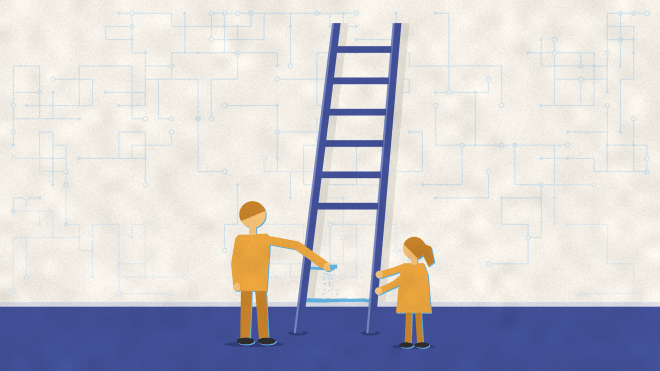
Image created using Claude

The Future

“We only really know two things about the future. One is that it will be full of technologies far more capable than those that exist today. Secondly, we know very little else. That feels quite dispiriting, disempowering. But actually, I think there’s a huge amount we can do.”

Daniel Susskind, speaking at the Royal Society of Arts, London, September 15

What should I do to prepare my children for a working world being reshaped by artificial intelligence? I am asked that more than any other question right now, from conference stages to the school gate, and I have as much riding on the answer as anyone asking it. Freddie, my eldest, started secondary school this month. His sister, Darcey, is not far behind.

We need to answer it now, because the present is grim and the outlook worse. I call it the vanishing first rung. In July, UK graduate vacancies fell to 8,383, down 45.6% on a year earlier and the lowest since Adzuna began counting in 2016; in mid-2017 there were more than 55,000. Adzuna points to April’s rise in employers’ National Insurance contributions and the higher National Living Wage. Whatever the mix of cost-cutting and automation, a 21-year-old graduate with no offers feels it the same way.

Many young people are effectively giving up, with no obvious career ladder to grab. According to the Office for National Statistics, the number of 16 to 24-year-olds not in employment, education or training passed a million in the first three months of this year, for the first time since 2013: 553,000 young men and 459,000 young women (I’ll come back to that split). Granted, by the second quarter it had eased to 981,000, but the point stands: a degree offers less protection than many parents assume. Alan Milburn’s review of young people and work found that one in seven NEETs already holds one.

Leaders tell me they worry about where tomorrow’s leaders will come from. Yet they cut the roles that produce them. That is myopia, and it is self-defeating, because the young people being shut out grew up alongside the tools everyone above them is scrambling to learn. Yesterday, September 29, on a Zellis webinar, AI Turning Point: Actionable Insights (watch the session here), I said I hoped flatter hierarchies would bring more reverse mentoring, because these youngsters – the most AI-fluent generation – can teach us so much. For now, we are closing the door on them.

Underneath the numbers sits a structural problem, and it reaches people already in work. Daniel Susskind, a King’s College London economist and father of three whose What Should My Children Do? was published on September 10, supplied this month’s opening quotation at a talk I attended at the Royal Society of Arts.

“People’s jobs are not simply sources of income,” he told a packed Great Room, which dates back to 1774, as the first Industrial Revolution gathered pace and machines were already unsettling workers. “They are sources of meaning, purpose and identity.” When the work on offer no longer fits the person someone believes they are, he argues, they walk away.

Susskind told us that more than 80% of America’s preschool teachers, nurses and carers are women, and that, as some argue, many men pushed out of manufacturing would rather not work at all than take up “that so-called pink-collar work”. US census data puts preschool and kindergarten teachers at 97.3% female, and registered nurses at 89.6% female. In South Korea, he said, roughly 60% of the unemployed hold a degree, about three times the British rate, because graduates refuse jobs they consider beneath their education. Three countries, one pattern. People will choose no work over work that does not match who they think they are.

Watch how adults react to AI itself and the same identity crisis plays out in miniature. I sort people into three tribes. AI zealots are fervent believers who hand everything over: they give their Copilot a name and send its emails unread. AI martyrs have concluded the machines will win regardless and are, in effect, queueing for early retirement. The third tribe, the one I keep urging people to join, are the agnostics. They treat AI as a tool, to be neither feared nor worshipped.

So what should children learn? Susskind cites the Spartan king Agesilaus, who, according to Plutarch, was asked that about 2,400 years ago and replied: “That which they will use when they become men.” The catch is that nobody can now say what that will be. “The idea of future-proofing the next generation is an impossible task,” Susskind admitted. Britain has already run that experiment. In 2013, David Cameron announced that every child in England’s primary and secondary schools would learn to code, and Michael Gove, then education secretary, said it would equip them to succeed in the 21st century.

In May, Anthropic‘s chief financial officer, Krishna Rao, said “90%-plus” of the code for its coding assistant, Claude Code, was written by AI. “Something that was literally meant to prepare the next generation for the rest of the century barely lasted until the end of school,” Susskind said.

His alternative is to go back to basics in school: literacy, numeracy and critical thinking; these are “fundamental as the building block to everything else”. Whatever proves valuable later, creativity or judgement, will rest on them. On top of that, he wants roughly a third of school time spent learning to use AI critically.

Here I part company with Susskind. He names no age for that third, and he warns against letting worries about social media “bleed into a kind of general scepticism about AI”. I would keep AI, and screens generally, out of primary school, and out of the family home as far as possible, then bring it in properly at secondary, much as we already rate films by age. 

Children first need the capacity for deep concentration, and the adults they copy are losing it. Gloria Mark, a professor of informatics at the University of California, Irvine, measured average attention on a single screen at two and a half minutes in 2004. Nearly two decades later, it was 47 seconds. Susskind himself backs “no smartphones before 14, no social media before 16, phone-free schools”. I would add a fourth rule: no AI before secondary school.

One of his book’s best ideas is more than four decades old. In 1978, as electronic calculators spread through classrooms, James Callaghan’s government asked Wilfred Cockcroft, a mathematician from the University of Hull, to examine how maths was taught. His 1982 report, Mathematics Counts, as Susskind tells it, split the subject into time with the calculator and time without, and examined both. Susskind calls it “teach both, test both” and wants it applied to AI in every subject. At the RSA, a child in the audience asked if ChatGPT was allowed for homework. His answer, framed around his own daughter: calculator paper or non-calculator paper? If it is the second, “I’m afraid I’m going to take it downstairs to the kitchen.”

I like the principle, with one reservation. Nobody fell for a Casio. The calculator was plainly a tool, and banning it from an exam hall left no one bereaved. Generative AI talks back and flatters. Nour Shaker-Fayad, director and chief AI architect at Microsoft, called it “a glorified calculator” on yesterday’s webinar, one “trying to calculate the next word”. Technically, she is right. I am just not sure how many people named their pocket calculators.

That is why critical thinking sits at the centre of all this. It is one of the seven Cs I keep coming back to, the heart skills that grow more valuable as the machines grow more capable: collaboration, compassion, communication, courage, creativity, critical thinking and curiosity. Geoffrey Hinton, often called the godfather of AI, calls these systems “idiot savants”, Susskind noted. A model that solves frontier mathematics may still miscount the Rs in “strawberry”. Telling the savant from the idiot is the skill, and a child who has only ever been handed answers will never learn it.

I asked Alexia Cambon, whom I have known since her Gartner days and who now studies how people and AI work together as a director in Microsoft’s Office of Applied Research, what she would tell a parent preparing a child for work. She skipped skills entirely. “The first question we need to be asking ourselves is: why are we building these systems, and for whom? Who’s going to benefit?”

“Who gets to be in the room when we build this?”

Her team, focused on human-machine collaboration, studies what happens when AI joins a group rather than a single user, which she calls the next frontier, and two of its experiments make a pair. Last summer, watching a team working with Copilot, she saw one participant type: “Copilot, if you don’t do this right, I will shut you down.” The others recoiled; the participant replied, quite rationally, that a machine will not be offended. “If we start to normalise rudeness towards machines,” Alexia asks, “do we start, inadvertently, to normalise rudeness towards the humans on the team?”

The second came in May, when her team gave MBA students at NYU Stern an unfinished AI prototype and asked them to help decide what it should become. “We were interested in understanding what if we gave these students, who are the next generation, the ability to help influence the product,” she said. One group set out to break it with conflicting instructions. “The aha moment was when one student said to it, ‘Oh no, we have everyone sign off on this; do what I say,'” she told me. “It created an awareness that these tools can be manipulated.” The system had no built-in hierarchy, so it borrowed the room’s, and the most confident voice won.

Influence runs both ways, then. How we treat the machine may leak into how we treat each other, and how we treat each other feeds straight into the machine. The team’s write-up of the Stern project, The Half-Finished Workplace, calls the students’ questioning stance “the enduring skill of working with AI”, and concedes that even those “decades into our careers are having to learn this now”.

Which makes her answer to the vanishing first rung worth hearing. Alexia’s team built its multimedia public research site, the New Future of Work Reader, without a single designer or software engineer, “purely through access to AI skilling”. That system now needs constant upkeep, with new skills installed and capabilities updated. “That’s probably work that an entry-level person could do,” she said. Her hypothesis is that building and maintaining AI agents becomes the new ticket into work. If she is right, the rung has moved, and firms cutting graduate intakes are removing the people best placed to climb it.

Alexia Cambon – Director at Microsoft’s Office of Applied Research and a keen runner

On children, she is warier than Susskind, and closer to my view. Young people are “still developing themselves as humans”, she said, and a technology that simulates human speech and reasoning, “always on, always accessible” and in some cases “highly sycophantic”, needs introducing with care, at the right age. She also expects AI proficiency to be among the most important skills for employment, so curricula will have to change; the aim is a thought partner rather than somewhere to offload thinking.

Then she drew a distinction every parent should borrow. Learnt experience, anything you could once acquire from a book, AI now supplies. Lived experience it cannot. Alexia has a neurodivergent sister, and learnt young how to head off conflict so as not to upset her. That is “a skill that has not come from my university training or my degrees”, she said. “It has come from my own personal life.” Taste starts there too. The basics tell you something is wrong; lived experience tells you why it matters.

If AI hands a room to its most confident voice, it matters who has been talked over already. Nick Isles, director of the Centre for Policy Research on Men and Boys (CPRMB), founded it after one of his four daughters told him men were “a bit rubbish” and there were no decent ones left to date. He asked young men what they thought of themselves. They agreed with her.

The CPRMB’s Missing Men 2026 scorecard, published in August, shows boys in the UK falling behind from the start. In England, 61.6% of boys reach a “good level of development” by five, against 75.3% of girls; for boys on free school meals, the figure is 43.5%. In the last academic year, 1,276 boys were permanently excluded from primary school, which the report reckons is 42 full classes, all gone before the age of 12.

“We created, in the state system particularly, an exam factory,” Nick told me. By 11 or 12, he said, too many have given up and decided they are failures. In 1983, the American psychologist Howard Gardner identified seven types of intelligence (linguistic, logical/mathematical, spatial, bodily-kinaesthetic, musical, interpersonal, and intrapersonal), later adding an eighth (naturalist). “We only test two,” Nick said. Few men are around to spot a boy slipping. Roughly two per cent of the UK’s early years workforce is male, according to Nick, and new male entrants to teaching in England fell from 5,676 in 2019/20 to 4,227 in 2024/25, even as teaching vacancies on Adzuna rose 11.9% in the year to July. He blames safeguarding: after a handful of appalling cases, a risk-averse system began filtering out good men with the bad. “There’s a bias in the selection process,” he said, “which doesn’t need to exist.”

Ask him to look 10 years ahead, and it darkens further. Something is filling the space that school and work are leaving. “The attention economy feeds the grifter economy,” he said, borrowing the analysis of Reset Tech. The algorithm finds what a young man fears most and sells him a materialistic, nihilistic version of manhood, so that it can sell him something else. A teenage boy browsing fitness content will be steered to manosphere material and misogyny within 12 minutes, Nick says. “They’re not seeking this,” he told me.

Susskind’s point about identity, followed to its end, arrives here. Work, Nick said, is “the main way in which, as adults, we act upon the world, and say what we are”. Take it away and “desperation leads to grievance. Grievance leads to adoption of extreme views.” His verdict, delivered flatly:

“We’re already on that road. It’s already happening.”

So what jobs are going to be left? “They’re going to be high-touch jobs,” he said: trades, care and teaching. “Most people would rather be cared for by another human being.” He attaches a condition. Those jobs grow “if we get AI right, you can transfer resources into paying for this stuff effectively. It’s a big if.” The same Adzuna figures show how big: healthcare and nursing vacancies fell 30.6% in the year to July. Care is hard to automate. It is also easy to underfund.

Hence This Boy Cares, the CPRMB campaign pushing boys towards health, education, administration and care with the seriousness we rightly brought to steering girls into engineering a generation ago. It is building role models and research, and Nick wants government careers advertising behind it. “This is non-zero-sum thinking,” he said. “We can care for our girls and our boys.”

Lynda Gratton widens the lens to all of us. The London Business School professor, whose Living the 100-Year Life was published the same day as Susskind’s book, argues that longer lives turn a career into something you weave rather than climb. “The 100-year life is no longer a distant idea. It is already unfolding,” she writes. She turned down a publisher who wanted 15 years of predictions. Instead, she offers eight threads (mastery, friendship, calm, intimacy, adventure, cooperation, knowing, and amplification) whose strengthening and reweaving, she argues, shape our health and sense of purpose across a century.

Her message applies in middle age as much as at 12: work hard, and work smarter. Next month I run the Amsterdam Marathon, my first in eight years, alongside nine other dads from a running group I started in lockdown. In Gratton’s terms, that is adventure and friendship.

None of these people will hand you a list of safe skills, and anyone selling one is repeating Gove’s 2013 failed bet. Between them, though, they point to six things any parent or employer can start this term to prepare children better for work.

  • Basics before bots. Whole books and times tables are where critical thinking begins. Keep AI for secondary school, and run Cockcroft’s rule at home: calculator paper or non-calculator paper, and for the second, the laptop goes downstairs.
  • Fill the diary with other people and hobbies. Freddie’s new secondary-school headmaster told parents on day one that grades alone would not be enough, and Freddie has pleasingly embraced sport, drama, music and art. Five-a-side, choirs, scouts and drama clubs are where they learn collaboration.
  • Offer them a first rung. “A week can literally open up a young person’s eyes,” Nick said of work experience. Push for a Saturday job. And if you run an organisation, offer a shadow day before Christmas to a teenager from outside your own network. That takes courage on both sides.
  • Ask which problem they want to solve. Susskind warns that anyone choosing law because of Suits, or medicine because of House, will be disappointed, because those jobs are changing fast. Improving health and widening access to justice won’t go away. Curiosity about a problem, however, outlasts ambition for a title.
  • Make care an ambition for boys, too. If your son wants to be a nurse or a nursery teacher, treat it as the demanding, skilled work it is, and say so where his friends can hear. That is compassion in action.
  • Protect one conversation at a time. Gloria Mark’s 47 seconds is an adult figure, and children learn their habits from us. Alexia guards her attention by running (snap!), which gives her “the ability to not be available”. Keeping phones off the dinner table is where communication, the listening half of it, is practised.

Look back at those six tips, and you will find half a dozen of the seven Cs: critical thinking, collaboration, courage, curiosity, compassion and communication. The seventh, creativity, is where AI makes its boldest claims, and October’s edition will test them. None of the six depends on predicting anything, which matters, because much of what I saw and heard this month suggests we are already behind, in classrooms and boardrooms alike. Here is how September looked from where I sat …

The present

Image created using Claude

It began with a report card. On September 8, the OECD published its PISA 2025 results, drawn from more than 760,000 pupils in 91 countries. Across the OECD, reading scores have fallen 28 points since 2015, which the report equates to more than a year of learning, and one in five 15-year-olds now sits below the baseline in all three of reading, maths and science, up from 16% in 2022. The share of what the OECD calls “hasty readers”, who skim a text and give a quick wrong answer, has nearly doubled since 2018. The slide began years before most of us would have guessed “LLM” stood for anything other than a law degree.

Two findings matter most for this edition. Pupils who used AI for specific schoolwork tasks scored lower in science than those who did not, unless heavy use came with proper teaching in AI literacy, and the OECD warns that such teaching is concentrated among advantaged pupils, “risking a growing AI divide”. And in almost every country, pupils reported less support from their families than in 2022, with boys and disadvantaged children singled out. Nick would not be surprised. Andreas Schleicher, the OECD’s director for education and skills, framed the stakes: “If we get this right, AI becomes a scaffold, not a crutch.”

Britain is a bright spot. UK science rose 12 points to 511, and the UK sits in the top 10 across all three subjects, alongside Estonia, Japan, Korea and Singapore. British schools, then, are holding their own. The worry is global: the skills the OECD sees falling fastest, evaluating information and connecting sources, are the ones this edition says our children will need most.

September 15 began at breakfast with Cameron Adams, co-founder of Canva, at the company’s London campus, and ended at the RSA. (Cameron’s thinking on AI and taste will anchor October’s edition, on creativity.)
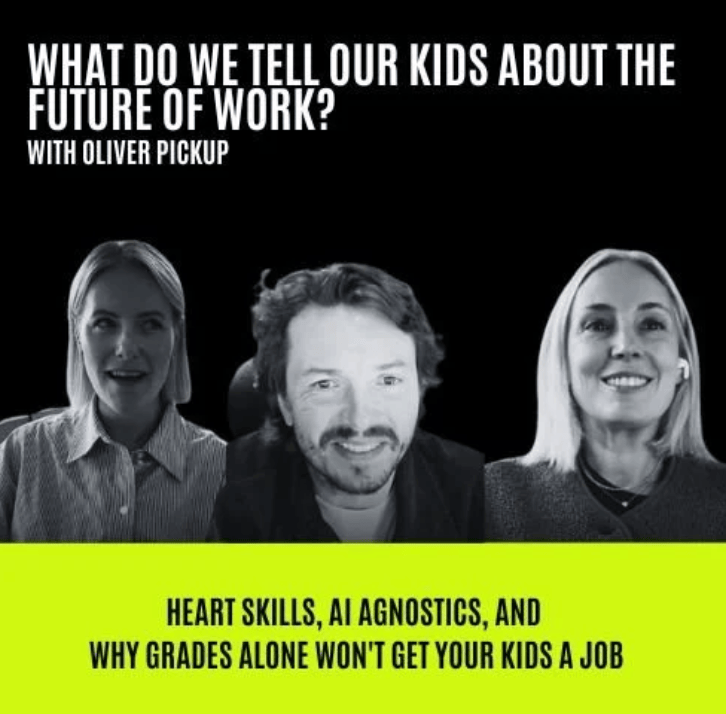
Three days later I recorded the season opener of Work is Weird Now with its hosts, Alice Phillips and Danielle Emery. It went live on September 23, which happened to be Freddie’s 12th birthday. I offered a metaphor about leaders gazing at their garden and telling themselves it looks fine, while sowing nothing for the next 10 years. A garden does not die the day you notice it is barren. It has been dying for a while. Time to water it.

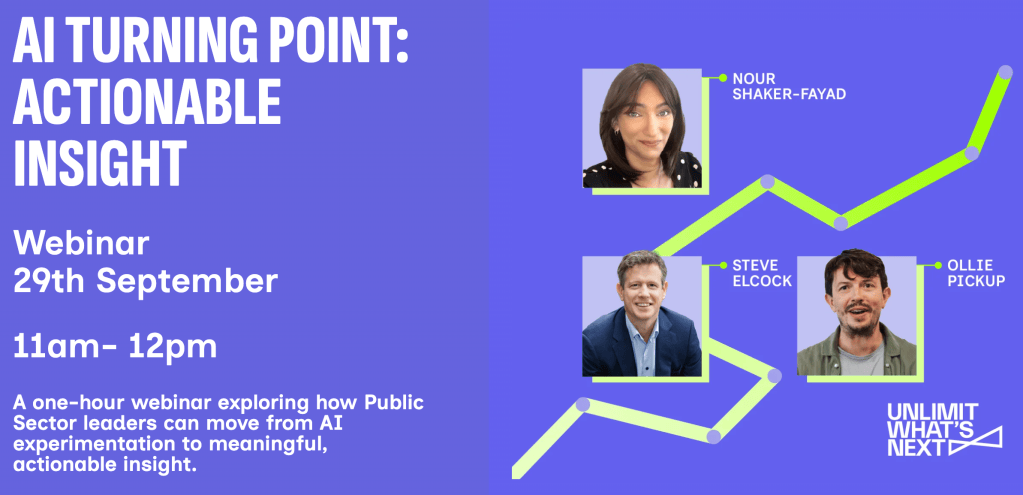
Yesterday’s Zellis webinar – alongside Nour from Microsoft and Steve Elcock, Zellis’s director of product AI (whom I featured in the newsletter earlier this year) – pulled the month together. On September 9, Zellis published my interview about the “worklife squeeze”: a three-car pile-up of flat budgets, unfillable vacancies, and the biggest technological shift since the Industrial Revolution. 

I opened the webinar by saying I want humans to be the carpenter, not the nail at the other end of the hammer, which is another way of putting the Turing trap: building AI to imitate what we’re already good at, rather than to cover what we’re not.
Nour’s illustration of that distinction wasn’t about technology at all. Her partner is a medical regulatory writer with a PhD in chemical biology, distilling clinical studies into documentation for pharmaceutical regulators. A client told Nour he wanted agents that would make the job obsolete. “That’s not going to happen any time soon,” she told him, “simply because AI doesn’t know what it doesn’t know.” Judging how a drug behaves in the world takes more context than side effects and interactions, and that context is exactly what basics and lived experience, to echo Alexia’s point, are for.

Steve explained why AI agnosticism is harder in practice than in principle. Airport baggage screeners, he said, have fake weapons inserted into their X-ray feeds at random, because they grow so used to the job that they stop looking properly. “We’re getting more and more trusting of this stuff,” he said, “precisely because it’s so good at imitating.” Organisations will need to plant their own friction.

My contribution was the example that shows the other side of the squeeze. In 2021 Ingka Group, IKEA’s largest franchisee, launched a chatbot called Billie, named after the Billy bookcase, which went on to handle 47% of customer queries to its call centres. Instead of cutting staff, it trained 8,500 call-centre workers as remote interior design advisers. That channel brought in €1.3 billion in the 2022 financial year, 3.3% of sales, and Ingka wants it at 10% by 2028. Retrain rather than remove, and a productivity story becomes a capacity story.

I also raised young researcher Jacob Coxon’s departure from Anthropic, and the talk it prompted of a 10% probability of doom (p(doom)) within a decade. At the RSA, Susskind had called attaching a number to that “absurd”, while insisting “it’s not zero”. Fine. Then track a second number with the same zeal: the probability of flourishing, p(flourishing). Leaders measure what they fear. They should measure what they want, too.

That argument goes into a classroom in November, as I’ve just been booked to speak at a school about using AI without fearing or worshipping it. I would like to do more of this, in schools, on stages, and in boardrooms. Contact me at oliver@pickup.media if you or your organisation would benefit from my insights.

Technology can buy us time, if someone decides it should. A century ago last Friday, an American carmaker did more than most to give us the weekend …

The past
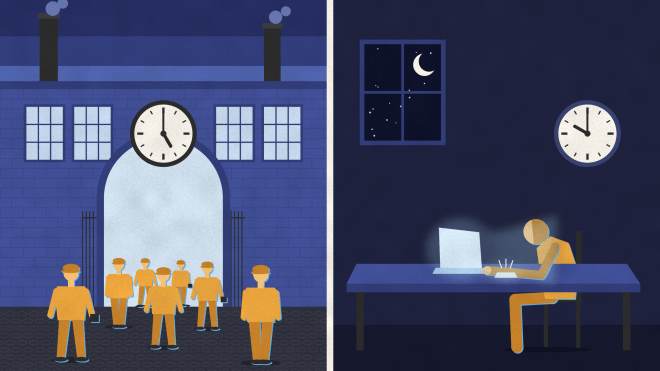
Image created using Claude

On September 25, 1926, Henry Ford announced to the world that the five-day, 40-hour week his factories had adopted that May was there to stay. “It is high time to rid ourselves of the notion that leisure for workmen is either ‘lost time’ or a class privilege,” he said. Ford was no philanthropist. By his own admission, he expected more effort in fewer hours. But he capped the hours, and manufacturers across America, then the world, followed his lead.

Four years later, John Maynard Keynes looked a century ahead. In Economic Possibilities for our Grandchildren, published in 1930, he predicted that living standards would be four to eight times higher by 2030, and that the work left over could be spread so thinly that “three-hour shifts or a 15-hour week may put off the problem for a great while”. He was right about the wealth and wrong about the leisure. With four years to go, nobody expects a 15-hour week. The same essay warned of “a new disease” that readers would hear “a great deal” about: technological unemployment.

Keynes’s miss had already been explained, by an economist who died before he was born. In The Coal Question, published in 1865, William Stanley Jevons argued that more efficient steam engines would not save Britain’s coal. Efficiency makes a resource cheaper to use, so we find more uses for it, and consumption rises. Jevons died in August 1882, aged 46; Keynes was born in June 1883, 10 months later. Half a century later, Keynes assumed productivity gains would be banked as leisure and walked into the paradox Jevons described.

It is happening again, with knowledge in place of coal. Aruna Ranganathan and Maggie Ye of Berkeley’s Haas School of Business spent eight months inside a US technology company, and reported in Harvard Business Review in February that generative AI intensified work rather than reducing it. Staff took on more, quicker. Work seeped into evenings and breaks, often without anyone asking. Right now, it feels like we are hamsters running faster on the wheel. Ford drew a line on hours. For AI, nobody has.

Ford’s lesson is that he took a bold stance: he decided rather than predicted. And he gave his staff the whole weekend, partly out of care and partly out of capitalist smarts: rested workers would work harder on Monday morning.

Which brings me to Saturday jobs. Nick Isles’s early work ranged from gardening for an elderly neighbour his mother found for him to a bookshop he loved. The strangest was playing the Pink Panther on the seafront at Great Yarmouth for a family photography business. “Probably the worst job I’ve ever done,” he told me. “At least I didn’t have to work with the monkeys.” His point was serious. A Saturday job, however absurd, puts a teenager among adults from outside their own world, and too many boys now look for that company online.

Mine were similarly unglamorous. At 15 I worked in a cafe in Macclesfield, where I learnt that most of a service job is talking to people properly, and picked up the mechanics of running a business. At 18, before travelling in South America, I was a theatre porter at a hospital in south Manchester; on my first shift I was locked in the morgue, whether by accident or initiation, I’m still unsure. University holidays brought bar work and a stretch in a wood-chip factory. None of it looked like a career. All of it taught me how to read a room, and how to be useful to people who owed me nothing.

Nobody handed me a map, and nobody will hand Freddie or Darcey one. So I have drawn my own line. In a couple of years, my eldest will be old enough for a Saturday job, and I hope it is a slightly absurd one.

Statistics of the month

😰 FOBO hits a record

A record 27% of US workers fear technology could make their jobs obsolete, up seven points in a year and double the 13% Gallup found in 2017. It is now the biggest job worry among workers under 45: 34% of them share it, against 19% of those older. (Gallup)

🐹 A faster hamster wheel


Some 86% of UK employees now use AI at work, and 57% say it has raised how much they are expected to do in a day. Almost three in 10 (29%) are “ghost working”, pushing tasks into the night to free up their days. Jevons would recognise the pattern. (Owl Labs)

🪜 A shaky first rung


Only one in five UK employers (20%) plans to recruit more 18 to 24-year-olds over the next year, while 26% expect to hire fewer people overall because of the costs they anticipate from the Employment Rights Act. Those planning to hire more young people most often cite a future talent pipeline and access to digital skills (40% each). (CIPD)

🧭 Encouraged, but not told why


More than four in five employees (85%) say their organisation actively encourages them to experiment with AI, yet 42% do not know why they should be using it, according to Culture Amp’s survey of around 112,000 employees. Awareness of internal career opportunities has fallen 10 percentage points since July 2025, the biggest single-year change in its engagement data. (Culture Amp)

🎙️ Talk, don’t type


Almost a quarter (24%) of Gen Z send voice notes several times a day, against 13% of Millennials and 5% of Gen X, according to Twilio’s survey of 2,000 UK adults. At work, 43% prefer speaking to typing when they need to communicate something quickly. Voice is back; listening is the harder part. (Twilio)

If you’re reading this, thank you. If you haven’t subscribed yet, you can sign up for Go Flux Yourself (there should be a pop-up). Please feel free to share it with friends and colleagues too, especially any with children wondering what comes next. Each edition lands on the last day of the month.

If anything in this edition struck a chord, particularly the vanishing first rung, or the question of what your organisation could offer a teenager before Christmas, I’d like to hear from you. Tell me about the shadow days and Saturday jobs you’re offering, or the ones you wish someone had offered you, and I’ll share the best in a future edition.

I’m always keen to help a team or a leader think through their own version of the problem, or simply to tell their story properly, whether in a boardroom or a classroom. Please drop me a line: oliver@pickup.media.

Go Flux Yourself: Navigating the Future of Work (No. 20)

TL;DR: August’s edition examines how companies are eliminating graduate jobs while redirecting recruitment budgets to failing AI pilots. From ancient rhetoric becoming essential survival skills to pre-social media university life, this edition explores why authentic human connection is our ultimate competitive advantage.

August's Go Flux Yourself explores:

The graduate job collapse: Entry-level positions requiring degrees have dropped by two-thirds since 2022, while students face £53,000 average debt. Stanford research reveals young workers in AI-exposed jobs experienced 13% employment decline as older colleagues in identical roles saw steady growth

The failing AI paradox: 95% of corporate AI pilots deliver no meaningful returns, yet companies redirect graduate recruitment budgets to these failing technologies. Half of UK firms now want to swap staff spending for AI investment despite zero evidence of productivity gains

The strategic generation: Anecdotal examples illustrate how young people aren't competing with AI but conducting it – using ChatGPT for interior design, creating revision podcasts, and embracing technology as "another thing to make life easier"

The pre-digital simplicity: Twenty-four years ago at St Andrews, Prince William was just another tutorial student alongside Oliver in a world without Facebook, smartphones, or AI assistants. Physical books, card catalogues, and pub conversations shaped minds through friction rather than convenience

To read the full newsletter, please visit www.oliverpickup.com.

Image created on Midjourney

The future

“First, we made our jobs robotic. Then we trained the robots how to do them. If AI takes your job, it won’t be because it’s so smart. It will be because over time we’ve made work so narrow, so repetitive, so obsessed with minimising variance and deferring to metrics, that it’s perfectly designed for machines.”

Tom Goodwin’s above observation about how we’ve made our jobs robotic before training robots to do them, articulated in mid-August on LinkedIn, feels remarkably prescient as thousands of teenagers prepare for university. When I interviewed the business transformation consultant, bullshit caller / provocateur, and media expert in 2022, following an update to his book Digital Darwinism, he warned about a looming leadership crisis. That crisis is now playing out in ways he probably didn’t fully anticipate.

The timing of the post couldn’t be more brutal. It’s been 25 years since I received my A-level results. Yet, I can still easily recall the pre-reveal trepidation followed by relief that I’d scraped the grades to study English Literature and Language at the University of St Andrews (as a peer of Prince William – more on this below, including a 20-year-old graduation picture).

What a thrilling time of year it should be: the end of school, then taking the next step on life’s magical journey, be it straight to university without passing go, a gap year working and then travelling, or eschewing higher education to begin a career.

I wonder how this year’s A-level leavers feel, given they’re walking into the most uncertain graduate job market in a generation. The promises made to them about university – to study hard, earn a degree, and secure a good job – are crumbling in real time.

Data from job search engine Adzuna suggests that job postings for entry-level positions requiring a degree have dropped by almost two-thirds in the UK since 2022, roughly double the decline for all entry-level roles (as quoted in the Financial Times). The same research found that entry-level hiring is down 43% in the US, and 67% in the UK, since ChatGPT launched in November 2022.

The study results tally with other sources. In June, for instance, UK graduate job openings had plunged by 75% in banking and finance, 65% in software development, and 54% in accounting compared to the same month in 2019, according to Indeed (also in the FT piece).

Meanwhile, students graduating from universities in England in 2025 have an average student loan debt of approximately £53,000, with total outstanding loans reaching £267 billion. Frankly, is university worth it today?

I was fortunate enough to be part of the last cohort to benefit from minimal tuition fees in Scotland before they were introduced to all students in the 2005-6 academic year. Further, when I studied my postgraduate degree in magazine journalism at Cardiff University’s JOMEC, we were (verbally and anecdotally) guaranteed jobs within a year; and, as far as I know, all my peers achieved that. Such certainty feels alien now, even quaint.

But where does this trend lead? What happens when an entire generation faces systematic exclusion from entry-level professional roles?

A Stanford University study tracking millions of workers through ADP payroll data revealed something rather more troubling: young workers aged 22-25 in “highly AI-exposed” jobs experienced a 13% employment decline since OpenAI released its LLM just under three years ago, while older colleagues in identical roles saw steady or rising employment.

Arguably, we’re witnessing the first generation where machines are genuinely better at doing what universities taught them than they are.

Erik Brynjolfsson, one of the Stanford paper’s co-authors (and a professor whom I interviewed a couple of months after ChatGPT was unveiled – even back then he was warning about the likely problems with AI acceleration and jobs), put it bluntly: “There’s a clear, evident change when you specifically look at young workers who are highly exposed to AI.” 

The research controlled for obvious alternatives — COVID effects, tech sector retrenchment, interest rate impacts — and the correlation held. Software developers and customer service agents under the age of 25 saw dramatic employment drops. Home health aides, whose work remains both physically and emotionally demanding, saw employment rise.

The distinction matters. AI isn’t just replacing workers randomly, but it’s targeting specific types of work. The Stanford team found that occupations where AI usage is more “automative” (completely replacing human tasks) showed substantial employment declines for young people. In contrast, “augmentative” uses (where humans collaborate with AI) showed no such pattern.

Anthropic CEO Dario Amodei warned in May that half of “administrative, managerial and tech jobs for people under 30” could vanish within five years. He’s probably being conservative.

However, what’s especially troubling about this shift is that a new MIT research, The GenAI Divide: State of AI in Business 2025, suggests that many AI deployment programmes are failing to deliver expected returns on investment, with companies struggling to show meaningful productivity gains from their technology investments. Specifically, 95% of generative AI pilots at companies are failing, and delivering next to no return on investment. 

Despite this, organisations continue redirecting budgets from graduate recruitment to AI initiatives. Half of UK companies now want to redirect money from staff to AI, according to Boston Consulting Group research.

This creates a dangerous paradox: companies are cutting the graduate pipeline that develops future leaders while betting on technologies that haven’t yet proven their worth. What happens to organisational capability in five years when the cohort of junior professionals who should be stepping into senior roles doesn’t exist, or those that are in the job market don’t have any meaningful experience?

This connects directly to Tom Goodwin’s observation. The combined forces of consulting culture, efficiency obsessions, and metric-driven management have reshaped roles once built on creativity, empathy, relationships, imagination, and judgment into “checklists, templates, and dashboards”. We stripped away the human qualities that made work interesting and valuable, creating roles “perfectly designed for machines and less worth doing for humans”.

Consider those entry-level consulting, law, and finance roles that have vanished. They were built around tasks like document review, basic data analysis, research synthesis, and report formatting – precisely the narrow, repetitive work at which large language models excel.

Yet amid this disruption, there are signals of adaptation and hope. During a recent conversation I had with Joanne Werker, CEO of the people engagement company Boostworks, she shared statistics and personal insights that capture both the challenges and the opportunities facing this generation. Her organisation’s latest research, published in late July, indicates that 57% of Gen Z and 71% of Millennials are exploring side hustles, not as passion projects, but to survive financially. Taking a positive view of this situation, one could argue that this will be a boon for innovation, given that necessity is the mother of invention.

Also noteworthy is that nearly one in five Gen Zers is already working a second job. Joanne’s daughters illustrate a different relationship with AI entirely. One, aged 30, works in music, while the other, 24, is in fashion, both creative fields where AI might be expected to pose a threat. Instead, they don’t fear the technology but embrace it strategically. The younger daughter used ChatGPT to redesign their family’s living room, inputting photos and receiving detailed interior design suggestions that impressed even Jo’s initially sceptical husband. As Joanne says, both daughters use AI tools not to replace their creativity, but to “be smarter and faster and better”, for work and elsewhere. “The younger generation’s response to AI is just, ‘OK, this is another thing to make life easier.’”

This strategic approach extends to education. Nikki Alvey, the (brilliant) PR pro who facilitated my conversation with Jo, has children at the right age to observe this transition. Her son, who just completed his A-levels, used AI extensively for revision, creating quizzes, podcasts, and even funny videos from his notes. As Nikki pointed out: “I wish I’d had that when I was doing GCSEs, A-levels, and my degree; we barely had the internet.”

Elsewhere, her daughter, who is studying criminology at the University of Nottingham, operates under different constraints. Her university maintains a blanket ban on AI use for coursework, though she uses it expertly for job applications and advocacy roles. This institutional inconsistency reflects higher education’s struggle to adapt to technological reality: some universities Nikki’s son looked at were actively discussing AI integration and proper citation methods, while others maintain outright bans.

Universities that nail their AI policy will recognise that future graduates need capabilities that complement, rather than compete with, AI. This means teaching students to think critically about information sources.

As I described during a recent conversation with Gee Foottit on St James’s Place Financial Adviser Academy’s ‘The Switch’ podcast: “Think of ChatGPT as an army of very confident interns. Don’t trust their word. They may hallucinate. Always verify your sources and remain curious. Having that ‘truth literacy’ will be crucial in the coming years.”

Related to this, LinkedIn’s Chief Economic Opportunity Officer Aneesh Raman describes this as the shift from a knowledge economy to the “relationship economy”, where distinctly human capabilities matter most.

The Stanford research offers clues about what this means. In occupations where AI augments rather than automates human work – such as complex problem-solving, strategic thinking, emotional intelligence, and creative synthesis – young workers aren’t being displaced.

Success won’t come from competing with machines on their terms, but from doubling down on capabilities that remain uniquely human. 

On The Switch podcast episode, which will be released soon (I’ll share a link when it does), I stressed that the future belongs to those – young and old – who can master what I call the six Cs of skills to dial up: 

  • Collaboration
  • Communication
  • Compassion
  • Courage
  • Creativity
  • and Curiosity

These are no longer soft skills relegated to HR workshops but survival capabilities for navigating technological disruption.

There’s a deeper threat lurking, though. The issue isn’t that the younger generations are AI-literate while their elders struggle with new technology, but understanding how to maintain our humanity while leveraging these tools. 

No doubt nurturing the six Cs will help, but a week or so ago, Microsoft’s AI chief, Mustafa Suleyman, described something rather more unsettling: “AI psychosis”: a phenomenon where vulnerable individuals develop delusions after intensive interactions with chatbots. In a series of posts on X, he wrote that “seemingly conscious AI” tools are keeping him “awake at night” because of their societal impact, even though the technology isn’t conscious by any human definition.

“There’s zero evidence of AI consciousness today,” Suleyman wrote. “But if people just perceive it as conscious, they will believe that perception as reality.”

The bitter irony is that the capabilities we now desperately need – namely, creativity, empathy, relationships, imagination, and judgement – are exactly what we stripped out of entry-level work to make it “efficient”. Now we need them back, but we’ve forgotten how to cultivate them at scale.

The generation entering university in September may lack traditional job security, but they possess something their predecessors didn’t: the ability to direct AI while (hopefully) remaining irreplaceably human. And that’s not a consolation prize. It’s a superpower.

The present

On stage with Tomás O’Leary at Origina Week

I tap these words on the morning of August 29 from seat 24F on Aer Lingus EI158 from Dublin to London Heathrow, flying high after a successful 48 hours on the Emerald Isle. A software client, Origina, flew me in. I’ve been assisting with the CEO, Tomás O’Leary’s thought leadership and the company’s marketing messaging for over a year (his words of wisdom around pointless software upgrades and needless infrastructure strain in my July newsletter). 

Having struck up a bond – not least thanks to our days reminiscing about playing rugby union (we were both No8s, although admittedly I’m a couple of inches shorter than him) – Tomás invited me to participate in Origina Week. This five-day extravaganza mixes serious business development skills with serious fun and learning.

Tomás certainly made me work for my barbecued supper at the excellent Killashee Spa Hotel: on Thursday, I was on stage, moderating three sessions for three consecutive hours. The final session – the last of the main programme – involved men and Tomás having a fireless “fireside” chat about technology trends as I see them, and his reflections on their relevance to the software space.

I was grateful to make some superb connections, be welcomed deeper into the bosom of the Origina family, and hear some illuminating presentations, especially behavioural psychologist Owen Fitzpatrick’s session on the art of persuasion. 

Watching Owen work was a masterclass in human communication, which no AI could replicate. For 90 minutes, around 250 people from diverse countries and cultures were fully engaged, leaning forward, laughing, and actively participating. This was neural coupling in action: the phenomenon where human brains synchronise during meaningful interaction. No video call, no AI assistant, no digital platform could have generated that energy.

This is what Tomás understood when he invested in bringing his global team together in the Irish capital. While many executives slash training budgets and rely on digital-only interactions, he recognises that some learning only happens face-to-face. That’s increasingly rare leadership in an era where companies are cutting human development costs while pouring billions into AI infrastructure.

Owen’s session focused on classical rhetoric: the ancient art of persuasion, which has become increasingly relevant in our digital age. He walked us through the four elements: ethos (credibility), logos (logic), pathos (emotion), and demos (understanding your audience). These are precisely the human skills we need as AI increasingly handles our analytical tasks.

It was a timely keynote. Those who have completed their A-levels this summer are entering a world where the ability to persuade, connect, and influence others becomes more valuable than the ability to process information.

Yet we’re simultaneously experiencing what recent research from O.C. Tanner calls a recognition crisis. Its State of Employee Recognition Report 2025 found that UK employees expect in-person interactions with recognition programmes to increase by 100% over the next few years, from 37% to 74%. These include handwritten notes, thank you cards, and award presentations. People are craving authentic human interaction precisely because it’s becoming scarce.

Recent data from Bupa reveals that just under a quarter (24%) of people feel lonely or socially isolated due to work circumstances, rising to 38% among 16-24-year olds. Over a fifth of young workers (21%) say their workplace provides no mental health support, with 45% considering moves to roles offering more social interaction.

Also, new research from Twilio reveals that more than one-third of UK workers (36%) demand formally scheduled “digital silence” from their workplace. Samantha Richardson, Twilio’s Director of Executive Engagement, observed: “Technology has transformed how we work, connect, and collaborate – largely for the better. But as digital tools become increasingly embedded in everyday routines, digital downtime may be the answer to combating the ‘always-on’ environment that’s impeding productivity and damaging workplace culture.”

This connects to something that emerged from Owen’s session. He described how the most powerful communication occurs through contrast, repetition, and emotional resonance – techniques that require human judgment, cultural understanding, and real-time adaptation. These are precisely the skills that remain irreplaceable in an AI world.

Consider how Nikki’s son used AI for revision. Rather than passively consuming information or getting out the highlighter pens and mapping information out on a big, blank piece of paper (as I did while studying, and still do sometimes), he actively prompted the technology to create quizzes, podcasts, and videos tailored to his learning style. This was not AI replacing human creativity, but human creativity directing AI capabilities.

The challenge for today’s graduates isn’t avoiding AI, but learning to direct it purposefully. This requires exactly the kind of critical thinking and creative problem-solving that traditional education often neglects in favour of information retention and standardised testing.

What’s particularly striking about the current moment is how it echoes patterns I’ve observed over the past year of writing this newsletter. In June 2024’s edition, I explored how AI companions were already changing human relationships. I’ve also written extensively about the “anti-social century” and our retreat from real-world connection. Now we’re seeing how these trends converge in the graduate employment crisis: technology is doing more than just transforming what we do. It is also changing how we relate to each other in the process. 

On this subject, I’m pleased to share the first of a new monthly podcast series I’ve begun with long-term client Clarion Events, which organises the Digital Transformation Expo (DTX) events in London and Manchester. The opening episode of DTX Unplugged features Nick Hodder, Director of Digital Transformation and Engagement at the Imperial War Museums (IWM), highlighting why meaningful business transformation begins with people, not technology.

The answer, whether in a hotel conference room in Dublin or a corporate office in Manchester, remains the same: in a world of AI, our ability to connect authentically with other humans has become our competitive edge.

The past

Twenty-four years ago in September, I sat in my first tutorial at the University of St Andrews — nine students around a table, including Prince William and seven young women. That tutorial room held particular energy. We were there to think, question, argue with texts and each other about ideas that mattered. Will, who played for my Sunday League football team, was just another student. 

The economic backdrop was fundamentally different. Graduate jobs were plentiful, social media was (thankfully) nascent – Facebook was three years away, and only mildly registered in my final year, 2004-05 – and so partying with peers was authentic, and free from fears of being digitally damned. Moreover, the assumption that a degree led to career success felt unshakeable because it was demonstrably true.

The social contract was clearer, too. Society invested in higher education as a public good that would generate returns through increased productivity, innovation, and civic engagement. Students could focus on learning rather than debt management because the broader community bore the financial risk in exchange for shared benefits.

My graduation day at the University of St Andrews in 2005

Looking back, what strikes me most is the simplicity of the intellectual environment. We read physical books, researched in libraries using card catalogues, and didn’t have any digital devices in the lecture halls or tutor rooms. (And the computers we had in our rooms took up a colossal amount of space.) Our critical thinking developed through friction: the effort required to find information, synthesise arguments from multiple sources, and express ideas clearly without technological assistance.

Knowledge felt both scarce and valuable precisely because it was hard to access. You couldn’t Google historical facts during seminars. If you hadn’t done the reading, everyone knew. If your argument was poorly constructed, there was nowhere to hide. The constraints forced genuine intellectual development.

The human connections formed during those four years proved more valuable than any specific subject knowledge. Late-night debates in residence halls, study groups grappling with challenging texts, and casual conversations between lectures – these experiences shaped how we thought and who we became.

We could explore medieval history, philosophical arguments, or literary criticism without worrying whether these subjects would directly translate to career advantages. The assumption was that broad intellectual development would prove valuable, even if connections weren’t immediately obvious. (Again, I was fortunate to be in the last cohort of subsidised university education.)

That faith in indirect utility seems almost lost now. Today’s students, facing massive debt burdens, quite reasonably demand clear pathways from educational investment to career outcomes. The luxury of intellectual exploration for its own sake becomes harder to justify when each module costs hundreds – if not thousands – of pounds.

Some elements remain irreplaceable. The structured opportunity to develop critical thinking skills, build relationships with peers and mentors, and discover intellectual passions in supportive environments still offers unique value. 

Indeed, these capabilities matter more now than they did a quarter of a century ago. When information is abundant but truth is contested, when AI can generate convincing arguments on any topic, and when economic structures are shifting rapidly, the ability to think independently becomes genuinely valuable rather than merely prestigious.

My 10-year-old son will reach university age by 2033. By then, higher education will have undergone another transformation. The economics might involve shorter programmes, industry partnerships, apprenticeship alternatives, or entirely new models that bypass traditional degrees. But the fundamental question remains unchanged: how do we prepare young minds to think independently, act ethically, and contribute meaningfully to society?

The answer may require reimagining university education entirely. Perhaps residential experiences focused on capability development rather than content transmission. Maybe stronger connections between academic learning and real-world problem-solving. Possibly more personalised pathways that recognise different learning styles and career ambitions. What won’t change is the need for structured environments where young people can develop their humanity while mastering their chosen fields of expertise. 

The students opening their A-level results this last month deserve better. They deserve educational opportunities that develop their capabilities without crushing them with debt. They deserve career pathways that use their human potential rather than competing with machines on machine terms. Most importantly, they deserve honest conversations about what higher education can and cannot provide in an age of technological disruption.

Those conversations should start with acknowledging what that tutorial room at St Andrews represented: human minds engaging directly with complex ideas, developing intellectual courage through practice, and building relationships that lasted decades (although my contact with Prince Will mysteriously stopped after I began working at the Daily Mail Online!). 

These experiences – whether at university or school, or elsewhere – remain as valuable as ever. The challenge is whether we can create sustainable ways to provide them without bankrupting the people who need them most.

Statistics of the month

🎓 A-level computing drops
Computing A-level entries fell by 2.8% in the UK despite years of growth, though female participation rose 3.5% to reach 18.6% of students taking the subject. Meanwhile, maths remains most popular with 112,138 students, but girls represent just 37.3% of the cohort. 🔗

👩‍💼 AI skills gender divide widens
Only 29% of women report having AI skills compared to 71% of men, while nearly 70% of UK jobs face high AI exposure. Under half of workers have been offered AI-related upskilling opportunities. 🔗

💰 Office return costs surge
UK employees spend an average £25 daily on commuting and expenses when working from the office, potentially costing nearly £3,500 annually in commuting alone if expected to be in the office for five days a week. 🔗

🏢 Summer hiring advantage emerges
Some 39% of UK businesses have struggled to hire in the last 12 months, with competition and slow hiring cited as key barriers. 🔗

🌍 Extreme poverty redefined
The World Bank raised its International Poverty Line from $2.15 to $3 per day, adding 125 million people to extreme poverty statistics. However, global extreme poverty has still fallen from 43% in 1990 to 10% today. 🔗

Thank you for reading Go Flux Yourself. Subscribe for free to receive this monthly newsletter straight to your inbox.

All feedback is welcome, via oliver@pickup.media. If you enjoyed reading, please consider sharing it via social media or email. Thank you.

And if you are interested in my writing, speaking and strategising services, you can find me on LinkedIn or email me using oliver@pickup.media.

Invest in employee training before it’s too late

The nationwide lockdowns, enforced to limit the deadly dissemination of COVID-19, sparked explosions in digital transformation and home-working trends across the globe. Digital transformation, though, is not deployed once: it’s an ongoing strategic campaign.

Technology and people are the two drivers powering successful digital transformation. Yet myopic business leaders, bedazzled by tech, risk forgetting the latter. Investing in staff training is critical. Moreover, it’s a win-win situation.

“The only thing worse than training your employees and having them leave is not training them and having them stay.” Henry Ford, the founder of the eponymous automotive giant and architect of the assembly line technique of mass production, died 73 years ago, but his words live on with matured meaning.

Encouraging employees to re-skill, or up-skill, emphasises a level of care and commitment towards them, at this time of acute vulnerability. If left unchecked, automation advancements and coronavirus’ long shadow are enough to disable anyone’s career. While investment in staff training boosts morale and, in turn, productivity, it also helps better future-proof an organisation and narrows the chasmal skills gap.

The World Economic Forum’s Future of Jobs Report 2018 laid bare the need to learn new talents to thrive in tomorrow’s workplace. Analytical thinking and innovation will be most desired in the 2022 skills outlook; manual dexterity, endurance and precision will be the first shown the door.

Further, the researchers calculated that on average employees will require 101 days of retraining and upskilling from 2018 to 2022 as “emerging skills gaps – both among individual workers and among companies’ senior leadership – may significantly obstruct [organisations’] transformation management”.

MANIFOLD BENEFITS OF INVESTING IN EMPLOYEE TRAINING

“On the one hand, businesses must retain and retrain their workforce to keep up with as well as take advantage of a constant stream of innovations,” says Anthony Tattersall, head of EMEA at online learning platform Coursera, which has generated more than 25 million enrolments since mid-March – a 520 per cent rise from the same period last year. “On the other hand, individuals must keep pace with a constant stream of innovations that hybridise and alter jobs.”

Last year the Office for National Statistics predicted 1.5 million jobs in England are at “high risk of being automated in the future”. Mr Tattersall continues: “Many jobs will slip away, but increased productivity will mean that many more new jobs will replace them – across all industries. These jobs are at risk of going unfilled if we don’t adapt to a new way of thinking about education and learning new skills throughout a lifetime.”

There are manifold benefits of investing in employee training, states Mr Tattersall. Funded learning improves staff engagement and empowerment, and helps facilitate the transition to remote working. It also enhances the emotional wellbeing of employees. “The act of learning helps cope with stress,” he says, noting the average age of a learner on the Coursera enterprise platform globally is 29.

But with business leaders struggling to cope with the onslaught of disruption wrought by COVID-19, is enough being done to protect future careers?

D2L published research in June that showed almost three-quarters (74 per cent) of learning and development (L&D) professionals believe the rise of automation and artificial intelligence is having “a serious effect on their workforce”. While 59 per cent have subsequently evolved their L&D programmes, the same percentage of employees don’t believe these challenges can be met with the current offering.

COLLABORATION AND A CONTINUOUS LEARNING CULTURE

“There is not only a mismatch between employees’ and L&D leaders’ views on the skills crisis,” says Alan Hiddleston, D2L’s director of corporate learning EMEA, “but it would seem that many organisations do not offer engaging learning opportunities that actively encourage personal development and ‘enable’ their workforce to continue to test themselves.

“To deliver effective L&D solutions, there needs to be greater collaboration among departments. Establishing a continuous learning culture is key.”

LinkedIn’s Leading with Learning report, also launched in June, presents a more positive conclusion. Some 76 per cent of L&D professionals in the United Kingdom say that more chief executives are now “actively championing the development of their workforce” since the COVID-19 outbreak – up from 28 per cent in a comparable study conducted in October.

“The coronavirus pandemic has forced many companies to pause hiring,” says Namrata Murlidhar, director at LinkedIn Learning, “and instead focus on helping their existing employees adapt to the ‘new normal’ and develop skills that will be crucial to future growth.”

So-called MOOCs (massive online course platforms) – including Mr Tattersall’s Coursera and Udemy – have stepped up. “The online learning world is now overflowing with courses on pretty much any topic from a professional or personal standpoint,” says Amanda Rosewarne, business psychologist and co-founder of the Professional Development Consortium, which accredits online courses. “Cost-effective online training is disrupting the world of education. Prior to COVID-19, it was estimated that the e-learning industry would be worth $325 billion by 2025. This is likely to have quadrupled since lockdown.”

Ms Rosewarne urges caution when selecting online courses, as many are scams, but says: “With barriers to entry being low, millions of people across the globe are beginning to share their knowledge with the world. The online learning boom shows that people are thirsty for knowledge.”

RISE OF BLENDED LEARNING FOR A LIFE-JOURNEY

Martin Raymond, co-founder of strategic foresight consultancy The Future Laboratory, argues that learning was due a shakeup. “If you could time-port a university professor from the 19th century to today they would think few things have changed,” he says, referencing the youth of students and the hierarchical system. “Prior to COVID-19, this was changing, especially for those in their 50s and 60s, millennials and members of Generation Z.

“We understand that new skills, disciples, and insights are needed to accommodate this multifaceted life-journey we are on. And since universities are still trying to accommodate the single career path, many organisations – recognising that their employees will stay with them, our research shows, for 2.3 years maximum, unless there is a wider prize to be won – are becoming educators in their own right.”

Mr Raymond celebrates the surge of blended learning – “part digital, part remote, part face-to-face” – and traces the trend for lifelong learning back to 2008, and the global financial crash, “when jobs became more precarious”.

It’s a time Lord Jim Knight, chief education and external officer at Tes Global, well remembers. “I was employment minister in the aftermath of the 2008 crash, and was part of preventing the scarring effect on young people of long-term unemployment,” the 55-year old says. “Right now, we are in a deeper economic crisis than anything in my lifetime. I hope a similar focus can help this time, but individuals also have a responsibility.”

Can organisations survive if they fail to invest in their staff? “Frankly no, not in the longer term,” continues Lord Knight. “Technological change and globalisation are redefining work and the wider economy constantly. The only answer is more individual and corporate agility – that is only possible through a deep-rooted, lifelong-learning culture.”

Hackathons, brown bag sharing sessions, and “coffee roulette” on Slack have been embraced to improve the learning culture within Tes, and break down siloes, reveals Lord Knight. “Right now people need to feel active and valued, even when isolated,” he adds. “Investing in them through learning and in making it easier to work remotely is just non-negotiable.”

It’s imperative that business leaders heed these lessons, and invest in their employees.

This article was originally published in Raconteur’s Digital Transformation report in June 2020