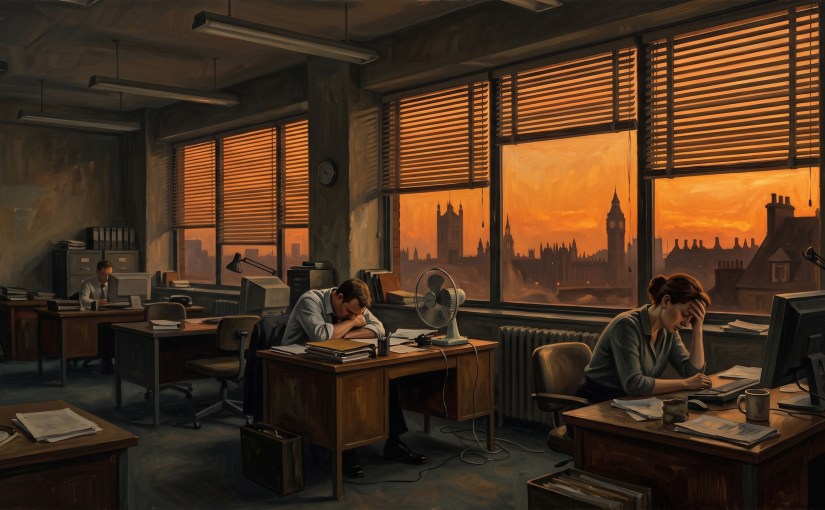
TL;DR: August’s Go Flux Yourself considers, after five heatwaves, what it means to work through a hotter Britain, why the heat falls hardest on front-line and gig workers, and lessons from Sir Joseph Bazalgette’s Victorian sewers …

Image created using Nano Banana
“Future generations will not wonder why we failed to predict the risks. They will wonder why we were so slow to act on risks we already understood.”
The future
How have you been keeping cool during this sweltering British summer?
Stereotypically, we Britons love to discuss the weather, but after enduring five heatwaves, it is a hot topic with good reason. Not one dramatic fortnight everyone remembers for a decade, the way we still talk about 1976, the previous benchmark for a scorchio summer, but a handful of separate episodes, stacked one after another, with a drought and wildfires threaded between them. There were more 30°C+ days by 15 July this year than in the whole of 1976.
Can you imagine what it will be like by the middle of the century? Not this summer repeated, but significantly worse. Temperatures are on a rising curve, heatwaves are lasting longer and arriving more often, and working through them will only become harder. What will be the cost, in terms of health and the economy, by 2050?
In July, the Grantham Research Institute at The London School of Economics and Political Science (LSE) and the Euro-Mediterranean Center on Climate Change (CMCC) put a figure on the June heatwave in the UK: 24 million lost working hours and £1.15 billion of lost output, across seven days. Stretch that kind of week across a longer, hotter, more frequent season, and the expense to the economy stops being an abstraction. The cost to the people living through it is harder to price, but no less important.
Elizabeth Robinson, Director of the Grantham Research Institute on Climate Change and the Environment and Professor of Environmental Economics in the Department of Geography and Environment at LSE, is one of the economists behind that figure, and she is candid about why she reaches for a number rather than a warning.
“I’m always looking for entry points as to how we can accelerate the transition to net zero and keep fossil fuels in the ground,” she says. “By showing the impacts of climate change in tangible ways, that may be one way to drive forward climate action.” A price tag, in other words, does what a graph of rising temperatures cannot: it gives a chief financial officer something to put in a spreadsheet.
Elizabeth and her co-authors have also traced what a single degree does to the workforce underneath that figure in a working paper published last year. A 1°C anomaly increases the probability that a worker cuts their hours by 9.9% and reduces their effort by 9.5%. Crucially, that risk is not spread evenly: workers paid hourly, on commission or by piece rate lose more of both and adapt less, while salaried workers absorb the same heat as reduced effort, without losing a penny.
I asked Elizabeth to project that pattern forward to 2050, and she offered cold comfort. “It’s really hard to imagine what it’s going to be like to be a worker in 2050 because collectively we are not rapidly reducing emissions,” she says. “We’re not just talking about adaptations to workplaces but whether workers can access enough food, whether society is functioning.”
If one degree today already decides who keeps their pay and who does not, several more degrees by mid-century will multiply the inequality. The workers with the least empowerment and room to negotiate, gig workers, the low-paid, and those in front-line public-facing roles, will feel it first and worst. Elizabeth says: “These are the people who wake up in the morning and have to decide: ‘Do I protect my health or do I protect my income?” Britain, as things stand, still has no legal maximum working temperature, only a guideline minimum, and more on that is in the section below.
I put a version of the 2050 question to Dr Shouro Dasgupta, an environmental economist at the CMCC and visiting senior fellow at the Grantham Research Institute at LSE, and Elizabeth’s co-author on the study above. Shouro, who lives in Italy and grew up in Bangladesh, wasn’t drawn to this field by a textbook. It was watching construction workers toil through Dhaka’s heat with no protection at all. When we spoke a few days ago, he was back home visiting family, and as we talked, he could hear a construction crew working outside his window in 40°C heat and 85% humidity. “I have seen people, workers, toiling under high heat,” he says. “My interest stems from the fact that effects on the labour force allow us to understand the effect of climate change on human beings, on sectors, on the occupational health side.”
Shouro is careful, precise, and not given to overstatement, which makes what he says next hit harder. “Our evidence shows that under the current trajectory, or a worsening trajectory, the impacts of future climate change on the labour force and low-wage workers will be severe. No matter which metric you look at, be it their number of working hours, their productivity or their health, it is a catastrophe.”
Then, more pointedly: “No amount of adaptation will be able to protect workers at that rate of warming. The costs of adaptation will exceed any benefits we might think we could get at those levels. We can protect workers in the short run, but in the long run it will be too hot.” Adaptation buys time, but not unlimited time, and those with the least power to negotiate feel the shortfall first. “The highest impact will be in some of the poorest parts of the world: Sub-Saharan Africa, South-East Asia and so on,” he continues.
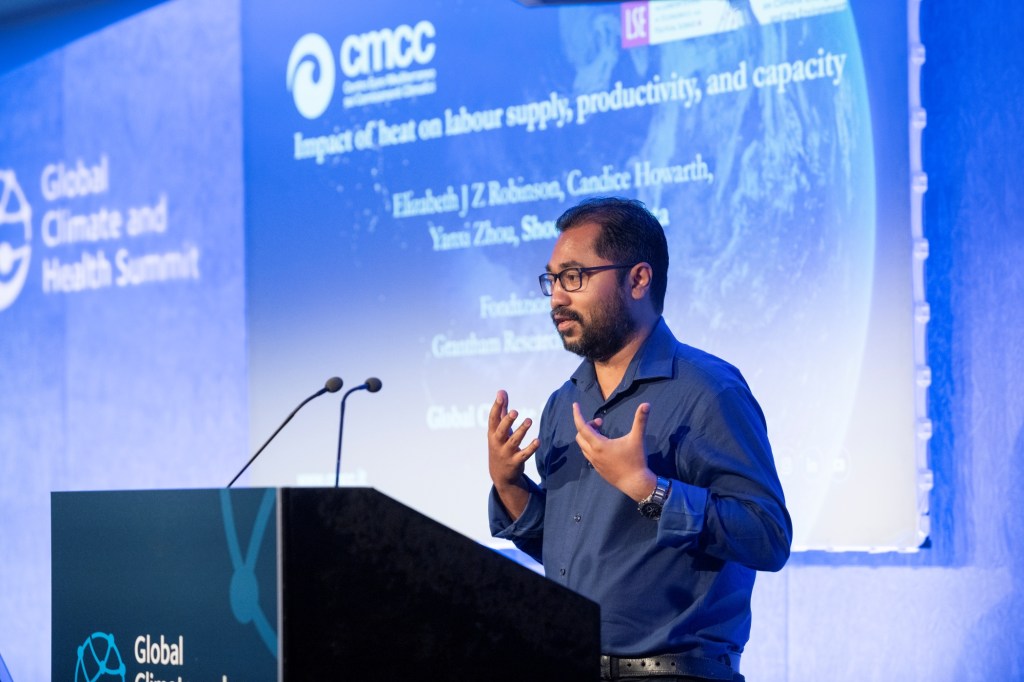
Dr Shouro Dasgupta predicts a climate “catastrophe” no matter what adaptation measures are implemented.
That is his picture of working in 2050: not unbearable everywhere, all the time, but a climate in which the margin most of us currently take for granted has vanished, and the workers who can least afford to refuse the work feel it soonest.
Shouro works at CMCC’s offices in Venice, which gives him a useful vantage point on what happens once a country legislates for this rather than debating whether to. Italy has no single national mandate, but individual regions have introduced ordinances that go considerably further than anything currently on the table in Westminster. The first, in Puglia, followed the death of a migrant worker from heat stress, and now bans outdoor work between 12.30pm and 4.30pm on high-risk days. Campania has since adopted something similar. Amber alerts elsewhere in Italy still fall short of a full stoppage, Shouro says, but “are still better than the non-existence of such regulations”.
Greece has gone further still this summer, suspending outdoor manual work entirely between 1pm and 5pm across four regions during extreme heat, covering construction, shipyards and delivery riders, with fines of €2,000 per worker for non-compliance.
Human-work evolution, the phrase I coined and the reason this newsletter exists, is mostly concerned with technology: what AI does to jobs, and what remains human once it has. But work does not only evolve because of what we build. Rather, it evolves because of what we are forced to endure.
The Climate Change Committee, the government’s climate advisers, has a line for the current reality. “The UK was built for a climate that no longer exists today and will be increasingly distant in years to come,” it writes in its latest assessment, published in May. Apply that sentence to the working week, the office, the shift pattern, the exam timetable, and you understand most of what is currently going wrong.
Left largely unmanaged, the Committee projects that climate damage could cost the UK economy between 1 and 5% of GDP a year by 2050, somewhere between £60 billion and £260 billion annually. Adapting properly would cost around £11 billion a year. It projects that 92% of existing UK homes could be overheating by 2050, an important statistic given the increase in remote working. Only 12% of working adults did any work from home in 2019, according to the Office for National Statistics. As of July, it was around 41%.
This month’s opening quotation comes from Swenja Surminski, who sits on the Committee’s Adaptation Committee, is Managing Director for Climate and Sustainability at Marsh, and is a Professor in Practice at the Grantham Research Institute at LSE. She describes the working week of the 2050s without reaching for anything exotic: outdoor work starting earlier, exams shifting away from the hottest weeks of the year, formal heat pauses built into shifts during the hottest hours, and facilities and supply chains relocating because of flood or water-stress exposure.
“Adaptation is about adjusting, re-scheduling, preparing the building fabric and infrastructure and making decisions well ahead, not when a flood or heatwave is happening,” she says. She worries, though, that it will take a catastrophic event to spur the critical upgrades. “Most adaptation investment still follows a loss event.”

Professor Swenja Surminski thinks “future generations will … wonder why we were so slow to act on risks we already understood”.
The trigger she believes will eventually shift serious capital is blunt: “As investors and insurers increasingly incorporate physical climate risk into their models, adaptation becomes less of a sustainability issue and more of a prerequisite for maintaining asset value and access to capital.” Swenja also chairs the board of the Munich Climate Insurance Initiative, the world’s longest-running not-for-profit that delivers climate resilience and insurance to vulnerable communities, which gives her a foot in the market she is describing.
Dr Chloe Brimicombe, a climate scientist and postdoctoral researcher at the University of Oxford whose PhD built a global heat early warning system, puts it more simply: either we choose to adapt, or the heat forces our hand. “The realistic scenario is that people and policy will catch up, because we almost won’t have a choice,” she says. “If we do it now, we won’t be forced to make that change. Realistically, something will happen. Optimistically, it should happen now, so we’re not forced into something we might regret later.”
Long before anyone reaches a hospital, heat takes its toll, and Chloe lists the typical symptoms: brain fog, disrupted sleep, dehydration, cramps, the kind of everyday depletion that makes an ordinary shift harder without ever showing up in a statistic. And when it does turn serious, the official record still undercounts it. “Heat-related illnesses are underreported in hospital admissions,” she says. “You’re more likely to see an increase in respiratory hospitalisations and heart disease than you are heat admissions.”
Heat exacerbates existing heart and lung conditions, so a death is often recorded as a heart attack rather than as heat. Bear this in mind when you reach the 2026 death tolls in the present section below: they are very likely a floor rather than a ceiling.
Peter Hogg, UK and Ireland country director at global design, engineering and management consulting company Arcadis, whom I have interviewed regularly about the future of cities since 2020, sees the same shift through a different lens: resources. His argument is that the assumption of abundant resources is already breaking down, and that energy is the resource under the most strain, the same strain now bending the climate this edition is about. The International Energy Agency expects data centre electricity consumption to more than double to around 945 terawatt-hours by 2030, roughly what Japan currently uses in a year, while Allianz Trade’s June study put data centre emissions at 286 million tonnes of CO2 in 2025, 57% higher than the IEA’s prior estimate. The technology reshaping how we work is heating the planet, which in turn is now forcing us to rethink how we work.
“I think we, or our successor generations, will look back on the 70 years between the end of the Second World War and 2015 as an aberration, in terms of the ability to assume that whatever you want to build, wherever you want to build it, you’ll have enough energy and enough natural resources,” says Peter. “We’re going to move back into a period where you can only develop and grow where you can bring your own infrastructure and natural resources.”
Growth in parts of London is already constrained because electricity is not available, and cooling itself is an electrical load, so the instinctive answer to heat, more air conditioning, only worsens that constraint in the hottest regions. I put that tension to Swenja as an either/or, and she declines the premise. “Neither should give way. The answer is not simply more air conditioning. Passive cooling through better building design, shading and greener urban environments reduces both heat risk and energy demand.”
Peter also sees the same strain reshaping how cities compete. “What we are seeing significantly now is the rise of the discerning investor and the discerning citizen. Capital, organisations and individuals are being very choiceful about what they’re looking for from a place: if a place doesn’t offer that, I’ll go somewhere else.” Nobody currently lists “tolerable in August” as part of a city’s proposition. By 2050, perhaps they will.
Piecemeal discovery describes British infrastructure policy. It describes British workforce policy better still, because the resource we treat as most abundant and most free is not electricity or water. It is people.
There are, though, glimpses of what can be achieved. A couple of years ago, University College London modelled nine interventions across Greater London and found that cool roofs, essentially reflective white paint, cut air temperature by around 1.2°C, compared with roughly 0.5°C for solar panels and approximately nothing for green roofs. Air conditioning warmed the outdoor environment by as much as 1°C in dense central London, exporting the problem to the pavement where the couriers and street cleaners stand.
This summer, passive radiative cooling made the World Economic Forum’s Top 10 Emerging Technologies of 2026, with SRI International’s Self-Cooling Paint cited for reducing surface temperatures by up to 15°C below ambient.
Elsewhere, Paris has turned asphalted schoolyards into cool islands, aiming for a shaded space within a seven-minute walk of everyone by 2030. Barcelona’s climate shelter network has grown from 70 sites in 2020 to 368. None of it required new technology. All of it required someone deciding that shade was infrastructure rather than decoration.
Government moves slowly on this, as governments do. Employers do not have to wait for it. Let’s have a look at what’s happening now …
The present
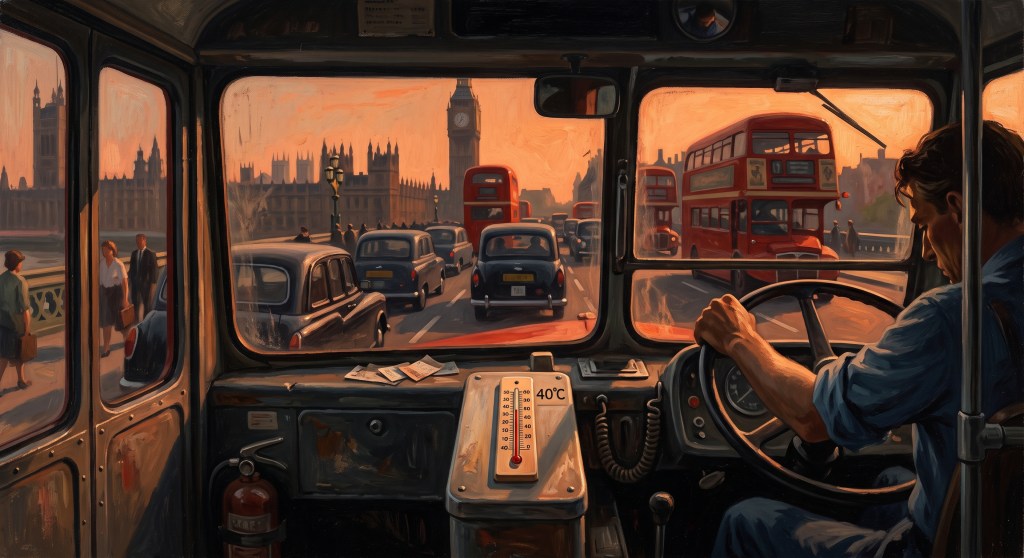
Image created using Nano Banana
While I write and prepare for my speaking gigs from my cool home office, a local friend who works for an NHS Trust in London has been feeling the heat at the hospital this summer. His poorly ventilated office had been above 30°C for days. No remedy was available to him because no one is obligated to provide one (the staff are not even allowed free teas and coffees, but that’s another story). Britain has a guideline minimum working temperature of 16°C, or 13°C for mostly physical work. It has never had a maximum.
Huma Haq, Health and Safety Lead at the Trades Union Congress, explained that her own central-London workplace, opened in 1958, is no better equipped. “Congress House is a very old building, and I was quite surprised how hot it was,” she says. The TUC’s headquarters runs on portable air conditioning units, and the usual expectation that staff spend half their time in the office was suspended during the worst of the heat. Huma is frank about what that reveals. “I realised how lucky I am. I can work from home, but someone who’s a nurse has to come in. There’s no option.” Even the people campaigning hardest for change are working in buildings that fail the same test they are trying to fix, which says less about hypocrisy than about how widespread the neglect actually is.
As it happens, Huma is covering the health and safety brief while a colleague is on maternity leave. This point provided an irony to something else she raised unprompted: heat affects pregnant women, people going through the menopause and neurodiverse workers more severely than most, and no single policy will land the same way across all of them.

The TUC’s Huma Haq has plenty of examples showing how organisations are not supporting employees in the heat.
This illustrates why the heat challenge cannot be solved with one number applied uniformly. A threshold that works for a warehouse will not work for a maternity ward. Policy written for the average worker was never written with a woman managing pregnancy during a heatwave in mind, or even with NHS workers, such as the local friend I mentioned, tending to patients. That is precisely why employers talking to their own people, sector by sector and often person by person, matters more now than ever.
That neglect is not abstract for nurses either. Huma hears the same story repeatedly from across the NHS. “There are loads of cases of nurses feeling faint, because they have to carry out their roles within very old hospitals or buildings that don’t have much more than one fan,” she says. My friend’s NHS Trust is one of thousands of organisations making do with exactly that. A building that cannot cool the ward cannot cool the office next to it either, and the people inside both are expected to keep calm and carry on.
Hospital workers are not the only ones bearing the strain. More than 1,500 Unite members at Arriva North London are striking over cab conditions, with action resuming on August 25 through to October 20. Driver cabs reach 40°C or higher; the air-cooling system reduces the temperature by only 2 or 3 degrees. “You’ve got a case here of an employer saying: ‘We’ve got a system.’ But the workers are saying this system is not effective in keeping us safe,” says Huma. “I would not want someone driving a bus feeling dizzy, having their decision-making impaired.”
If Professor Elizabeth Robinson and friends’ economic figures were not shocking enough – the research put the £1.15 billion figure on the June heatwave – consider the mortality rates that have risen alarmingly in line with the heat. The UK Health Security Agency estimated 2,877 heat-associated deaths in England across the May and June episodes alone, nearly double the 1,504 recorded across the whole of summer 2025. Britain is not suffering alone, though. Across Europe, at least 35,000 more people died than would normally be expected during back-to-back heatwaves this summer, according to provisional figures covering barely half the continent, with August totals still to come. Germany’s public health agency recorded around 14,000 heat-related deaths between April and early August, its worst toll since records began. Spain’s estimated 4,947 deaths make 2026 the country’s worst year on record for heat mortality. France recorded its hottest national average day ever measured.
S&P Global Ratings has already flagged the strain: this summer’s heat has pressured European life and health insurers’ financials, driven by rising claims and worsening chronic conditions among older policyholders, and the agency expects credit pressure to build as extreme heat becomes more frequent and existing contracts fall further behind the risk. It hasn’t yet dented ratings. It is Professor Swenja Surminski’s argument in miniature, the moment before the repricing, and it is exactly the kind of pressure that should be bearing down on Westminster too, given what is happening to the people at the sharp end of it here at home.
With rising temperatures posing a growing health risk to UK workers, the TUC is calling for the Health and Safety Executive, an independent regulator, to update its guidance to require employers to take specific steps to protect workers’ wellbeing when temperatures exceed pre-set trigger points. That call is not coming from nowhere. The TUC’s survey of more than 2,700 health and safety representatives, published at the start of August, found that the proportion citing high temperatures among their top five workplace hazards had risen from 15% in the 2022/23 survey to 38% in 2025/26, with only around a third of workplaces having any specific measures that trigger once it becomes hot.
The regulations governing all of this date back to 1992, and have not been substantively reviewed since. The TUC wants the eventual review to set a work-stopping temperature of 30°C, or 27°C for strenuous work. Thirty-four years is a long time for a rule to sit unchanged while the climate it governs has moved so far.
Elizabeth points out that cows have more rights in this regard. “There’s a maximum temperature that you can transport cattle, but there isn’t a maximum temperature you can transport people,” she says, wryly. We regulate the temperature of a lorry carrying livestock more carefully than the temperature of a hospital corridor, and have done so long before this summer made the gap so obvious.
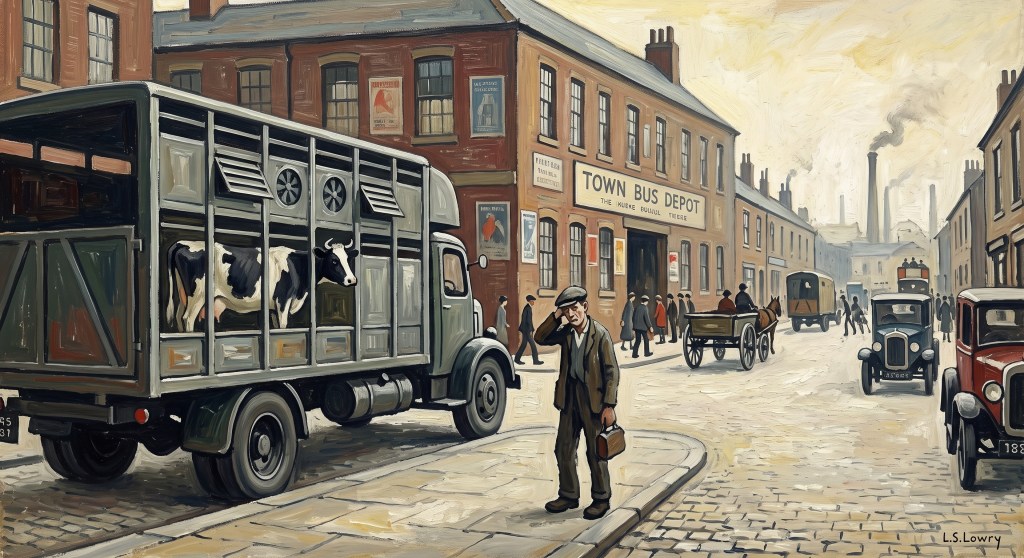
Image created using Nano Banana
Huma sees that absurdity play out again and again, and this summer has given her a stack of examples to prove it. For instance, at the Victoria and Albert Museum, Public and Commercial Services Union members have petitioned for the right to carry their own drinking water, citing members working while dehydrated and some fainting on the way home. A building with climate control for its ceramics and one broken fountain per floor for its people has its priorities expressed in plumbing.
Britain needs a maximum working temperature, but a single blanket figure is the wrong instrument, and Dr Chloe Brimicombe convinced me of that. “You can’t say a firefighter can’t work because it’s too hot, because they need to fight the wildfires,” she says. “That threshold should be developed with individual sectors.” Sector thresholds, with legal force behind them, and genuine consultation with the people doing the work, not a memo from an air-conditioned head office, three decades after the last one was written.
Which is really the point Huma and Chloe both make from opposite directions, and it circles back to my NHS friend who cannot work from home, and to every employer wondering where to start while they wait for legislation. You do not need Parliament’s permission to ask your own staff what they need. “A lot of the time, when we do communication of heat, we’re just reminding people what they know to do anyway,” says Chloe. Consultation beats prescription, in a heatwave as in most things, and it beats it especially for people whose circumstances don’t match the average the policy was written for.
That principle – ask people what they need before deciding for them – is one I’ll be returning to at the end of September, in a different context entirely.
On September 29, I’m joining a live webinar for Zellis, AI Turning Point: Actionable Insight, alongside Nour Shaker-Fayad, Chief AI Architect at Microsoft, and Steve Elcock, Zellis’s Director of Product for AI and HCM. It runs from 11am to midday and explores how public sector leaders move from AI pilots to changes that transform how people work.

I’ll be teasing a new framework: the five Ts, targeting, talent, training, time and trust. The last one is the connective tissue that binds everything above in this newsletter together. Deciding which judgements a system may make on someone’s behalf, and which must stay human, is exactly the question a heatwave forces onto an employer too: does the app decide when it’s too hot to work, or does the person on the shop floor get a say? Whether the technology in question is an AI model or a cab cooling system, the discipline is the same. Ask first. Decide deliberately. Don’t let the tool decide for you by default.
I’ve also just published a new speaker showreel, pulling together keynote conversations and, I hope, a decent case for what I can add to a room as a speaker, moderator, host and journalist. Take a look and let me know what you think …
And the episode of The New Gig podcast, in which I discuss with the host how individuals and entrepreneurs can future-proof themselves in the age of AI, and what that means for education and culture, launched last week.
Human-work evolution was never only about what AI does to a job. This summer, it has been just as much about what the heat does to a person doing that job as about whether anyone in charge thought to ask them first. Britain has been here before, and it is worth remembering how it was solved.
The past
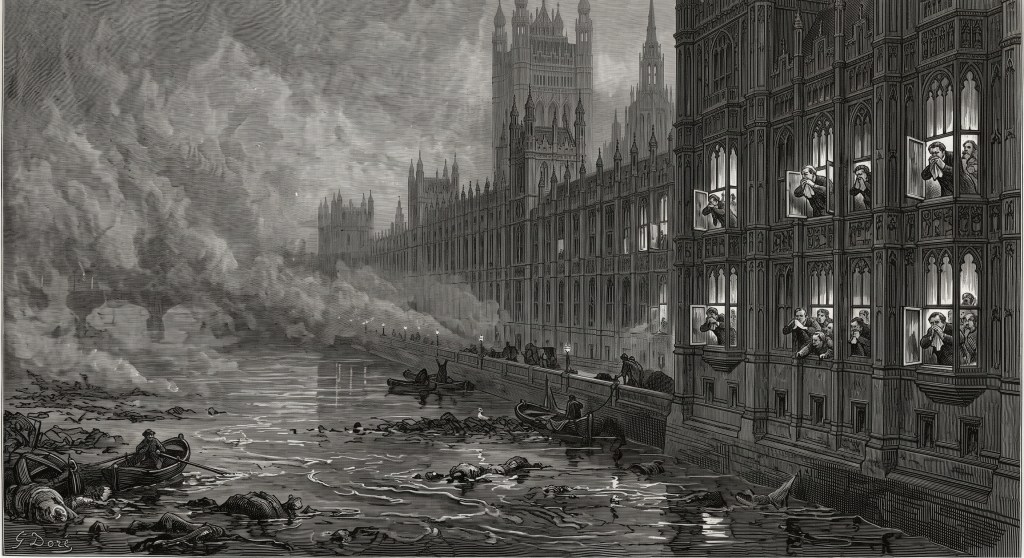
Image created using Nano Banana
By the scorching summer of 1858, the Thames had become London’s sewer as well as its water supply, and everyone with the power to fix that had known it for years. Cholera killed 15,000 Londoners in 1853. Reports were written. Engineers proposed solutions. Nothing moved, because nothing had yet forced anyone’s hand.
Then came the heat, and with it “the Great Stink”. Parliament, sitting directly on the riverbank, soaked the curtains in chloride of lime and debated relocating to Oxford rather than sit through the smell. What changed that summer was not the evidence, which had been on desks for years. It was the point of no return. Once the people who controlled the money could smell the consequences from their own benches, Parliament passed the enabling legislation in just 18 days.
Britain fixed its sanitation not because it learned something new, but because inaction finally became unbearable to the people who held the purse strings.
There’s a reasonable case to be made that this summer is Britain’s stink. Five heatwaves, a death toll heading for a record, buildings that cannot cool the people inside them, and a temperature code of practice unreviewed since 1992. None of this is new information. The Climate Change Committee has been sounding this alarm for years. What may be new is the discomfort finally reaching people who can do more than commission another report.
Whether it has reached that point is the honest question, and I’m not certain it has. Parliament in 1858 smelled the crisis directly, from the same seats where the decision got made. A minister today doesn’t sit in a 40°C bus cab or in a ward with a single working fan. The 1858 crisis climbed the social ladder by accident, because Parliament happened to be built beside the river. Ours has to be carried up deliberately by unions, researchers, and journalists, because heat has no smell that reaches Whitehall on its own.
Once the will did arrive, Sir Joseph Bazalgette, the engineer given the job, calculated his sewer diameters against the densest population he could imagine, then doubled them anyway. His reasoning: the network would only ever be built once, and something unforeseen always turns up. It’s the logic of buying an umbrella twice the size you think you need, because you have no real idea how hard it will rain. That decision is why the system absorbed a city many times the size that the Victorians had pictured, and held on until well into the 1960s.
He built that margin for the wrong reason. Bazalgette believed disease spread through foul air, not foul water, so he was trying to stop the smell, not the cholera. Removing sewage from London’s drinking water killed the disease almost by accident. Wrong about the cause, right about the infrastructure, and his margin was wide enough that the mistake never mattered.
Cool roofs, sector-specific thresholds, a rewritten 1992 code, none of them need a perfect model behind them. They need enough margin that being wrong doesn’t sink you. Britain does the opposite: every intervention priced pound for pound against a narrow projection, margin treated as waste rather than the only sane answer to a future nobody can see clearly.
The 1858 precedent is encouraging in pace: 18 days from stench to statute, with work underway within months. But it leaned on three things harder to find today. A single visible trigger everyone felt at once, which a slow accumulation of heatwaves and rising death tolls doesn’t naturally supply. Decision-makers who personally suffered the consequences, which mostly isn’t happening now. And one engineer with the authority to make a generous call and be trusted to see it through, in an age before tendering rules and value engineering existed to strip caution from every budget line.
Bazalgette’s pipe, commissioned today, would likely be built to the minimum specification, only to be found wanting decades later, at a cost far higher than doing it properly the first time.
The real change needed is not engineering. It’s who feels the cost of delay. Britain lacks a mechanism for placing risk on those with the authority to fix it, rather than exclusively on the people with the least power to do anything about it. Insurance repricing, as Professor Swenja Surminski describes, is one such mechanism. A binding maximum working temperature is another. Public pressure, applied by unions, researchers and, in a small way, newsletters like this one, is a cruder version of the same idea, a kind of slow-acting chloride of lime.
The Victorian sewer eventually became infrastructure for a crisis nobody in 1858 could have foreseen. Rochdale, Kingston and Hounslow are all now drawing heat from sewer networks originally built to solve a very different problem in a very different century. Bazalgette’s margin has outlived his theory by more than 150 years and is still being spent today.
The question this edition leaves open is whether Britain in 2026 can deliberately build that kind of margin, for a risk it actually understands, rather than stumbling into one by doubling a pipe for the wrong reason and getting lucky.
Tech for good: Milkshake / NFU Mutual
Cattle keep wandering into this edition, and it’s not a coincidence. As mentioned in the present section, there’s a maximum temperature for transporting cows (and none for transporting people). Now there’s an insurance product built for cows before one existed for us. Consistent, if nothing else. Think of the cows!
A dairy farmer’s phone can now buzz with an insurance payout before anyone’s walked out to check on the herd. As Bart Simpson would say, “don’t have a cow, man”, the heat’s already been priced in. That’s Milkshake, built by AIR Parametric with Guy Carpenter and Liberty Mutual Reinsurance. It takes the modelling more commonly used to price reinsurance and hedge funds and points it at the farm down the road instead, so farmers can chill when the mercury climbs, even if the cows can’t.
Milkshake tracks the Temperature-Humidity Index, an established measure that combines heat and humidity and reliably predicts when dairy cattle stop producing normally. A farmer sets a threshold: three, five or seven consecutive days above a chosen level, calculated against their own farm and decades of local weather data. Cross it, and the payment lands automatically. No claim form, no adjuster driving out to inspect the herd, no argument about whether the heat actually caused the drop in yield. The thermometer does the underwriting.
It is, for now, a US product, launched in 2024 and expanded in 2025. James Luce, AIR Parametric’s CEO, has said he plans to add “distribution partners across the US and in other livestock regions around the globe”.
British readers needn’t feel left out, though. NFU Mutual launched the UK’s first dairy heat stress insurance in 2023, developed with Skyline Partners and underwritten by Markel, operating on the same index-driven principle: no assessed loss, just a weather trigger and an automatic payout, calculated by postcode and scaled to a farm’s own herd size. Cover runs from £50 to £100 per cow for a minimum of 50 animals.
The NFU’s dairy board chair, Ian Harvey, said in August that members are “continuing to face huge pressures from the hot, dry weather”, which has restricted grass growth and diminished pasture quality, on top of a bluetongue outbreak that’s further straining herds.
Professor Swenja Surminski, who spends her working life at Marsh thinking about exactly this kind of risk, points to products like Milkshake as proof that parametric insurance, paying against a measured trigger rather than an assessed loss, has moved past the pilot stage. Marsh has built one of its own for a different customer entirely: a digital crop insurance app for small-scale farmers that pays out automatically when a local weather station records too much heat, too little rain, or too much rain, ahead of harvest.
A herd’s milk yield is now better insured against heat than a courier’s income. The technology exists, tested, priced, and sold. Somebody worked out cows were worth insuring. Nobody’s worked out that people are, too.
Statistics of the month
🏙️ Cities are where loneliness clusters. Almost one in six adults in England report feeling lonely “often or always”, according to Imperial College London’s INTERACT study of more than 135,000 people, the largest study of its kind conducted in a single country. Nearly 44% said the pandemic made it worse. The loneliest clusters sit in London, Birmingham and Manchester, not the countryside. (Imperial College London)
🎓 Graduate job adverts just hit another record low. Only 8,383 graduate-level vacancies were advertised in July, down 45.6% year on year, the lowest figure since records began in 2016 and worse than May’s previous low. “July’s numbers are a step backwards, not a blip,” said Adzuna co-founder Andrew Hunter. (Personnel Today, via Adzuna)
🤖 Most Americans think chatbots make loneliness worse. They’re twice as likely to say AI chatbots harm people’s loneliness and depression as they are to say they help, 39% versus 19%, with under-30s the most sceptical age group of all. (Pew Research Center, 2026)
🏢 One in five workers can’t get the flexibility they’re asking for. A fifth of UK employees who would like to work flexibly say their employer simply doesn’t offer it. (Employee Benefits, via Health Shield Friendly Society)
✍️ AI is quietly writing much of the internet. Roughly a third of new web pages published today were generated using AI rather than written by a person, and the trend runs well beyond blogs and marketing copy. About a fifth of new Kindle ebooks now being uploaded are AI-written too, often with little or no disclosure to the reader buying them. (Pew Research Center)
If you’re reading this, thank you. If you haven’t subscribed yet, you can sign up for Go Flux Yourself (there should be a pop-up). Please feel free to share it with friends and colleagues too. Each edition lands on the last day of the month.
If anything in this edition struck a chord, particularly the missing maximum working temperature, or the question of whether your organisation is talking to its people about the heat before the next heatwave forces the conversation, I’d like to hear from you.
I’m always keen to help a team or a leader think through their own version of the problem, or simply to tell their story properly. Please get in touch: oliver@pickup.media.


