
TL;DR: July’s Go Flux Yourself examines why the world is so bad at matching people with jobs they’d love. Fix that, and nurture the skills the future of work demands, and everything else follows: productivity, dignity, even social cohesion.

Image created using Nano Banana
“Job creation is the key thing missing from the entire ecosystem of support. The people who regain their dignity are those who can work, use their skills, and give something back. And if I know that isn’t happening, and I know I have the tools to do something about it, I cannot just sit and watch.”
The future
How do we match people with work they would love? Which skills should the children who broke up for summer this month nurture, given they will still be working in the 2080s? And why is an economy that measures everything (clicks, keystrokes, sentiment, the whereabouts of a parcel) still so hopeless at arguably the measurement that matters most: whether the person fits the work?
This month’s opening quotation comes from Oxford-based Washingtonian Giselle Gonzales. Three years ago, she founded EqualReach, a platform that matches displaced people, refugees with real technical and creative skills, with businesses that need digital work done. It builds teams rather than placing individuals, always blending displaced talent with local talent, deliberately, because the point is cohesion as much as employment.
Teamship, not individual brilliance, is the whole idea. It happens to be the same idea that decided the latest FIFA Men’s World Cup.
Spain won it with a substitution on 19 July. Manager Luis de la Fuente sent on forward Ferran Torres, who scored the only goal in the 106th minute, as the lottery of penalties loomed. Argentina brought the greatest individual talent of the age, Lionel Messi. Spain provided a team and system, built over decades, in which every player – including the substitutes – fitted.
Two numbers tell you which philosophy won. Argentina’s goalkeeper, Emi Martínez, made 11 saves in the final alone, a World Cup final record. Meanwhile, Unai Simón, in the opposite goal, made 10 saves in the entire tournament and won the Golden Glove anyway: Spain conceded just once across the whole competition, the first champions in the tournament’s history to manage it. The best goalkeeper of the summer was the one his teammates made nearly redundant.
None of it was luck, either. Spain planted this garden decades ago, in the coaching reforms and academies that produced the 2008 to 2012 golden era, and the same beds are still fruiting: a teenager, Pau Cubarsí, anchored the defence and was named the tournament’s best young player.
A garden doesn’t die on the day you stop watering it, and it doesn’t win you a World Cup the year you plant it either. Regrowing is always harder than maintaining, and workforces obey the same logic: skip the training now, and the bill doesn’t arrive for years. It shows up the day a manager badly needs someone who can read a room or make a judgement call, and finds nobody was ever taught how. This is why I keep saying from stages that the moment to walk the garden is now, while it still looks reasonably rosy from the office window.
None of this is a criticism of HR and people leaders, most of whom know this perfectly well and are fighting for skills budgets against entirely real cost pressures. The failure lies higher up, with whoever decided that developing people was an overhead rather than an asset on the balance sheet.
This summer, Britain offers a preview of what happens when nobody tends the garden. The latest ONS figures, published in May, show that over a million 16-to-24-year-olds are outside education, employment or training – the first time this has exceeded a million since 2013. This news comes as many business leaders I meet insist they cannot hire the skills the AI era demands.
The talent exists. The demand exists. Yet the introduction never happens. We run the labour market like a lost-property office: everything valuable is in there somewhere, but the filing system is organised by date of arrival rather than by what anyone is looking for.
This situation is more than wasteful. It’s expensive, and economists have started counting the cost. Stanford’s Erik Brynjolfsson, whom I featured in April’s Go Flux Yourself, calls human capital the most misallocated asset on the planet, around $200 trillion in the United States alone by his estimate, and warns of the Turing trap: building AI to imitate people rather than complement them.
January’s Wharton–Accenture Skills Index named the underlying fault: a “skills mismatch economy”, in which employers, workers and universities still operate in a role-based world of job titles, CVs and safe signals, while the economy has already moved to a skills-based one.
And new research released this week by Hemsley Fraser further sharpens the point (I’ll add the URL when it becomes available). Four in 10 UK business leaders say technology is the skill they most wish they’d developed earlier in their own careers. Yet three-quarters of those same leaders say human or blended capabilities, balancing digital skills with human ones, plain people skills, and adaptability are what they actually prioritise when hiring someone else. Leaders are chasing the wrong gap in themselves while correctly spotting it in everyone else. Nearly three in 10 (28%) admit they don’t even know which capabilities to train their own people in as new technology arrives.
It’s not a hopeless situation, though. Matching can be learned, like anything else, and there are tools that genuinely help now, if leaders use them for the right job. Here’s where I’d start.
- Decompose the role before you hire. Break it into its underlying tasks and ask which need a human, which need a machine, and which need a human working at a higher level. (The Wharton index is a decent template here.)
- Advertise projects, not just jobs. Internal talent marketplaces, now standard in large firms, use AI to surface skills people never put on a CV, and routinely find the person you need is already on the payroll, filed under the wrong title.
- Widen the pool you match from. Match on interests as well as ability (Age UK – this month’s Tech for good story – pairs volunteers and older people by shared hobbies, because conversation flows where curiosity already lives) and test candidates outside your usual channels through structured, task-based trials rather than keyword-filtered CVs, which is exactly how a refugee-led team ends up delivering for a global pharmaceutical company, as you’ll read below.
The same recommendation engines that know what show you’ll want to watch next could just as easily be matching people to work. Almost nobody’s pointed them that way yet.
But better matching creates its own problem. Once machines become smarter at finding the right person for a task, the smaller, entry-level tasks are the first to be automated entirely, which raises the harder question of what happens to the rungs below.
Jason Foster, founder of AI and data consultancy Cynozure, told a compelling story about the history of container ships when we thrashed it out on his Hub & Spoken podcast earlier in the month – link here for the episode titled As AI gets smarter, what makes humans more valuable?
Containerisation destroyed the dockworker’s job as it existed, and raised the level at which humans worked, out of the hold and into crane operation, port planning, logistics design. Jason’s phrase, “raising the level of abstraction”, is his answer to navigating the AI age.
For instance, take a junior coder whose whole job is writing code exactly as instructed. AI can already do that part. But someone still has to decide what to build, why, and how the pieces fit together, and that person has moved up a level, the way the crane operator did. His argument: the coder who only takes orders is finished. The one who architects, who works at a higher level, moves ahead of the problem rather than being replaced by it.
I admire the idea, yet raising the level of abstraction assumes there’s still a bottom rung to climb from. Graduate opportunities have collapsed since ChatGPT arrived: UK grad vacancies fell 42.1% year-on-year to just 8,398 in May, Adzuna’s job market data shows, the steepest annual decline since the series began in 2016. Saw off the first rung to save money and you haven’t made the ladder efficient. You’ve guaranteed that in 10 years you’ll wonder where all the experienced people went.
The container ship destroyed old rungs and built new ones, in roles nobody had imagined. Ask yourself, as a business leader, which one you’re doing: building new rungs, or just removing the old ones and hoping?
And which skills belong on those new rungs? Be suspicious of anyone with a tidy answer. A fixed list of the 10 skills of 2030 is a map of a country that won’t exist by the time you arrive.
What can be said with confidence is that the capabilities that appreciate as machines improve are the human ones. Dame Minouche Shafik’s line remains my compass: “In the past, jobs were about muscles; now they’re about the brain; in the future, they’ll be about the heart,” the economist and currently V&A Chair said in a 2018 interview. Heart skills will be central to success, individually and collectively. The seven Cs I often talk about – collaboration, communication, compassion, courage, creativity, critical thinking, and curiosity – are increasingly valuable because machines can’t supply them.
One catch, though. These capabilities only grow through use. We already ran the experiment with sat-nav and lost our sense of direction; outsource the effort and the faculty fades. A workforce that hands its judgement to the machines will one day reach for it and find the cupboard bare.
Nobody feels this more sharply than the generation on school holiday. My eldest, Freddie, has just finished primary school. As it stands, he’ll still be working in the 2080s. What kind of work will exist for him, and how will he find the version of it he’d actually enjoy?
Part of the answer is a skill we barely teach, the one that an interview, a pitch and leadership itself all run on: having the communication skills and confidence to make the case for yourself. Kirsten de Bouter Shillam, a communication strategist with 30 years of experience in psychology, coaching, and performance, spent two years in Málaga helping young entrepreneurs pitch to investors. The technical brilliance was never the problem, she found; the founders were gifted, and their pitches “utterly boring”.
Her diagnosis of the school-leavers of 2026 is that they have become “consumers of content, not participants”, unable to recognise their own stories as worth telling. She described asking a room of teenagers for a story and being met with silence. “You’ve been on the planet 18 years,” she replied, “and you’ve got nothing to say?”
From September, she pilots her Human Voice Project in schools, teaching the speaking, debating and storytelling that every curriculum assumes will develop by osmosis. It won’t, and she finds the omission unbelievable: we teach children to read and write for a decade and leave speaking to chance. “We shape the world with the words we choose,” as she puts it.

If you want to see what a well-matched human looks like at full power, though, study Giselle. She calls herself a “justice-seeker”, and means it: her Christian faith and her anger at indignity drive the whole enterprise. “If I just sit and know that’s happening, and I know I have the tools to do something about it, that doesn’t sit well with me,” she told me.
In 2016, as a young freelancer from Seattle, she travelled the refugee route from Lesbos to Germany, documenting displacement for a network of nonprofits. In Serbia, an official-looking Disney jacket from a part-time job carried her past the guards of a repurposed meatpacking facility where busloads of people arrived every 30 minutes. In the family tent, among rows of bunk beds, people had torn strips of fabric into a sign on the ground reading “We are human”. No press were there to read it.
Then, waiting for a train, a man mentioned he had been a designer back in Syria. Giselle’s mind went, briefly, to her own mother, who crochets, and she made the kind of polite noise you make when someone mentions a hobby. He pointed across the crowd. “See that woman’s jacket? I designed that.”
He had lost his country, his home, his clients. He had not lost his talent, only the means to use it. Giselle started noticing it everywhere after that: the accountant serving food in a canteen, the engineer waiting for permission to work, people carrying real skills that nobody around them had thought to ask about.
What she kept coming back to was dignity, and how much of it depends on being seen as a whole person rather than a single story: “displaced”, “vulnerable”, “in need”, rather than designer, engineer, accountant. It’s why, when she built social enterprise EqualReach years later, the whole model is designed around one idea: enable dehumanised people to start working again, being seen for what they can do, and the rest starts to follow.
On 28 July, the 1951 Refugee Convention turned 75. It promised safety and the right to work. Three-quarters of a century later, the second promise remains largely unhonoured, which is the gap EqualReach exists to close.
The matches themselves are the best argument for the model. Alex Pervak ran technology teams as a CTO in Ukraine before the war disrupted his career; through the platform he has built, he has rebuilt his life in Somerset and now consults for Amazon. “People like Alex are not starting from nothing,” Giselle told me. “They are starting from experience.”
Elsewhere, a Palestinian developer built an AI tool for Bayer. A team that includes displaced Gazans delivered an exhibition for One Young World, its design led by an artist working from Gaza itself. A Ukrainian refugee who arrived as talent now works as EqualReach’s own product lead. When Bayer needed an internal video for its 85,000 employees, one of Giselle’s teams made it, cutting the usual production time by an estimated 85%. Even Giselle’s social media is run by one of her teams in Uganda, who chase her when she’s slow to post.
Since launching, EqualReach has created more than 200 jobs and $500,000 in earnings for the people on its platform, and 60% of clients come back for more work once they’ve tried it.
I’d like to set you some homework. For business leaders: audit your organisation the way a football manager picks a team, tasks not titles, capabilities not credentials, and count your rungs before AI removes any more of them. For educators: nurture the heart skills as deliberately as the hard ones, because a generation that can’t tell its own story will lose interviews to machines that can fake one.
The children who broke up this month will work late into this century. Whether those decades feel like a career or a sentence depends on the decisions made now by people who mostly don’t believe matching is their job. Giselle’s standard is the one to aspire to. When you know the mismatch is happening, and you hold the tools to do something about it, sitting and watching is not an option.
The present
Image created using Nano Banana
As of July 20, with Andy Burnham taking the keys to Downing Street, Britain has now had seven prime ministers in a little over a decade (thanks, Brexit!). None of them had time to settle in, build a team, or actually learn the job before the talk turned to who’d replace them.
Anthony Seldon, author of The Impossible Office? The History of the British Prime Minister, made the case in the Financial Times in May. His argument is that stable government requires longevity, that relationships and proficiency can’t develop without it, and that Britain’s habit of churning through leaders and the people around them has hollowed out the institutional experience that once made Whitehall work. Hopefully Burnham will fare better, but he is hamstrung by recent history.
It’s the same failure I keep finding in business. A manager parachuted in to hit next quarter’s numbers, with no time to build a team or learn where the bodies are buried, is akin to a football club sacking its manager every August and wondering why it never wins anything. Short-termism is not a technology problem. It is older than any of us, and AI has simply given it a new excuse.
I made this argument twice this month on other people’s podcasts. On The New Gig, Glen Hodgson and I covered a lot of ground: what the platform economy does to the people inside it, and what individuals can actually do about it. (I’ll share a link to that on LinkedIn when it lands … hopefully soon.)
My answer to “how do you future-proof yourself” was that the question itself, and the phrase “future proof”, is the problem. It implies a finish line, and there isn’t one. The better query is: what do you keep doing yourself rather than handing over to technology? We’re strangely relaxed about outsourcing thinking in a way we’d never be about outsourcing a major purchase (would we?).
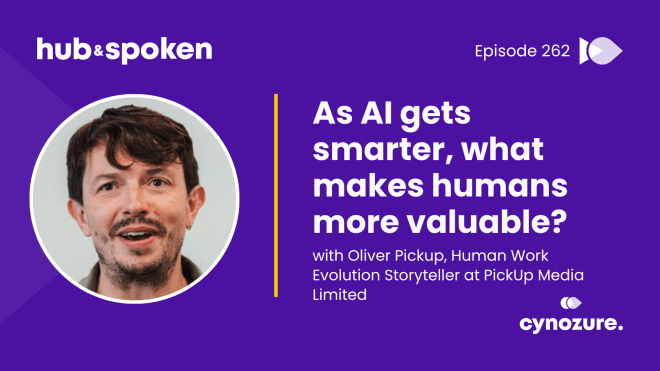
On the Hub & Spoken episode, Jason and I spent plenty of time on the container-ship argument summarised above. Three additional practical tips came out of that conversation that I’d put in front of any leader reading this.
- Protect the friction that builds judgement rather than automating it away entirely.
- Fund the relationship layer because, as routine work disappears, trust becomes what differentiates you.
- And build the new rungs deliberately, because if AI eats the old entry-level tasks, somebody has to design the ones that grow people towards the “level of abstraction” Jason talks about. None of that is expensive. All of it requires believing the problem is real before it becomes visible, which is the entire argument of this edition.
Also in July, What the Flux Just Happened?, my six-month review video, went out, pulling together the first half of 2026’s newsletters: the future of education, cognitive atrophy, big tech’s big tobacco moment, AI’s failure of women, the 60-year working life, the vanishing first rung. (Check it out on LinkedIn here, and see some nifty edits – I’m learning new skills!)

A screenshot from the opening of What the Flux Just Happened?
The past
I’ve spent parts of my career playing out of position, to borrow a football phrase. Competent enough that nobody drops you from the team, wrong enough that you’re never quite where the game needs you.
This whole edition argues that matching people to work they’re suited for is what separates flourishing from merely coping. It took me the better part of 15 years to turn that argument on myself.

Image created using Nano Banana
Twenty years ago, sports journalism looked, on paper, like the obvious fit. I was reasonable at English, studied it at university, and had wanted, more than anything, to play rugby professionally. I wasn’t good enough. Writing about the sport I couldn’t quite play felt like the sensible next best thing, close enough to the thing I loved to count as a version of it.
For a while it looked like I’d called it right. I was accredited, bylined, paid to watch the best in the world do their jobs.
Then I was working an FA Cup final at Wembley, assigned to write a colour piece for a broadsheet newspaper, and I remember standing among the other football journalists as they traded the kind of detail that makes up most matchday punditry: when these two sides had last met, who’d scored in which minute back in the 1970s, the whole encyclopaedic weather system of facts that serious football writers carry around with them. I didn’t know any of it. Worse, I realised I didn’t care.
What I did care about, standing in that same press box, was everything else: the character under pressure, the manager’s face in the tunnel, the story of the substitute who’d spent four years waiting for this exact moment. The scoreline was never really the story for me. The humans playing it out were.
That’s the thread that’s run through everything in my career since. It’s why I coined the phrase “human-work evolution” rather than nod along to “the future of work”: the technology only ever matters in terms of what it does to the people underneath it.
Freddie, my son, changed the course of my career, though not on purpose. Almost 12 years ago, when he was born, weekends stopped being mine to give away. Sports journalism runs on Saturdays and Sundays, the days that were becoming sacrosanct family time, and I found myself resenting a job I’d once considered a dream. I moved into business and technology journalism.
It was a better match: bigger canvas, same underlying subject. The secret I smuggled out of the press box is that I had never really been covering sport at all. I was most interested in telling the human stories behind the results, the people under pressure, and that is the whole story of work now, too.
Then, three and a half years ago, ChatGPT arrived and handed me FOBO, fear of becoming obsolete. A machine could suddenly produce serviceable prose on any subject at a speed no freelancer could live with, and I spent an uncomfortable few months contemplating my own first rung being sawn through in real time.
What I did next, I now realise, was exactly what Jason prescribes: I raised my own level of abstraction. Writing became the foundation rather than the product, and I evolved into speaking, moderating and hosting.
It is the best match of my career, and the tell is simple. I enjoy the work more now than I did at 25, which is not how the standard career script says the graph should run.
I offer this as inspiration and evidence. Every argument in this month’s edition – that matching is solvable, that the heart skills carry you between careers, that new rungs can be built while old ones burn – happened first in my own life, twice over. The designer on the Serbian train platform knew exactly what he was. The system around him simply had no way of finding out. I was luckier. Nobody stopped me from rematching myself, not once but twice, and there was no border in the way either time.
That’s the whole point of this newsletter’s rather rude-sounding name. Go Flux Yourself isn’t a comment on the world. It’s an instruction. Nobody is coming to rematch you. You have to go and do it, on purpose, before the world does it to you instead.
Tech for good: Age UK

Age UK’s Telephone Friendship Service is built on a simple bet: that the technology behind food delivery apps and customer service bots could be pointed at something else entirely, keeping older people connected rather than keeping them scrolling.
“We really think about technology as empowering humans to have that connection,” Alistair Stewart, Age UK’s Director of National Services, told me. The organisation runs two national phone services, both built on Twilio’s platform: the Silver Line, a 24/7 helpline anyone can ring, and the Telephone Friendship Service, which matches a volunteer with an older person for a weekly call.
Technology runs through every part of this service, not just the introduction. Age UK built a platform that cross-references thousands of volunteers and older people at once, by availability and by interest, something no small team could manage by memory or instinct. A volunteer free on Tuesday afternoons who likes classical music and tennis is paired with an older person free at the same time who likes the same things, not because a staff member happened to remember they’d get on, but because the system found the overlap.
The same technology, built on Twilio’s platform, then handles the call itself. Neither party ever sees the other’s phone number: both dial into a Twilio number that connects them, so the volunteer’s identity and the older person’s stay protected on both sides. Every call can be recorded, which means if either person raises a concern, or a staff member reviewing calls spots something worth a closer look, there’s a record to act on. None of that would be possible with a phone number handed over in the old-fashioned way.
That shift, from one person holding both sides of a match in their head to a platform doing it automatically, is what let the service grow. It now sustains more than 4,000 active friendships at any one time, alongside the Silver Line, the 24/7 helpline anyone can ring.
The need behind that growth is significant. Age UK’s research finds 360,000 older people go a week without speaking to a friend or family member, and 3.4 million – one in four older people in the UK – won’t tell anyone they’re lonely for fear of being a burden. Twilio’s Age of Distraction research adds further scale: 29% of UK adults say they feel more isolated than ever, 28% have reduced how often they socialise since the coronavirus pandemic, and 22% go between one and seven days without any face-to-face contact.
Alistair is clear-eyed about where technology should and shouldn’t go. Age UK is exploring AI to handle routine queries on its Advice Line, which takes more than 200,000 calls a year (last year the team helped identify more than £30 million in unclaimed benefits for older people), so that human advisers are free for genuine crises. “That reassurance that a human can give, an AI bot can’t,” he said.
The win-win, as he described it, runs both directions. “What I think is lovely is volunteers gain just as much out of it as the older people.” Some 96% of Silver Line volunteers report being fairly or very satisfied.
I speak from the volunteer’s perspective on this, too. For years I was a befriender through a scheme called Linking Lives, matched with a nonagenarian, Terry, who shared my love of jazz, and those weekly calls were genuinely rewarding on both sides.
The constraint now is people, not technology. Age UK’s Silver Line can currently answer about two in three incoming calls, and the charity wants to grow its volunteer base from a little over 200 to 350 to 500, which would allow it to answer thousands more calls a month.
There’s a sharper way to see why this distinction – technology enabling human contact rather than replacing it – matters right now. BBC One’s new sitcom Ann Droid, which started this month, follows a recently widowed woman in 2029 whose son buys her a secondhand eldercare robot to keep her company. It’s a comedy, and a good one by early reviews, but the premise only works because the anxiety underneath it is real: a society increasingly comfortable outsourcing the job of companionship to a machine.
Age UK’s whole model is built on the opposite bet: that the machinery should handle the matching and logistics, and leave the actual company to a human being. I told Alistair I intend to apply as a volunteer. If any of this moved you, the door’s open.
Statistics of the month
🥀 The garden, unwatered. Employers now report more than a quarter of UK job vacancies (27%) are hard to fill due to skills shortages, even as business investment in training fell 9% overall between 2019 and 2024, and by 13% per employee. The shortage isn’t a lack of people. It’s a lack of tending. (Skills England, Annual Skills Report 2026)
🧭 The heart, priced. PwC’s 2026 AI Jobs Barometer, published in June, finds junior AI-assisted roles are now seven times more likely to demand leadership and face-to-face skills than roles less exposed to AI. Meanwhile, the wage premium for workers with AI skills has tripled in a year, from 11% to 34.2%. The machines are taking the routine work and pricing up everything human that’s left. (PwC UK, 2026 AI Jobs Barometer)
🔌 AI’s electricity bill lands. Data centres now consume 67.7 GW of electricity globally, about 1.9% of all electricity generated on the planet, following 17% growth in a single year. AI-focused data centres increased consumption by 50% during 2025 alone. The US accounts for 43% of global demand. Meanwhile, the UK devotes around 5.8% of its grid to data centres. (IDCA, 2026 Global Energy Report)
📱 We know it, and we scroll anyway. More than one in four UK adults (27%) say the media they consume has a negative effect on their wellbeing, and 51% say they spend more time on it than intended. Among 18 to 24-year-olds, 46% report disrupted sleep and 39% reduced productivity. (YouGov, UK Media Consumption Trends 2026, part 4)
📉 The layoffs and the spending are the same story. US tech companies have cut nearly 140,000 jobs since the start of 2026, a wave that accounts for more than a third of all announced US layoffs this year, even as the same firms pour a projected $725 billion into AI infrastructure. Amazon, Oracle, Meta and Microsoft alone account for almost 50,000 of the cuts. Markets aren’t entirely convinced by the trade: companies citing AI as a reason for job losses have underperformed the Nasdaq by nearly 10% in the following month. (Financial Times, via TechCrunch)
🎤 Over one-third of the U.S. general population considers themselves content creators. How depressing. “These creators are highly active, with a notable 35% directly uploading music audio or video online,” says a new report. Penny for a thought, or song? (Luminate)
If you’re reading this, thank you. If you haven’t subscribed yet, you can sign up for Go Flux Yourself (there should be a pop-up). Please feel free to share it with friends and colleagues too. Each edition lands on the last day of the month.
If anything in this edition struck a chord, particularly the heart skills argument, or the question of whether your organisation is building a pipeline for its future leaders or blindly dismantling one, I’d like to hear from you. These are the conversations I’m currently having on stages and in companies, and I’m always keen to help a team or a leader think through their own version of the problem, or simply to tell their story properly. Get in touch: oliver@pickup.media.


