Go Flux Yourself: Navigating the Future of Work (No. 2)

TL;DR: February’s Go Flux Yourself discusses FOBO – the fear of becoming obsolete – tarot readings, why communication (and not relying on AI) matters more than ever, and leaping out of one’s comfort zone …

Image created on Midjourney with the prompt “the page of swords taking a leap outside of his comfort zone in the style of an Edgar Degas painting”

The future

“It always feels too soon to leap. But you have to. Because that’s the moment between you and remarkable.”

So wrote American author, entrepreneur and former dot-com business executive Seth Godin in his prescient 2015 book, Leap First: Creating work that matters. It’s a fitting quotation. Not least because today is February 29 – a remarkable date only possible in a leap year. 

It’s appropriate also because most of us must jump out of our comfort zones – whether voluntarily or shoved – and try new things for work and pleasure in this digital age. We want to be heard, to be valued. Moreover, there is a collective FOBO – fear of being obsolete (as discussed with suitable levity on the Resistance is Futile podcast this week).

As someone primarily known as a writer, I have felt FOBO in the last 15 months, since the advent of generative artificial intelligence. So much so that when I was sitting in a cafe, waiting for my car to be serviced in November – a year after OpenAI unleashed ChatGPT – I couldn’t help but approach, with nervous excitement, the tarot card reader on the next table, whose 10.30am booking hadn’t appeared. 

I asked: “What’s coming next in my career?”

She pulled six cards from the deck in her hands, although two fell out of the pack, which was significant, I was informed. One of the fumbled cards was The Two of Wands. “This is about staying within our comfort zone and looking out to see what’s coming next,” the reader said. “It suggests you must start planning, discovering who you are and what you really want, and focusing on that.”

The other slipped card was The Page of Swords. “This one – intrinsically linked to the Two of Wands – says that you need to work in something that requires many different communication skills. But this is also something about trying something new, particularly regarding communication, learning new skills, and getting more in touch with the times.”

Energised by 20 minutes with the tarot reader, I’ve leapt outside my comfort zone and re-focused on expressing my true(r) self, having established this newsletter, and a (sobriety) podcast. (I’ve also set up a new thought-leadership company, but more of that next month!) I’m loving the journey. Taking the leap has forced me to confront what makes me tick, what I enjoy, and how to be more authentic professionally and personally. Already, the change has been, to quote Godin, “remarkable”.

And yet, I fear an increasing reliance on AI tools is blunting our communication skills and, worse, our sense of curiosity and adventure. Are we becoming dumbed down and lazy? And, by extension, are the threads that make up the fabric of society – language, communication, community – fraying to the point of being irreparable?

At the end of last month, in the first Go Flux Yourself, I wrote how Mustafa Suleyman, former co-founder of DeepMind, discussed job destruction triggered by AI advancement. He predicted that in 30 years, we will be approaching “zero cost for basic goods”, and society will have moved beyond the need for universal basic income and towards “universal basic provision”. How will we stay relevant and curious if we want for nothing? 

Before we reach that point, LinkedIn data published earlier this month found that soft skills comprise four of UK employers’ top five most in-demand skills, with communication ranked number one. Further, the skills needed for jobs will change by “at least 65%” by the decade’s end. 

Wow. Ready to take your leap?

The present

Grammarly’s 2024 State of Business Communication Report, published last week, exposed the problem of communication – or rather miscommunication – for businesses. Getting this wrong affects the organisation’s culture and its chances of success today and tomorrow. 

Indeed, the report showed that effective communication increases productivity by 64%, boosts customer satisfaction by 51%, and raises employee confidence by 49% – that last one is especially interesting, and it’s worth noting that March 1 is Employee Appreciation Day, which was started in 1995. While I’m sure hardly any companies will appreciate their employees any more than usual, building confidence through better communication is business critical.

There is much work to do here. The Grammarly study found that in the past 12 months, workers have seen a rise in communication frequency (78%) and variety of communication channels (73%). Additionally: “Over half of professionals (55%) spend excessive time crafting messages or deciphering others’ communications, while 54% find managing numerous work communications challenging, and for 53%, this is all compounded by anxiety over misinterpreting written messages.”

Is AI helping or hindering communication?

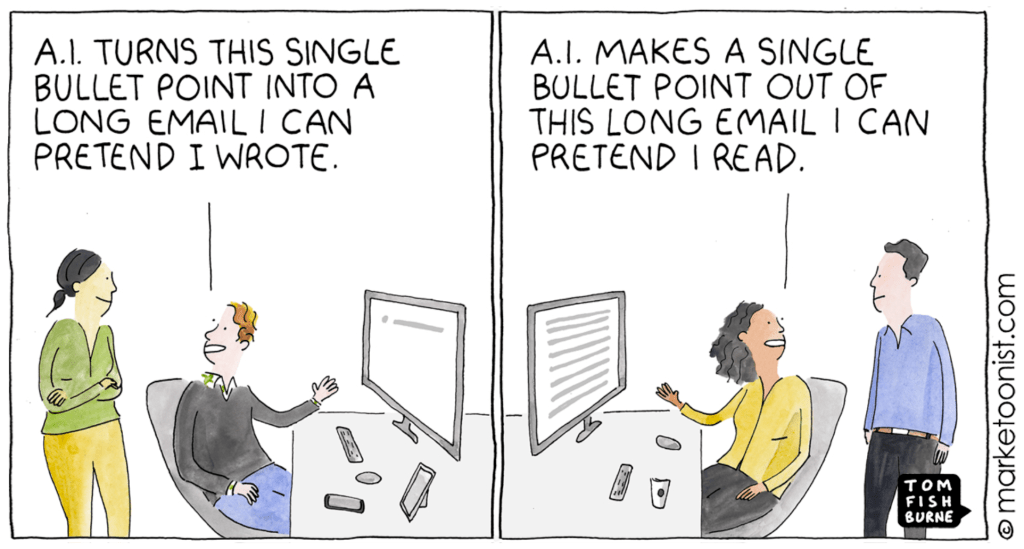
I love this cartoon by Tom Fishburne, the California-based “Marketoonist”, who neatly summarises the dilemma.
Also this month, we marvelled at OpenAI’s early demonstrations of Sora (Japanese for “sky”, apparently), which converts text to video. FOBO was ratcheted up another notch.

Thankfully, I was reminded that most AI is far from perfect – like the automatic camera operator used for a football match at Caledonian Thistle during the pandemic-induced lockdown. The “in-built, AI, ball-tracking technology” seemed a good idea, but was repeatedly confused by the linesman’s bald head. It offered an amusing twist on spot the ball.

Granted, that was over three years ago, and the use cases of genuinely helpful AI are growing, if still narrow in scope. For example, this fascinating new article by James O’Malley, highlights how Transport for London has been experimenting with integrating AI into Willesden Green tube station. The system was trained to identify 77 different use cases, broken down into these categories: hazards, unattended items, person(s) on the track, unauthorised access, stranded customers and safeguarding.

Clearly, better communication between man and machine is essential as we journey ahead.

The past

“My heart is too full to tell you just how I feel … I sincerely hope I shall always be a credit to my race and to the motion picture industry.”

On this day 84 years ago, Hattie McDaniel spoke these words after being named best supporting actress at the 12th Academy Awards in 1940. She was the first black actor to win – or be nominated – for an Oscar. 

The 44-year-old won for her portrayal of Mammy, a house servant, in Gone With the Wind. She accepted her gold statuette on stage at the Cocoanut Grove nightclub in Los Angeles’ Ambassador Hotel – a “no-Blacks” hotel (she was afforded a special pass). However, McDaniel, whose acting career included 74 maid roles, according to The Hollywood Reporter, was denied entry to the after-party at another “no-Blacks” club. A bittersweet experience in the extreme.

We might look back and be appalled by old social norms. Certainly, the pace of progress in certain areas is lamentably slow – after McDaniel, no other Black woman won an Oscar again for 50 years until Whoopi Goldberg was named best supporting actress for her role in Ghost. Still, it is important to track progress by considering history and context.

How long will it be before we have “no-AI” videoconferencing calls? And would that be classed as progress?

I’ve been thinking about the darker corners of my past recently. Earlier this month, I started a podcast, Upper Bottom, that takes a balanced (not worthy, and hopefully lighthearted) look at sobriety. Almost exactly a year ago, I called Alcoholics Anonymous and explained that while nothing tragically wrong had happened, I wanted to reset my relationship with booze. “Ah, you are what we call an ‘upper bottom’,” said the call handler. “You haven’t reached rock bottom but want to change your ways with alcohol.”

Spurred by the tarot reading, and fortified by the ongoing sobriety – April 1 (no joke) will make it a year without a drop – I’m grateful for the opportunity to polish my communication skills, learn new skills (if you want me to produce and host a podcast I would be delighted to collaborate), and build a community via Upper Bottom.

My voice is being heard, literally, and I’m speaking the truth on a human level. In 2024, that matters.

Statistics of the month

  • On the subject of slow progress, only 18% of high-growth companies in the UK have a woman founder, according to a report just published by a UK government taskforce.
  • Nearly seven in 10 UK Gen Zeders are rejecting full-time employment – many as a result of AI and layoff fears, finds Fiverr.
  • And new research by Uniquely Health shows that less than half (49%) of the nation is confident they would be classed as “healthy” by a doctor. Time to make the most of the extra day this year and leap to some exercise?

Stay fluxed – and get in touch! Let’s get fluxed together …

Thank you for reading Go Flux Yourself. Subscribe for free to receive this monthly newsletter straight to your inbox.

All feedback is welcome, via oliver@pickup.media. If you enjoyed reading, please consider sharing it via social media or email. Thank you.

And if you are interested in my writing, speaking and strategising services, you can find me on LinkedIn or email me using oliver@pickup.media

Why the need for leaders to address poor workplace communication is so urgent now

Ineffective communication costs U.S. businesses $1.2 trillion annually, or $12,506 per employee, pointed out by Grammarly Business’s latest State of Business Communication report, published in early March. But are leaders receiving the message that urgent improvement is required? 

The Grammarly Business survey of 251 business leaders and 1,001 knowledge workers suggested connection problems are growing. Time spent on written communication grew 18% compared to 2022, while worker stress levels were 7% higher due to poor communication, and this caused a 15% decline in productivity.

Further, the research, conducted in partnership with The Harris Poll, showed that workers spent over 70% of their working weeks communicating on various channels. Yet 58% wished they had better tools to streamline communication. “Leaders who shrug off the massive impact of poor communication on their bottom line will lose,” argued Matt Rosenberg, Grammarly’s chief revenue officer and head of Grammarly Business. 

Rosenberg said that the results of the second annual report indicated the challenge was growing, causing a “greater impact on everything from operational efficiency to employee and customer satisfaction.” As a result, he urged a rethink of communications strategies. “At a time when the stakes are critically high, leaders who invest in empowering efficient, consistent communication across their organizations will see results and profits climb.”

The full version of this article was first published on Digiday’s future-of-work platform, WorkLife, in March 2023 – to read the complete piece, please click HERE.

‘It’s pulling us apart’: Has the ‘bring our whole selves to work’ trend backfired?

In the post-Covid-19 era, business leaders are advised to be authentic in word and deed, display their vulnerabilities, and encourage staff to bring their whole selves to work. But some argue this has merely opened a can of worms within organizations — an outcome that may be hard to rectify.

Almost half (44%) of U.S. employees said they have actively avoided some co-workers because they disagree with their political views since returning to the office following the coronavirus crisis, according to unpublished Gartner research seen by WorkLife.

Brian Kropp, group vice president and chief of research for Gartner’s human resources practice, acknowledged that events of the last 2 1/2 years have frayed work relationships. Still, in his view, we have brought this problem on ourselves.

“We spend so much time talking about ‘bringing your whole self to work,’ making sure that we’re inclusive and encouraging people to be who they are when they’re in the office,” he said. “Part of an employee’s whole self is their political beliefs.”

As workplaces have become more open and inclusive, they have also invited the day’s political, societal and cultural debates into the workplace. “Unfortunately, in this period of extreme political and cultural tension, that conflict has permeated into the workplace, and now it’s pulling us apart from each other,” added Kropp.

This article was first published on DigiDay’s future-of-work platform, WorkLife, in August 2022 – to read the complete piece, please click HERE.

People are being harsher in the workplace post-pandemic – how did we get here?

Be honest: are you snappier with your colleagues and harsher with your spoken and written words than two years ago? We might not like to admit it, but the pandemic altered us all, to a degree – at work and home. 

Individually, the change might be imperceptible. However, collectively it adds up to a negative conclusion. And if left unchecked, this general lack of positivity will toxify the workplace and corrode relationships.

Brian Kropp, group vp and chief of research for Gartner’s HR practice, expressed his concern for employers and their staff. “There are numerous things pulling employees apart from each other, and that’s incredibly difficult as an organization because the purpose of having a company is bringing people together, to collaborate, and to achieve something bigger than any individual could achieve alone,” he said.

Could this be the start of a worrying trend? “We’re finding that we are entering a period where things inside and outside our organizations are causing the workforce fragmentation,” Kropp added. 

This article was first published on DigiDay’s future-of-work platform, WorkLife, in August 2022 – to read the complete piece, please click HERE.

Tech troubles, urgency bias, bad communication: Hybrid working’s biggest hurdles

New data confirms what most already suspected: hybrid working is not working for a large majority of companies. 

The XpertHR research, gathered from 292 U.K. organizations with a combined workforce of over 350,000 employees, revealed that 95% of companies have struggled to implement a hybrid-working strategy. Reluctant returners – staff who don’t want to head back to the office – are the primary reason for failure. However, there are plenty of other causes besides.

The data indicated that 59% of organizations’ staff spend two or three days in the office, but 37% of employers are unhappy and would rather spend less time there. This finding echoed results from Slack’s Q2 global Future Forum study, which questioned 10,000 knowledge workers in the U.S., U.K., Australia, France, Germany and Japan on how they feel about their work environments and employers.

This article was first published on DigiDay’s future-of-work platform, WorkLife, in July 2022 – to read the complete piece, please click HERE.

WTF is a digital HQ?

Pandemic-induced lockdowns forced many industries to dial up their digital capabilities rapidly. However, thanks to the marvels of technology, we learned that communication and collaboration were possible without being physically present with colleagues, even if “you’re on mute” was an all-too-familiar refrain.

But now that most businesses are firming up their post-pandemic strategies, with numerous organizations around the globe opting for a hybrid-working model, how can leaders strike the right balance between in-office and remote work? 

In a digital-first, post-pandemic world, the physical office is no longer the key place that people connect, it could be argued. Could the answer be a futuristic-sounding digital headquarters with no proximity bias, where communication is transparent and the culture thrives? What many are referring to as a digital HQ?

This article was first published on DigiDay’s future-of-work platform, WorkLife, in June 2022 – to continue reading please click HERE.

Why poor coordination and communication are undermining hybrid working models and making staff miserable

In theory, hybrid working is incredibly empowering for employees as it promises greater flexibility and autonomy. But it’s difficult to get right. In practice, poorly coordinated efforts are causing them to fall short.

What’s worse, those affected often suffer in silence, not raising their concerns, worried about repercussions.

For instance, New York-based finance administrator Stella — a pseudonym WorkLife agreed to — has become wholly demoralized by returning to the office. A toxic combination of poor coordination and miscommunication means that her teammates and colleagues are absent most of the time. 

This article was first published on DigiDay’s WorkLife platform in March 2022 – to continue reading please click here.

Businesses wake up to the immense potential of TikTok

Companies are increasingly cottoning on to the fact that the video-sharing app, once seen as the preserve of the young, is increasingly a powerful marketing tool to reach all ages

TikTok celebrated its recent fifth birthday by announcing that more than one billion people – almost one-in-eight people on the planet – now use the video-sharing app every month.

And its star is only set to shine brighter: a new social media trends report for 2022 by marketing experts HubSpot and consumer intelligence platform Talkerwalker suggests it will continue to expand and “take over social media”, forcing other brands to adapt. This is based largely on TikTok’s highly personalised feed, which curates different content for each user drawing on known interests as well as previous likes and comments on the platform, instead of simply showing them videos from accounts they have chosen to follow.

Given this colossal global reach and potential, combined with the ability to easily record and edit videos of up to three minutes in-app and then share clips to multiple platforms, it’s no wonder that businesses of all sizes are flocking to the platform. TikTok’s growing corporate appeal, including to B2B companies such as financial and technical services providers, has been boosted by a shift in the user demographic. Once seen almost solely as the preserve of the young, the latest user base statistics show that almost one-in-four users are now over the age of 30.

However, despite this promise, getting started can still be daunting to companies unused to using video as part of their marketing efforts. As inspiration, here are five examples of brands using TikTok in unexpected ways to expand their audiences and boost awareness of their services.

•   Sage

In February, Sage – a cloud business company best known for its accounting software – launched the #BOSSIT2021 Challenge, challenging UK small and medium-sized enterprises (SMEs) to use their creativity to showcase their ‘boss it’ moments inside work or out. Over one million companies took the opportunity to show how they were excelling despite the uncertain times. The overall winner was Broken Planet Market, a recycled fabrics clothing company, which documented the struggle to keep up with storage in the one-bedroom flat it is run from after the company ‘blew up’ on TikTok.  A podcast, a yoga company and a jewellery business were among the runners-up in the campaign, which won the Best Use of TikTok Ads category at the UK Paid Media Awards.

Sophie Fresco, a TikTok specialist for communications consultants Hotwire Global, says Sage is continuing to build on that initial success. “Following the triumph of the #BOSSIT2021 Challenge, it asked followers to use #SageTellMe and create their own videos and explain how they are an SME without saying they are an SME,” she says. “The hashtag has over 4.5 billion views, so far.”

•   Harvard Business Review

The renowned business management magazine posts videos on how to “deal with work, school and life” and has over 1.2 million likes. Its TikTok account is an extension of its global Ascend brand, which targets modern young professionals just starting their careers and is not behind a paywall – unlike the content targeted at more mature workers. Paige Cohen, Ascend’s editor-in-chief, told media trade magazine Digiday that: “We introduce younger people to the brand, help them build better habits, help them make better career decisions. And when the day comes that they’re more in the middle of their careers instead of at the beginning, they will turn to the Harvard Business Review content.” She, and other editors, are the faces seen on TikToks on subjects including interview hacks and tips, and Halloween-themed resumé killers to give “more personality and connection to the brand”.

•   Gymshark

“On TikTok, you’ve got to put entertainment and comedy value before your product,” advises Harvey Morton, digital expert and founder of Harvey Morton Digital. He singles out Gymshark, a British fitness clothing and accessories brand which posts content designed to help its users stay active, as using the platform well. “They have built up a large following from posting consistent, quality videos from workouts, workout memes and inspiration,” he says.

Playfulness seems to be the winning ingredient. Gymshark’s profile description states: “Nothing to do with sharks. Something to do with the gym.” On TikTok, the brand has 3.4 million followers, and its irreverent videos about life in the gym – including men wearing crop tops to work out and pet dogs obediently watching their owners lift weights – have amassed more than 51 million likes.

•   Marks and Spencer

M&S dates back to 1884, but its food division has enhanced its modernity by entering the TikTok scene and using the self-parodying profile description “This is not just any TikTok page…”, in a nod to the brand’s famous marketing tagline. By leveraging the reputation of own-brand sweet favourite Percy Pig, piggybacking #FoodTikTok and responding to viral trends and news, M&S Food has attracted 133,000 followers and over 2.3 million likes. A recent video for Hallowe’en, which showed Percy Pig and friends doing an amusing ‘pumpkin workout’ to a spooky song, generated over 110,000 plays in less than a week.

•   Ryanair

The budget airline offers a perfect example of how a sense of humour can trigger a surge in customer engagement and brand presence on the platform. The consistency and tone of Ryanair’s TikTok output has attracted over one million followers. The formula is simple – often images and footage of its planes with superimposed human facial features, or cabin crew sharing common thoughts – but very effective. Set to funky music, the results are amusing but subtly keep attention focused on the airline’s branding and core product of low-priced flights across Europe.

•    Miss Excel

Used well, TikTok can raise the profile of individual entrepreneurs, too. For example, Kat Norton – aka Miss Excel – has danced her way to becoming a full-time spreadsheet influencer by making Microsoft Excel “fun”. Having attracted over 652,000 followers and had one video go viral with over three million views, she has given up her day job as a consultant to focus on being Miss Excel.

She mostly posts clever dance videos containing shortcuts, tips and tricks for the masses, with a subtle message to seek out her courses. Normally, how-to videos are step-by-step posts, possibly with screenshots with helpful arrows. Not so Miss Excel. The message for other businesses is that it’s not just what you do, it’s how you frame it. Even the dullest of subject matters can become fun and excite with a quirky twist.

“You have to have an element of polarity,” Norton told Quartz, when asked what makes a successful TikTok profile. “When you take something as boring as Excel and something so different like dancing and combine them… people are flabbergasted.

Joining the TikTok revolution

So, now we’ve shown a snapshot of how other businesses are embracing the TikTok opportunity, why should yours join them? Top of the long list of reasons to post on the social media platform are that it’s free to use and videos can be as short as 15 seconds in length, so content can be produced and published quickly. Crucially, you needn’t be a big brand or have a big budget to make TikTok a success.

Additionally, Jon Abrahams, global managing director of virtual office provider Rovva and a big fan of TikTok, suggests bearing in mind that while the playful nature of the platform is forcing brands to be more innovative, quality rather than quantity of content is still key.

“It’s important to remember that your business’s TikTok account is essentially an extension of your brand, and jumping on trends that don’t fit with your core purpose and values can make your response appear out of place,” warns Abrahams. “This can negatively impact engagement with your brand. Essentially, don’t try to do everything that’s trending; if it’s not in line with your brand personality, leave it.”

Lastly, remember TikTok’s stated mission to “inspire creativity and bring joy”. In this spirit, businesses should not be afraid to experiment or try doing things differently. And certainly, they ought not shy away from being either bold or quirky with their videos. While there may be an element of trial and error to begin with, those that craft a winning TikTok marketing strategy will discover it can pay off, handsomely.

This article was first published on First Word Media in November 2021