
TL;DR: June’s Go Flux Yourself asks where you would trust a machine to act for you and where you would not, and finds the same answer everywhere: we protect what matters by keeping the friction in it.

Image created using Nano Banana
“Trust is one of the most precious and valuable human currencies that we have. Technology can enable that; it can augment trust, but it should never be outsourced or automated.”
The future
Would you let an AI agent buy your weekly grocery shop? Probably. Would you let it book a holiday, organise your mother’s care home placement, or email your boss while you sleep? Somewhere in that list you stopped, and the exact point where you halted is the most revealing thing about you as a consumer, an employee and a parent in 2026.
I spent the middle of June at London Tech Week as one of the festival’s official hosts and presenters, shaping and fronting the content: welcome films, roving interviews on the show floor, and longer studio conversations meant to outlast the week. Moderating the future of agentic commerce panel was an additional billing, and it was a joy, because it put me in the AI Arena in front of more than 1,000 people, the largest audience I have addressed.
The panel for How are Enterprises Preparing for Agentic Commerce & AI-Assisted Purchasing? gathered senior figures from WPP, Skyscanner, Pandora and HubSpot, and the premise was that the engineering is essentially finished. Payment rails now let an agent check out on your behalf; protocols are multiplying, and Visa built its own version after seeing AI-driven traffic to online merchants climb by 4,700%. The machines are ready to spend your money. But when will we be ready to hand over the reins?
To frame the scale before the doubt: last October, McKinsey valued the global agentic commerce prize at between $3 trillion and $5 trillion by 2030. Gartner goes further on the corporate side, expecting that by 2028, some 90% of business buying will pass through AI agents, with roughly $15 trillion of spend flowing through them. The direction is not in dispute. The readiness is. In its latest State of AI in the Enterprise report, Deloitte surveyed more than 3,000 leaders and found that nearly three-quarters intend to deploy agentic AI within two years, while only one in five has a mature way to govern it. Ambition is sprinting; the guardrails are walking.
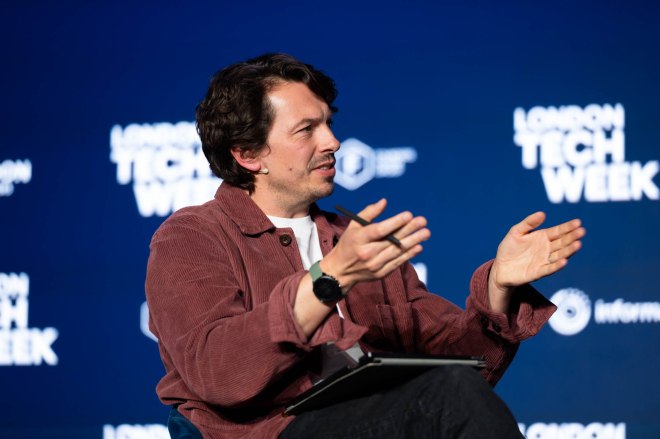
Image from London Tech Week taken via ASV Photography Ltd
One figure complicates all of it. I put a question to the AI Arena: who would hand an agent the final click, trusting it to run a purchase from start to finish with no review? The lights came up, and the hands up accounted for roughly one in 10.
That instinct is not a rejection of the technology, and fresh numbers show how far the rest of the behaviour has already travelled. A January 2026 Omnisend survey of 4,000 shoppers across Britain, the United States, Canada and Australia found that 67% of Britons had used generative AI to shop in the previous six months, up from 55% a year earlier, mostly for the sober tasks of researching products, comparing options, hunting deals and summarising reviews. Some 44% of UK shoppers now rate ChatGPT’s recommendations above a search engine’s, a judgement only one in four held a year ago. The assistant has become a habit.
What it has not become is a proxy with a free hand. The same survey found 77% of Britons comfortable letting AI handle transactions in some form, up from 68% the year before, but overwhelmingly on conditions: that their approval be sought before anything is bought, or that the agent be confined to routine reorders. Only 15% would let it reorder without reviewing first. Comfort is climbing quickly, and it halts at the exact point the panel kept circling, the moment of irreversible commitment. Set that against Accenture’s finding that 74% would trust a personal agent more than their best friend to buy on their behalf “within defined boundaries”, and the apparent contradiction resolves. The boundary is the whole point.
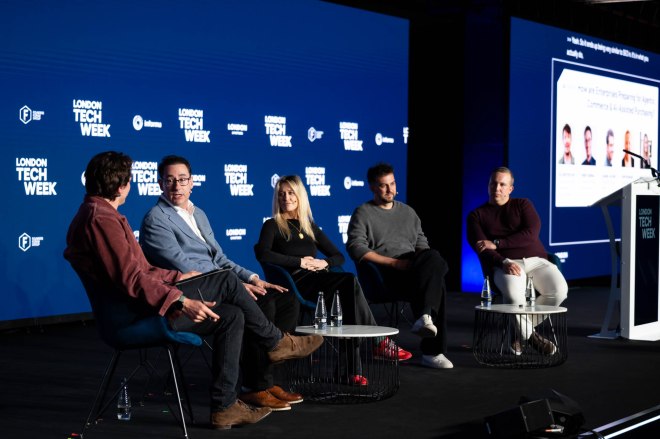
Image from London Tech Week taken via ASV Photography Ltd
The person who has helped me make sense of that boundary is Rachel Botsman. She has spent the best part of 20 years studying trust, lectures on it at Oxford’s Saïd Business School, and wrote the book, more or less, that reframed it for the digital age, although Who Can You Trust?: How Technology Brought Us Together – and Why It Could Drive Us Apart is now almost a decade old. In late May, on stage at the Workhuman Forum in London, she made the case that opens this newsletter: that trust is one of the most precious currencies we have, and the one thing we should never hand to a machine to hold.
Botsman’s definition is deceptively plain: trust is “a confident relationship with the unknown”. She is fond of pointing out that there are more definitions of trust than of love, and that this is the one that has held up over two-plus decades of study. The force of it lies in that last word. Trust is not what you reach for when you know how things will turn out; it is precisely what lets you act when you do not. If you need certainty, surveillance or control, what you have is not trust but its absence.
She uses the example of a friend who monitors her husband’s phone and tracks his location, a marriage that may be transparent but is not, by this measure, a trusting one. Trust, in other words, lives in the realm of possibility, the willingness to step into the unknown, while its impostor, risk, lives in the realm of probability, the measurable and the hedged. Most organisations, she argues, believe they are having a trust conversation when they are, in fact, having a risk conversation, because risk is far easier to set out on a spreadsheet. That distinction does the heavy lifting for everything that follows, because an AI agent at the checkout is the unknown made concrete, and the question of how confident a relationship we are willing to have with it is the whole of agentic commerce in a sentence.
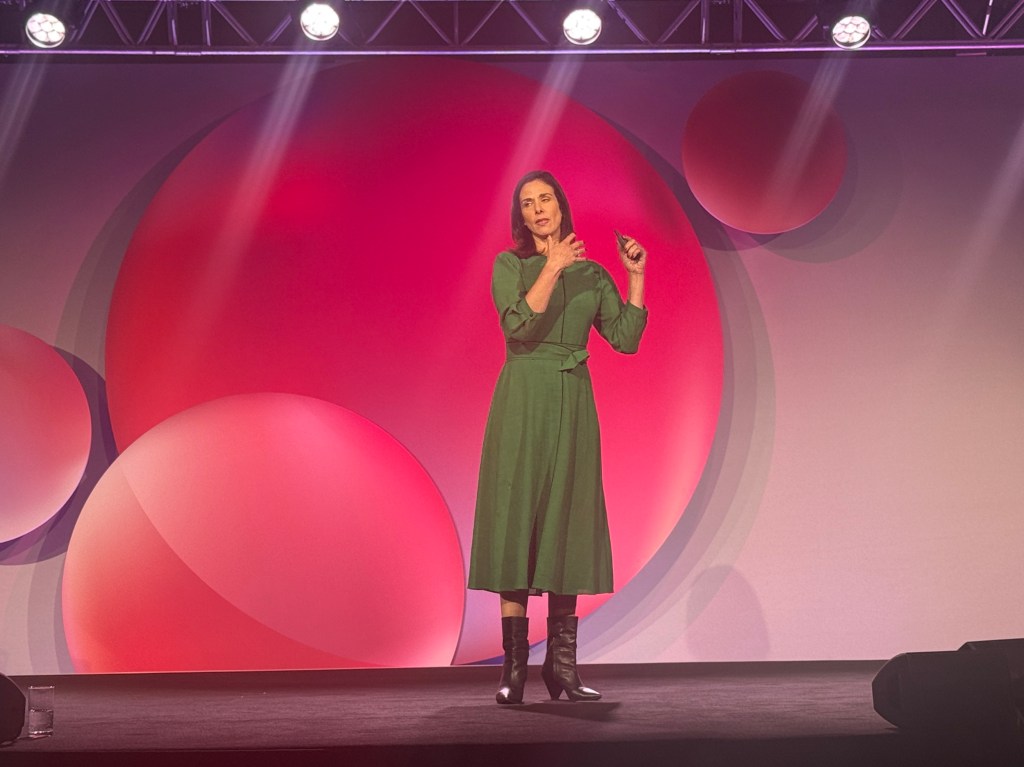
My snap of Rachel Botsman at Workhuman Forum
Her next move is to reject the question almost everyone asks. We want to know whether people trust AI, and her answer is that the question is empty, because trust is never general. The best question worth asking is “trusting it to do what?” You trust Amazon to deliver a parcel and refund it if it arrives broken; you may not trust Amazon an inch on how it treats the people in its warehouses. The trust does not travel between the two. So the 10% in the AI Arena who stuck up their hands were not technophobes. They were drawing a line precisely where the consequences turn irreversible, and reserving that part for themselves.
This is human-work evolution in a single gesture, and the phrase is worth defining, since I coined it to sidestep the usual talk about the future of work, which tends to treat humans as an afterthought. As I said on stage this last month, more than once, “I am interested in what people will do with machines, around machines, and instead of machines. I want us to be carpenters, not the nail at the wrong end of the hammer.” The shopper who lets the agent assemble the shortlist and then pays for the ring herself is doing carpentry. She is using the tool without becoming it. Some things should keep their friction because that’s where the meaning lives.
If trust is a confident relationship with the unknown, every leap into a new technology asks people to extend that confidence before the evidence exists, and one of Botsman’s favourite illustrations is the cash machine. The world’s first Automated Teller Machine (ATM) appeared at Barclays in Enfield, north London, in June 1967, 59 years ago this month, and by her telling, it took the best part of a decade for people to trust it. The history bears her out: a full 10 years on, in 1977, shoppers were still telling reporters they preferred a human teller, because “at least the girl behind the window doesn’t die in the middle of a transaction”. The barrier had almost nothing to do with the technology, according to Botsman. People associated PIN codes with spy films, where typing a secret number into a wall tended to make something explode. Agentic commerce is an ATM-scale leap of the same kind, unfolding now, and the resistance will sit where nobody quite expects it.
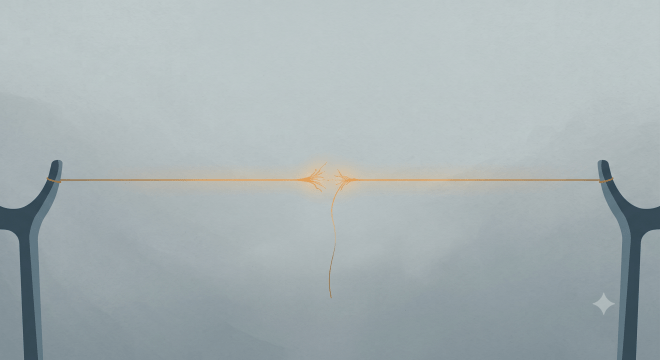
Image created using Nano Banana
To show what that resistance feels like, Botsman played the audience a clip of a woman riding in a self-driving car for the first time, her son laughing beside her as the wheel turned on its own. Within seconds she was shouting the line Botsman wanted us to catch: “Put me back in control.” That is the human response to uncertainty in its rawest form. The instinctive corporate answer is to tighten the reins, to add a checkpoint, a sign-off, a policy. Botsman’s counsel runs the other way: the route into the unknown is not to grip harder but to build solid ground, to make plain what will stay the same so people feel safe enough to let the rest change. Trust, she reminds leaders, is permission, and you earn permission by being reliable at the dull, repeatable things long before you ask for the leap.
That permission rests, in the end, on one trait above the others. Botsman divides trustworthiness into capability, which is competence and reliability, and character, which is empathy and integrity, and she is unambiguous about which carries the most weight. Integrity, she said, is “the most important trait, and it is the trait when trust breaks down”, the one that is “the hardest to repair”. She likens it to “a compass”, “a north star in organisations”, and defines its loss as the moment a person’s interests, intentions and motives stop aligning “with the interests of the team, of the customer, of the public”. The capability half, she notes, technology can already replicate; the character half is where human trust forms, and on whether it transfers to machines at all, she is candid enough to say we do not yet know.
This is where the commercial stakes of the whole agentic shift sharpen, and where companies stand to lose the most, fastest. If a brand lets an agent nudge you toward whatever pays it best, and is later found out, the damage is not a poor recommendation but a punctured integrity, and integrity, by Botsman’s own measure, is the hardest thing to rebuild. The aforementioned Omnisend survey marks the trip-wire exactly. Personalised pricing is the clearest red line: 69% of Britons say that if a retailer used AI to charge different customers different prices for the same item, they would cut back, leave, or post a negative review, and only around one in 12 would shrug it off. A third already suspect that AI recommendations are optimised for the platform rather than for them, or sponsored without being labelled as such. The same engine that helpfully steers you can also sell you, and the moment customers suspect that this is happening, trust does not bend; it snaps.
There is a useful parallel in the cockpit. We are relaxed about a plane flying itself at 38,000 feet, through the long, mathematically tractable middle of the journey. We still want a human hand on take-off and landing, the two minutes at each end where the consequences are total. Shoppers are applying aviation logic to retail.
If we are sensibly cautious about outsourcing the act of buying, we have been remarkably casual about outsourcing the act of thinking. At South by Southwest London, at the start of June, I sat in on a fireside conversation with Gloria Mark, Chancellor’s Professor of Informatics at the University of California, Irvine, specialising in human-computer interaction, who has measured human attention for two decades using sensors rather than surveys. In 2003, the average attention span on a screen was two-and-a-half minutes. By 2012 it had fallen to 75 seconds. Since 2014 it has hovered around 47 seconds. She likens modern life to a cocktail party where you talk to someone for 47 seconds, then turn to the next person, then the next, and the switching itself, she has measured, raises your blood pressure.
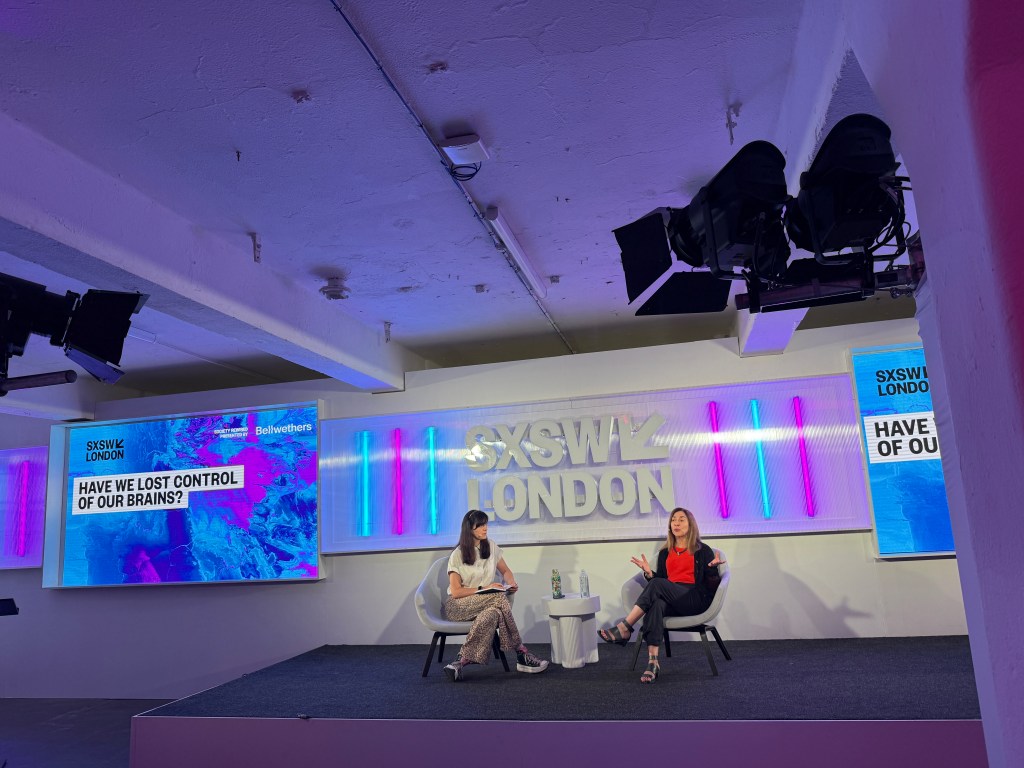
My image showing Gloria Mark sharing her wisdom at SXSW London
Her sharpest warning concerns what psychologists call “depth of processing”. When you wrestle an article into a summary yourself, the effort is what lodges it in memory; you understand it because you struggled with it. “You’re deferring your cognitive work to AI”, she said of the alternative, and “AI is creating a distance between the user and the information”. The thinking that would have changed you never happens. Her own students, asked to summarise a scientific paper with ChatGPT and then unaided, could not explain the AI version back to her; the one they had laboured over themselves, they retained. The brain, she added, runs on a use-it-or-lose-it logic, and the muscle we stop exercising is the one we most need.
Three recent studies point the same way, and I caught her as she came off stage to ask for the references: one from Microsoft and Carnegie Mellon, one from Michael Gerlich at SBS Swiss Business School, and the MIT Media Lab essay experiment that watched, through EEG, the brains of ChatGPT users show the weakest connectivity of any group. We have run this experiment before, with our sense of direction. Ask anyone under 30 to cross a city without a phone, and you will see what a decade of turn-by-turn instructions does to a faculty we no longer exercise.
Mark is no catastrophist. The evidence that social media causes poor mental health in the young, she insists, remains inconclusive, and may run the other way, with struggling teenagers drawn to the platforms rather than harmed into struggling by them. She is watching Australia’s under-16 ban as the closest thing to a real experiment. She is firm, too, that for a gay teenager in rural Montana, or a neurodivergent young person who finds nobody like them at school, social media can be a lifeline rather than a snare. The instruction is not to discard the good with the bad, but to work out for whom a given tool helps and for whom it harms. That nuance is the whole job. Loneliness, meanwhile, is rising worldwide while emotional intelligence falls, and she is unconvinced by the synthetic companions the industry sells as the cure. Apps such as Replika greet you each morning by telling you that you look beautiful today. Real relationships are difficult by design: we learn to read a face, to repair a rupture, to sit with someone else’s disagreement, and a bot that only flatters teaches none of it.
The same worry follows children, and it ran through a roundtable I joined at SXSW London, co-hosted by the futurist and economist Athena Peppes and the parenting psychologist Anita Cleare. Peppes laid out the paradox at the centre of all this. The leaders authorising vast AI budgets, asked which skills they will prize most as the technology spreads, name the human ones every time: judgement, creativity, empathy, resilience. The irony, in her words, is that they invest in “AI tools that remove the friction through which these skills are built”. We are buying machinery that erodes the thing we claim to value, and cutting the entry-level rung where graduates once learned their craft. Sawing the bottom rung off a ladder to economise on rungs is a poor way to lift anyone to the top.
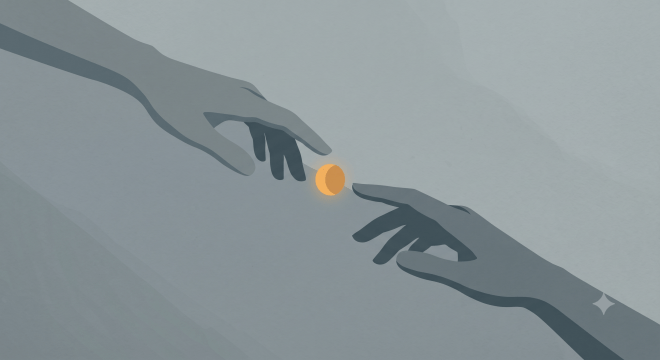
Image created using Nano Banana
Cleare offered an image that hit home. You can buy a child an AI teddy bear that generates a personalised bedtime story about dinosaurs, on demand, for ever. It sounds delightful, yet it is impoverishing, because it removes the productive discomfort of a tired parent reading a book that happens to be about fish, with all the eye contact, negotiation and shared boredom that real reading involves. The drift shows up in the data. The OnSide youth charity’s “Generation Isolation” study, which had YouGov survey more than 5,000 young people across England aged 11 to 18, found that almost four in 10 have already turned to AI for advice, support or company, and that nearly one in five do so because they find it easier than talking to a real person. More than three-quarters said they spend their free time mostly on screens. The children who thrive in an age of AI will not be the ones who used it earliest.
I made two arguments of my own in that room. The first was for a third path between the two exhausting framings of AI, the doom of “it will take your job” and the credulity of leaning on it for everything until your own faculties soften. I call it AI agnosticism: treat the tool as neither saviour nor threat; use it without surrendering to it; be the carpenter, not the nail.
The second built on a point from Ben Whur, who runs a legal campaigning charity and grew up in Lambeth when the borough had 27 youth clubs and now has three. We debate AI as though everyone stands on a level field, when many families cannot afford the device, the data, or the subscription that the apps require. The enrichment that better-off parents buy in place of those lost youth clubs, the tutors and clubs and stimulating screens, is itself an advantage the poorest cannot reach. So the gap opens at both ends at once: among the children priced out of the tools, and among those handed too many of them too soon. None of the seven human capabilities I return to in my work – collaboration, communication, compassion, courage, critical thinking, creativity and curiosity – can be acquired without friction, because friction is the sensation of a skill being built. A gym works because the weights are heavy. Remove the resistance, and you are left with an expensive chair and atrophied muscles.
So the real choice is not whether to use AI but what we are optimising it for. One participant, who used to run learning programmes at the LEGO Foundation, framed it as the difference between an engagement model and a utility model, between technology built to capture us and technology built to serve us, and pointed to a recent Brookings report making the same case. That distinction decides whether all this prediction and personalisation subtracts from human life or adds to it. The clearest proof I came across in June that the utility path is real I have saved for the end.
The present
It was a month of stages, and then a courtroom.
As mentioned above, I was an official host at London Tech Week; I spent three packed days at London Olympia catching speakers as they came off stage for the 90-second clips that feed the show’s social channels, and recording longer studio conversations built to outlast the week.
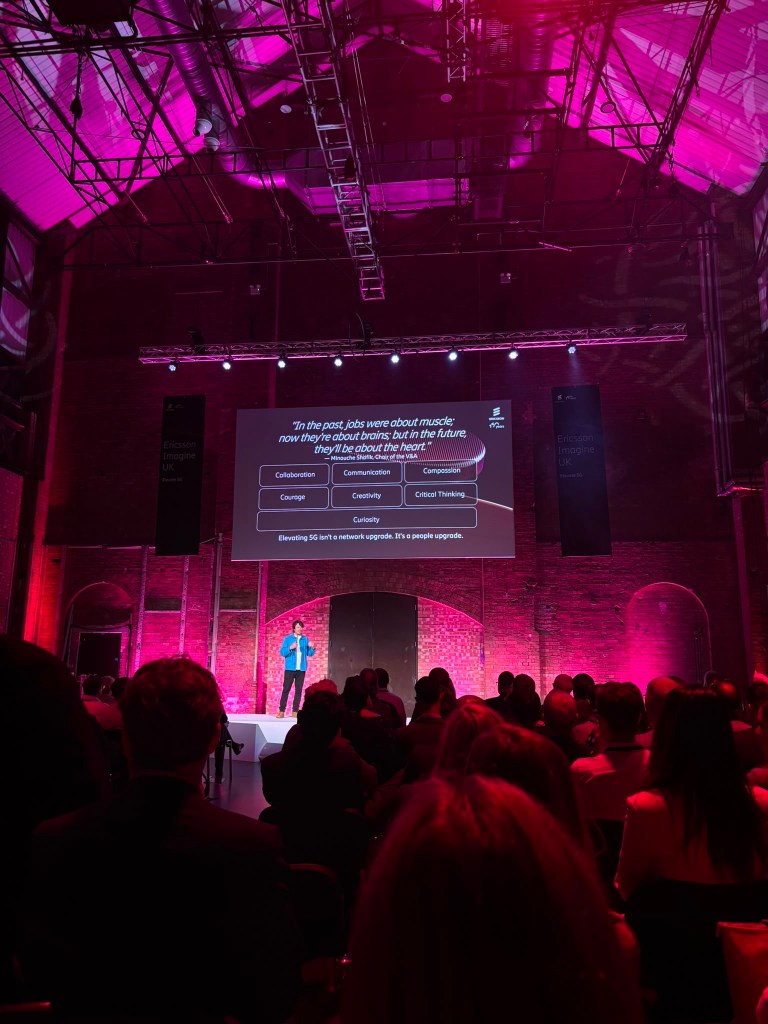
Taking the stage at Ericsson Imagine UK
Then, on 11 June, I opened Ericsson’s Imagine UK conference with a keynote on a problem that looks technical and is not. British telecoms has built remarkable infrastructure, the VodafoneThree merger alone committing £11 billion over a decade, yet the UK has slipped to the 10th percentile globally on mobile download speeds, only 9% of traffic uses the 5G Standalone capability already sitting in 42% of handsets, and close to 90% of operators worldwide still have no effective way to price 5G for business. The pipes are bigger than the revenue flowing through them.
My argument was that this gap is not a technology problem but a collaboration problem, and that the cure is the least fundable thing on any balance sheet: trust between competitors willing to share a network none of them owns. The networks are the muscle and the brain. The part that decides whether they ever pay off is the heart, the relationships and the trust, and it is the part the industry has been underfunding. Elevating 5G, I told the room, is not a network upgrade but a people upgrade. The same holds for almost every organisation now pouring money into AI while starving the human investment that would make it worth anything.
And then jury service, two and a half weeks of it, which finished this morning, with me as foreman. I will say little, and I will name nobody. We found a man guilty on all 19 counts, a list that took in the sexual abuse of a child under 13, rape, and cruelty to children, committed against his two daughters, whom he had groomed over years, and one of whom he had made pregnant. He will be sentenced in September and may not see the outside of a prison for a long time.
After a fortnight of confident talk about frictionless futures in early June, there is clarity in sitting in a courtroom and watching the slowest, most human machinery we have do the one thing no algorithm should be trusted to do: weigh a life. It is fragile and exhausting work. It was stop-start; delays were constant; at one point the judge worked through what should have been her holiday to keep the case moving.
What made it hard in this case was the lack of a “smoking gun”. No single piece of physical proof settled it. It came down, in the end, to the defendant’s word against his daughters’, and to 12 of us deciding whom was telling the truth. The judge gave us careful direction on how to weigh that: what a truthful account tends to look like, what can be performed, and what is very hard to fake. A memory that surfaces unbidden, fractured and specific, is a different thing from a story built to persuade, and if you listen closely for long enough, the difference declares itself.
That is a profoundly human act, and I don’t believe it can be outsourced. There is now a whole industry selling AI lie detection and emotion recognition tools that claim to read a face and score its honesty. In that jury box, I became certain that what we were doing, weighing a person’s credibility against the entire texture of what they said and how they said it, is not something I would hand to a machine, nor something I think a machine can do. The eldest daughter’s courage in coming forward, and in reliving what she did so that we could reach a verdict, is not a data point. It was the case.
There is a sharp irony in what convicted him. Alongside that human judgement, it was technology that helped: phone records, messages, the digital exhaust we all leave behind, turned to the service of two children failed by every softer safeguard. The machine could preserve the evidence. It could not weigh the truth. That line, between what technology can hold and what only a person can judge, is the whole of this newsletter in a single fortnight. The machinery is never the question. The use we put it to is.
Having been wholly consumed by the trial for over a fortnight (the average jury duty is two weeks), I feel such deep relief that 12 strangers were able to work together to change the course of two young girls’ lives for the better. I also feel quite emotionally spent this evening. We jurors can sleep well tonight. (Thank you!)
The past
After a fortnight like that, my mind reached for gentler ground, and – given the men’s football World Cup is in full swing – found a muddy pitch.
Twenty-five years ago, in the autumn of 2001, I arrived at the University of St Andrews, and the following year I founded a football club called The Strokers, named with all the gravity you would expect of a student side. It endures: there is still a Strokers team turning out in St Andrews, and an offshoot I later brought south is still playing Sunday league in London.
My first university tutorial held me, a fellow student named Will, and seven female students, and it took place four years before Facebook, five before Twitter and six before the first iPhone. We arranged to meet by knocking on doors. We fell out and made up in person, because there was no other way to do it.
Will, as it turned out, went on to rather more than Sunday league. I will only say that, in my occasional and ill-advised capacity as team selector, I once kept the future King of the United Kingdom on the bench for a full 90 minutes, a decision I have had a quarter of a century to regret. (For the literal-minded and the legally cautious: the anecdote is offered in the spirit of fond exaggeration, and no future monarch’s centre-half career was harmed in the making of this newsletter.)
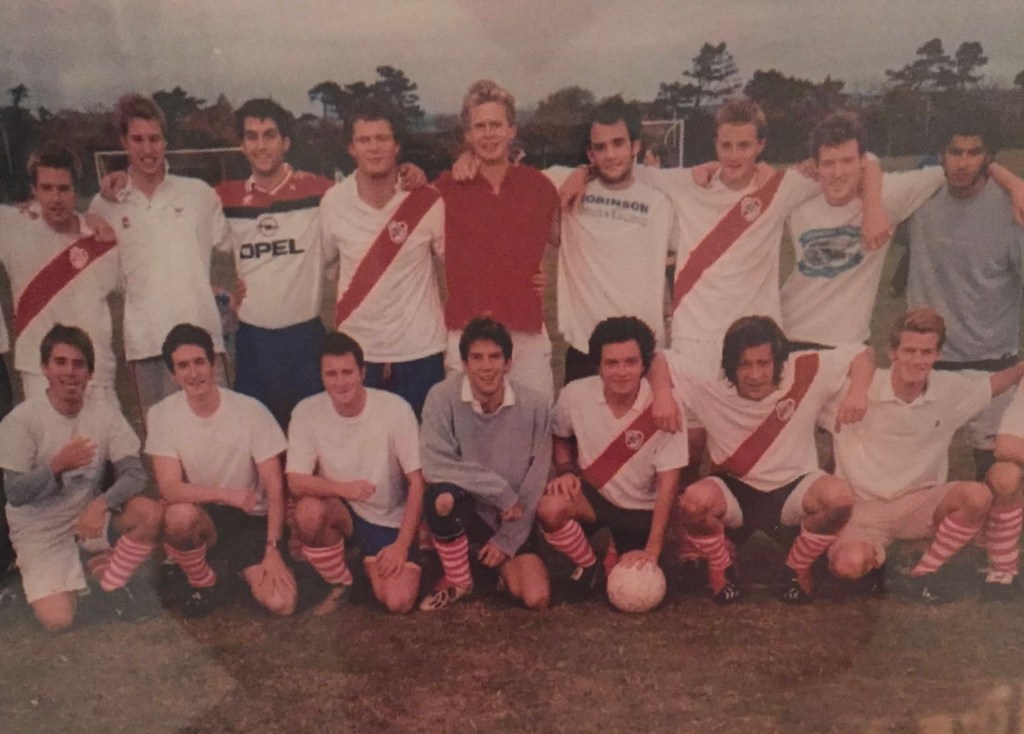
Spot the future human-work-evolution storyteller, and the future monarch
Sunday league is one of the last reliably friction-rich rituals we have left. You turn up in the cold, you talk to people you would otherwise never meet, you lose, and you repair to the pub. It is the opposite of the digital cocoon Gloria Mark describes, in which we venture out less, walk faster, and wear headphones to ward off the chance encounter. With the World Cup in the United States, Canada and Mexico now filling every screen, the point feels timely. The tournament is a vast act of shared, in-person congregation, and even its great modern grievance, the video assistant referee, is at heart a quarrel about how much human judgement we will hand to a machine for the sake of a technically correct decision.
Ask any supporter whether VAR improved the game and you will discover that people forgive a human error far sooner than a correct ruling that took four minutes and strangled the celebration. We do not merely tolerate friction. Now and then we love it. And if England are to end 60 years of hurt on 19 July, it will be down to the three things no algorithm can supply for them: collaboration, communication and the nerve to take a chance.
Tech for good: Homewards
Which returns me to the William who really was at London Tech Week, and the most hopeful thing I saw there, from a tech-for-good perspective. His Homewards charity programme has launched a Homelessness Data Lab, built with Salesforce and the property charity LandAid, in partnership with more than 25 organisations, including Accenture, NatWest and Bloomberg.
The idea is to take the predictive techniques businesses already use, the same machinery that powers the engagement economy, and aim them at prevention instead, reading the warning signs that tend to cluster before someone loses their home: a missed bill, a phone cut off, a child suddenly absent from school. As the Prince told the room, “so many of your customers, your clients, will be using data through banks, through the phones, that I’m not sure you realise how much of that data can be used to predict and see problems with potential homelessness before the action arrives”. His case for it was disarmingly plain: “The earlier upstream you deal with the problem, the better. As we all know, in life, prevention is better than the cure.”
More than 430,000 people face homelessness in the UK, half of them children, and as Salesforce UK and Ireland’s chief executive Zahra Bahrololoumi put it, homelessness is rarely random. It is often predictable, and what is predictable can be prevented. One of the lab’s first tools, an Economic Wellbeing Explorer built on anonymised banking data, is being trialled in Lambeth, the same borough whose vanished youth clubs Ben Whur described earlier, which is a neat illustration of the two faces of the same data: it can map where a community is fraying, or it can be left to do nothing while the clubs close.
This is the utility model the rest of this newsletter has been circling, and the consoling other face of what I saw in court. The same prediction that can be tuned to keep us scrolling or steer an agent toward a paid placement can instead read the warning signs in the data and reach a family before the crisis arrives. Identical technology, opposite intent. We spend a great deal of effort asking what AI will do to us. The better question, the one Homewards answers and the one the whole of this edition keeps returning to, is what we will choose to do with it.
Statistics of the month
🧠 The white-collar exodus. One in three knowledge workers say they are looking to change industry because of AI, rising to 41% among Gen Z, with a quarter eyeing more “AI-proof” manual work. (Adaptavist)
🦻 Low-tech, high-return longevity. Three cheap measures, home-safety improvements, exercise programmes and wider access to hearing aids, could prevent 400 million falls and 2.4 million dementia cases, and unlock $5.8 trillion in healthcare savings by 2040. (World Economic Forum, The Longevity Dividend)
⚽ Sport as an economy. The World Economic Forum ranks sport among the top 10 industries driving growth to 2030 and projects the global sports economy could reach $8.8 trillion by 2050. (World Economic Forum)
🧩 The neurodivergent jobs gap. Neurodivergent jobseekers spend roughly five times longer searching than the national norm, 23.4% of them for more than two years, while only 9.1% feel consistently valued once in work. (Mentra)
🏳️🌈 A good place to live. A global median of 40% of adults across 120 countries say their area is a good place for gay and lesbian people to live, against 44% who say it is not. (Gallup)
If you’re reading this – thank you – and haven’t yet subscribed, you can sign up for Go Flux Yourself (there should be a pop-up). Please feel free to share it with friends and colleagues, too. Each edition lands on the last day of the month.
Get in touch: oliver@pickup.media. I write, speak, and strategise on the future of work, AI, and human capability. For speaking enquiries, contact Pomona Partners.

