Go Flux Yourself: Navigating Human-Work Evolution (No. 27)

TL;DR: March’s Go Flux Yourself asks what a 60-year working life actually requires and finds that almost every institution designed to support it was built for a much shorter one. We are asking people to summit a much bigger mountain with the same kit we packed for a hill walk.

Image created by Nano Banana

The future

“People will need to work longer. But many ageing people in good health will want to work longer, because work gives us meaning, it gives us networks, it gives us a sense of self-worth, and it gives us skills.”

Those words come from Ian Goldin, Professor of Globalisation and Development at the University of Oxford, speaking to the Financial Times this month as part of a remarkable survey of 45 experts, from demographers to a Nobel laureate, on what shifting population patterns will mean for the global economy. Goldin’s argument contains the observation that tends to become lost in the panic about ageing populations: that work, properly designed, is not merely an economic obligation but an important source of identity. The question is whether the institutions built around it are capable of supporting a version that lasts 40, 50, or 60 years.

Imagine it is 2066 in the UK (if nuclear-drone war has not obliterated our planet). You are 62 years old. You started work at 22, as most people do (if, indeed, they opt for traditional higher education, though the value proposition is souring every year, with a rise in freshly minted grads but fewer high-skilled jobs – but that’s another edition of Go Flux Yourself). You have been at it for four decades, and your state pension age, assuming no further adjustments, is still six years away. You are not young, but you are not old. Your knees might disagree, but your brain, provided you’ve bothered to maintain it and keep flexing your cognitive muscle (see February’s Go Flux Yourself for much more on this), is functioning rather well.

Here is the puzzler nobody asked when you graduated: what does a working life of 40 or 50 years actually require that the world around you was ever built to provide? The answer is embarrassingly basic. You need to be able to learn new things after the age of 21, which most institutions treat as an optional extra. You need employers who recognise that the person they hired at 25 will be, by 50, someone with entirely different priorities, capabilities, and tolerance for nonsense. And you need a health system that keeps you functional, not merely upright. Almost none of this exists on a serious scale. We have extended the road by 20 miles and have not bothered to check whether the car has enough fuel.

Consider my friend Charlie Rogers. He is 27, has competed for Team GB, has never held a conventional 40-hour-a-week job, and shows no signs of slowing down. He published his first book, Undefinable Life Design, at the start of March (I was at the Soho launch, a room packed with people of various ages who had noticed that the ladder they were climbing wasn’t leaning against anything they particularly wanted to reach). The book is, at its core, an argument for designing a working life for the world that actually exists, rather than the one our institutions were built for.

His framework is called the Ascent. It has three components: the Purpose Acropolis (your destination), the Energy Toolkit (your capacity), and the Income Pathway (your practical route). A destination without capacity is optimism without oxygen. Capacity without direction is what a lot of people in their mid-career describe when they’re being honest about it, usually around the second glass of something.

Charlie plans his career the way an athlete plans a season. He does not drink caffeine because he says it masks the feedback signal his body is trying to send him. He prioritises seven hours’ sleep above almost everything else (and I’m going to come back to golden slumbers shortly). His running coach, Colin, told him to stop trying to match GB athletes’ pace and think instead about sustainable progression.

“He was like: ‘You must have some days where you just do less,'” Charlie told me. “‘Chill out, take down the tempo.’ We built fitness and reached the goal from a much more sustainable design rather than one of constant injury, burnout, overwhelm.”

That, though, is not a running tip. It is a philosophy for a 60-year working life. And it directly contradicts the operating model of most organisations, namely: sprint from quarter to quarter, reward availability over effectiveness, treat rest as a break from the method rather than the method itself.

The idea that we should even have a concept called “retirement” is, in historical context, brand new. The German Chancellor Otto von Bismarck invented it in 1889: the world’s first state pension, passed through the Reichstag on May 24 of that year. The qualifying age was 70. Average life expectancy at the time was around 40. As the Deutschlandmuseum notes drily, few people lived long enough to cash in. It was, in practice, the most fiscally conservative welfare programme ever devised: a promise to pay people a pension at an age almost none of them would reach.

The retirement age was lowered to 65 in 1916 (by which point Bismarck had been dead for 18 years), and the basic architecture has barely changed since. Germany’s current retirement age is set to reach 67. Life expectancy is over 81. That is 136 years of demographic transformation met with a three-year policy adjustment.

The British demographer Paul Morland, who featured in the aforementioned FT study, called the broader optimism about working longer and deploying robots as akin to “rearranging the deckchairs on the Titanic”. I think the truth sits somewhere less dramatic, but no less urgent. We are not sinking. We are simply trying to cross an ocean in a vessel designed for a river.

Professor Andrew Scott, one of the world’s leading experts on the economics of longevity, points out that lumping everyone over 65 into a single category and assuming they are a deadweight on the economy is, in his words, “just crazy”. He calls for investment in human capital in the second half of life. One in five people who retire are back in employment within two years, Scott stated for the FT article. The retirement they imagined and the retirement they get turn out to be different things. The cosy retirement ambition of a newspaper, pipe and slippers is so last century.

Should we, then, retire the idea of retirement? Do we not need work, to be stimulated, to feel useful, as per the quotation at the top of this edition? I see a little of this in my own parents. Both lawyers by trade, now in their seventies, they are still working in some capacity, my Mum as an artist and my Dad as a pro bono legal advisor (mostly for local sports clubs).

I have previously interviewed both Scott and Lynda Gratton, his co-author on The 100-Year Life (published in 2016, and widely credited with reframing the longevity conversation from a pension problem into a life-design problem). Gratton is a Professor of Management Practice at London Business School, a Fellow of the World Economic Forum, and one of the foremost global thinkers on how work is changing.

Her follow-up, Living the Hundred Year Life, is due to land in September, and shifts focus from the economic case for longer lives to what she calls the “threads” that hold those lives together: productivity threads (mastery, knowing, cooperating, and amplifying through AI) and nurture threads (friendship, intimacy, calm, adventure).

In a recent webinar, she shared an especially insightful finding from her recent studies: the executives who rate their productivity threads highest almost invariably rate calm lowest, even though her data shows the two are inseparable over any meaningful timeframe. Roughly one in five leaders have genuine calm as an operating mode. Yet calm is not the reward at the end of a productive stretch. It is what makes sustained productivity possible in the first place. Trying to reach calm by first maximising output is like trying to sink into sleep by thinking really hard about it.

Lucy Standing, founder of the career-change community Brave Starts and co-author of Age Against the Machine, forthcoming in April, has spent years studying the gap between what longer working lives require and what organisations actually provide. Her four career archetypes (Advancement, Stability, Recalibration, Transition) are deliberately age-agnostic, because the data doesn’t support the assumption that what you want from work stays constant across a 40-year career, let alone a 60-year one. What people want at 25 (status, money at priority two or three) is genuinely different from what they want at 55, when purpose, flexibility, and collegiality move to the front, and money drops to priority six or seven. This is not a failure of ambition. Rather, it is what maturation looks like.

She makes another crucial observation. How many graduate schemes do you come across? Plenty. What about career-changer programmes for someone in their forties? Almost none. The NHS, the largest employer in Europe, has over 100,000 vacancies and has consistently resisted structured midlife retraining, Lucy points out. “Their entire recruitment strategy probably should be asking who in their forties wants to retrain into becoming a medical professional,” she said. “They’d fill all of their vacancies tomorrow if they just thought a little bit more about the values of their organisation and what might sit with people at a different stage of life.”

As I’ve quoted in the newsletter before, Minouche Shafik’s lovely line – “In the past, jobs were about muscles; now jobs are about the brain; in the future, jobs will be about the heart” – is central to my thoughts around human-work evolution. If that is true, then the NHS is sitting on a vast reservoir of the human capital it needs and refusing to build a pipeline to reach it.

Another of Lucy’s predictions is worth flagging. “By 2030, we’re going to have more people working freelance and gig than full-time,” she told me. “Google and PayPal already employ more people as gig workers than they do full-time employees.” If careers are no longer linear, the honest employer value proposition is not: we’ll invest in you for life. It is: we recognise you’re using us as a stepping stone, and we’ll help you make the most of it. Accommodate the side hustle. Support the retraining. Stop pretending the deal is permanent when neither party believes it.

The trouble, Lucy says, is that nobody wants to go first. “The first question I get asked isn’t ‘talk us through how this can happen’, because it’s so obvious that it makes sense. The first question is: ‘Who else is doing it?'”

Now consider the cohort for whom this 60-year career is not a projection but near-certainty. The graduate salary premium in the UK has collapsed from 80% above non-graduate earnings in 1999 to 45% today, according to a typically brilliant John Burn-Murdoch data-led piece in the FT last month, while 41% of workers now hold a degree, up from 20%. In the US, over the same period, the premium rose from 80% to 92%. Something structural, not cyclical, is happening to the value of education in Britain.

And an alibi is being assembled. In 2025, AI was cited for more than 54,000 US layoffs. Yet, in the same Guardian piece, Forrester projects only 6% of US jobs will be automated by 2030.

Steve Elcock, Director of Product (AI) at Zellis, provider of AI-enabled payroll, HR, and workforce management software and services, brings a different lens. His background is in neuroscience, and he talks about using AI in an “ascendant” way: not as a crutch or a replacement for thinking, but as a means of operating at higher levels of abstraction. “What’s unique about AI is it’s encouraged us to think about not just hard data but about abstract layers,” he told me. “Challenging ourselves as humans to think higher all the time. That’s the right way of thinking about it.” His phrase for the choice facing every worker, “be the carpenter, not the nail”, is one he borrowed, he told me, from January’s Go Flux Yourself.

Neuroscience underpins this notion: the brain’s synaptic connections turn over every fortnight to four weeks, while understimulated pathways atrophy. What the brain practises and what it abandons across a 60-year career will matter enormously. Steve’s concern is a drift from knowing things towards knowing where to look things up. “It’s not about what you know any more,” he said. “It’s about how you acquire it.”

He has sons in their late teens and early twenties, all in higher education, and watches the divergence in real time. “I’ve got one who’s a carpenter, one who’s a nail,” he said. “One really sees AI as an opportunity to get on in life. The other just wants it to do his homework.” The technology is the same. The orientation is what differs.

Steve’s vision, and the one embedded in Zellis’s new AI-integrated HR platform, is technology in service of human flourishing: AI that helps people think at higher levels, not lower ones. The people using it to ask better questions are gaining ground. The people using it to avoid the questions altogether are losing capability they may not notice is gone until they need it.

Charlie is 27. He will very likely still be working in 2066. “You cannot conquer the mountain,” he writes, “if you are exhausted at basecamp.”

The organisations now asking people to work until 68 might want to consider whether they are building basecamps or burning them down, by design or rather design failure.

The present

Last week, a California jury found Meta and YouTube liable for deliberately designing addictive products. A young woman called Kaley started YouTube at six and Instagram by nine. By 10, she was depressed and self-harming. At 20, she told the court she still cannot live without the platforms. A jury overwhelmingly found in her favour, and she was awarded $6 million in damages. But the legal theory matters more than the number: for the first time, the platform design itself (not the content) was found defective and capable of causing personal injury, sidestepping the Section 230 shield that has protected tech companies from liability for two decades. As one juror told reporters: “We wanted them to feel it.”

Image created by Nano Banana

The same week, a New Mexico court ordered Meta to pay $375 million for misleading consumers about child safety on the platform. Internal Meta communications, now part of the public record, acknowledged that engagement-based algorithms reward negativity and that the company’s financial incentives do not appear aligned with its stated mission. Thousands of similar cases are pending. The Tech Oversight Project, a Washington DC watchdog, said plainly: “The era of big tech invincibility is over.”

Again, be the carpenter, not the nail. These platforms were designed to make their users into nails. The California verdict is the first legal recognition of that fact.

To connect this watershed-moment news to the golden thread of this edition, the people entering the longest working lives in history grew up entirely inside these social media systems. The synaptic formation Steve describes (pathways built and abandoned across childhood, every two to four weeks) occurred in products that, it is now confirmed en masse, designers knew were harmful. If the 60-year career demands sustained cognitive capability, how can we measure the damage that those early years did to the substrate?

Gallup’s World Happiness Report 2026, published on 11 March with a focus on happiness and social media, sharpens the picture. In eight of 10 global regions, young people’s well-being is higher today than in 2006–2010. The exceptions: Western Europe, the US, Canada, Australia, and New Zealand, which rank 122nd to 133rd out of 136 countries for under-25 happiness change. Something is happening in the English-speaking world that is not happening elsewhere.

PISA data across 47 countries shows that teenagers using social media seven or more hours a day have significantly lower well-being. For girls in Western Europe, the gap between heavy and light users is almost a full point on a 10-point scale. But the most important finding is about belonging. Going from low to high school belonging raises girls’ life satisfaction in the UK and Ireland by four times more than reducing social media use. Across all 47 PISA countries, the belonging effect is six times larger. The policy conversation has been almost entirely about screens. The data says it should be about belonging.

There is a product-level irony, too. After a month without Facebook, people reported being happier, yet would demand significant payment to stay off it. Young people surveyed said they would pay to have Instagram and TikTok removed from their communities entirely. Not from their own phones. From everyone’s. That is not the response of empowered users. It is the response of people who know they are trapped. (The report itself includes an important caveat: heavy social media use is “an important part of the explanation” for declining youth well-being in the West, but not the whole story.)

On the subject of what the kids want, earlier this month, I moderated a panel at Economist Impact’s Sustainability Week: “Future-proof or flawed? Bridging the gap between Gen Z passion and commercial capability.” Notably, a 2025 UK poll of 2,307 people aged 16–29 found that young people identified financial worries, work pressures, and job security or unemployment as their top three sources of anxiety. Climate change and environmental concerns ranked last out of the 13 issues presented. While the youth may be ecologically aware people, they are in the phase of life where money matters most, as per Standing’s analysis.

Meanwhile, only 3% of leaders said they currently have the green skills their organisations need. Mae Faugere of Climate Fresk made a point that connects directly to Lucy Standing’s argument: the real opportunity for structural change belongs not to Gen Z, whose passion is genuine but whose institutional power is limited, but to older generations who have the money, the safety net, and the authority to act. You cannot hire your way out of a talent vacuum. You have to build the capability.
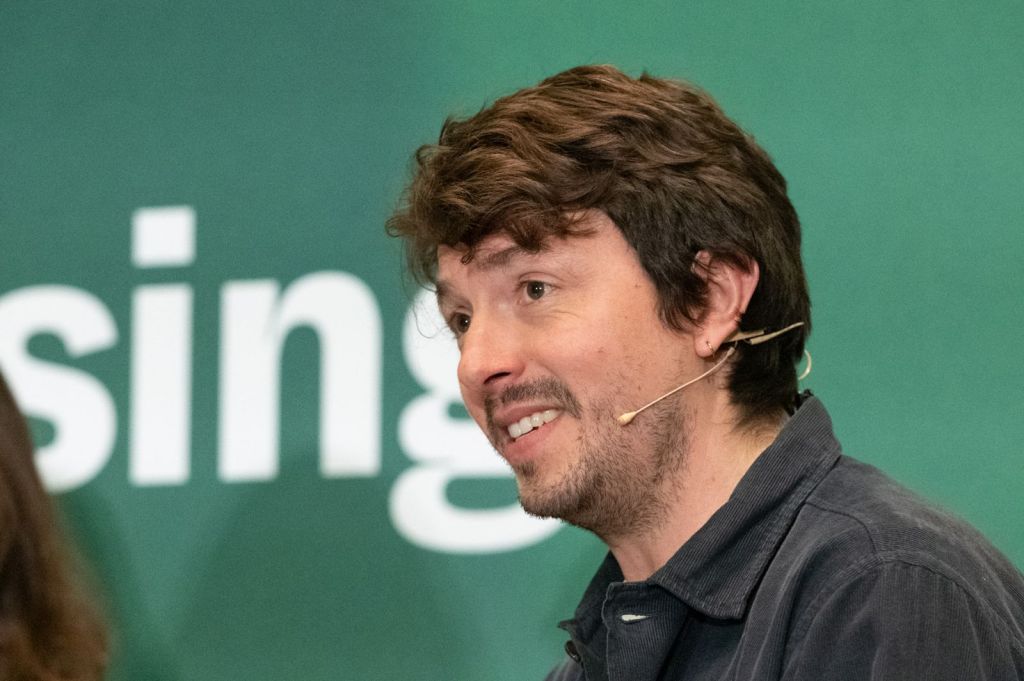
Image from Sustainability Week 2026

Now for the golden slumbers I promised. Charlie’s coach designed recovery into the training programme because without it, the training doesn’t work. Lynda Gratton’s research says the same thing about calm: it is not the reward at the end of productivity but the precondition for it. Both depend, at the most basic biological level, on sleep. And sleep is precisely what certain industries have decided their workers can do without.

In February, Kathryn Shiber, a former junior analyst at Centerview Partners, one of Wall Street’s more prestigious investment banks, reached a settlement in her case against the firm. She had a diagnosed mood and anxiety disorder. She had been granted, then stripped of, a guaranteed nine-hour sleep window, and was dismissed after three weeks. The settlement arrived, with impeccable timing, just weeks before World Sleep Day on March 13.

When did taking care of your recovery become a sackable offence? The judge who allowed the case to proceed had noted that Centerview never formally codified its working-hour expectations: the 3am demands were cultural norms presented as essential functions. We will not now get a jury’s answer to whether round-the-clock availability is genuinely essential or simply the way things have always been done. But the question hangs in the air, and it applies well beyond Wall Street.

The 996 culture (9am to 9pm, six days a week) has spread from Chinese tech firms to pockets of Western finance and Silicon Valley, and its adherents wear the hours like medals. The science says they are medals for the wrong event.

Dr Deborah Lee, a GP and sleep specialist, is not interested in whether 996 feels exciting, but what it does to the brain. After 16 continuous hours awake, she told me, cognitive performance measurably deteriorates: reaction times, accuracy, emotional regulation, working memory. The Mental Health Foundation found the average UK adult manages just three good nights’ sleep – seven hours or more – a week. We are not, as a nation, starting from a position of strength.

Dr Lee’s proposed intervention is the workplace equivalent of what Colin told Charlie: design recovery into the system, do not leave it to the individual. Her version is a default protected overnight communication window for non-urgent work, a clear expectation that employees are not required to read or respond to messages during that period. The workplace equivalent of a building regulation: a minimum standard below which employers should not be permitted to go.

Steve Elcock’s neuroscience closes the loop. The brain’s synaptic substrate depends on what you practise and what you rest. A culture that maximises hours and minimises recovery is optimising for the appearance of effort, not performance. Over a 60-year career, that distinction is the difference between a workforce that compounds capability and one that quietly degrades it.

[IMAGE PROMPT — The Present: A smartphone screen glowing blue-white in a completely dark bedroom, casting light across an unmade pillow. No person visible. The phone shows a notification bar with multiple alerts. Shot from the side, shallow depth of field. The mood should feel intrusive, not cosy.]

The past

A couple of weekends ago, I bagged three Munros in a wild weekend in the Highlands of Scotland with a few close friends. For the uninitiated, Munros are Scottish mountains above 3,000 feet, as identified by Sir Hugh Munro, and “bagging” them is a peculiarly British hobby that typically involves walking uphill in horizontal rain for several hours, arriving at a cairn too clouded-in to see anything, and then describing the experience as magnificent.

It was magnificent, though, not least because we were fortunate with sunny weather. Off-grid, out of signal, moving and sharing with people I trust. In a world in which wars are multiplying, the political weather is vertiginous, and the news cycle has become an endurance sport, this was an act of deliberate simplicity. Not escapism. “Recalibration”, to borrow Lucy Standing’s word.

Image: human-evolution storyteller’s own

What struck me, beyond the views, was the other walkers. Cheery, fiddle-fit couples in their sixties and seventies, moving steadily, unhurried, looking so thoroughly contented that you could not help but notice it. They had the air of people who had worked something out a long time ago and were now simply living it.

It made me think of something Professor Andrew Scott told me in an interview not long after the first lockdown. “For the chances of having a longer life,” he said, “you need to invest in your future self.” The prescription, when you strip it back, is almost boringly simple: drink less, eat less, and move more. On a Highland ridge on a Saturday morning, the evidence was walking past us in Gore-Tex.

It is also, unavoidably, a reminder of what we are doing to ourselves the rest of the time. As big tech faces its big tobacco moment – the lawsuits mounting, the research damning, and the regulatory mood shifting – places like this might become considerably more crowded. Not for the Instagram content or the TikTok influencers, but for the raw, unmediated enjoyment of putting one foot in front of another without a screen in sight. And wouldn’t that be something?

Charlie calls his framework the Ascent. Scott and Gratton call it life design. On a Scottish hillside, surrounded by people two and three decades older who looked like they had more energy than most of my London colleagues, the theory felt less like theory. The 100-Year Life arrived in 2016; Living the Hundred Year Life lands in September. Ten years between the two, and in the gap, a pandemic, an AI revolution, a dramatic lengthening of the average career – and very little structural change to how organisations actually design working lives.

Six years on from that interview with Scott, here is what has changed: the vocabulary. People say sustainability, burnout, purpose, portfolio careers in ways they could not quite manage before 2020. Here is what has not: the structures, the incentive systems, the financial services culture quietly restored after the pandemic as if the question had been answered rather than deferred.

The Munros weekend did not solve any of that. But it was a small, deliberate act of counter-design; the same impulse that leads Charlie to cut out caffeine so he can hear what his body is telling him. The question is still being asked, in courtrooms, in longevity research, in a 27-year-old’s book about designing a working life worth living. The answers, with a few honourable exceptions, are still somewhere in the post.

[IMAGE PROMPT — The Past: A misty Scottish mountain summit with a stone cairn, no people visible, low cloud obscuring the view below. Heather and grey rock in the foreground, muted grey-green palette. Morning light breaking through on the left side. The mood should feel quiet, grounded, slightly raw.]

Tech for good: Day2

Matt Ross spent 20 years in advertising, eight of them as YouTube’s Global Head of Brand. Around a decade ago, he was diagnosed with Parkinson’s at 38 while living in New York. He continued at a high level until the pandemic, then moved to London. Working West Coast hours remotely while managing a condition where stress directly worsens symptoms was not sustainable. Then he started building Day2.

Image from Matt Ross

The numbers are difficult to read without flinching. Some 166,000 people in the UK live with Parkinson’s, and with a positive diagnosis every 20 minutes, that figure is set to double by 2040. It is considered to be the fastest-growing neurological condition in the world, and the WHO has called it a pandemic. The NHS spends £728 million a year on it, but the true economic burden across the UK economy is £3.6 billion, rising to £7.2 billion by 2040. Hospitalisations are driven primarily by falls, and a tailored exercise programme can reduce that risk by up to 54%, yet the NHS’s current provision for personalised exercise guidance is a YouTube playlist.

Parkinson’s presents through 41 different symptoms. Matt can run 10k. Some patients struggle to stand. Generic advice is worse than useless. Day2 uses AI to model each patient’s disease state and fitness level, then serves bespoke movement plans built around four pillars: movement, nutrition, sleep, and social connection. An AI coach nudges past apathy and depression, which are themselves Parkinson’s symptoms, creating a vicious cycle that exercise can break. Co-founder Ed Shaw, a movement specialist with 15 years of experience working with neurological conditions, met Matt at his gym in the Cotswolds. Their governing principle, in Ed’s words: “Treat the human, not the illness.”

Matt was candid about the medication puzzle that nobody warns newly diagnosed patients about. “Animal protein stops the drugs working almost completely for some people,” he said. “So go out and have a nice steak at lunchtime and you’re kind of screwed.” Day2 will surface that information before people have to learn it the hard way.

If Steve Elcock’s vision is AI in service of human flourishing, Day2 is perhaps the purest example of it I’ve come across this year. The same technology that the previous section describes being weaponised against young people’s attention is here doing something entirely different: helping someone with a progressive neurological condition decide which movement to attempt on a bad day.

Meanwhile, AI is accelerating the search for treatments that could slow Parkinson’s progression itself. Michele Vendruscolo’s team at the University of Cambridge used machine learning to identify five promising compounds targeting the Lewy body protein aggregations associated with early neurodegeneration, compounds more novel than anything conventional methods would have produced. Traditional screening might assess around one million molecules over six months at a cost of several million pounds; AI can screen billions in days, for thousands. Vendruscolo’s ambition is not merely to treat but to prevent: “If we can stabilise the proteins in this form by binding to them, we have prevented Parkinson’s, which is better than curing it.”

Two stories running in parallel, then: Day2 using AI to help people live better with the condition today; and a team at Cambridge using AI to find something that might stop it altogether. Both are technology in its ascendant form.

Statistics of the month

🌍 The demographic arithmetic is broken
The OECD estimates demographic change will dramatically slow living-standards growth across rich economies through 2060: a 70% slowdown for Japan compared with the previous two decades, 40% for the UK and South Korea, 80% for Germany. Italy and Greece face not a slowdown but an accelerating decline. The car is running out of fuel. (FT / OECD)

😞 The collective action trap
Surveyed young people said they would pay $28 to have TikTok deactivated across their entire community for a month, and $10 to do the same for Instagram. (World Happiness Report 2026)

🔗 A generational fault line
Researchers estimated that internet use is most harmful for Gen Z, less harmful for millennials, close to neutral for Gen X, and slightly beneficial for baby boomers. The generation facing the longest careers in history is also the one most damaged by the tools they grew up with. (World Happiness Report 2026)

🧠 AI cannot create on its own – yet
A University of Barcelona study published in Advanced Science tested whether AI could generate original visual ideas without human guidance. When given abstract shapes and a minimal prompt, the AI’s output was rated the least creative of any group, below both trained artists and non-artists. Feed it a single idea from a human participant, and its performance jumped to the level of an ordinary person. (Advanced Science)

🤖 AI scheming is no longer theoretical
The Centre for Long-Term Resilience analysed over 180,000 transcripts of real-world user interactions with AI systems shared on X between October 2025 and March 2026 and identified 698 scheming-related incidents: cases where deployed AI systems acted in ways misaligned with users’ intentions or took covert or deceptive actions. (CLTR)

If you’re reading this and haven’t yet subscribed, you can sign up for Go Flux Yourself (there should be a pop-up). Each edition lands on the last day of the month.

Get in touch: oliver@pickup.media. I write, speak, and strategise on the future of work, AI, and human capability. For speaking enquiries, contact Pomona Partners.


Which tech has the greatest potential to transform banking?

A whole array of emerging technologies could grant a crucial edge to banks that can apply them successfully. How do their innovation specialists go about finding a winning combination?

In the long shadow of the 2007-08 global financial crisis, concurrent advances in three technologies – smartphones, 4G cellular networks and cloud computing – sparked an explosion of innovation in financial services. Their convergence enabled mobile banking: the sector’s most significant development in generations.

Just over a decade later, the industry is again “on the cusp of another inflexion point”. That’s the belief of Prakash Pattni, MD of digital transformation at IBM Cloud for Financial Services. He predicts that progress in tech including 5G, blockchain, artificial intelligence and quantum computing will trigger “another spurt” of innovation. 

“People talk about data being the new oil,” Pattni says. “Well, blockchain is the new oil rig, and AI is the new refinery. The coming together of these things makes it an exciting time to be part of the industry.” 

Given that R&D is notoriously costly and success is never guaranteed, how do banks approach experimenting with tech that might just as easily fall by the wayside as revolutionise their industry? 

As head of innovation, global functions, at HSBC, Steve Suarez is particularly well qualified to answer this. He believes that the secret to successful innovation is to stay focused on “how to make things cheaper, faster and frictionless for people”. The bank is “constantly scanning the horizon to see how we can apply new technologies. We want to gather data that enables us to personalise banking and give our customers what they need, quickly but also securely.”

The London-based American applies what he calls a “three horizon” approach to innovation. Horizon one concerns “the stuff that we already know well and will incrementally improve things in the short term. Horizon two, which is about two or three years from now, concerns technologies that are fairly new to the industry – blockchain, for instance. We look at how we can provide use cases with these to make the bank better.” 

He continues: “And then there is horizon three, which is about the long shots. Right now, they include the metaverse and quantum computing, which could turn out to be a game-changer for financial services.” 

The possibility that a horizon-three punt might come off is clearly exciting to Suarez, but he’s careful not to get too preoccupied with the potential benefits of such tech. 

“We’re all betting on these technologies to achieve an advantage. There are huge opportunities, but we also need to look at the risks from a security perspective and work out how we might need to structure ourselves,” he says. “As we process 1.5 trillion transactions a day, we understand our great responsibility to protect all customers.”

HSBC’s recent horizon-three R&D activities have included hiring experts in quantum computing and announcing a three-year collaboration with IBM to explore applications for this nascent tech and so ensure its “organisational readiness” to take full advantage of it. 

The bank has also bought a plot of virtual real estate in an online gaming space called The Sandbox, marking its first significant foray into the metaverse. 

People talk about data being the new oil. Well, blockchain is the new oil rig and AI is the new refinery

The term ‘metaverse’ was coined by sci-fi writer Neal Stephenson in his 1992 novel Snow Crash. He was referring to a digital realm in which humans, avatars and software programs could interact and where property could be purchased. Suarez indicates that HSBC intends to stay loyal to Stephenson’s original meaning. 

“We will be building on our plot, putting in virtual stadiums and working out how to better serve our customers,” he says, hinting that the bank might seek to engage with sports and e-sports fans in the metaverse.

Jehangir Byramji is senior innovation manager and fintech lead at Lloyds Banking Group. He also revels in exploring potentially transformative emerging tech and “analysing weak signals from other markets and regions that the bank can use in the future”. 

Byramji’s approach is slightly different from that of Suarez, though. He organises the bank’s IT innovation work into three broad categories: data; AI (particularly machine learning); and Web3 (tech based on decentralised systems such as blockchains) and the metaverse. 

“On the data pillar, there’s this whole idea of ‘hard’ and ‘soft’ identities. Younger people are more worried about losing their social media profile than their passport,” he says. “They are more likely to embrace machine-to-machine payments. As a bank, you therefore need to think about non-traditional ways of processing their data.” 

In this category he also places digital twins – virtual representations of real entities “to help you understand both your own organisation and its customers and clients”.

But Byramji is most enthused by the latest developments in machine learning. “You’re going to see more intelligent agents, just as much in the physical world as in the data realm,” he says, adding that the internet of things will play a key role in this field. “Some of our clients have connected factories or farms – the latest combine harvesters are covered in sensors, for instance – so we’re asking how we can use the data these smart machines gather in an intelligent way and work with clients to better serve them.”

Given the sheer range of possibilities, banks must remain focused on use cases that are most likely to benefit the customer, Byramji stresses. Otherwise, it’s a waste of time, money and effort. 

“We’re starting to see quite gimmicky AI, with deep-fake videos and things like that,” he says. “While they are interesting developments, we have to remember our first principle: better serve our customers.”

That said, Byramji can’t help but be fascinated by the longer-term potential offered by Web3. 

“Banks are unpicking blockchain technologies more effectively than they did a few years ago. We are starting to understand smart contracts and other capabilities that minimise risk and build trust,” he reports. “With these related technologies, I think we can form relationships with fintech firms, build ecosystems, develop new markets and unlock some exciting opportunities.”

This article was first published in Raconteur’s Future of Banking report in May 2022

Raise the bar with accounts receivable automation to release cash

Thanks to pioneering technology, there is now a golden opportunity for financial controllers to free enormous sums of tied-up working capital. This will empower employees and enable them to drive value and strategy, writes Kevin Kimber, Managing Director, Global AR, BlackLine

The coronavirus crisis has prompted most organisations worldwide to spend big on automating their financial services – but only a tiny fraction have upgraded their accounts receivable processes. Today, with the advanced technology and pioneering tools available, those who fail to automate their AR processes miss a golden opportunity to empower the finance teams and unlock the cash held hostage.

In November 2019, months before the pandemic hit Europe, PricewaterhouseCoopers calculated that a staggering $1.2 trillion of excess working capital was tied up on global balance sheets. While there is clearly a latent opportunity to free this enormous amount of cash, ahead of the coronavirus crisis automating AR operations was not a priority for businesses.

Back then, the reluctance to focus on upgrading AR processes for the digital age was, to an extent, understandable, given the ease of borrowing for businesses. Now, though, organisations realise that optimising these processes has never been more critical. A recent Institute of Finance and Management survey suggests 55% of finance leaders are less than satisfied with how their company’s AR procedures have performed during the recession. And over half (52%) say that too many manual processes are the biggest weakness.

The combination of the lines of credit being significantly compressed and the increased demand to have cash more readily available – to drive innovation, boost agility and strengthen resilience – has elevated the need to embrace AR automation.

Historically, solution vendors possibly didn’t know how best to position the value and business benefits of automating AR processes. It’s so easy to pigeonhole AR automation as a single process primarily about headcount reduction and driving efficiencies. While these points are valid, there is so much more from which to benefit. 

Articulating the benefits of automating the AR process

Presenting the point that “if you deploy a technology like ours, you can reduce your headcount from, say, 16 to five people” does not go far enough – there are so many additional advantages now. However, if we reframe the case for AR automation, it becomes so much more compelling.

For example, a large, global B2B manufacturer with a high volume of low-value invoices might offer 30-day payment terms. Each day is worth $150 million, so customers paying 63 days late means $9.5bn late and at risk.

Not only is this woefully inefficient, but there is also friction generated between the increasingly frustrated finance team and the customers whom they are chasing for payment.

Deploying technology like BlackLine enables that cash to be collected and applied much faster, giving access to cash quicker, reducing the need to borrow to cover working capital exposure and tightening customer relationships. Ultimately, through artificial intelligence and machine learning, automating that process will enable businesses to unlock the cash held hostage.

More than that, investment in AR solutions starts a virtuous circle: the business becomes more agile, innovative, and resilient – all essential elements for organisations seeking to thrive in the coming months and years – because the cash is available. 

Looking at the broader picture, it’s a fallacy that robots are taking our jobs. On the contrary, they are enhancing and improving them. Humans are empowered to make smarter, data-driven decisions. And at BlackLine, we are transforming the relationship finance teams have with technology.

According to Adobe’s Future of Time study, published in late August, UK business employees waste more than a day a week on low-value tasks that should be automated. So much so that almost two-thirds (59%) of respondents are seeking new jobs with better technology to reclaim work-life balance.

Automation propels finance teams from the back office to driving strategy 

Indeed, the reduction of repetitive manual tasks transforms finance departments to be more human and less robotic – they become enablers rather than blockers. Automating the AR process means that risk is easier to manage. 

For instance, BlackLine AR Automation solutions put key information at the fingertips of organisations – from live payment data to debtor performance – so teams can quickly identify customer trends and maximise cash and debtor performance metrics.

It also helps to optimise relationships with customers. Access to and analysis of the data provides a markedly better understanding of customer behaviours, allowing the finance team to be more proactive, and helpful, when engaging. For example, how and when are they paying? What levels of credit are they on? With managing existing customers and looking for new customers crucial for growth, deepening these relationships is vital. 

Further, when supported by automation and data-hungry AI algorithms, finance teams are propelled from the “back office” to the heart of the business, driving both value and strategy.

Automated solutions, such as BlackLine’s, instantly improve a business’s cash flow, better protect revenue, and boost working capital and customer-centricity. We know what customers need to thrive in the digital age. Armed with our expert help and pioneering tools, they can unlock the cash held hostage while empowering their finance teams. Organisations that prioritise automating AR processes today will win tomorrow.

Small steps to accounts receivable automation – but large rewards

1. Understand that business outcomes are being challenged, unnecessarily. In 2019 PricewaterhouseCoopers estimated that $1.2 trillion of excess working capital was tied up on global balance sheets. A more recent IOFM survey suggests days sales outstanding (DSO) has increased by 59%. Additionally, PYMNTS’s B2B Payments Innovation Readiness Playbook shows businesses that rely on manual AR processes often have a 30% longer average DSO.

2. Most AR processes are not fit for purpose – so say finance leaders. The IOFM survey finds that 55% of respondents are less than satisfied with their AR operation. Over half (52%) report that too many manual processes are the biggest weakness. Further, only 23% have utilised some kind of cash application automation. Notably, the lowest number of days taken to collect debt for those businesses using AR automation is 12.

3. Realise the potential of automating AR processes. Organisations that have upgraded to BlackLine’s AR automation solutions all report huge – and immediate – benefits. “You can reduce your costs by at least 75%,” says the head of credit, Atkins Group. Meanwhile, Veolia’s UK credit manager says the solution “has allowed the credit controllers to focus on collecting cash and managing risk”.

4. BlackLine AR Intelligence delivers real-time insight into customer financial behaviour to mitigate financial risks and improve cash flow and working capital performance. With cash flow vital to every business, AR automation is a future-proofed solution.

This article first appeared in BlackLine’s special report, Optimising the accounts receivable department, published by Raconteur in November 2021

Five ways automation enables finance teams to be more human

As we stride into the fourth industrial revolution, finance teams can work alongside machines to drive strategy and value. And, as the war for talent rages investing in technology is crucial to attract and retain skilled workers

The argument that robots will replace human jobs misses the crucial point that machines empower workers with a pulse. It has been this way for hundreds of years – since the original industrial revolution in the mid-18th century when the Luddites, led by Ned Ludd, a Leicester weaver fearful of change, attacked factories and their owners. However, it soon became obvious man worked much better alongside machine.

Now, as we stride into the fourth industrial revolution, which uses modern smart technology to automate traditional manufacturing and industrial practices, robots are taking over more menial, repetitive tasks. This capability frees up workers to be more human. For finance teams especially, this automation of processes enables them to be more human and drive value and strategy – here follow five ways how.

1. Paper processes are old news

In the finance world, paper has been essential for centuries – but in the digital age, we can speed up processes, and save the trees, argues Nitin Purwar, India-based industry practice director of banking at UiPath. “Within finance, data-intensive and repetitive tasks are commonplace,” he says. “Often further weighed down by legacy systems, paper-based documents and unstructured data, these processes can take up a large proportion of a professional’s day.”

Purwar argues that “this work isn’t what humans are best at and often isn’t what we enjoy doing. By automating these processes, finance professionals can be freed to spend more time on value-added, strategic activities that require judgement and skill, thus enhancing the employee experience all while saving the department time, money and improving the accuracy of processes.”

2. Manual ways of working are highly inefficient – and a turn off for talent

Businesses that embrace automation stand to gain a competitive advantage – not least when it comes to attracting and retaining talent. Adobe’s Future of Time study, published in late August, finds that UK business employees waste more than a day a week on low-value tasks that should be automated. Tellingly, almost two-thirds (59%) of respondents are seeking new jobs with better technology to reclaim work-life balance.

Purwar from UiPath uses an example to explain the benefits of automation in this regard.“One infrastructure solutions firm we work with used to process all invoices manually, printing, signing, scanning and uploading 400,000 invoices a year. Now, a robot affectionately named Archie processes all invoices digitally, freeing up on average 11 minutes per invoice of time that employees can now spend focusing on value-added tasks instead. That amounts to thousands of hours per year saved.” 

There is more potential to realise, which is why organisations should double down on automated solution. Kevin Kimber, managing director of global accounts receivable at BlackLine, suggests that while many businesses seek robotic process automation, now “advancements in artificial intelligence and machine learning take what is possible to the next level”.

3. Financial leaders can show their human skills and improve collaboration

Ash Finnegan, digital transformation officer at Conga, which provides commercial operations transformation solutions, points out that the pandemic has forced financial leaders to show their human sides and manage change.

“Out of necessity, most digital transformation journeys have been accelerated, with artificial intelligence being a major focus,” she says. “Financial leaders have invested heavily in AI and wider automation technology, entirely restructuring their back office to deliver their services remotely.”

Neil Murphy, global vice president at ABBYY, a digital intelligence company, posits workers who embrace automation can “work more efficiently, collaborate better, and ease the burden of administration in their day-to-day roles. Deploying AI-powered robots gives this opportunity, gifting finance teams more time to focus on more creative, problem-solving tasks and alleviate the pressure. Now more than ever, it’s time to put the human touch back into the finance.” 

4. Automation elevates financial professionals to become trusted advisors

Glen Foster, director of small business and partners at accounting software company Xero, says “time truly is money” for financial professionals. Xero data shows these workers can use up to 30% of their time on manual data entry – equivalent to 1.5 days a week.

By contrast, automation and digital software can free up most of that time. “Cloud accounting tools allow you to automate time-consuming tasks like data entry, bank reconciliation and payments so that you can spend more time advising, analysing data and focusing on growth,” he says. 

“Providing advice and insights on financials is more valuable to clients and businesses than manual, repetitive data entry skills. This ultimately sets accountants and finance professionals up as trusted advisors.”

5. Improve relationships with customers – and add value

FreeAgent survey from 2020 calculated that 81% of accountants have discovered that using automated software has freed up an average of two working hours a week. The same report states that this time saved could generate an additional £68,000 in revenue a year.

John Miller, chief operations officer of Addition, a London-based financial services firm, adds: “Automation has allowed humans to do what they do best: offer advice to the client, knowing that the routine tasks are done robustly and accurately.”

This article first appeared in BlackLine’s special report, Optimising the accounts receivable department, published by Raconteur in November 2021

Brexit and COVID-10 accelerate move to digital

The United Kingdom European Union membership referendum was inevitable when David Cameron won the 2015 general election, having promised such a vote during his campaign. Coincidentally, 2015 was when branchless challenger banks Monzo and Revolut were founded, with Starling launching a year earlier. 

While the direction of travel was established five years ago, the combination of Brexit and now COVID-19 has quickened the drive for older financial institutions to transform their business and operating models, because it’s clear: the future is digital.

Technology is enabling fintechs to enter the banking market, and thrive. Experts predict traditional banks will have to partner with tech organisations to keep pace with developments. 

A study of 200 UK and European banking executives by Marqeta – an open-API card issuing and processing platform that MasterCard has recently invested in – found that in the wake of the coronavirus pandemic over three-quarters (78 per cent) of banks have been forced to change their future banking strategy. 

Some 72 per cent of those surveyed are planning to grow the number of in-branch digital services, and two-thirds will invest more in digital banking and services. Further, nine in 10 respondents (89 per cent) says the COVID-19 situation has “drastically increased” the speed of change in banking from years to months.

Max Chuard, chief executive of Geneva-based banking software fintech Temenos, says: “Uncertainty is a catalyst for innovation. The 2020s were already set to be the decade for digital banking transformation. But now the coronavirus crisis has accelerated this process. It has made the need for advanced banking technologies – like artificial intelligence, cloud and SaaS – even greater.”

Defining moment for the banking industry

The Temenos CEO points to his organisation’s global survey that shows almost half of the respondents (45 per cent) say their strategic response to the rapidly changing banking landscape is to build a “true digital ecosystem”. He adds: “It’s a defining moment for the banking industry, and those who can harness the potential of digital technology will shape the future.”

Michael Plimsoll, industry head of financial services at computer software giant Adobe, thinks the same. “Banks have to ensure they keep pace with digital-first challenger banks, such as Monzo or Starling, to deliver new experiences that both enhance and complement their bricks-and-mortar branches,” he says. “This has included implementing new technologies within apps and websites that enable customers to perform tasks previously exclusive to the branch, like cashing cheques or remote meetings with advisors.”

This need to evolve banking operations provides an opportunity to streamline typically time-intensive tasks, such as setting up an account or applying for a loan, Plimsoll says. “As an example, TSB implemented digital signature technologies using Adobe Sign to allow customers to carry out important processes from their own home, moving over 15,000 account sign-ups that would normally require a trip to the branch,” he adds.

That convenience will be central to winning customers, believes Aaron Archer, chief executive and founder of London-headquartered challenger bank Finndon. “Digital banks will see a major increase in their market share compared to high street banks, due to their lack of flexibility to adapt to market conditions, and customers will be seeking greater opportunities to save.” 

He wouldn’t be surprised if big tech firms, including Apple and Google, begin to “offer banking products to their customer base to create a robust ecosystem”. Archer adds: “You will see an increase of mergers and acquisitions between tech firms and traditional banks looking to stay relevant.” 

Sophia La Vesconte, a fintech lawyer at Linklaters, agrees. “With increasing digitalisation, we are likely to see a growth in outsourcing arrangements between the financial sector and technology service providers.” However, she warns: “Regulators across the globe are quite concerned about the sector becoming overly dependent on a small number of – unregulated – technology companies.”

This article was first published in Raconteur’s Future of Banking report in November 2020

Is London still king in post-Brexit banking?

The EU referendum may be a distant memory, but as the end of the transition period approaches, global banking hubs are gearing up for a post-Brexit world

Will it be a happy new year for the UK banking sector? When the transition period of Britain’s exit from the European Union ends on January 1, business leaders and bankers alike will tiptoe into a post-Brexit reality. Enmeshed by confusing and in some cases yet-to-be-determined rules, they will be entering a new global banking landscape.

But given that financial institutions inside and outside Europe have been preparing for this day since the EU referendum on June 23, 2016, will things be markedly different?

Whatever happens, British banks and their European counterparts have had enough time to ready themselves for post-Brexit life. Admittedly, some details still need to be finalised, though Bank of England governor Andrew Bailey has been warning the largest UK lenders to plan for a no-deal Brexit since June.

Legally, there will be changes, if only slight to begin with, on a global scale. “As of January 1, banks located in the EU and the UK will have to operate in two separate regulatory and supervisory environments,” says Yves Mersch, a member of the European Central Bank’s executive board. “Providers of financial services between the EU and the UK will no longer enjoy the benefits of the single market.

“Many euro-area banks doing business across the Channel, as well as UK banks operating in the euro area, have made considerable progress in view of this event.” Mersh adds that most are “on track to finish their preparations” this year, but others “have much work to do”.

For the latter, the coronavirus fallout has disrupted post-Brexit plans. “Broadly speaking, the main priority for banks over the past few months has been tackling the multi-faceted consequences of the pandemic,” he says.

No excuse for banks to be unprepared

Indeed, the “C” word has obscured the “B” word since March, and although COVID-19 may provide a reason for the sluggish progress of Brexit negotiations, it is not a just excuse for banks to be ill-equipped. Many big players lined up their moves long ago.

EY calculates that banks and fund managers have committed to moving £1 trillion of assets out of the UK and into the EU because of Brexit. US lender JPMorgan Chase & Co., for 

instance, is expected to shift around £180 million in assets to Germany. Further, it has ordered 200 staff to move out of London to other European cities including Paris, Milan, Madrid and Frankfurt, in the expectation that the UK and the EU will not firm up an agreement on financial services.

The UK has always been, and continues to be at least for now, a world leader in financial services

Considering the UK exports more than £26 billion in financial services to the EU, according to the Office for National Statistics, perhaps the global post-Brexit banking landscape may transform quicker if no deal is reached.

However, James Butland, vice president of global banking at cross-border fintech Airwallex, argues the “mass exodus” from London “has not happened to the extent so many were sure it would”. He says: “London remains an attractive place where people want to live and work. Equally, the ecosystem in London is truly global, like New York or Hong Kong, and has always been regarded as a crucial financial hub.

“The UK has always been, and continues to be at least for now, a world leader in financial services, eclipsing many of its EU rivals across the sector. And despite uncertainty around Brexit, one thing is clear: Europe will remain a leader within the global banking industry, mainly due to the strength of the euro as a currency.”

London has critical role to play

But Butland says ”a new leader needs to take London’s crown” within the region. He continues: “The European banking community may start to face geographical fragmentation, as the position to become the epicentre of the eurozone opens up. The race to become the financial capital of the EU seems to be between Paris, Frankfurt, Brussels and Amsterdam, with no winner yet in sight. Wherever this location may be, it should look to London to continue Europe’s legacy as a leader within the global banking economy.”

Alastair Holt, financial regulations partner at global law firm Linklaters, agrees. “Other European cities will not be as influential as London, at least in the short to medium term,” he adds. “London can play a critical role in bridging the East and the West, particularly given the increasing tensions we have seen between the world superpowers in those regions.

Brexit and London

“The UK will still be a leading global financial centre, boosted by its language, time zone, the legal system, and the pre-existing ecosystem of financial institutions and suppliers, the vast majority of which will remain in the UK.”

Professor Brian Scott-Quinn, director of banking programmes at Henley Business School, is more cautious and believes the global banking landscape has been fragmented since the 2008 financial crash.

“Just as trading relationships between the major blocs – the United States, Europe and China – have been damaged in recent years, as well as the relationship between the UK and the rest of Europe, so globalisation of banking and finance has been in low gear now since the financial crisis,” he says. “Most UK banks that had plans for internationalisation or for building up their investment banking capabilities have since abandoned such plans.”

Contingency plans needed for uncertain year

Regardless, Holt argues that coronavirus is more of a threat to the banking sector’s future. “COVID-19 is clearly a worry, more so than Brexit,” he says.

Chris Ganje, chief executive and co-founder of Cardiff-based fintech AMPLYFI, which focuses on developing artificial intelligence for banking, expands upon this theme. “The banking sector should have already dealt with Brexit over the past two years with robust models in place to move on,” he says. “The fallout of COVID-19 is a major unknown. For example, any FCA Section 166 notice into how a bank handled crisis-related loan applications could cost it tens of millions of pounds to review.”

Additionally, Alessandro Hatami, co-author of Reinventing Banking and Finance, says it is hard to quantify the effect of Brexit at the moment. And he points out: “The impact of leaving the EU financial passporting scheme, making it harder for UK fintechs to serve European customers from the UK, is also not clear and won’t be until the final deal is negotiated.”

Butland at Airwallex concurs that 2021 will be pivotal in shaping the global banking landscape. “The next 12 months will certainly be interesting, as both the pandemic continues and the repercussions of a potential Brexit deal loom ahead,” he concludes. 

“Whatever happens over the coming year, disruption lies ahead. Financial institutions will be making contingency plans for every possible eventuality.”

This article was first published in Raconteur’s Future of Banking report in November 2020

Tech-enabled finance could save your company

When crises hit, organisations always lean heavily on their internal finance specialists to reduce costs, streamline operations and plot a roadmap to recovery, in that order. While lessons should have been learnt after the global economic crash a dozen years ago, and more robust business continuity plans established, it was impossible to predict the speed, scale and severity of the coronavirus pandemic.

Once again, business leaders are looking, desperately, to their finance teams for rapid solutions to colossal challenges. It’s a mighty responsibility, given the amount of uncertainty and an impending global recession.

“During the current crisis, C-suite executives rely on financiers to identify the most cost-effective sources of financing, not only for the survival of the firm in the short run, but also for the growth that follows economic stagnation,” says Dr Nikolaos Antypas, finance lecturer at Henley Business School.

“For most companies, the top-down directive is: survive first, grow later. Since the pandemic started, the role of internal finance has shifted towards turning down or postponing indefinitely any project or cost item with non-existential importance.”

However, unlike in 2008, access to digital technologies, cloud storage and data analysis are enabling faster results, greater agility and collaboration, and better forecasting. If COVID-19 has accelerated digital transformation, the financial function is in the driving seat of that change.

Finance Tech

Tech-savvy organisations have major advantage

Laggard organisations that decline to embrace technology will fail. And even industries that have rallied well since lockdown, such as ecommerce and healthcare, should be anticipating more obstacles on the road to recovery.

“The threat of decreasing revenue looms ominously,” warns Antypas, nodding to the tapering of the furlough scheme, which could trigger a sharp rise in unemployment. “No company should be complacent with their current success; their customer base is about to lose its revenue stream and that loss can have devastating ripple effects. Even the most profitable company can suffer if cash flows are not managed efficiently.”

Red Flag Alert, a credit risk management company, has amassed financial data of UK businesses for the last 16 years. The analysis is bleak. “UK industry is facing a mountain of unsustainable debt; it could be as much as £107 billion,” says Mark Halstead, a partner at the Oldham-based firm.

“Technology and data will be critical to companies bouncing back from the pandemic. It will also enable businesses to protect themselves and strive for growth in an economy saddled with record levels of debt.”

Technology and data will enable businesses to protect themselves and strive for growth in an economy saddled with record levels of debt

Organisations that invested in digital technologies and evolved the financial function before the pandemic have an early-adopter advantage. Kaziu Gill, who co-founded London-headquartered LimeGreen Accountancy in 2009, has long promoted accountancy software and other digital tools to his clients, who are mostly small and medium-sized businesses in the creative industries.

“COVID-19 has forced many businesses to change and become leaner and more mobile, but we have managed to continue without any disruption,” he says. “In some cases, we have been more productive.

“We are seeing more businesses exploring how they can grow digitally and the suite of tools that we use complements any organisation’s approach to budget and forecasting.”

Finance functions arm themselves with digital tools

LimeGreen enjoys a partnership with cloud-based accounting software platform Xero. “We offer plug-ins to Xero, like Spotlight, which is a great forecasting tool, and Receipt Bank,” says Gill. “And there are other project management tools that help link the financial function with human resources, such as CakeHR. We have always strived to utilise tech and now financial functions simply have to make that transition to digital. Pieces of paper are no good when you can’t send or receive physical mail during lockdown and with remote working.”

He argues that the recent open banking directive – a government-enforced programme designed to open up banking data, launched in 2018 – strengthens the case for finance departments to embrace digital tools. “It’s the perfect time because every bank in the UK is obligated to open up their application programming interfaces so third-party software companies can use them.”

Xero, for instance, recently launched a short-term cash-flow tool that projects bank balances 30 days into the future, showing the impact of existing bills and invoices, if paid on time. “This capability helps the financial function to scenario plan accurately and make changes to business plans instantly,” explains Donna Torres, Xero’s general manager of global direct sales and operations.

“It’s more important than ever for organisations to have an up-to-date view of their cash flow so they can plan, forecast and make the right decisions about their future. Cloud accounting technology provides a real-time snapshot.”

Empowering finance teams to change business plans

Financial functions that push to arm their organisations with other digital tools, including artificial intelligence-powered document scanning and e-signature, are discovering they can achieve company-wide efficiencies almost overnight.

Mike Plimsoll, industry head of financial services at Adobe, offers a banking example. “Facing increased demand with reduced branch capacity to maintain social distancing, TSB acted quickly to transform a significant amount of offline forms into digital-only interactions, creating an end-to-end journey for its personal and business banking customers,” he says.

“After implementing Adobe Sign, TSB managed over 80,000 customer interactions in the first eight weeks, saving the need for up to 15,000 potential branch visits.”

Plimsoll posits that by switching their processes and establishing digital technologies, finance teams have been able to “keep the business moving and react quickly to the shifting landscape and help steer a course through the uncertainty”.

Adopting a shorter planning window is paramount for business continuity and recovery, says Thomas Sutter of Oracle NetSuite’s Global Solutions Centre of Excellence. “Most businesses operate on a 12-month budget cycle and manage strategictra plans with longer timeframes, but at this time the focus must shift to immediate priorities,” he says.

“Now more than ever, establishing a clear framework of visibility and control will streamline and protect cash flow in the short term, keep customers happy, and reveal new and innovative options business leaders have available to drive the business forward in the future. Finance leaders and their teams will be at the heart of these strategic moves.”

Finance departments may have had more responsibility thrust upon them when COVID-19 hit, but it seems their role will only grow in importance in the coming months and years. Technology is both empowering and enabling their new lofty status.

This article was originally published in Raconteur’s Business Continuity and Growth report in August 2020