
Generation game: how to sell to all ages

While consumers in different demographics have varying priorities when it comes to online shopping, they’re all losing tolerance for substandard etail experiences

Gertrude Stein, the avant-garde novelist and poet, declared that “whoever said money can’t buy happiness simply didn’t know where to go shopping”. The meteoric rise of ecommerce has, 75 years after her death, given this aphorism added meaning.

Thanks to the power of the internet and the ubiquity of smart devices and applications, today’s consumers have never had more places to go shopping and be happy, without even having to leave their homes. With such a wealth of choice at their fingertips, they’re unlikely to be patient when a retailer fails to hit the standard of ecommerce experience to which they’ve become accustomed.

Any brand that fails to engage with its target customers in their preferred place to shop will pay a heavy price. The lack of an effective ecommerce strategy has proved damaging for Topshop, Debenhams and Primark, to name but three laggards.

Research shows that 51% of consumers now want a mix of both bricks and clicks for the best experience

It’s clear that retailers need to keep pace with consumers’ changing requirements to survive. The digitalisation of the shopping experience, accelerated by the Covid-19 lockdowns, has transformed how customer loyalty is gained and lost. New statistics indicate what shoppers want from etailers varies depending on their age. 

A survey published by Sitecore, a company focused on improving consumers’ online experiences, suggests that 61% of 18- to 24-year olds are less loyal to brands than they were before the pandemic, compared with 33% of baby-boomers, while 69% of these post-millennials have become less patient with poorly functioning websites. 

Meanwhile, research from customer-service software firm Zendesk has indicated that 80% of UK consumers will switch retailers after only one bad experience. 

A great opportunity to innovate and expand the customer base

“The pandemic has undoubtedly changed the way we shop,” says Jeni Mundy, Visa’s MD in the UK and Ireland. “Our research shows that 51% of consumers now want a mix of both bricks and clicks for the best experience.”

She continues: “As the lines between offline and online continue to blur, there is great opportunity for businesses to keep innovating to reach new shoppers, expand their customer base and build their brands. But different generations and age groups have varying priorities, so it’s more important than ever for retailers to tailor their websites and social media offerings to meet their target audiences’ needs.”

Visa’s research suggests that 18- to 34-year-olds shop mainly online for a wide variety of goods and services. “Updating your website to showcase the full range of products is a good way to attract this audience,” Mundy recommends. “Many in this age group are also likely to shop on social media, so having a presence here and switching on the ‘swipe up to shop’ functionality is a great way to meet them.”

Social media campaigns and digital events encourage micro-influencers

Studies show that consumers aged between 35 and 54 most want an efficient online shopping experience. A well-signposted website is therefore vital. For people aged 55 and above, simplicity is the key, so maintaining an uncluttered, straightforward page design should help to attract and retain them as customers. 

Francesca Grillini, an ecommerce manager at Reckitt, points out that social media platforms ranging from TikTok and Clubhouse to Instagram and Facebook are especially popular among both millennial and gen-Z audiences. 

“Members of generation Z are digital natives who have attention spans of eight seconds, compared with millennials’ 12 seconds. Yet they are notoriously loyal,” she says. “They can quickly become brand ambassadors, acting as micro-influencers on social channels.”

Ecommerce is “more about necessity” for baby boomers, she says, suggesting that people in this generation have changed their shopping behaviour the most during the pandemic. Ecommerce has “opened previously closed doors” for boomers, many of whom have been forced to shop online more often because of lockdowns and health concerns. 

The Covid crisis obliged most high-street businesses to close their doors at various points over the past 18 months. North London restaurant Top Cuvée was among them, but it took a glass-half-full approach to the problem and has successfully turned to ecommerce, becoming an online wine supplier. It has fostered customer loyalty by adopting a multichannel marketing strategy, including email newsletters, social media campaigns (the firm’s Instagram following has grown tenfold to 35,000 in a year) and interactive online events. 

Brodie Meah, co-founder and chef at Top Cuvée, says: “Our mailing list is a great way of keeping people informed and engaged, but we generate a lot of sales from social media too. We recently held a digital Easter egg hunt, which drove mass engagement online as well as attracting over 1,000 customers to our physical store.”

Tom Pugh is director of client services at Revive Management, a software company specialising in payment systems. He salutes any retail business that’s willing to embrace a multichannel approach. 

“There is a huge demand for them to accelerate, improve and enhance their digital capabilities and to blend these with in-store experiences to add value,” he says. “Omnichannel strategies allow businesses to create breadth and increased accessibility to their customers.”

Connecting with consumers across various channels enables a deeper understanding of their generational habits, which is why investment in ecommerce is worthwhile, Pugh adds. “Providing customers with a variety of channels of engagement is key, as it empowers them to interact via their preferred channel.” 

After all, shopping instils happiness – as Gertrude Stein would concur.

This article originally featured in Raconteur’s Future of Ecommerce report, published in June 2021

Taking a peek at the new retail calendar

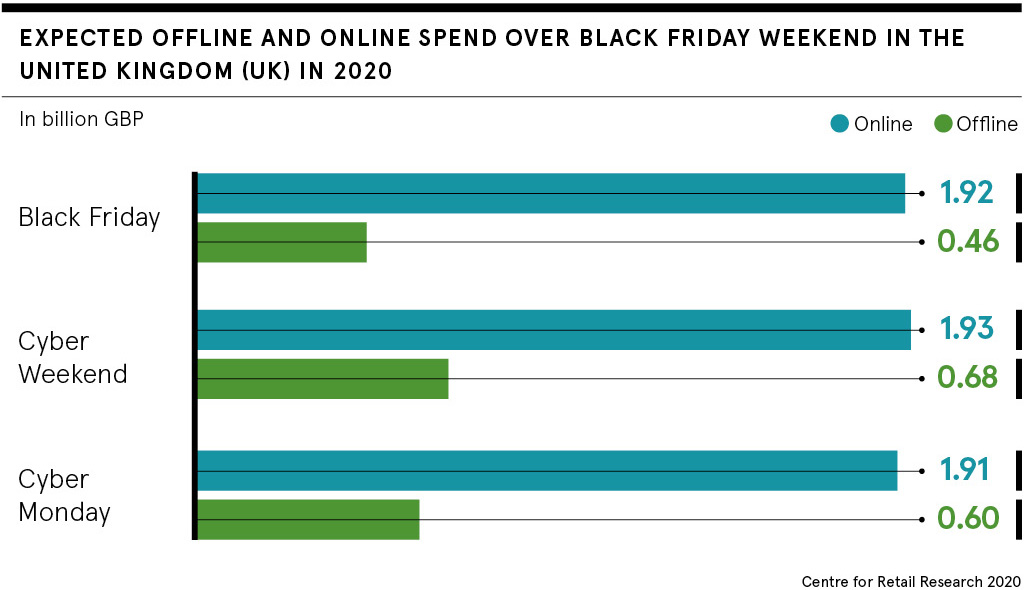
What happens to Black Friday when customers can’t jostle in the aisles? Or Christmas shopping season when we can’t hit the high street? Experts think these dates will become part of a whole new online retail calendar

Will it be a happy Christmas for UK retailers? After the coronavirus pandemic squeezing the life out of the high street, they certainly deserve some cheer. Data shows their fortunes could be resurrected by ecommerce. But given the shift to online, and the evolution of shopping habits, what does it mean for the traditional retail calendar?

New data from Adobe indicates activity around key retail dates will begin earlier, and peak retail occasions will be higher and more prolonged. According to the software giant’s international president Paul Robson, online holiday sales will “shatter all previous records”.

This is supported by Adobe’s projections that, in America alone, Black Friday will generate $10 billion (£7.5 billion) in online sales. “That’s a 39 per cent year-on-year increase,” says Robson. “Cyber Monday will remain the biggest online shopping day of the year,” he continues, adding that $12.7 billion (£9.6 billion) is expected to be spent in the United States, up 35 per cent on last year.

Robson says: “Our research into the online shopping habits of UK consumers during lockdown found that while they were up to four times more likely to buy from marketplaces like Amazon, it’s not always at the expense of smaller independent retailers. Where marketplaces may have the edge when it comes to convenience and speed, shoppers have also shown they are keen to support local, independent retailers where they can.

“The extended shopping period, coupled with the ability of independent retailers to deliver great, personalised digital experiences, could see them have a happier Christmas period than many might expect.”

Looking beyond traditional retail peaks

Google data also implies the retail calendar needs updating. “As a direct result of COVID-19, we have witnessed heightened search queries for online retail this year that will lead to a new baseline for Black Friday,” says Becky Power, director of consumer retail and technology at Google UK. “Google searches for ‘early Black Friday deals’ were up by 150 per cent versus November 2019.” Further, Google searches for “Christmas shopping” are up 1,800 per cent compared to the same period last year.

“The message is clear: consumers are looking beyond traditional peaks in the retail calendar as they continue to enjoy the flexibility of browsing online,” says Power, who points out that Enders research estimates there will be an additional £4.5 billion-worth of online sales in 2020.

Retail owners must keep pace with customer expectations and arm themselves with technology that enables multi-channel personalisation and improves data analysis. “Given that a continually growing number of consumers are already shopping online for traditional peaks, retailers will have to adapt to be ready for this rise in demand,” says Power. “Digital tools are imperative for applying product promotions easily and quickly, boosting retailers’ visibility to new customers, and can uncover meaningful insights from their performance.”

Kyle Harbinson, of global technology consultants REPL Group, agrees. “To reduce the impact of the troughs, retailers need to connect with and understand the circumstances of their customers, in a dynamically changing environment,” the consulting partner says. “We are in uncharted territory, so retailers need to pivot from instinct-driven decision-making to a data-driven culture.”

Taking steps to bolster the online offering

Warnings are being heeded. Capgemini’s annual Holiday Shopping Survey reports that while more than a third (36 per cent) of UK retailers expect an increase in holiday sales compared to previous years, 91 per cent have taken deliberate steps to bolster their online offering. Almost half (47 per cent) have improved their ecommerce propositions and 52 per cent will offer more generous discounts both online and in-store.

The benefit ecommerce brings allows you to create and build your own peak retail event

However, Dr Rajesh Bhargave, associate professor of marketing at Imperial College Business School, cautions that one issue retailers will face post-COVID-19 is the dilemma of “sticky prices”. “Consumers tend to remember what they would have paid previously for a product, so would view price increases as unjust in poor economic conditions,” he says. “Similarly, cutting prices would erode pricing power.”

No retailers should be discouraged from embracing ecommerce, however, stresses author and business consultant Erica Wolfe-Murray. “The hype surrounding traditional retail peak days has a halo effect across the board whether you are actively marketing or not,” she says. “But the benefit ecommerce brings allows you to create and build your own peak retail event. Think ‘Founder’s Day’, ‘Dress-Up Day’, or whatever.”

Embracing technology is business-critical

Technology can also help with the morphing of traditional peak retail periods, from dealing with stock management and the supply chain, to predicting when more staff might be required. Or with improving the delivery process, posits Mike Hancox, chief executive of UK couriers Yodel. “The five months stretching from November to the end of March have long been the busiest period for those in logistics as they encompass retail’s traditional peaks of Black Friday, Christmas, Valentine’s Day and Mother’s Day,” he says.

“This year we’re expecting Christmas to be higher in intensity and longer in duration than previous years, but a greater increase in overall volumes means the fluctuations seen in previous years could be less pronounced in the future.”

Yodel has developed a parcel-scanning app to streamline the delivery process. “It gives more flexibility to the growing numbers of self-employed couriers out on the road who can download the app on their own devices rather than having to get up to speed with a handheld terminal.”

Striving to reduce touchpoints and frictions through tech is now business critical, argues Professor Laurent Muzellec, founder and director of Trinity Centre for Digital Business. “Big digital players such as Netflix, Amazon and Apple use artificial intelligence to produce an effortless experience; this should be a source of inspiration for all retailers,” he says.

Retailers that act on this advice and tailor their offerings, both online and offline, look set to have a happy Christmas and beyond.

This article was originally published in Raconteur’s Future of Retail report in November 2020