Crypto’s energy use might worry eco-conscious investors, but there are reasons to hope for a greener future
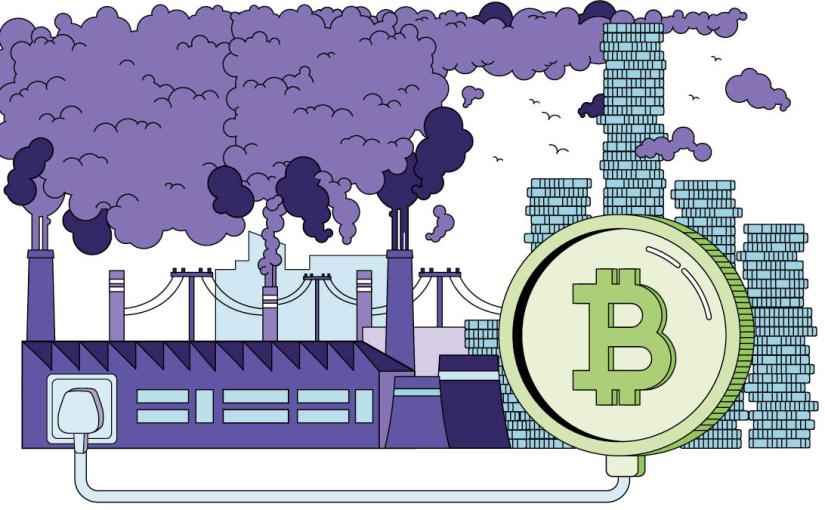
Cryptocurrency has long had a dirty secret: the energy needed for bitcoin mining.
Crypto evangelists – who believe a decentralised financial system is for the greater good – tend to ignore this inconvenient truth. In May, however, when Tesla boss Elon Musk decried the environmental effects of the mining that goes into validating bitcoin transactions, the energy issue became a burning topic.
It’s a big problem for cryptocurrencies because the majority of investors (77%) are aged under 45, according to a study published earlier this year by Gemini Exchange. These consumers are also more eco-conscious than older generations. Indeed, Musk’s damning assessment arrived at the same time that a Pew Research Center study found that 37% of Gen Z and 33% of millennials in the US cite climate change as their top personal concern.
Unsurprisingly, some worry that these investors could sour on bitcoin and other energy-draining cryptocurrencies. Bitcoin in particular is a victim of its own success, at least when it comes to environmental concerns. This is due to its ‘proof-of-work’ protocol: a decentralised consensus mechanism that requires members of the network to expend effort solving an arbitrary mathematical puzzle so that no one can hijack the system.
It’s a vicious correlation, because the higher bitcoin’s market value – in February it easily became the quickest asset in history to reach $1tn, after only 12 years – the more energy is consumed.
The latest bitcoin bull run, which began at the end of 2020, has sparked a surge in mining, bringing with it increased energy consumption. It’s no coincidence that China’s government has cracked down on crypto: the vast majority of bitcoin is mined there, driving up energy demand and making it harder for the country to achieve its target of net-zero emissions by 2060.
Solving the proof of work energy issue
Currently, bitcoin would rank as the 32nd-highest nation in the world by energy consumption, ahead of the Netherlands. Bitcoin and ethereum between them consume more than three quarters of the electricity used by all cryptocurrencies. Notably, the other three on the list of the five worst offenders – dogecoin, bitcoin cash and litecoin – all use the ‘proof-of-work’ protocol.
Bitcoin’s energy consumption has more than quadrupled since the beginning of its last peak in 2017, says Charles Hoskinson, co-founder of ethereum – the second largest crypto by market capitalisation. “It’s set to get worse because energy inefficiency is built into its DNA,” Hoskinson argues. As chief executive of global blockchain engineering firm IOHK, he’s also the driving force behind third-generation cryptocurrency cardano.
According to Hoskinson, bitcoin’s carbon footprint will “become exponentially worse because the more its price rises, the more competition there is for the currency” and thus the more energy it consumes.
Other, greener consensus mechanisms are gaining in popularity, such as the ‘proof-of-stake’ blockchains that underpin cryptocurrencies like cardano, polkadot and algorand, and don’t require mining. Proof-of-stake uses considerably less energy than proof-of-work chains, because “network participants are chosen to validate ‘blocks’ of transactions based on how many coins they hold rather than the computational processing power they have”, Hoskinson explains. He estimates that cardano is “four million times” more energy efficient than bitcoin.
Going green, one block at a time
Monica Long, general manager of RippleX, which provides open-source code and developer tools to accelerate interoperable blockchain technology, agrees that proof of work is “very energy intensive”. However, she says things are changing rapidly, noting that ethereum will shortly be switching to a proof-of-stake protocol that is expected to reduce electricity consumption by 99%.
She welcomes both the Bitcoin Mining Council, unveiled by Musk in May to monitor and improve the industry’s sustainability, and the Crypto Climate Accord, which is a private sector collaboration focused on making all blockchains carbon neutral by 2030.
Ultimately, not only does digital money offer many great advantages, but it’s a step towards a greener future overall
Rhian Lewis, author of The Cryptocurrency Revolution: Finance in the Age of Bitcoin, Blockchains and Tokens, says it’s vital to keep things in perspective. “Modern life is by its very nature energy intensive. In the US alone, the energy consumed by inactive household devices left on standby every year would power the entire bitcoin network for 1.9 years.”
And when people compare the energy consumed by a transaction on the Visa network, for instance, with a transaction on the bitcoin network, it is a “false equivalent”, she says. “A transaction on Visa needs the entire world banking system to be in place before its transaction can be processed, with all the physical infrastructure of banks, their buildings, people travelling between them, physical money being minted and transported, and so on. In contrast, bitcoin does all that inherently.”
An eco-friendly future?
Pavel Matveev, founder and chief executive of Wirex, a crypto payment card, believes bitcoin’s energy consumption is the exception in the industry. “With more than 4,000 cryptocurrencies in existence, there are plenty of environmentally friendly options available, and many more on the way,” he says.
For example, he points to nano, a eco-friendly cryptocurrency that doesn’t rely on mining, printing or minting and aims to address the current inabilities in today’s existing financial systems and limits fees while providing quick transaction speeds.
Given the introduction of less energy-intensive coins and a move towards renewable energy for mining, crypto could well become a more eco-friendly payment system in coming years, he suggests.
“Even the less eco-friendly cryptos can still be better for the environment than traditional currency,” says Matveev. “Imagine: goodbye plastic cards, paper receipts and pennies.
“Ultimately, not only does digital money offer many great advantages, but it’s a step towards a greener future overall.”
Perhaps Musk’s energy truth bomb was just what the industry needed to hear to clean up its act, even if, in the long term, the appeal of the original crypto is overtaken by more environmentally conscious alternatives.
This article was first published in Raconteur’s Cryptocurrencies report in June 2021

 Oliver Pickup