
TL;DR: December’s Go Flux Yourself explores how AI agents are reshaping the workforce, draws philosophical parallels between death and AI uncertainty, examines predictions for 2025, considers the growing AI-induced loneliness epidemic, and reflects on key themes from the newsletter’s inaugural year …
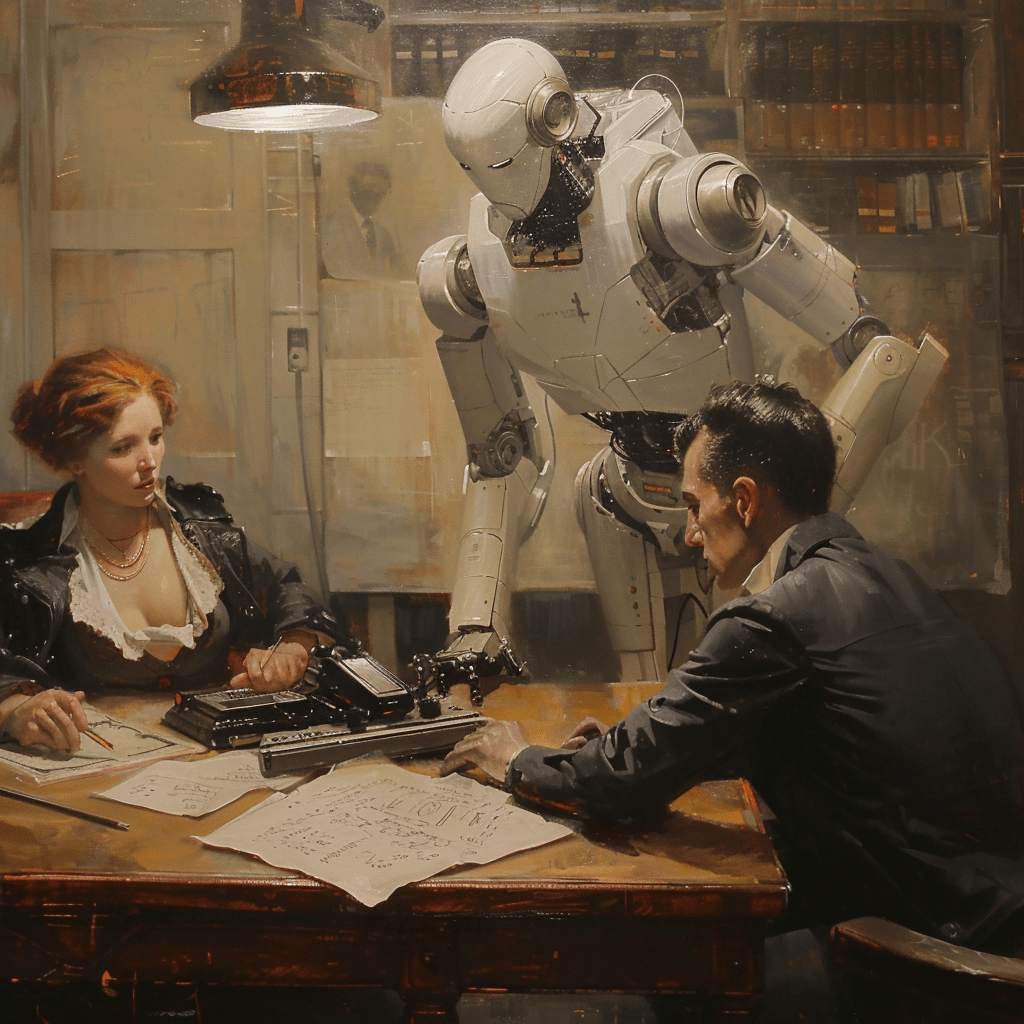
Image created on Midjourney with the prompt “a thoughtful AI agent working alongside humans in an office setting, with both harmony and tension visible, in the style of a Rembrandt painting”
The future
“Stop thinking of AI as doing the work of 50% of the people. Start thinking of AI as doing 50% of the work for 100% of the people.”
These words from Jensen Huang, the CEO of Nvidia (whose vision of a two-thirds non-human workforce featured in November’s Go Flux Yourself) crystallise a profound shift in how we should conceptualise the relationship between artificial intelligence and human work – a subject that has been top of mind for me this last year. On the eve of 2025, the conversation is evolving from whether AI will replace humans to how AI agents will augment and transform human capabilities.
At the start of December, I spoke with Sultan Saidov, Co-Founder and President at Beamery, an HR management software company headquartered in London. He offers valuable insights into this transformation and suggests we’re witnessing a fundamental restructuring of organisations, shifting from traditional pyramid structures to diamond shapes.
“In a world where AI might not be super smart or reliable, but it can do lots of low-cost tasks, you may not need as wide a pyramid at the bottom of the organisation,” Saidov explained. This structural evolution reflects Huang’s declaration.
The implications of this shift are far-reaching. “If you start with empowerment,” Saidov argued, “you don’t just have to think about what tasks you are doing today that an agent could do. You have to think about what work would be really valuable in my time in a world where agents are available to me.”
This transformation brings profound questions about human identity and purpose in an AI-augmented world. Chris Langan, the so-called “smartest man in the world”, according to the Daily Mail, whose IQ reportedly ranges between 190 and 210, offers an intriguing perspective through his Cognitive-Theoretic Model of the Universe.
He suggests that when we die, we transition entirely to another plane of existence – one we cannot access while alive. In this new state, we might not even remember who we were before, existing in what Langan describes as a “meta-simultaneous” state where all possible incarnations exist at once.
The parallels between Langan’s metaphysical musings and our current AI moment are striking. Just as “no one knows what happens next” – the motto above OpenAI CEO Sam Altman’s desk – when we die, we face similar uncertainty about how AI will transform our existence. Both scenarios involve a fundamental transformation of consciousness and being, with outcomes that remain tantalisingly beyond our current understanding.
Saidov recognises this uncertainty in the workplace context. “You have certain roles that are gradually becoming agents,” he noted, “like, let’s say, scheduling interviews and coordinating. That’s increasingly becoming this primarily non-human task. The humans that did that before are gradually moving into other things; otherwise, you won’t need as many of them.”
The emergence of “agentic AI” – autonomous systems that can perform complex tasks with minimal human supervision – represents perhaps the most significant shift in how work gets done since the Industrial Revolution. No doubt there will be opportunities and challenges (not least with security permissions and data sharing, as raised by SailPoint’s CEO Mark McClain in last month’s newsletter). Sultan emphasises that this isn’t just about efficiency: “The purpose of the HR function is increasingly to help navigate this massive human transformation.”
Just as Langan suggests, our consciousness might persist in a different form after death, but Saidov sees human work evolving rather than disappearing. “The nuance of how do you do this right, especially for people topics, has to come with a bit of governance,” he stressed. This governance becomes crucial as we navigate what he calls “task taxonomies” – the complex mapping of which AI agents should handle tasks versus humans.
In 2025, the challenge isn’t just technical implementation but preparing the next generation for this uncertain future. As I have come to ask many interviewees, I quizzed Saidov about how we should prepare our children. (I’m interested in these answers as the father of two children, aged 10 and four.) “It’s hard to predict what tools you will use [in the coming years], so probably the best thing you could do is encourage a curiosity for finding a passion, which isn’t so much a skill as a mindset that lets you explore what you care about more proactively,” he advised.
I love this reply, and this emphasis on curiosity and adaptability echoes through Langan’s philosophical framework and Sultan’s practical insights. In a world where AI agents are transforming traditional roles, the ability to navigate uncertainty becomes paramount. “There’s probably going to be toolkits for kids who are trying to zoom in on what’s real and what’s not real, to be more sophisticated in thinking about what’s fake and not fake than we are,” Saidov added.
The transformation of human interaction extends beyond the workplace, however. A Financial Times article about Meta’s plans to create bots on its social media platforms confirmed fears that – thanks to misguided rapacious capitalism goals – the biggest players are missing the point of technology, and accelerating tech-induced loneliness and content that is eating itself.
Indeed, Meta revealed its alarming vision for AI-generated characters to populate its social media platforms, with Connor Hayes, Vice-President of Product for Generative AI, suggesting these AI personas will exist “in the same way that accounts do”, complete with biographies, profile pictures, and the ability to generate and share content.
While this might make platforms “more entertaining and engaging” – Meta’s stated priority for the next two years, according to Hayes – it raises profound questions about authenticity and connection in our digital future. As Becky Owen, former head of Meta’s creator innovations team, warned: “Unlike human creators, these AI personas don’t have lived experiences, emotions, or the same capacity for relatability.”
This observation feels particularly pertinent when considered alongside Langan’s theories about consciousness and Saidov’s emphasis on human value in an AI-augmented workplace.
Like Langan’s view of consciousness, human-work evolution may exist simultaneously in multiple states – part human, part machine, with boundaries increasingly fluid. As organisations evolve toward diamond structures, the key to success is not resisting this transformation but embracing its uncertainty while maintaining our essential human qualities.
As we stand on this threshold of unprecedented change, perhaps the most valuable insight comes from combining Langan’s metaphysical perspective with Saidov’s practical wisdom: the future, whether of consciousness or work, may be unknowable, but our ability to adapt and maintain our humanity within it remains firmly within our control.
In early January, I’ll be talking about my latest thinking as the first guest of 2025 on the Leading the Future podcast – look out for that here.
The present
As we peer into the uncertainty of 2025, the predictions from industry leaders paint a picture of unprecedented transformation. Yet beneath the surface, enthusiasm for AI adoption lies a growing concern about its impact on human connection and wellbeing.
“The biggest threat AI offers is loneliness,” warned Scott Galloway, professor at NYU Stern School of Business, in his pre-Christmas annual predictions. His concern is far from theoretical – in March, SplitMetrics found that AI companion apps reached 225 million lifetime downloads on the Google Play store alone. We’re witnessing a fundamental shift in how humans seek connection. The rise of AI girlfriends, outpacing their male counterparts by a factor of seven, signals a troubling retreat from human-to-human relationships.
This shift towards digital relationships parallels broader workplace transformations. Roshan Kindred, Chief Diversity Officer at PagerDuty, predicts that “companies will face increasing demands for transparency in their DEI efforts, including publishing data on workforce demographics, pay equity, and diversity initiatives”. The human element becomes more crucial even as automation increases.
The numbers tell a sobering story. According to Culture Amp’s latest data, nearly one in four workers (23%) plan to quit their jobs in 2025. This predicted attrition rate is particularly pronounced in the UK, exceeding both US (19%) and Australian (18%) figures. Only Germany shows a higher potential turnover at 24%.
Leadership quality emerges as the critical factor in this equation. With a great manager and leader, employees’ commitment to stay reaches 94%; with poor leadership, it plummets to just 19%. The financial implications are staggering – replacing an employee can cost between 30% and 200% of their salary, with the average UK salary in 2024 being £37,400.
Jessie Scheepers, Belonging & Impact Lead at Pleo, envisions 2025 as a year when “human-centric leadership will come to the fore, with authentic and empathetic leaders placing a greater focus on their team’s mental health”. This prediction gains urgency when considered alongside Galloway’s warnings about technology-induced isolation.
Meanwhile, the education sector faces its own reckoning. Nikolaz Foucaud, Managing Director EMEA at Coursera, notes that 54% of employers now prioritise skills over traditional credentials. This shift comes as higher education faces financial challenges, with university fee caps rising to £9,535 a year. The solution, Foucaud suggests, lies in industry “micro-credentials” that bridge the gap between academic learning and workplace demands.
Perhaps most telling is the quantum-computing horizon outlined by Dominic Allon, CEO of Pipedrive. While quantum technologies promise revolutionary advances in optimisation and data security, their immediate impact may be less dramatic than feared. “Small businesses may benefit from breakthroughs in areas like optimisation, but those that adopt or integrate quantum solutions early on could gain a competitive edge in innovation, cost efficiency, and scalability,” he notes.
The financial landscape presents particular challenges. Hila Harel from Fiverr predicts UK businesses will face significant pressures, with average losses predicted to reach £138,000 and a quarter of companies expecting losses over £100,000. Yet within this disruption lies opportunity – particularly for freelancers and flexible workers who can navigate the evolving landscape.
These predictions collectively suggest that 2025 will be less about technological revolution and more about human evolution. The successful integration of AI and other advanced technologies will depend not on the tools’ sophistication but on our ability to maintain and strengthen human connections in an increasingly digital world.
The past
As it’s the end of 2024, I’d like to look back and reflect on the inaugural year of Go Flux Yourself. The themes that emerged across my monthly explorations feel eerily prescient. I began in January examining Sam Altman’s aforementioned desk motto – “no one knows what happens next” – a humble acknowledgement that set the tone for a year of thoughtful examination rather than confident predictions.
That uncertainty proved to be one of my most reliable companions through 2024. In February, I explored the concept of FOBO – fear of becoming obsolete – through an unexpected lens: a chance encounter with a tarot card reader in a cafe. The Page of Swords card suggested the need to embrace new forms of communication and continuous learning, while The Two of Wands warned about the dangers of remaining in our comfort zones while watching the world transform around us.
March’s Go Flux Yourself featured Minouche Shafik’s prescient observation that while “jobs were about muscles in the past, now they’re about brains, but in the future, they’ll be about the heart”. This insight gained particular resonance as the year progressed and AI capabilities expanded, emphasising the enduring value of human empathy and emotional intelligence.
In April, I shared my thoughts about values. In August, I revealed the CHUI Framework – Community, Health, Understanding, and Interconnectedness – providing structured guidance for navigating human-work evolution. These values proved essential as organisations grappled with technological change and the persistent challenge of maintaining human connection in increasingly digital workplaces.
During the summer months, I examined what Scott Galloway calls “the biggest threat we’re not discussing enough”: loneliness. June’s newsletter warned about the potential social costs of increasing reliance on digital relationships.
July’s Go Flux Yourself provided one of the most sobering insights of the year. Futurist Gerd Leonhard compared the arrival of artificial general intelligence (AGI) to “a meteor coming down from above, stopping culture and knowledge as we know it”. This metaphor gained particular potency when considered alongside Chris Langan’s theories about consciousness and existence, which we explored earlier in this edition.
August introduced the concept of being “kind explorers” in the digital age, inspired by my daughter’s career ambition shared at her nursery graduation. September reflected on the importance of wonder and magic in an increasingly automated world, while October examined the dark side of AI through conversations with cybersecurity luminaries Dr Joye Purser and Shlomo Kramer.
November channelled Marcus Aurelius’s wisdom about the quality of our thoughts determining the quality of our lives – a theme that resonates powerfully as we conclude our year’s journey. Throughout these explorations, certain constants emerged: the importance of human connection in an increasingly digital world, the need for thoughtful implementation of technology, and the enduring value of authentic leadership.
I’ve witnessed the workplace transform from a location to a concept, and documented the rise of what we now call the “relationship economy”. Further, research suggests that by 2025, up to 90% of online content could be AI-generated, making human authenticity more valuable than ever. (This is one of the reasons I have this year established Pickup_andWebb, a content company providing human-first thought leadership for businesses and C-suite executives. Read this blog on our thinking about the near future of thought leadership here.)
The year brought tangible changes too. Australia made history by banning social media for under-16s, while EE recommended against smartphones for under-11s. Microsoft’s Copilot AI demonstrated both the promise and perils of workplace AI integration, with privacy breaches highlighting the gap between technological capability and practical implementation.
My explorations of – and writing and speaking about – human-work evolution have taken me from London’s Silicon Roundabout to Barcelona’s tech hubs, from Manchester’s Digital Transformation Expo to a security conference in Rome, and elsewhere.
Looking back, perhaps Go Flux Yourself’s most significant achievement in 2024 has been maintaining a balanced perspective – neither succumbing to techno-optimism nor falling into dystopian pessimism. I’ve documented the challenges while highlighting opportunities, always emphasising the importance of human agency in shaping our technological future.
The questions I asked in January remain relevant. How do we maintain our humanity in an increasingly automated world? How do we ensure technology serves human flourishing rather than diminishing it? But I’ve gained valuable insights into answering them, understanding that the key lies not in resisting change but in thoughtfully shaping it.
As I close the last chapter of 2024 of Go Flux Yourself, we can appreciate that while uncertainty remains our constant companion in the coming year, our capacity for adaptation, innovation, and human connection provides a reliable compass for navigating whatever comes next.
Ultimately, whether facing AGI, armies of AI agents, or augmented workplaces, the quality of our thoughts and the strength of our human bonds will determine the success of our journey.
Statistics of the month
- AI is the fastest-growing skill among employees, job seekers and students in the UK and globally, with Coursera course enrolments in this domain having increased 866% year-on-year, according to newly released data
- Nobel laureate Geoffrey Hinton – the “Godfather of AI” – has doubled his doomsday prediction, speaking to BBC Radio 4’s Today programme, now warning of a 1-in-5 chance that AI could wipe out humanity by 2054. He cautions we’ll be like toddlers attempting to control super-intelligent machines, adding: “We’ve never had to deal with things more intelligent than ourselves before.”
- As pointed out on Swiped, a two-part documentary aired on Channel 4 in mid-December about teenage smartphone use (that I watched with my 10-year-old son), a recent Education Select Committee report reveals that one in four children now use their smartphones in a manner resembling behavioural addiction. Even more worrying, half of children have accessed violent pornography on a screen by the age of 13
Stay fluxed – and get in touch! Let’s get fluxed together …
Thank you for reading Go Flux Yourself. Subscribe for free to receive this monthly newsletter straight to your inbox.
All feedback is welcome, via oliver@pickup.media. If you enjoyed reading, please consider sharing it via social media or email. Thank you.
And if you are interested in my writing, speaking and strategising services, you can find me on LinkedIn or email me using oliver@pickup.media.
 Oliver Pickup