Go Flux Yourself: Navigating the Future of Work (No. 19)


TL;DR: July’s newsletter explores why servers are literally melting, teenagers are hacking from their bedrooms, and we’re wasting resources on an industrial scale. Better stewardship – of energy, talent, and attention – separates tomorrow’s winners from the rest.

Image created on Midjourney

The future

“We cannot build enough chips, we cannot build enough data centres, we cannot build enough power grids to meet the demand. But whether or not we need it and where do we draw the line, that’s a different topic.”

The servers are melting, literally.

On July 19, Google and Oracle revealed that their UK data centres had experienced cooling-related failures during Britain’s third heatwave of the summer. Google’s London-based region Europe-West2 went down, while Oracle’s local facilities faced similar technical difficulties. Our digital infrastructure buckled under the relentless heat.

These weren’t isolated incidents, either. OpenAI’s image-generation models regularly push graphics processing unit temperatures beyond sustainable limits, while cooling systems struggle to keep pace with computational demands. 

According to the Boston Consulting Group (BCG), generative AI is expected to account for 60% of data centre power growth through 2028. Every new AI iteration consumes exponentially more power, water, and computational capacity than the last.

What we’re witnessing is the collision of two unsustainable systems: our heating planet and our energy-hungry digital ambitions. It’s hard to ignore the brutal mathematics, which add up to a planet increasingly heating up and being sucked dry.

Notably, on May 20, the United Kingdom reached Earth Overshoot Day: the date when our demand for ecological resources exceeds what the Earth can regenerate in a year. Alarmingly, we hit this tipping point three days before supposed emissions-guzzler China, and far earlier than the global average. We’re over-consuming everything, not just digital resources.

Mehdi Paryavi, Chairman of the International Data Center Authority (IDCA), put it starkly when I spoke with him recently: the global race to build computing capacity is outpacing our ability to power it sustainably. “AI becoming the future of our world today does require massive investments,” he told me. “We cannot build enough chips, we cannot build enough data centres, we cannot build enough power grids to meet the demand,” he added, which is where this month’s opening quotation comes from.

The numbers tell the story. According to the International Energy Agency (IEA), data centres are on course to consume 3% of global electricity by 2030, roughly equivalent to the entire energy consumption of Japan. Elsewhere, the Center for Strategic and International Studies calculates that United States data centres alone will need 84 gigawatts by the end of the decade, a 2,100% increase from today’s 4 gigawatts.

Meanwhile, Morgan Stanley research published last September projects data centre carbon emissions will triple by 2030, reaching 2.5 billion tons of CO2. Forget about building a digital future, we’re constructing a carbon catastrophe.

The regulatory landscape is tightening, too. The upcoming Cyber Security and Resilience Act, expected to be introduced within weeks in the UK, will bring data centres into critical national infrastructure for the first time. Andy Green, a partner at cybersecurity consultancy Avella, explains the significance: “Where previously it was just best endeavours or they tried to comply with an ISO standard, now they’ll have actual regulations that they need to meet.”

This means mandatory incident reporting within specific timeframes, supply chain security assurance, and adherence to the National Cyber Security Centre’s Cyber Assessment Framework. As Green notes: “It’s a high bar that they’re going to have to hit in quite short order.”

The shift represents another constraint on an already strained system. Data centres now face not only physical limits from heat and power, but also regulatory compliance, which could further complicate their operations.

At South by Southwest London in early June, I enjoyed speaking with Will Alpine (he and his wife, fellow co-founder of Enabled Emissions Campaign Holly, chose their surname to reflect their climate activism, which I love).

Alpine is a former Microsoft sustainability engineer who helped coin the term “Green AI” back in 2020. He was among the first to warn about AI’s energy impacts before the generative AI boom made those concerns impossible to ignore. Alpine eventually left Microsoft after internal battles over what he calls “enabled emissions”: the carbon cost of AI accelerating high-pollution industries.

His frustration with corporate sustainability theatre was palpable: “It doesn’t matter how green your compute is if it’s being used to enable fossil fuel extraction.”

This insight points to the heart of our resource crisis: we’re optimising individual components while ignoring systemic waste.

Alpine warns that we must consider not just the operational energy costs, but “the physical materials that go into making the chips and precious materials, all the resource constraints associated with that, and then the waste at the end of the life cycle”. Often, hardware is recycled before its natural end to chase the latest specifications, and companies sleepwalk through needless software upgrades.

Here’s where the crisis becomes truly absurd. Tomás O’Leary, CEO of Origina, captured this waste perfectly when we spoke recently. “Every pointless software upgrade, every vendor-mandated migration, every compliance-driven refresh adds to infrastructure strain,” he said. “Companies waste enormous resources on changes that deliver zero business value.”

The infrastructure barons are exacerbating the situation. Hyperscalers now command around 60% of data centre capacity, with Amazon, Microsoft, and Meta leading the land grab. They’re securing entire campuses before they hit the market, creating what O’Leary calls “digital feudalism”, where smaller companies queue cap in hand for access to computational resources.

Yet amid this escalating consumption, some organisations prove that efficiency beats excess. At the start of the year, DeepSeek achieved generative AI performance comparable to ChatGPT at just 6% of typical costs: $6 million versus the industry standard of $100 million. The problem isn’t computational limits, though, but computational waste.

Chicago-based Roger Strukhoff, IDCA’s Chief Research Officer, sees this reflected in the organisation’s latest global digital readiness rankings. Despite hosting 44% of the world’s data centres, the US ranks just 38th globally because its approach prioritises scale over sustainability. He told me: “Are we environmentally sound? Are we socially, economically sound? There’s no point having a digital economy if your society is going in other directions.”

The Scandinavian countries top the IDCA rankings because they understand holistic resource management. Building the biggest data centres means nothing if you’re burning through energy, materials, and human potential at unsustainable rates.

This brings us to our most mismanaged resource: human talent. While we obsess over GPU shortages, we’re squandering cognitive capacity on an industrial scale. Arrests in mid-June, related to the Scattered Spider cybercriminal gang, highlight just how badly we’re failing young people with extraordinary capabilities.

On July 10, police arrested four people in connection with the M&S and Co-op cyberattacks from a couple of months ago: a 20-year-old woman from Staffordshire and three males aged 17-19 from London and the West Midlands, highlighting the poor support we provide to young people with extraordinary capabilities.

Indeed, these weren’t sophisticated criminal masterminds but teenagers operating from their bedrooms. A 2022 study by the University of East London found that 69% of European teenagers have committed some form of cybercrime. Additionally, there are 3.5 million vacant cybersecurity positions globally. We’re criminalising the people we need to protect our digital infrastructure.

For the New Statesman, I’ve been investigating the subject of teenage hackers: their motivations, the lack of career opportunities, and how initiatives like The Hacking Games, which uses gaming to identify skills to combat cybercrime, are addressing these issues. The pattern is depressingly predictable: bedroom gaming leads to online gaming, then gaming cheats, hacking forums, minor cybercrime, financial gain, and finally serious cybercrime. Each step feels logical and harmless, yet the pathway leads from curiosity to destruction. (I will share the essay once it is published. As a long-time NS subscriber, I am thrilled to feature its hallowed pages.)

The rise of AI should free humans to focus on tasks that are uniquely human, such as creativity, empathy, and complex problem-solving. Instead, we’re automating away entry-level opportunities while burning out experienced workers with increasingly demanding tasks. Two-thirds of HR professionals now believe that colleagues who do not use AI risk falling behind, potentially creating a two-tier workforce, according to new Culture Amp research. Yet 77% of those using AI are entirely self-taught, hinting at a shortfall in formal AI training across organisations.

The solution isn’t to abandon technology but to steward it more thoughtfully. As Paryavi explained, data centres “are not the drivers impacting our environment negatively. They are actually enablers of creating a cleaner environment if we do it right, if we think outside the box.”

Smart organisations are already making this shift. Rather than constantly upgrading systems, they’re optimising existing ones. Instead of demanding the latest AI models, they’re solving specific problems with targeted solutions. And rather than competing for scarce computational resources, they’re building efficiency into their operations from the ground up.

Those who choose efficiency over excess, sustainability over waste, and genuine innovation over artificial obsolescence will thrive within physical constraints while others chase computational fantasies.

As we enter an era where every joule of energy and every moment of human attention becomes precious, the future belongs to the resource stewards, not the resource raiders.

The present

Image created on Midjourney

By the time this month’s Go Flux Yourself is published, on the last day of July, I’ll be in Greece on a family holiday, taking a proper break for the first time in months. No newsletters or keynotes to write, podcasts to organise, workshops to facilitate, and no interviews to conduct. Just sea, sun, and the kind of decompression that only comes when you physically remove yourself from your usual environment.

This break feels particularly timely, as I facilitated a couple of workshops on the power of taking breaks earlier in July. I’ve been working with a global pharmaceutical company on their LinkedIn summer challenge, helping technical professionals find their voices during the holiday season. The core message was simple: time away helps creativity flourish in ways that always-on hustle simply can’t match.

During an unrelated visit to this client’s UK headquarters, I interviewed six young professionals about their international assignments. The company sends young European graduates anywhere in the world for up to two years through their early-career development programme, and their role is often very different from what they studied, for good reason. For example, one employee shifted from project management to employee engagement. Another moved from pricing to global market access. A third transitioned from pharmacy to brand management. The pattern wasn’t about perfect qualifications but recognising capabilities that traditional recruitment processes miss entirely.

This approach reminds me of February’s newsletter, where Harvard’s Siri Chilazi warned about the distinction between “performative fairness” and structural change. This company has embedded skills-based career development into its culture, actively cultivating potential across international boundaries.

On the subject of expanding opportunities, I’m pleased to announce I’m now hosting a new podcast for Clarion Events called DTX Unplugged, which delves into innovations, trends, and challenges shaping business evolution. After years of moderating the company’s main stage panels and writing event takeaways, this feels like a natural evolution. Good working relationships develop organically over time, and when they mature into new opportunities, that’s genuine relationship capital at work.

The timing of the podcast – which I will share in future newsletters, once live – aligns with broader shifts I’ve been tracking since launching Go Flux Yourself in January 2024. Ultimately, in our resource-constrained world, the most successful collaborations are no longer transactional but built on a shared curiosity about solving real problems together.

Back to switching off, now. Remember that rest doesn’t equal unproductive time. It’s an investment in capabilities that can’t be automated or optimised away. The ideas that emerge from genuine downtime, the connections that develop through unhurried conversations, and the perspectives that shift when you step outside familiar patterns all remain irreplaceably human.

It will take me a couple of days to properly decompress in Greece. And, no doubt, in the final days before my flight home, I’ll start thinking about my next moves: a new speaker-focused website, for instance, more speaking opportunities, and exciting podcast developments. But for now, the most productive thing I can do is absolutely nothing at all.

The past

Image created on Midjourney

As a bushy-haired 12-year-old football addict with a love of Alessandro Del Piero, I scored a hat-trick for Tigers against Panthers to win our internal school football competition. It remains one of my most cherished memories: being carried off the pitch on my teammates’ shoulders, feeling that perfect combination of individual achievement and collective celebration. Sad, I know!

Over three decades later, watching my own children at their sports day a couple of weeks ago, I was reminded why these moments matter so much.

The temperature had hit nearly 30 degrees as parents gathered on the Astroturf. It was Darcey’s first sports day, and I watched her throw herself into each event with uninhibited enthusiasm, a little taken aback. There was space hopping (where she excelled), the egg-and-spoon race, football dribbling, and the climactic tug of war, among other more traditional events. The children competed in teams representing continents of the world, with both Darcey and elder brother Freddie proudly wearing Europe’s (blue) colours.

What struck me wasn’t just the competition but the collaboration. Freddie, despite being one of the tallest and strongest in his year, made sure to encourage a teammate with special educational needs, offering words of support and gentle reassurance through gentle touches during the more challenging events. In that moment, I saw everything that matters for the future of work: competitiveness balanced with compassion, individual capability channelled toward collective success.

I thought about this before appearing as a human-work evolution expert on St James’s Place Financial Academy’s The Switch Podcast, where I discussed preparing careers for an AI-driven future with host Gee Foottit. I was asked whether it’s possible to future-proof careers anymore, or if adaptability is the only strategy. My answer drew on exactly these sporting metaphors. “You can’t future-proof a career,” I said, “but you can future-ready yourself by developing what I call the ‘six Cs’: the uniquely human capabilities that become more valuable as AI advances.”

I listed communication, creativity, compassion, courage, curiosity, and collaboration. These so-called soft skills are the defining capabilities of the age. They allow us to build trust, forge connections, and work across differences in ways that no algorithm can replicate. (Again, I will share the episode once it has been aired, later in the year.)

The sports day reinforced this: children learning to compete fairly, support teammates, handle disappointment gracefully, and celebrate others’ achievements. These are precisely the skills that will matter in a world where routine tasks become automated.

The most successful societies have always been those that channel competitive instincts toward collaborative ends. Whether we’re talking about Olympic teams, scientific research groups, or the small cohort of reformed teenage hackers now working to protect rather than exploit digital infrastructure, the magic happens when individual capabilities serve shared purposes.

The pre-digital era naturally fostered this kind of collaboration. You couldn’t build a cathedral, win a war, or explore new continents without complex coordination between different specialists. Physical constraints meant that waste was visible and resources had to be allocated thoughtfully.

We’ve gained tremendous individual capabilities since then, but we’ve lost something essential: the productive friction that forced people to work together, to consider long-term consequences, to balance personal ambition with collective welfare.

As we enter a period where every joule of energy, every moment of human attention, and every ounce of raw material becomes precious, those childhood lessons from the playing field become more vital than ever. Competition drives excellence, but collaboration determines whether that excellence serves human flourishing or just individual advancement.

The teammates carrying me on their shoulders weren’t just celebrating my goals but what we’d achieved together. In our resource-constrained future, that distinction may well determine which teams, organisations, and societies thrive.

Statistics of the month

🏢 AI governance vacuum
Some 93% of UK organisations use AI, but only 7% have fully embedded governance frameworks. Alarmingly, 35% of companies have no clear owner for AI strategy, despite EU AI Act obligations. [🔗] [🔗]

⚙️ AI testing failures exposed
Only 28% of organisations apply bias detection during AI testing, while just 22% test for model interpretability. Most rely on legacy development processes that have not been updated to address AI-specific risks, such as bias and explainability gaps. [🔗]

🎯 AI skills paradox
One in five UK business leaders now depend on freelancers to deliver critical AI skills they lack in-house, while 46% of freelancers report increased earnings from AI work. [🔗] 

💼 Freelance revolution accelerates
Over a third of UK businesses now save more than £40,000 monthly using freelancers, with 87% planning to engage them up to 10 times in the next six months. Meanwhile, 70% of self-employed workers earn more than in full-time employment. [🔗]

🚫 AI resistance grows
Meanwhile, across the Atlantic, nearly two-thirds of US adults (64%) say they’re more likely to resist using AI-powered technologies as long as possible, compared with 35% who say they’re more likely to embrace using AI as soon as possible. [🔗]

Thank you for reading Go Flux Yourself. Subscribe for free to receive this monthly newsletter straight to your inbox.

All feedback is welcome, via oliver@pickup.media. If you enjoyed reading, please consider sharing it via social media or email. Thank you.

And if you are interested in my writing, speaking and strategising services, you can find me on LinkedIn or email me using oliver@pickup.media.

Cool ideas: How technological innovations can reduce urban temperatures

Removing reflective surfaces, increasing natural shade and harnessing the power of sewage are all options to limit the heat island effect – but progress will stall without collaboration and political boldness

Below a cloudless, blueberry-blue sky, where the sun blazes fiercely and gleams from London landmarks, a multi-person mass of liquifying limbs smoulders. The caption for Zoom Rockman’s Private Eye cartoon reads: “I love London; it’s such a melting pot.”

But few people were laughing when, on 19 July, the UK temperature exceeded 40C for the first time, according to the Met Office, and the city’s infrastructure melted – literally. Half of the six areas to surpass that level were in and around the capital: St James’s Park, Kew Gardens and Northolt. 

With global warming an increasingly hot topic and residents figuratively melting, the heat is being turned up on politicians, planners and other key stakeholders to keep cities cool.

The way our cities have been designed is no longer appropriate for modern times

Just days after the record high temperature, the mayor of London, Sadiq Khan, loosened purse strings. He awarded £2.85m from the Green and Healthy Streets fund to 19 projects, including rain gardens, tree pits and sustainable drainage areas. Further, a £1m grant will support “innovative and exemplary projects” on the Transport for London Road Network, and £150,000 was released to improve walking routes connecting green spaces.

“We cannot shy away from it: the climate crisis is on our doorstep,” wrote Khan on LinkedIn in early August, announcing the funding decisions. “We’re taking action before time runs out and investing £4m … to make London more resilient to heatwaves.” 

He added: “Working with London boroughs and TfL, these projects will make London more resilient against extreme weather, plus make our streets more green and pleasant for Londoners. It’s a win-win.”

Collaboration and long-term planning are paramount to reducing the impact of extreme heat in cities. And investing in innovative technology solutions can accelerate the virtuous circle to which Khan alluded.

Beware the heat island effect

Indeed, embracing an approach to building that keeps nature in mind, rather than seeking to dominate it, will lead to better urban spaces for both people and the planet. So says Chris Bennett, co-founder and managing director of sustainability services at Evora Global, a London-headquartered real asset consultancy. 

“Our urban environments are dominated by densely grouped buildings made of reflective materials creating a ‘heat island effect’,” he explains. “This is why it’s often hotter in cities than rural areas.”

Bennett believes simple tech and nature-based solutions will make a big difference. “Reducing hard reflective surfaces such as road pavements would help to lower temperatures,” he says. “Re-engineering pavements to be permeable blocks, instead of concrete or Tarmac, would allow water to flow through the pavers in wet conditions and evaporate when the heat rises, creating a cooling effect.

“Also, incorporating trees and plants reduces the reflective nature of the streetscape, provides habitats for wildlife and offers shelter from harsh ultraviolet radiation and solar heat during summer.” 

Ironically, it is partly due to technology that we find ourselves in this sticky situation. Since the 1960s, planes, trains and automobiles have heavily contributed to global warming, and cities have evolved to accommodate gas-guzzling vehicles. So it’s time for a swift U-turn, says Bennett.

“In London, we are blessed with many urban parks and squares created by the Georgians and Victorians. But many of the city’s trees have been lost to provide car parking spaces,” he says. “Planting street trees will increase protection from the climate by reducing heat stress and limiting the degradation of the urban construction materials, making buildings last longer.”

Appropriate early-stage design 

Another expert urging cross-industry action is Håvard Haukeland, co-founder of Spacemaker AI. His company provides early-stage analysis for architects and urban planners and enables buildings to be designed with the local microclimate in mind to minimise urban heat islands. 

“The way our cities have been designed is no longer appropriate for modern times,” he says. “As temperatures rise due to climate change, the design choices previously made either due to tradition or practical considerations around energy efficiency are making our cities even hotter.”

Haukeland contends that architects and urban planners need to step up. “While solutions such as additional greenery or reflective roofs can help keep things a little cooler, the reality is the most impactful solutions are done at the early stage when new developments are being built,” he continues. 

Design adaptations – including rotating structures to “open up” for wind or even altering the shape of a building – can make “the biggest difference to microclimates”, Haukeland says. Although these solutions are “much harder to implement”, he asserts that designers “must consider microclimates at the outset”.

That may be so, but how should cities upgrade older infrastructure to make it better able to withstand extreme heat? “This is the critical question when you think about the number of heritage and older buildings we have in the UK,” says Ian Ellis, smart buildings expert at Siemens Smart Infrastructure. Sensors that capture data and allow deep analysis of how people use buildings – especially as hybrid-working strategies are firmed up – could be the answer.

“This technology is already being used in buildings across the UK, where it can provide usage data on the flow of people through a building, where they congregate and how they use it,” says Ellis. “Data like this provides invaluable insights in optimising other technologies like heating and ventilation systems.”

Sensors, shade and sewage

Sebastian Peck, a partner at Kompas – an early-stage venture capital firm focused on transforming the built environment – lists some pioneering solutions to cool cities. “Vertical Field is installing sensor-controlled smart planters to purify the air from carbon dioxide and, when mounted to buildings, they help insulate them from the sun,” he says. 

Meanwhile, Lumiweave has developed an innovative fabric that provides shade during the day and harvests the sun’s energy to illuminate itself and its surroundings at night. “And,” Peck continues, “TreeTube has a patented modular system of tubes that lets tree roots grow safely in a tunnel without disrupting their surroundings.”

Peter Hogg, UK cities director at global design, engineering and management consulting company Arcadis, offers a more practical but pongy example. “We are looking at using effluent as a heat exchanger that allows you to extract energy used for cooling with minimal carbon impact. Imagine the potential in a city the size of London, which houses 8.5 million people.”

At this stage, no idea should be flushed away. And while there is much work to do, the willingness to force change – and think up unusual solutions – is finally evident, suggests Hogg. “The pandemic was a watershed,” he says. “There is a collective understanding that this situation must be addressed. Today, building plans that fail to consider the climate challenge won’t attract investors. 

“Before the coronavirus crisis, you would have to go to the Netherlands or the Nordics to find people taking this seriously. We now acknowledge that significant behavioural and structural changes are required, and quickly.”

Peck concludes that enough technologies are available to cool cities but to harness their power, leaders must be bold. 

“The difficulty is that urban planners need to rethink our cities, make them greener and ensure water is put to good use,” he says. “But changing and building back existing urban infrastructure is expensive. Cities are under pressure to demonstrate to the public that their scarce resources are well invested.

“In other words, cooling our cities is not a technological challenge, but a political one.”

This article was first published in Raconteur’s Smart Cities report in August 2022

How sustainability has become an advantage in the talent war, but candidates aren’t fooled by ‘greenwashing,’ say experts

The meeting in early November of officials from approximately 120 countries at the 2021 United Nations Climate Change Conference (COP26), in a desperate bid to improve the planet’s health, highlights the critical importance of environmental issues.

But it’s not just world leaders who need to boost their sustainability credentials: so do businesses, or they risk defeat in the raging war for talent.

Indeed, new research from global recruitment firm Robert Walters indicates 34% of U.K. office workers would refuse a job offer if a company’s environmental, sustainability or climate control values do not align with their own. In the U.S., the figure is even higher: 41%. France and Chile (both on 53%) top the list, closely followed by Switzerland (52%).

It’s a “new era of recruiting,” according to Chris Poole, managing director of Robert Walters U.K. “While all the normal questions still get asked around pay, benefits, training and career paths, increasingly we get asked: ‘What does X company stand for?’” he said.  

Before accepting a job offer, people now carefully consider their prospective employer’s social media output, check the “about us” pages on its website and Google the latest news articles about the company to see if its actions match its words.

“Employers failing to improve on their sustainability credentials should expect to see a knock-on impact to their hiring,” said Poole. “With there being so many avenues to being environmentally conscious as an employer, there simply isn’t much room to ignore the matter.” Moreover, he added: “As a workforce strategy, ESG [environmental, social and governance] has become a competitive advantage in attracting and retaining talent.”

However, while a commitment to improving sustainability is attractive to employees, the opposite is true if businesses offer token gestures. Younger workers are especially attuned to this, according to Gordon Wilson, CEO of Advanced, a U.K.-based software company. His business’ recent trends report found 56% of 18 to 24-year olds “are accusing their employer of ‘greenwashing’, meaning that they overstate and gloss over their sustainable business efforts for business gain,” he said. 

“We cannot afford to ignore the voice of this generation, which has much greater personal awareness of their values and the impact they want to have on the world than previous generations. These are the voices of future leaders, and they’re joining the business world with an inherent distrust.”

Young people want to align themselves with companies that are doing the right thing for the planet and society, and are working towards positive change. “They want more than just a job,” added Wilson.

This insight chimes with the experience of Andrew Hunter, co-founder and economist at job-search engine Adzuna. “Having a strong ESG strategy can be a big talent draw for a brand, though people are becoming increasingly aware of greenwashing and are judging employers based on their actions, rather than their opinions,” he said. 

“It’s part of a wider trend where company culture and beliefs are becoming more important to job seekers, financial reimbursements alone are taking a bit more of a back seat, and work-life balance and well-being are instead coming to the fore.”

Hunter points out the social element of ESG is also about sustainability.

He notes that many of the businesses leading the way in this area are B Corp certified, including Homeboy Recycling in California, which provides on-the-job training and employment opportunities for ex-offenders. “Rubicon Bakers is another B Corp focusing on creating opportunities for marginalized sectors of the workforce,” he said. “In the U.K., The Body Shop has a focus on providing employment for people experiencing homelessness or with lower levels of education. Making sure these jobseeker segments don’t slip through the cracks is an important aspect of ESG efforts that we forsee growing.”

Rita Trehan, founder of DARE Worldwide, a global transformation consultancy, believes that a well-known Swedish teenager, who has been in Glasgow at COP26, is spearheading the drive for younger workers demanding greater sustainability. “Greta Thunberg’s ‘Blah, blah blah’ message has resonated with people,” she said. “The conversation today is more scrupulous, more cynical, better at challenging businesses and governments on the gap between policy and impact.”

Trehan pointed to statistics that show a vital distinction to make for businesses looking to dial up their sustainability credentials: nearly three-quarters of employees believe all workers are responsible for upholding a sustainability policy. It needs to be baked into the company culture, she added.

And yet, businesses that want to do so will need to tread carefully if they’re to avoid being accused of greenwashing, according to James Hand, a data scientist and co-founder of Giki—which stands for Get Informed Know your Impact—a social enterprise in London that helps people live sustainably. “There aren’t any ‘quick wins’ that don’t end up looking like greenwashing,” he said.

Instead, companies need to include all stakeholders and map the carbon impact of their operations to inform their sustainability policy, said Hand. “When they have measured their operational footprint, having a net-zero plan and building a staff engagement program can really help bolster their credentials and, more importantly, actually have an impact. Some 70% of emissions come from individuals, but organizations can bring those individuals together to make sure we halve emissions this decade,” he added.

Taylor Francis, co-founder of Watershed, a climate-action startup based in San Francisco, agreed and stressed that companies who improve their sustainability credentials have higher employee retention — 40% higher according to a 2020 Deloitte report.

“Employees are putting pressure on their current employers to introduce more accurate methods for carbon accounting, and more actionable and aggressive plans to reach true net zero,” he added.

Clearly, what’s been discussed at COP26 is just the tip of the (melting) iceberg.

This article was originally published by Digiday in November 2021

Will Bitcoin’s energy issues turn off investors?

Crypto’s energy use might worry eco-conscious investors, but there are reasons to hope for a greener future

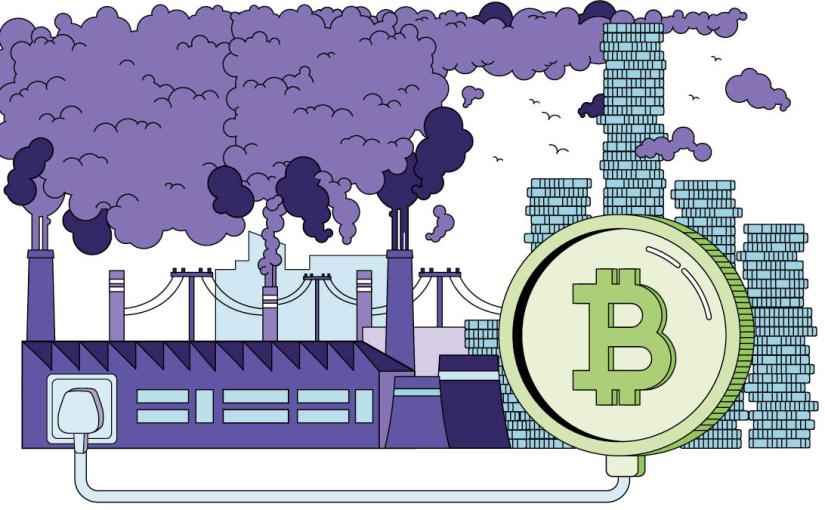
Cryptocurrency has long had a dirty secret: the energy needed for bitcoin mining. 

Crypto evangelists – who believe a decentralised financial system is for the greater good – tend to ignore this inconvenient truth. In May, however, when Tesla boss Elon Musk decried the environmental effects of the mining that goes into validating bitcoin transactions, the energy issue became a burning topic. 

It’s a big problem for cryptocurrencies because the majority of investors (77%) are aged under 45, according to a study published earlier this year by Gemini Exchange. These consumers are also more eco-conscious than older generations. Indeed, Musk’s damning assessment arrived at the same time that a Pew Research Center study found that 37% of Gen Z and 33% of millennials in the US cite climate change as their top personal concern.

Unsurprisingly, some worry that these investors could sour on bitcoin and other energy-draining cryptocurrencies. Bitcoin in particular is a victim of its own success, at least when it comes to environmental concerns. This is due to its ‘proof-of-work’ protocol: a decentralised consensus mechanism that requires members of the network to expend effort solving an arbitrary mathematical puzzle so that no one can hijack the system. 

It’s a vicious correlation, because the higher bitcoin’s market value – in February it easily became the quickest asset in history to reach $1tn, after only 12 years – the more energy is consumed.

The latest bitcoin bull run, which began at the end of 2020, has sparked a surge in mining, bringing with it increased energy consumption. It’s no coincidence that China’s government has cracked down on crypto: the vast majority of bitcoin is mined there, driving up energy demand and making it harder for the country to achieve its target of net-zero emissions by 2060.

Solving the proof of work energy issue

Currently, bitcoin would rank as the 32nd-highest nation in the world by energy consumption, ahead of the Netherlands. Bitcoin and ethereum between them consume more than three quarters of the electricity used by all cryptocurrencies. Notably, the other three on the list of the five worst offenders – dogecoin, bitcoin cash and litecoin – all use the ‘proof-of-work’ protocol.

Bitcoin’s energy consumption has more than quadrupled since the beginning of its last peak in 2017, says Charles Hoskinson, co-founder of ethereum – the second largest crypto by market capitalisation. “It’s set to get worse because energy inefficiency is built into its DNA,” Hoskinson argues. As chief executive of global blockchain engineering firm IOHK, he’s also the driving force behind third-generation cryptocurrency cardano.

According to Hoskinson, bitcoin’s carbon footprint will “become exponentially worse because the more its price rises, the more competition there is for the currency” and thus the more energy it consumes. 

Other, greener consensus mechanisms are gaining in popularity, such as the ‘proof-of-stake’ blockchains that underpin cryptocurrencies like cardano, polkadot and algorand, and don’t require mining. Proof-of-stake uses considerably less energy than proof-of-work chains, because “network participants are chosen to validate ‘blocks’ of transactions based on how many coins they hold rather than the computational processing power they have”, Hoskinson explains. He estimates that cardano is “four million times” more energy efficient than bitcoin.

Going green, one block at a time

Monica Long, general manager of RippleX, which provides open-source code and developer tools to accelerate interoperable blockchain technology, agrees that proof of work is “very energy intensive”. However, she says things are changing rapidly, noting that ethereum will shortly be switching to a proof-of-stake protocol that is expected to reduce electricity consumption by 99%.

She welcomes both the Bitcoin Mining Council, unveiled by Musk in May to monitor and improve the industry’s sustainability, and the Crypto Climate Accord, which is a private sector collaboration focused on making all blockchains carbon neutral by 2030.

Ultimately, not only does digital money offer many great advantages, but it’s a step towards a greener future overall

Rhian Lewis, author of The Cryptocurrency Revolution: Finance in the Age of Bitcoin, Blockchains and Tokens, says it’s vital to keep things in perspective. “Modern life is by its very nature energy intensive. In the US alone, the energy consumed by inactive household devices left on standby every year would power the entire bitcoin network for 1.9 years.”

And when people compare the energy consumed by a transaction on the Visa network, for instance, with a transaction on the bitcoin network, it is a “false equivalent”, she says. “A transaction on Visa needs the entire world banking system to be in place before its transaction can be processed, with all the physical infrastructure of banks, their buildings, people travelling between them, physical money being minted and transported, and so on. In contrast, bitcoin does all that inherently.”

An eco-friendly future? 

Pavel Matveev, founder and chief executive of Wirex, a crypto payment card, believes bitcoin’s energy consumption is the exception in the industry. “With more than 4,000 cryptocurrencies in existence, there are plenty of environmentally friendly options available, and many more on the way,” he says. 

For example, he points to nano, a eco-friendly cryptocurrency that doesn’t rely on mining, printing or minting and aims to address the current inabilities in today’s existing financial systems and limits fees while providing quick transaction speeds.

Given the introduction of less energy-intensive coins and a move towards renewable energy for mining, crypto could well become a more eco-friendly payment system in coming years, he suggests.

“Even the less eco-friendly cryptos can still be better for the environment than traditional currency,” says Matveev. “Imagine: goodbye plastic cards, paper receipts and pennies.

“Ultimately, not only does digital money offer many great advantages, but it’s a step towards a greener future overall.”

Perhaps Musk’s energy truth bomb was just what the industry needed to hear to clean up its act, even if, in the long term, the appeal of the original crypto is overtaken by more environmentally conscious alternatives. 

This article was first published in Raconteur’s Cryptocurrencies report in June 2021

Time to reboot and drive meaningful change

For the future of humanity, society must grasp this opportunity to evolve, rethink broken systems, remove corrosive business cultures, and right deep inequalities

While it is distressing and lamentable that the chaos spread by the coronavirus pandemic has squeezed the life out of countless businesses across the gamut of industry and restricted liberties we all previously took for granted, I am optimistic that society will be reborn for the better. The darkest days will prove the catalyst to drive meaningful change for a brighter future, I sincerely hope.

Despite – or perhaps because of – being locked down, minds have been set free. Concepts that were considered radical at the start of 2020, such as universal basic income, have gained tremendous momentum. It has been liberating to discuss how to solve some of humanity’s most significant challenges, together. But the time for talking is over: we now need to act on the promises to improve life for more people and repair the planet.

The events of 2020 have exposed that society is gravely poorly, traditional systems are broken, and inequality in all its forms is growing. If the COVID-19 fallout has accelerated various trends and catapulted businesses into the digital era, now we need to reboot the world.

“The coronavirus pandemic has taken an X-ray of society and shown us where we are sick,” an Australia-based chief executive told me recently. “It’s also like a time machine and has taken us forward to where problems that were latent are now acute, whether that’s the glaring reality that to be successful businesses need to be as good at generating clicks as they are at bricks, or deep-rooted social inequality.”

It was galling to learn, via an Oxfam report published at the end of January, that the world’s ten wealthiest people according to Forbes – all men, bar one (Alice Walton, the only daughter of Walmart founder Sam Walton) – have seen their fortunes grow by $540 billion since mid-March 2020, when the pandemic took hold. 

However, I sense there is a genuine groundswell to rebalance inequality, in all its forms. It won’t happen overnight, but there will be an inexorable and seismic shift to the point where it is no longer morally acceptable to turn a blind eye to, for instance, racism and gender disparity. The same goes for environmental issues.

One of the few pleasing long-term consequences of the pandemic is the proof of concept of collectivism: if we act together, we can achieve remarkable things. Millennials and younger generations weaned on social media have always considered themselves part of a global community. If we can apply that drive and discipline to matters like the environment, sustainability and equality, we can deliver colossal change.

We must begin thinking beyond ourselves, where we live, to create the sort of future that we all need. Whatever happens, if we go back to how things used to be and forget the tragedy – as with happened after the September 11 attacks – would be a huge failure. As a society, we must grasp this unique opportunity to take stock, look at what’s worked and what hasn’t, and move forward to address some of the most expansive cracks.

How lockdown has affected my working experience

As I’ve typed from home as a freelance journalist since 2014, there were no sweeping changes required when lockdown was enforced, fortunately. However, one key difference was that my family members were suddenly also around, and in particular my young son required homeschooling (and entertaining). Over the last year, it has been fascinating to chronicle the significant changes society has undergone so far. I have found, though, that not relying on the black and white of email and speaking to clients and contacts – thus allowing the time and space for nuance and being, well, more human – has greatly benefited both parties and strengthened bonds.

This article was first published in Beyond the bylines report by Farrer Kane in March 2021