Why companies are struggling to build a ‘single customer view’

Investing time, resources and money to create personalised and valuable customer experiences can reap big rewards, but there are challenges in aligning data for a business-wide strategy

Organisations that invest heavily to build a data-driven “single customer view”, enabling personalised experiences, are likely to reap huge rewards. And I can vouch for that.

At the risk of offending family and friends, by far the greatest highlight of a recent birthday was receiving a personalised celebratory email from the captain of the football club I have supported since I could kick a ball. 

While it was a surprise to see his grinning portrait and accompanying message landing in my inbox, it triggered a giddy response. The feeling of being unique and valued overpowered any rational scepticism that my Premier League team’s superstar skipper had taken the time to congratulate my age milestone. 

This nifty, cost-effective note, made possible because the club somehow knew my birth date,  emboldened my trust and loyalty. I duly spent hundreds of pounds in the online shop on kits, mugs and hats, and marked with a flag the email, which I often click on when needing either a mood lift or guidance.

Businesses will score if they use real-time data to communicate with customers at appropriate times, and it comes across as sincere and authentic, says Adam Spearing, chief technology officer for Europe, Middle East and Africa at Salesforce. “Brands can build trust through meaningful interactions with their customers, anticipating their needs and delighting them,” he says. 

“Having a 360-degree customer view is crucial for enabling brands to have more personal and contextually aware interactions with customers. The more valuable an interaction is for a customer, the more inclined they will be to continue to trust a brand to use their data appropriately.” 

Spearing warns there is “a fine line”, though: “Only if brands use the data respectfully will they gain that trust.” Herein lies the main challenge with building a single customer view.

Slow and steady wins trust

There are myriad benefits to investing in digital identity specifically to build a single customer view by unifying all relevant data into a centralised profile. Done well, aside from improving all-important customer trust and loyalty, it can guide marketing, boost customer service, better model consumer habits and, therefore, generate more accurate predictions and increase revenue.

Yet there are many pitfalls to dodge to obtain this view. For instance, brands need to connect all historical data with real-time behavioural data, which means digital identities should grow organically over time.

“Achieving a single customer view remains a huge challenge for many businesses due to the multiple touchpoints the average customer faces when dealing with an organisation and the rapid rate at which data is generated,” says Gavin Laugenie, head of strategy and insight at dotdigital, an omnichannel marketing automation platform.

He points to a recent Experian study that found 92 per cent of companies do not have access to a single customer view. Laugenie says this “staggering” figure is mostly because the many touchpoints result in fragmented and siloed data. “The key to getting around this is by adopting technology that not only allows you to communicate with all of your data touchpoints, but pool the data and enable you to use it quickly and easily,” he says.

A single customer view will provide the foundation from which an organisation can “easily read the data and plot the right messages to send individuals as they navigate their unique journeys with you”, says Laugenie. Once armed with the data, it is crucial not to bombard customers, though.

“It’s a continuous process and that mutual sharing process will generate trust, which is essential, especially for older online shoppers,” he adds. “Slow and steady will win the race.”

Rising appetite for personalisation

Benoit Soucaret, group creative director at LiveArea, a global customer experience agency, concurs. “Good personalisation shouldn’t appear personalised at all,” he says. “Instead it should appear fortuitous, delivering value to a consumer at the right time, in the right place, in the right way. 

“It is less about selling consumers products and more about complementing their life experiences. At no point can it appear disconcerting, intrusive or annoying.”

There appears to be a rising appetite for personalisation, according to research published by the Data & Marketing Association (DMA). Some 39 per cent of consumers are “personalisation fans”, a group whose members prefer offers to reflect their interests instead of being surprising. A further 33 per cent appreciate both personalised offers and those that are more random. Only 28 per cent do not favour personalisation. 

“This strong desire for personalisation is encouraging for brands wanting to strengthen their relationship with existing customers,” says Tim Bond, head of insight at the DMA. But he identifies something else brands seeking to build a single customer view must beware: poor quality or misused data. 

Consider how, in January 2020, Aviva addressed its entire email base as “Michael”, proving that mistakes can creep in, even with basic data. “The assumptions, errors and insults will be amplified with each step more personal,” says Tom Kennedy, M&C Saatchi’s senior art director.

Bond agrees: “For a centralised profile to have meaningful value, businesses must have a system in place that can analyse data on previous interactions and combine it with insights from real-time user journeys. Only then can businesses truly understand a customer’s preferences and values.

“Having the right data, consent and preference management processes in place is imperative for businesses that want to guarantee and gain the maximum value for and from their customer data.”

Connecting online and offline data

In particular, marketers understand the merits of a single customer view, according to another recent DMA study. Such a system enables brands to offer more personalised experiences (45 per cent of respondents recognised this as a benefit) and increased transparency (44 per cent gave this the thumbs up). “These are two key factors in fostering long-term customer loyalty and trust,” says Bond.

Consumer expectations in this area are also rising. Some 78 per cent now expect consistent interactions across departments and four in five won’t buy from companies they don’t trust, a report from Salesforce shows.

Given the uptick in demand for customer personalisation, there is an urgent need for businesses of all sizes to evolve for the digital age. “The growing prevalence of ecommerce and multichannel customer journeys through 2020 only increased the importance of understanding your customers’ digital identity,” says Matthew Avery, enterprise sales manager at Infinity, a cloud-based call-tracking platform. 

Avery argues that many businesses are not taking advantage of the technology now available to connect online and offline data, including telephone calls and point-of-sale systems. “If you’re currently only monitoring the touchpoints where customers finally convert, you risk neglecting your understanding, and optimisation, of pivotal engagements higher up the sales funnel,” he says. 

However, Megan Jones, senior strategist at R/GA London, worries that some larger companies, where departments work in silos, are simply not set up to maximise the potential of a single customer view. “Legacy organisations struggle to execute these grand visions,” she says. “This failure can be caused by many reasons, including a lack of digital talent or poor data proficiency. Ultimately, it comes down to a lack of strategy and understanding.”

Clearly, for those who have their sights set on crafting a single customer view, the road to glory is fraught with challenges. To help guide the way, perhaps business leaders can make use of an inspirational personalised email from their favourite football team’s captain, too.

This article was originally published in Raconteur’s Digital Identity report in February 2021

Best of Boat Floaters 2020 – for Meet Bernard

“Freak storm comes.” This refrain, layered on top of the track’s sense of loss, powerlessness and restriction in Idris Ackamoor and The Pyramids’ When Will I See You Again? – which concludes the exclusive Meet Bernard mix of my Boat Floaters Best of 2020 – works neatly as a three-word summary of the most complex and chaotic year in history.

Some 1,783,100 million deaths have been attributed to coronavirus, at the time of writing. And while that’s a tiny fraction of the 7.8 billion humans alive today, the pandemic has touched every element of our lives, and choked many of them. Paradoxically, the coronavirus outbreak has set us free and opened minds. It has exposed and exploded outdated systems and antiquated mores, and triggered meaningful transformation across the globe.

Selecting just 20 songs for 2020 was always going to be challenging (and here is the 46-track, 226-minute longlist on a Spotify playlist). But having scrolled through my monthly Spotify playlists for Meet Bernard it has been fascinating to see what tunes were floating my boat at a given month, and how the sonic salve I sought to soothe my soul shifted with global events.

Music truly has been my sanctuary in the last nine months. I’ve listened to – and discovered – more music, both ancient and new, than in any other year. I’ve unearthed countless decades-old gems. And with artists locked down and not gigging it has enabled the time, space and emotion to produce a trove of fresh, enriching tracks.

This 20-track mix features artists from Africa, the Caribbean, North and South America, Scandinavia, as well as elsewhere in Europe, and much closer to home, in London. To me, all the tracks are standalone delights, and I could pen detailed blurbs on every one. But highlights of these highlights are as follows …

I simply had to begin the set with Cándido’s 1979 classic Thousand Finger Man. Yes, it is an awesome set-starter. But the unparalleled, innovative Cuban percussionist died, aged 99, in November, so this is a homage to him and his unique talent.

The secretive SAULT, supposedly fronted by London vocalist Cleo Sol, has seasoned 2020 with two incredible, tone-perfect albums, UNTITLED (Black Is) – which you can download on Bandcamp at any price – and UNTITLED (Rise). From the latter comes Free, a brilliant track about shorn independence and the need for connection and collaboration. 

I love French “Afropean” duo DjeuhDjoah & Lieutenant Nicholson, and in the April-released Caipirinha, a nod to Brazil, it’s coolness served in a cocktail glass.

The return of hip-hop collective Quakers, later in the year, was welcome, too. With South African legend Sampa The Great on rapping duty, Approach With Caution captures how many of us have felt at the tensest times this year. 

Danish singer-songwriter Astrid Engberg’s jazzy soul track Daylight, which speaks of a brighter tomorrow after a heavy night, has been an earworm ever since it was released in September. 

Elsewhere, there is succour to be found in Hamburg-based ensemble Bacao Rhythm & Steel Band’s new version of Erykah Badu’s The Healer, and more steelpan goodness in Steel Band de la Trinidad’s much-older arrangement of Coming Home.

I had to include the original and best version of Money’s Too Tight (To Mention), released in 1982 by the Valentine Brothers, for all the musicians struggling to make ends meet in 2020. It’s also a superb funk track. 

The aforementioned When Will I See You Again? ends the 87-minute mix. I am not alone in wishing to see Ackamoor and his nonpareil group live again, and sooner rather than later. 

Finally, thanks to Ryan and Dani for offering an opportunity to make sense of and showcase my monthly musical mystery touring. If we learn only one thing from 2020 it is that collaboration and supporting others is critical. Together we are stronger.

Here’s hoping for fewer freak storms in 2021. Good luck to you and your nearest and dearest.

Yours in music,

Ollie (Boat Floaters)

Why content is king – especially now

If business leaders have learnt one thing this year it is that good, authentic communication is critical – both for employees and customers. Trust is essential to attract and retain staff, consumers, and other stakeholders – including investors – alike. And to drive good communication and build trust you need excellent content.

Much in the same way many companies have had to pivot – or at least adapt their business strategies – in 2020, the content needs to evolve to keep pace, and celebrate those changes. It’s all about storytelling, and being honest – don’t try to be something / someone you are not, as when you are found out it will erode that all-important trust. It’s also easy to see through. Equally, if there have been bumps in the road it would be of interest to people to learn how you overcame them.

Thankfully these days there is a range of content you can utilise to tell your story, set out your goals and articulate your purpose and key messages – and none of it is expensive, if you know where to look.

great content drives communication and engenders trust

Often a variety, or suite of content, works best, and this might include ghostwritten thought leader website blogs (which can be filleted for social media platforms, including LinkedIn), videos (the rawer, the better), infographics, roadmaps, data-driven articles, listicles, newsletters, podcasts, and much more. And content can be proactive and reactive – the main point is to keep the content tap open, so that people want to keep coming back.

Good content can help you find your voice and your business’ voice, and trigger change by uniquely expressing ideas and showcasing your goods or services in a way that interests, informs, influences and inspires readers (or viewers).

However, often it is tricky for business leaders to whip up winning content in-house. There might be time-commitment issues, and usually the process of telling the business’ story to an outsider (with expert content production skills) can help articulate the important messages and unearth the nuggets that will appeal to a wider audience. This is true for companies of all sizes – indeed, the biggest businesses certainly understand the value of outsourcing content to freelancers.

Many times I have been parachuted into a business when there was a clear goal: to produce better content. But they no real idea of how to reach that point. And that’s fine – and understandable. It takes some time to research and interview key stakeholders and perform a kind of content audit, to understand what has already been produced (and what can be reused / updated) and tease out the interesting use cases and stories.

Indeed, content production is often elevated by freelancers whose task it is to better understand the business and ask questions you might have not thought of, or think of ways in which the content might be presented.

Ultimately, great content drives communication and engenders trust, and together those two factors are paramount to business success in 2020 and beyond.

This article was originally published on YunoJuno in December 2020

Could the pandemic have been predicted?

Governing in advance may seem like something from science fiction, but by using artificial intelligence and predictive analytics, experts say it’s possible

When the coronavirus pandemic hit UK businesses in the spring, forcing organisations to lock down, it required open minds to grasp technology and reimagine ways of working. Government and the public sector sought to solve challenges old and new, including rushing through essential financial support to companies and their furloughed staff, and improve service delivery and data-driven decision-making by dialling up investment in tech, especially artificial intelligence (AI).

After all, with predictive analytics, governments can conceivably prevent, rather than cure, issues or respond to citizens’ needs before they arise. But how far off are we from governing in advance? And what are the ethical implications of such a system?

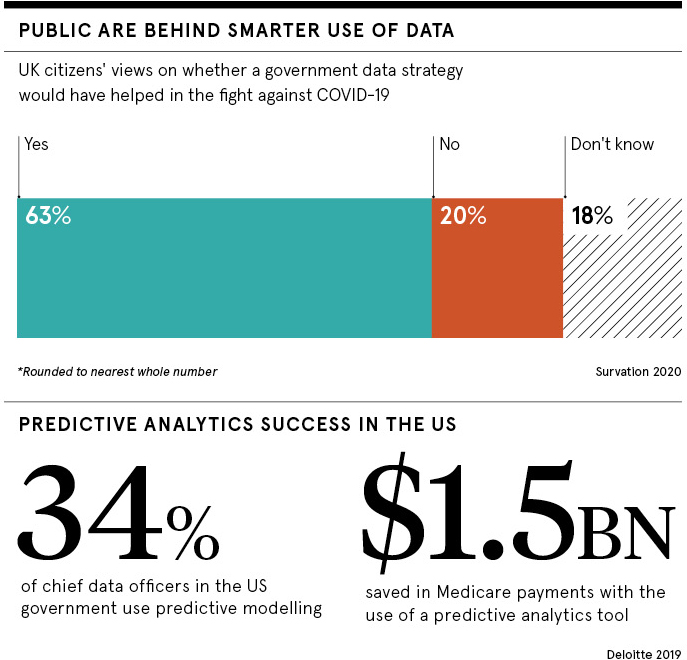
Around the world, there are numerous narrow-scope use cases of authorities using predictive analytics to life-saving and life-enhancing effect. In Durham, North Carolina, the police department reported a 39 per cent drop in violent crime from 2007 to 2014 after using AI to observe patterns and interrelations in criminal activities and to identify hotspots, thus enabling quicker interventions.

Also in the United States, AI has helped reduce human trafficking by locating and rescuing thousands of victims. Knowing that approximately 75 per cent of child trafficking involves online advertisements, the Defense Advanced Research Projects Agency developed a platform using software that monitors suspicious online ads, detects code words, and infers connections between them and trafficking rings.

Further afield, the Indonesian government has partnered with a local tech startup to better predict natural disasters. By analysing historical flood data, collected from sensors, and accessing citizen-complaint data, prone areas can now be quickly identified, speeding up the emergency response and improving management.

Actionable intelligence and data scientists needed

In the UK, the public sector has much work to do, and requires people to do it, if governing in advance is to become a reality, says David Shrier, adviser to the European Parliament in the Centre for AI. “More investment in predictive analytics will help with risk mitigation, although this exacerbates the already extant shortage of data scientists who can develop and manage these models.”

Predicting trends through data analysis is vital for governments and has been for some time. “Forecasting approaches using historical data to build mathematical predictive models have been core to government economic policy for decades,” says Andrew Hood, chief executive of Edinburgh-headquartered analytics consultancy Lynchpin. “Whether those models allow governments to govern in advance effectively depends on to what extent they have enough political motivation and capital to apply the model outputs directly.

It’s too tempting to see predictive analytics as a magical answer, a black box that can solve all our challenges

“Arguably, there has been no shortage of predictive models kicking around as the pandemic took hold. However, the pandemic also points to the reality of a lot of prediction and forecasting: it is not about having one crystal ball to rely on, rather a set of predictions based on the best data to hand that need to be reviewed constantly, updated and critically applied.”

Hood stresses that skilled humans must remain in the driving seat and warns of the dangers of solely relying on technology to steer choices. “As with any application of predictive analytics,” he says, “it is the integration of those models within the context of governing and the processes of human decision-making that is the critical success factor.”

Public trust in AI must be won

Futurist Tom Cheesewright, whose job is to predict trends, posits that predictive analytics is “one subset of a wider array of foresight tools for scanning near and far horizons”. Should governments be making better use of such tools? “Absolutely,” he answers. “But I think it’s too tempting with predictive analytics to see this as a magical answer, a black box that can solve all our challenges. It’s not like Minority Report-style predictive justice. It’s about pulling policy levers in time to dodge obstacles or maximise opportunities.”

Echoing Hood’s advice, Cheesewright adds: “Foresight needs time and investment of cash and political capital, both of which are in short supply in our volatile, post-austerity era.”

Nick McQuire, of specialist technology market intelligence and advisory firm CCS Insight, says: “Historically, the public sector has been behind most sectors in terms of maturity in deploying and investing in AI,” but senses the purse strings are being loosened. “We are starting to see more AI applications in the public sector: chatbots, contact centre assistance and demand forecasting,” says the senior vice president and head of enterprise research.

AI has been excoriated in the UK media this year, though, making citizens and politicians wary of the tech and by extension predictive analytics. “Public confidence in AI is not high,” McQuire concedes. “To build trust in AI, organisations are now having to double-down on areas like data governance and security, privacy, explainability and ethics.”

It didn’t help that prime minister Boris Johnson, the most powerful politician in the UK, blamed the Ofqual exam-marking fiasco in August on “a mutant algorithm”, says Dr Jeni Tennison, vice president and chief strategy adviser at the Open Data Institute. “We have to recognise people are at the heart of designing algorithms; it’s not that algorithms go off and mutate on their own and we have no control over them,” she says. “We need to ensure there is a good end-to-end process that recognises the AI isn’t always going to get things right.”

Tennison, a fervent supporter of open data, believes those in the public sector must take care of how they deploy the technology. And, as such, predictive analytics, if applied, should be closely managed. “Algorithms that are used by the public sector have a much bigger impact on people’s lives. Government has a particular responsibility to make sure it uses AI and data well,” she says.

“Right now we’re operating from a position where people distrust the use of algorithms. The public sector has to be very proactive and win that trust.”

Given the public scepticism around AI, and the paucity of data scientists to make best use of predictive analytics, it seems we are some way off the UK governing in advance. Ethically, perhaps that is no bad thing.

This article was originally published in Raconteur’s Public Sector Technology report in December 2020

Fighting fraud in times of crisis

Cybercrime is always distressing for those affected, but when the resultant losses come from the public purse, it must be taken even more seriously

Coronavirus has coursed through every facet of our lives, and society and business have already paid a colossal price to restrict its flow. We will be counting the cost for years, if not decades. And while people have become almost anaesthetised to the enormous, unprecedented sums of support money administered by the government, it was still painful to learn, in October, that taxpayers could face losing up to £26 billion on COVID-19 loans, according to an alarming National Audit Office report.

Given the likely scale of abuse, it raises the question of how authorities should go about eliminating public sector fraud? Could artificial intelligence (AI) fraud detection be the answer?

Admittedly, the rapid deployment of financial-aid schemes, when the public sector was also dealing with a fundamental shift in service delivery, created opportunities for both abuse and risk of systematic error. Fraudsters have taken advantage of the coronavirus chaos. But their nefariousness is not limited to the public sector.

Ryan Olson, vice president of threat intelligence at American multinational cybersecurity organisation Palo Alto Networks, says COVID-19 triggered “the cybercrime gold rush of 2020”.

Indeed, the latest crime figures published at the end of October by the Office for National Statistics show that, in the 12 months to June, there were approximately 11.5 million offences in England and Wales. Some 51 per cent of them were made up of 4.3 million incidents of fraud and 1.6 million cybercrime events, a year-on-year jump of 65 per cent and 12 per cent respectively.

Cybercrime gold rush – counting the cost

Jim Gee, national head of forensic services at Crowe UK, a leading audit, tax, advisory and risk firm, says: “Even more worryingly, while the figures are for a 12-month period, a comparison with the previous quarterly figures shows this increase has occurred in the April-to-June period of 2020, the three months after the COVID-19 health and economic crisis hit. The size of the increase needed in a single quarter to result in a 65 per cent increase over the whole 12 months could mean actual increases of up to four times this percentage.”

In terms of eliminating public sector fraud, Mike Hampson, managing director at consultancy Bishopsgate Financial, fears an expensive game of catch-up. “Examples of misuse have increased over the last few months,” he says. “These include fraudulent support-loan claims and creative scams such as criminals taking out bounce-back loans in the name of car dealerships, in an attempt to buy high-end sports cars.”

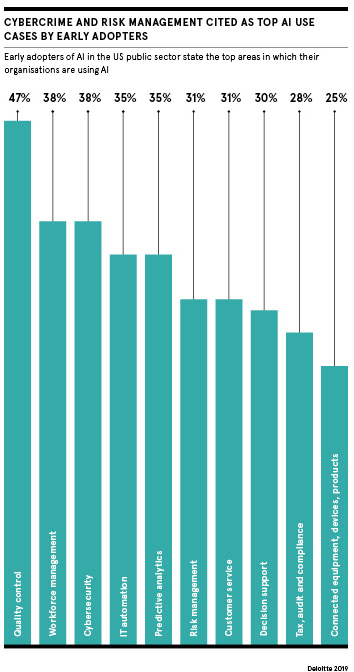
AI fraud detection and machine-learning algorithms should be put in the driving seat to pump the brakes on iniquitous activity, he argues. “AI can certainly assist in carrying out basic checks and flagging the most likely fraud cases for a human to review,” Hampson adds.

John Whittingdale, media and data minister, concedes that the government “needs to adapt and respond better”, but says AI and machine-learning are now deemed critical to eliminating public sector fraud. “As technology advances, it can be used for ill, but at the same time we can adapt new technology to meet that threat,” he says. “AI has a very important part to play.”

Teaming up with technology leaders

Technology is already vital in eliminating public sector fraud at the highest level. In March, the Cabinet Office rolled out Spotlight, the government grants automated due-diligence tool built on a Salesforce platform. Ivana Gordon, head of the government grants management function COVID-19 response at the Cabinet Office, says Spotlight “speeds up initial checks by processing thousands of applications in minutes, replacing manual analysis that, typically, can take at least two hours per application”. The tool draws on open datasets from Companies House, the Charity Commission and 360Giving, plus government databases that are not available to the public.

“Spotlight has proven robust and reliable,” says Gordon, “supporting hundreds of local authorities and departments to administer COVID-19 funds quickly and efficiently. To date Spotlight has identified around 2 per cent of payment irregularities, enabling grant awards to be investigated and payments halted to those who are not eligible.”

We need to watch how the technology fits into the whole process. AI doesn’t get things right 100 per cent of the time

She adds that Spotlight is one of a suite of countermeasure tools, including AI fraud detection, developed with technology companies, and trialled and implemented across the public sector to help detect and prevent abuse and error.

Besides, critics shouldn’t be too hard on the public sector, argues David Shrier, adviser to the European Parliament in the Centre for AI, because it was “understandably dealing with higher priorities, like human life, which may have distracted somewhat from cybercrime prevention”. He believes that were it not for the continued investment in the National Cyber Security Centre (NCSC), the cost of fraudulent activity would have been significantly higher.

Work to be done to prevent fraud

Greg Day, vice president and chief security officer, Europe, Middle East and Africa, at Palo Alto Networks, who sits on Europol’s cybersecurity advisory board, agrees. Day points to the success of the government’s Cyber Essentials digital toolkit. He thinks, however, that the NCSC must “further specialise, tailor its support and advice, and strengthen its role as a bridge into information both from the government, but also trusted third parties, because cyber is such an evolving space”.

The public sector has much more to do in combating cybercrime and fraud prevention on three fronts, says Peter Yapp, who was deputy director of incident management at the NCSC up to last November. It must encourage more reporting, make life difficult for criminals by upping investment in AI fraud detection and reallocate investigative resources from physical to online crime, he says.

Yapp, who now leads law firm Schillings’ cyber and information security team, says a good example of an initiative that has reduced opportunity for UK public sector fraud is the NCSC’s Mail Check, which monitors 11,417 domains classed as public sector. “This is used to set up and maintain good domain-based message authentication, reporting and conformance (DMARC), making email spoofing much harder,” he says. Organisations that deploy DMARC can ensure criminals do not successfully use their email addresses as part of their campaigns.”

While such guidance is welcome, there are potential problems with embracing tech to solve the challenge of eliminating public sector fraud, warns Dr Jeni Tennison, vice president and chief strategy adviser at the Open Data Institute. If unchecked, AI fraud detection could be blocking people and businesses that are applying for loans in good faith, or worse, she says.

“We need to watch out how the technology and AI fit into the whole process,” says Tennison. “As we have seen this year, with the Ofqual exam farrago, AI doesn’t get things right 100 per cent of the time. If you assume it is perfect, then when it doesn’t work, it will have a very negative impact on the people who are wrongly accused or badly affected to the extent they, and others, are fearful of using public sector services.”

There are certainly risks with blindly following any technology, concurs Nick McQuire, senior vice president and head of enterprise research at CCS Insight. But the public sector simply must arm itself with AI or the cost to the taxpayer will be, ultimately, even more significant. “Given the scale of the security challenge, particularly for cash-strapped public sector organisations that lack the resources and skills to keep up with the current threat environment, AI, warts and all, is going to become a crucial tool in driving automation into this environment to help their security teams cope.”

This article was originally published in Raconteur’s Public Sector Technology report in December 2020

Creating a culture of change

Legacy infrastructure and outmoded ways of thinking can trip up digital transformation projects in the public sector

Private sector organisations that began digital transformation before the coronavirus pandemic suffocated business as usual were equipped and agile enough to revamp their strategies and operations, and thrive despite the chaos.

And laggards quickly realised that to keep pace they needed to invest in digital technologies and accelerate digital transformation plans. Meanwhile, those operating in the public sector, lumbered with legacy systems unsuitable for the digital age, looked on with envy, twiddling their thumbs.

A slight exaggeration, perhaps, but it is a truism that the public sector is notoriously slow to embrace technology. There is a pervading sense, though, that COVID has necessitated a levelling-up across the sector.

Given the mass shift to remote working, the strain on public services, especially the National Health Service, and the immediate need to streamline operations and reduce spending while improving efficiencies, digital transformation is critical. As private sector business leaders can attest, change management is paramount when deploying new technologies and ways of working.

While there is great urgency for speedy improvement, it’s appropriate to acknowledge digital adoption within the UK public sector is well behind other countries. Johnny Hugill, head of research at PUBLIC, a govtech venture firm, notes that although many public services have been moved online, to http://www.gov.uk, the harmonisation of digital services has much ground to make up. For instance, he says, around 60 per cent of citizens fill out online forms to public authorities here, while digital front-runners such as Denmark, Norway, Estonia and South Korea enjoy rates of up to 80 per cent.

Constrained by legacy infrastructure

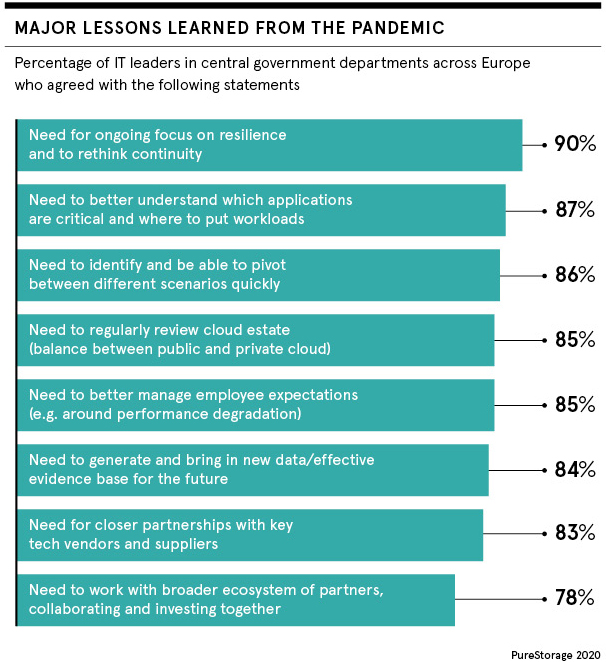
The coronavirus fallout served to expose the UK public sector’s woeful lack of readiness to operate in the digital era. Indeed, a meagre 6 per cent of public sector workers said they were “extremely prepared for the pandemic”, according to research published in mid-November by Pure Storage, a global data storage solutions firm.

More than two-thirds (67 per cent) responded that “legacy infrastructure is holding up digital transformation progress”. This hindrance leads to “increased operational costs, reduced efficiency, and reduced operational agility”, says Shaun Collings, Pure Storage’s director of public sector in the UK.

The organisation’s research suggests eight out of 10 public sector workers believe agile methodologies and design-thinking are more important now than before the pandemic. “Clearly, many are constrained by legacy infrastructure,” says Collings. “The challenges and upheaval that public sector organisations have been faced with should act as a catalyst for reviews of supporting infrastructure and consideration of what is needed for the future.”

This advice is supported by new data from SAP, which indicates that 28 per cent of UK civil servants say they still lack adequate IT systems to support remote working. Leila Romane, the enterprise software provider’s head of SuccessFactors in the UK and Ireland, says: “Public sector organisations often operate independently and many are burdened by old and siloed technology infrastructure, which has made digital innovation more challenging.

“In the private sector, however, technology is increasingly seen as a tool to drive efficiencies by sharing data across departments and geographies.” Romane urges public sector organisations to be more collaborative, digitally focused and flexible, not least because they will otherwise find it harder to attract and retain top young talent, she warns.

Collaboration with suitable tech partners is vital

While public sector leaders may realise the need, and show a willingness to upgrade their digital capabilities, there are, frustratingly, many hurdles to overcome. Professor Julie Hodges of Durham Business School lists them. Of the many barriers, budget constraints and legacy infrastructure is a big one. Lack of leadership and vision also ranks highly, as does a reluctance to change among managers and frontline staff. Possibly most limiting is a culture that does not support transformational change, says Hodges.

PUBLIC’s Hugill agrees. “Together, culture, skills and practice form a fairly significant stumbling block to getting the public sector on board with projects,” he says, making the case that tech companies and startups should be considered over traditional partners that might not be best placed to drive digital adoption.

“Public sector officials have fallen into a routine of ‘this is how we’ve always done it’ when choosing preferred suppliers. The truth is that these suppliers were often chosen because they were good at what they did 30 years ago, but then became better at winning contracts than they were at innovating.”

Culture, skills and practice form a fairly significant stumbling block to getting the public sector on board with projects

Thankfully, there is a growing list of case studies where public sector bodies have teamed up with tech organisations to great effect. For instance, the North East Ambulance Service (NEAS), a completely mobile and essential frontline organisation with 2,500 staff covering 32,000 square miles, uses Workplace from Facebook’s communication platform to enable employees to connect and communicate better with each other.

“When the pandemic hit, I wanted a safe and secure space for staff to ask questions, challenge each other, share stories and help us build a stronger team and supportive culture,” says Helen Ray, chief executive of NEAS. “Workplace has helped us move away from having conversations behind closed doors to more openness and transparency. The social media platform has helped to bring us closer together and instil a sense of belonging.”

The last word of advice for public sector leaders seeking to navigate their digital transformation journey, which once started should never stop, comes from Romane at SAP. “To drive change in any organisation, leaders need to first listen to their employees, especially those who are on the frontline,” she says. “Then empower them with the tools and training to manage the change effectively and efficiently. Finally, create a mechanism for them to collaborate and feedback any learnings about their experiences.”

This article was originally published in Raconteur’s Public Sector Technology report in December 2020

Taking a peek at the new retail calendar

What happens to Black Friday when customers can’t jostle in the aisles? Or Christmas shopping season when we can’t hit the high street? Experts think these dates will become part of a whole new online retail calendar

Will it be a happy Christmas for UK retailers? After the coronavirus pandemic squeezing the life out of the high street, they certainly deserve some cheer. Data shows their fortunes could be resurrected by ecommerce. But given the shift to online, and the evolution of shopping habits, what does it mean for the traditional retail calendar?

New data from Adobe indicates activity around key retail dates will begin earlier, and peak retail occasions will be higher and more prolonged. According to the software giant’s international president Paul Robson, online holiday sales will “shatter all previous records”.

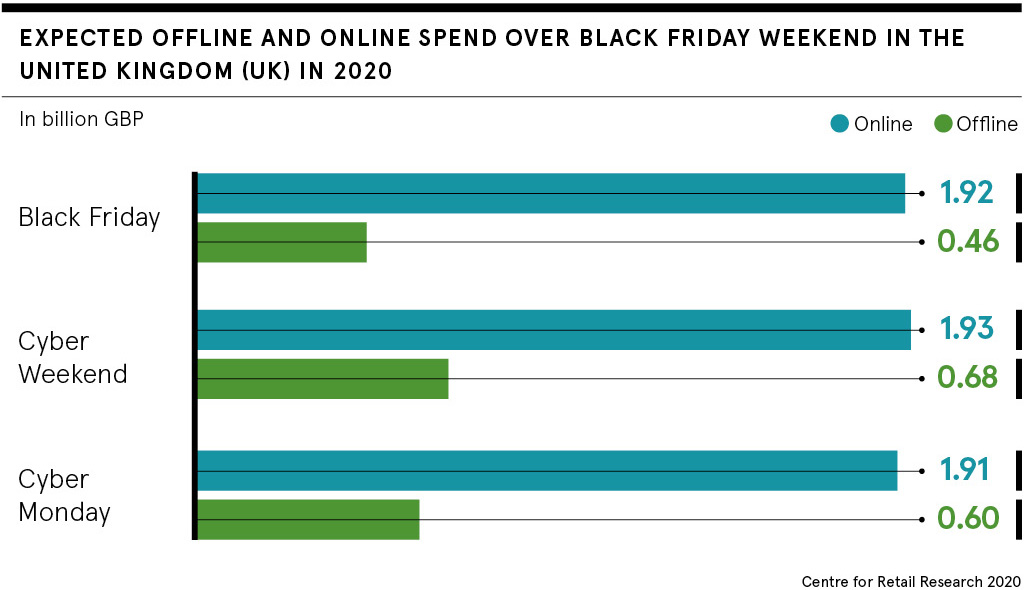
This is supported by Adobe’s projections that, in America alone, Black Friday will generate $10 billion (£7.5 billion) in online sales. “That’s a 39 per cent year-on-year increase,” says Robson. “Cyber Monday will remain the biggest online shopping day of the year,” he continues, adding that $12.7 billion (£9.6 billion) is expected to be spent in the United States, up 35 per cent on last year.

Robson says: “Our research into the online shopping habits of UK consumers during lockdown found that while they were up to four times more likely to buy from marketplaces like Amazon, it’s not always at the expense of smaller independent retailers. Where marketplaces may have the edge when it comes to convenience and speed, shoppers have also shown they are keen to support local, independent retailers where they can.

“The extended shopping period, coupled with the ability of independent retailers to deliver great, personalised digital experiences, could see them have a happier Christmas period than many might expect.”

Looking beyond traditional retail peaks

Google data also implies the retail calendar needs updating. “As a direct result of COVID-19, we have witnessed heightened search queries for online retail this year that will lead to a new baseline for Black Friday,” says Becky Power, director of consumer retail and technology at Google UK. “Google searches for ‘early Black Friday deals’ were up by 150 per cent versus November 2019.” Further, Google searches for “Christmas shopping” are up 1,800 per cent compared to the same period last year.

“The message is clear: consumers are looking beyond traditional peaks in the retail calendar as they continue to enjoy the flexibility of browsing online,” says Power, who points out that Enders research estimates there will be an additional £4.5 billion-worth of online sales in 2020.

Retail owners must keep pace with customer expectations and arm themselves with technology that enables multi-channel personalisation and improves data analysis. “Given that a continually growing number of consumers are already shopping online for traditional peaks, retailers will have to adapt to be ready for this rise in demand,” says Power. “Digital tools are imperative for applying product promotions easily and quickly, boosting retailers’ visibility to new customers, and can uncover meaningful insights from their performance.”

Kyle Harbinson, of global technology consultants REPL Group, agrees. “To reduce the impact of the troughs, retailers need to connect with and understand the circumstances of their customers, in a dynamically changing environment,” the consulting partner says. “We are in uncharted territory, so retailers need to pivot from instinct-driven decision-making to a data-driven culture.”

Taking steps to bolster the online offering

Warnings are being heeded. Capgemini’s annual Holiday Shopping Survey reports that while more than a third (36 per cent) of UK retailers expect an increase in holiday sales compared to previous years, 91 per cent have taken deliberate steps to bolster their online offering. Almost half (47 per cent) have improved their ecommerce propositions and 52 per cent will offer more generous discounts both online and in-store.

The benefit ecommerce brings allows you to create and build your own peak retail event

However, Dr Rajesh Bhargave, associate professor of marketing at Imperial College Business School, cautions that one issue retailers will face post-COVID-19 is the dilemma of “sticky prices”. “Consumers tend to remember what they would have paid previously for a product, so would view price increases as unjust in poor economic conditions,” he says. “Similarly, cutting prices would erode pricing power.”

No retailers should be discouraged from embracing ecommerce, however, stresses author and business consultant Erica Wolfe-Murray. “The hype surrounding traditional retail peak days has a halo effect across the board whether you are actively marketing or not,” she says. “But the benefit ecommerce brings allows you to create and build your own peak retail event. Think ‘Founder’s Day’, ‘Dress-Up Day’, or whatever.”

Embracing technology is business-critical

Technology can also help with the morphing of traditional peak retail periods, from dealing with stock management and the supply chain, to predicting when more staff might be required. Or with improving the delivery process, posits Mike Hancox, chief executive of UK couriers Yodel. “The five months stretching from November to the end of March have long been the busiest period for those in logistics as they encompass retail’s traditional peaks of Black Friday, Christmas, Valentine’s Day and Mother’s Day,” he says.

“This year we’re expecting Christmas to be higher in intensity and longer in duration than previous years, but a greater increase in overall volumes means the fluctuations seen in previous years could be less pronounced in the future.”

Yodel has developed a parcel-scanning app to streamline the delivery process. “It gives more flexibility to the growing numbers of self-employed couriers out on the road who can download the app on their own devices rather than having to get up to speed with a handheld terminal.”

Striving to reduce touchpoints and frictions through tech is now business critical, argues Professor Laurent Muzellec, founder and director of Trinity Centre for Digital Business. “Big digital players such as Netflix, Amazon and Apple use artificial intelligence to produce an effortless experience; this should be a source of inspiration for all retailers,” he says.

Retailers that act on this advice and tailor their offerings, both online and offline, look set to have a happy Christmas and beyond.

This article was originally published in Raconteur’s Future of Retail report in November 2020

Easy recipes: cooking became a piece of cake with TikTok’s snappy videos

How a series of 60-second videos helped a hapless cook like me whip up date-night dinners in lockdown

Carving out romantic “couple time” with my wife was pretty difficult during lockdown. In addition to all the pandemic-related chaos, it included a house move, the birth of our daughter and home schooling our energetic five-year-old son.

Before our first child was born, knowing friends urged us to feast at as many upmarket restaurants as time and money allowed, given the impending, limiting reality of life with a baby. It’s advice that we have passed on to other expectant parents. During lockdown, however, it was impossible to play restaurant-going gourmand.

But when my wife suggested we make an effort to pencil in some food-focused “date nights”, I silently balked at the prospect for fear of my hopeless cooking skills. It wasn’t a case of can’t cook, won’t cook: shamefully, I just haven’t clocked up many hours in the kitchen. After an internalised pep talk, convincing myself it would be a cinch, what with my – ahem – natural creative flair and love of food, I informed my grinning wife that I would relish the opportunity.

I determinedly set about my task and reached for the dusty cookery books on the shelf above the oven to find winning recipes for our favourite cuisine: Italian. Leafing through the oil-slicked pages, I quickly became overwhelmed by the dull, lengthy, hard-to-follow instructions. I needed a shortcut, and fast.

Oliver lights a candle.

Funnily enough, it was my son’s relaxed home schooling that provided me with the perfect solution. We afforded him a carefully monitored 10 minutes a day on TikTok and usually admired the dance routines, laughed at the pranks and cooed at the cute animals. Shortly after we had formed the dinner-date plan, he swiped to reveal a video of a charismatic Italian chef explaining how to cook spaghetti al limone in her 20-second film. The quick, instructive video begins with Nadia Caterina Munno – @the_pastaqueen, who has 1.5 million followers on TikTok – saying: “When life gives you lemons, make spaghetti.”

So I did, following Munno’s short and straightforward guide, which was part spoken, and mostly visual. The dish was a modest hit on our inaugural lockdown date night.

I’d seen boiled-down recipe videos on social media – often called “hands and pans” videos – before. But, because of my lack of hunger to cook, I never paid too much attention, save to marvel at the satisfying brevity and beauty of the mini films. The successful spaghetti al limone changed everything, though.

Encouraged by my wife’s reaction, and slightly surprised at my ability to present a respectable main course that took me mere minutes to master, I sought out more ambitious Italian dishes on TikTok.

To start the next date night, a couple of weeks after the first, I served rolled aubergine slices, momentarily deep-fried in olive oil (Italian, of course), stuffed with mashed up ricotta and mozzarella, and topped with chopped parsley.

Munno was my inspiration once again. And she also helped with the main: a hearty bowl of seafood linguine, accompanied by slightly chewy, oozy and warm garlic bread. For the latter, I took Munno’s advice to rub the garlic clove over the bread “passionately”; and for the former, I easily followed the – unusually – wordless video.

The starter and a glass of fizz.

Wishing to round off the meal with something extra special, I typed “Italian dessert” into the TikTok search bar on my smartphone app, and immediately found a tiramisu recipe. It was the perfect sweet course for our date night. There is a family joke about the coffee-flavoured pudding – which translates literally to “pick me up” – being so similar to our surname, Pickup.

For the tiramisu, my guide was Arturo Avallone: a refreshingly cool LA-based Italian chef, with 31,000 TikTok followers. His 60-second film – featuring dark rum, Savoiardi sponge ladyfingers dipped in cold coffee, and a whipped mixture of eggs, sugar and mascarpone cheese, plus a sprinkling of cocoa powder – proved a doddle to understand, even for a beginner like me. “And no,” Avallone says at one point to the camera, shaking his head, “in the original recipe, there is no heavy cream.” So now you know.

And, more importantly, now I know how to wow my wife with home-cooked food. All thanks to the fun and free videos on TikTok that pack a lot into less than a minute. Moreover, since I started engaging with the hands and pans films on the platform, I’ve discovered a love of cooking and newfound kitchen confidence.

As for those sticky old cookery books, you’ll be relieved to read we have “decluttered” them. Ciao!

The article was first published by Guardian Labs in November 2020

Brexit and COVID-10 accelerate move to digital

The United Kingdom European Union membership referendum was inevitable when David Cameron won the 2015 general election, having promised such a vote during his campaign. Coincidentally, 2015 was when branchless challenger banks Monzo and Revolut were founded, with Starling launching a year earlier. 

While the direction of travel was established five years ago, the combination of Brexit and now COVID-19 has quickened the drive for older financial institutions to transform their business and operating models, because it’s clear: the future is digital.

Technology is enabling fintechs to enter the banking market, and thrive. Experts predict traditional banks will have to partner with tech organisations to keep pace with developments. 

A study of 200 UK and European banking executives by Marqeta – an open-API card issuing and processing platform that MasterCard has recently invested in – found that in the wake of the coronavirus pandemic over three-quarters (78 per cent) of banks have been forced to change their future banking strategy. 

Some 72 per cent of those surveyed are planning to grow the number of in-branch digital services, and two-thirds will invest more in digital banking and services. Further, nine in 10 respondents (89 per cent) says the COVID-19 situation has “drastically increased” the speed of change in banking from years to months.

Max Chuard, chief executive of Geneva-based banking software fintech Temenos, says: “Uncertainty is a catalyst for innovation. The 2020s were already set to be the decade for digital banking transformation. But now the coronavirus crisis has accelerated this process. It has made the need for advanced banking technologies – like artificial intelligence, cloud and SaaS – even greater.”

Defining moment for the banking industry

The Temenos CEO points to his organisation’s global survey that shows almost half of the respondents (45 per cent) say their strategic response to the rapidly changing banking landscape is to build a “true digital ecosystem”. He adds: “It’s a defining moment for the banking industry, and those who can harness the potential of digital technology will shape the future.”

Michael Plimsoll, industry head of financial services at computer software giant Adobe, thinks the same. “Banks have to ensure they keep pace with digital-first challenger banks, such as Monzo or Starling, to deliver new experiences that both enhance and complement their bricks-and-mortar branches,” he says. “This has included implementing new technologies within apps and websites that enable customers to perform tasks previously exclusive to the branch, like cashing cheques or remote meetings with advisors.”

This need to evolve banking operations provides an opportunity to streamline typically time-intensive tasks, such as setting up an account or applying for a loan, Plimsoll says. “As an example, TSB implemented digital signature technologies using Adobe Sign to allow customers to carry out important processes from their own home, moving over 15,000 account sign-ups that would normally require a trip to the branch,” he adds.

That convenience will be central to winning customers, believes Aaron Archer, chief executive and founder of London-headquartered challenger bank Finndon. “Digital banks will see a major increase in their market share compared to high street banks, due to their lack of flexibility to adapt to market conditions, and customers will be seeking greater opportunities to save.” 

He wouldn’t be surprised if big tech firms, including Apple and Google, begin to “offer banking products to their customer base to create a robust ecosystem”. Archer adds: “You will see an increase of mergers and acquisitions between tech firms and traditional banks looking to stay relevant.” 

Sophia La Vesconte, a fintech lawyer at Linklaters, agrees. “With increasing digitalisation, we are likely to see a growth in outsourcing arrangements between the financial sector and technology service providers.” However, she warns: “Regulators across the globe are quite concerned about the sector becoming overly dependent on a small number of – unregulated – technology companies.”

This article was first published in Raconteur’s Future of Banking report in November 2020

Who protects the unprotected? Insuring freelancers in times of crisis

Being self-employed has always involved some insecurity, but as the coronavirus pandemic sweeps away potential work, financial support for this vital part of the workforce has never been more urgent

When disaster strikes, who protects the unprotected? Three years ago, LV= calculated that just 4 per cent of self-employed workers in the UK had income protection cover. The insurance firm warned, with eerie prescience, of a “heightened risk of a financial crisis”.

At a conservative estimate, more than four million members of the UK’s self-employed workforce did not have relevant insurance when the coronavirus pandemic began to suffocate the economy. And now that they are feeling the squeeze, having complained about inadequate financial support from the government, many are so cash strapped, it is hard to justify paying insurance premiums.

The plight of Dani, a Preston-based freelance lighting technician, is all too typical. On March 17, a day after prime minister Boris Johnson announced lockdown plans, she was due to begin her dream job. “Literally ten minutes after that announcement, the email came through from the theatre explaining ‘we can’t continue’,” she says.

The 31 year old has fallen through every financial crack and only receives Jobseeker’s Allowance. But at £73 a week, it doesn’t cover her bills. With Dani’s partner being made redundant, the outlook is bleak. “I don’t even feel like we’re surviving,” she says.

Self-employed musician, composer and sound engineer David, who lives in Perth, Scotland, qualified for the government’s COVID-19 Self-Employment Income Support Scheme, but he too is struggling to cope financially.

David and his wife, a care worker, haven’t bought anything non-essential since March and, to reduce petrol costs, their car has remained stationary. Despite tightening their belts, this has not been enough to prevent having to dip into their savings to pay the bills. 

“The events industry folded overnight,” says David. “That’s my entire income gone. What am I going to do? Have I got any transferable skills?”

It is a particularly challenging time for those in the live events industry, which depends on self-employed workers with niche skills. Conal Dodds, who co-founded Bristol-headquartered Crosstown Concerts in 2016 and had staged more than 300 music events within 18 months, has already written off next year.

The events industry folded overnight. That’s my entire income gone. What am I going to do? Have I got any transferable skills?

“This situation has highlighted that the self-employed, freelancers, zero-hours contract workers have no safety net,” he says. “We need to recognise the importance of these workers and look to protect them in the future.”

Deepening the finance crisis for the self-employed

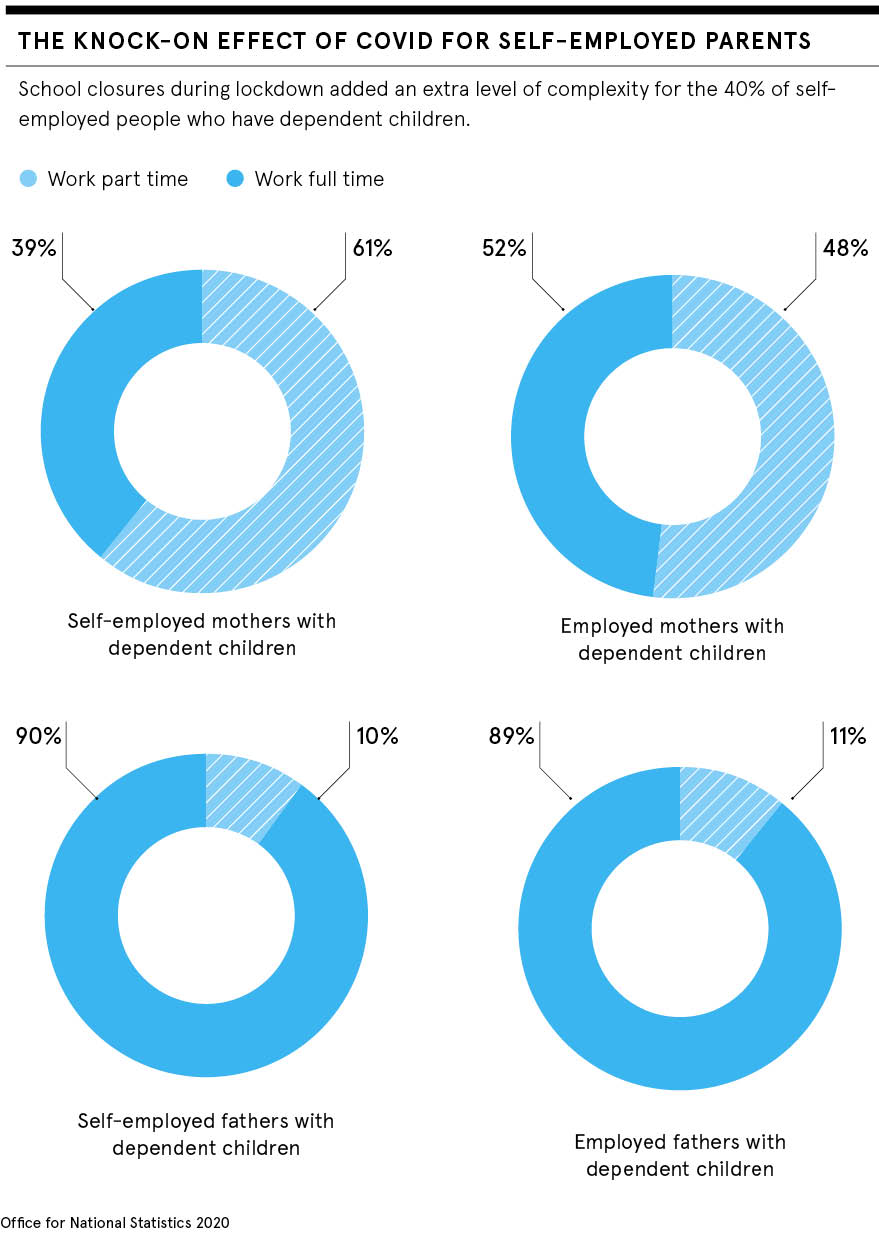
Those self-employed workers whose industries are still open for business feel pressure to keep working regardless, according to Nesta research. Some 22 per cent of self-employed, 29 per cent of sole traders and 30 per cent of gig workers agree that if they caught COVID-19 and had to self-isolate, they fear they’d lose their job.

In mid-October, the Office for National Statistics showed the UK’s self-employed workforce had shrunk to 4.56 million, and fallen by 240,000 in the third quarter compared to the same period in 2019.

Derek Cribb, chief executive of the Association of Independent Professionals and the Self-Employed, laments the record drop to 2015 levels. Before the COVID-19 outbreak, the UK had experienced a consistent trend towards higher self-employment. “At the start of this year, there were over five million self-employed people in the UK, up from 3.2 million in 2000, representing 15.3 per cent of all employment,” says Cribb.

He argues the new figures are evidence of the “devastating impact of the gaps in government support for the self-employed during the first wave of the pandemic” and reflect the critical need for better solutions. “In times of recession, the self-employed are key to driving recovery,” says Cribb, “but the sector is now struggling to save itself, let alone the economy.”

Mike Parkes, technical director at GoSimpleTax, worries that the financial pressures facing self-employed workers will soon ratchet up. He predicts a “double bubble” in January, as his organisation’s research suggests 56 per cent of people opted to defer payment to HM Revenue & Customs. Many self-employed workers will have to settle tax liabilities for the 2019-20 tax year and the first payment on account due for 2020-21.

“Unless you have your house in order by January 31, and sufficient funds to cover all tax liabilities, a deferral could create a perfect storm,” says Parkes. “What’s more, once that date passes, HMRC will not hesitate to reimpose the interest charges, penalties and collection procedures usually in place.”

Knock on effect

Bleak outlook for the hardest hit

Can insurtechs or traditional insurers come to the rescue? Andy Chapman, chief executive of insurance provider The Exeter, acknowledges “the self-employed are among those hardest hit” by COVID-19 fallout. “Despite the perks and flexibility of self-employment, the reality is they are not protected in ways their full-time counterparts are,” he says.

The Exeter’s research indicates that workers in this sector have a stark lack of savings. Almost a fifth (17 per cent) have no personal savings to fall back on and 35 per cent don’t save anything in a typical month. Chapman reports The Exeter’s Day 1 cover, permitting policyholders to claim after just three days off work due to illness or injury, has proven popular, with more than 5,000 applications during lockdown. 

Is technology the answer to freelancer insurance?

Now is the time for insurers and governments alike to embrace tech-driven solutions, urges Freddy Macnamara, founder and chief executive of flexible car insurance provider Cuvva. The insurance industry “must modernise its processes and products to better support millions of people’s changing needs” and adapt for the on-demand generation, he says.

“More affordable and fair insurance products and services to protect the self-employed community, bolstering the right level of support, will encourage growth in the sector, which is critical in the economic downturn,” says Macnamara, pointing out that Cuvva provides car insurance by the hour, week or month. “It’s not surprising that insurance providers offering flexibility and a better product market fit are thriving.” 

Chris Kaye, co-founder and chief executive of Sherpa, an insurtech organisation offering personal risk management, agrees. “Drewberry has a nice angle focused on freelancers as a more traditional broker and Dinghy has picked up on the need for flexibility in cover that is important to freelancers,” he says. “I also really like what Zego has done, embedding insurance into the gig-economy platforms to make it a seamless part of the worker experience.”

Collective Benefits, a London-based insurtech startup, is similarly working with leading gig-economy platforms. “Providing benefits and protections for workers is a win-win,” says Anthony Beilin, co-founder and chief executive, who reveals the companies his organisation works with have seen a 17-fold increase in engagement.

With the government unable, or unwilling, to offer greater support for self-employed workers, the onus is on organisations and those within the insurance industry to collaborate and provide a lifeline. Otherwise, millions will sink.

The article was first published in Raconteur’s Future of Insurance report in September 2020

Are boring jobs a thing of the past thanks to technology?

Technology has the ability to rid employees of repetitive, mind-numbing tasks, but it will be up to organisations to ensure workers’ adapted roles are challenging and rewarding enough to keep them engaged

Will it soon be impossible to have a wholly boring job, given the gallop of automation and artificial intelligence? Already, technological capabilities enable workers, across the gamut of business sectors, to relinquish repetitive, menial tasks and use that clawed-back time to focus on more exciting and engaging endeavours.

Perhaps it was a surprise when, in June, a French court ruled that Frédéric Desnard’s former employer, a perfume business, should pay him €40,000 after his mental health deteriorated due to “boreout”, the antithesis of burnout. Under closer inspection, though, Desnard’s unfortunate mismanagement was the result of strict legislation that complicates the redundancy process in France. French employment law needs updating, evidently.

Consider that by 2030 up to one fifth of the global workforce, or 800 million people, will see their jobs replaced by robotic automation, according to an oft-quoted McKinsey & Company report from November 2017.

This headline figure fails to account for all the new, and more exciting, roles that technology will create in the coming decade. The key takeaway for business leaders, though, should be that it is crucial to invest in employees or risk paying a higher price for not evolving boring jobs. Employers that narrow the digital skills gap and help human and machine work side by side will gain a competitive advantage.

Autonomy is critical to interesting jobs 

Psychologist Portia Hickey, co-creator of the Smart Collaboration Accelerator, posits the model presented in the mid-1970s by organisational psychologists Greg Oldham and Richard Hackman still remains the blueprint for job design today. “They identified the significance of the job, being able to see the outcome of their work, variety, autonomy and feedback were all key,” she says.

“Jobs are generally becoming more interesting, partly because organisations are more aware of job design, but also because technology can take over highly repetitive, lower-skilled work. However, what makes a job more enjoyable is autonomy.”

The gathering of knowledge allied with autonomy is the perfect combination to motivate workers, according to Karthik Krishnan, chief executive of Britannica Group. “Learning happens when one is stretched outside one’s comfort zone,” he says. “Dopamine is the brain’s reward system and is secreted when accomplishing a challenging task. If the task is too challenging or not challenging enough, negative emotions set in, such as stress, apathy and boredom.”

Krishnan, who lists TikTok content creator, drone operator and driverless car engineer among the most exciting jobs spawned by tech recently, also notes that people’s boredom threshold has never been lower. “The ‘always-on’ mode, the 24/7 information flow and stimulation lead to constant distraction and craving for newness,” he says.

Employers should “design jobs and identify the right talent to be successful”, says Krishnan, adding that it is vital to understand a worker’s ikigai – a Japanese expression that translates loosely as “reason for being” – to keep them engaged and happy.

How tech is improving employee happiness

He says the ultimate goal is to create a culture where employees feel inspired, challenged and empowered. “The good news is that today, technology increasingly performs jobs that are well-defined, regimented and repetitive, thus reducing boring and risky jobs. From taxi drivers to shop workers to soldiers, the range of traditional jobs that will decline or disappear is huge,” says Krishnan.

Research published in September by multinational software company Pegasystems suggests intelligent automation has a critical role to play in crafting a new, tech-enabled, post-pandemic future of work. The global study surveyed more than 3,000 global senior managers and frontline IT staff, and 76 per cent agreed that increased use of tech is improving employee satisfaction, says Pegasystems’ chief technology officer Don Schuerman.

Technology increasingly performs jobs that are well-defined, regimented and repetitive, thus reducing boring and risky jobs

Further, more than half of the surveyed UK businesses (51 per cent) say intelligent automation currently saves them over ten working hours per person a week, freeing up roughly a quarter of their time. And with that available time, the top-three activities are working alongside machines, engaging more with customers and innovating. “What this study makes clear is that technology is one of the top trends shaping the future of work,” says author and futurist Jacob Morgan.

Research presented by robotic process automation (RPA) leader UiPath supports this insight. “Some 35 per cent of UK workers believed that automation would deliver more interesting and creative jobs for future generations,” says Chris Duddridge, UiPath area vice president and managing director in the UK and Ireland. He offers UiPath’s work with Brent Council’s housing benefits departments as an example to highlight how RPA “cuts out the dull parts”.

Making ‘mind-numbing’ tasks history

Before embracing RPA, all rent adjustments had to be uploaded manually on to the system. “It was described as ‘mind numbing’,” says Duddridge. “A single rent change that could take a staff member over four minutes manually now takes fewer than 40 seconds. The council estimates that this automation alone has saved it over £32,000 in the overtime costs needed to ensure deadlines were hit.”

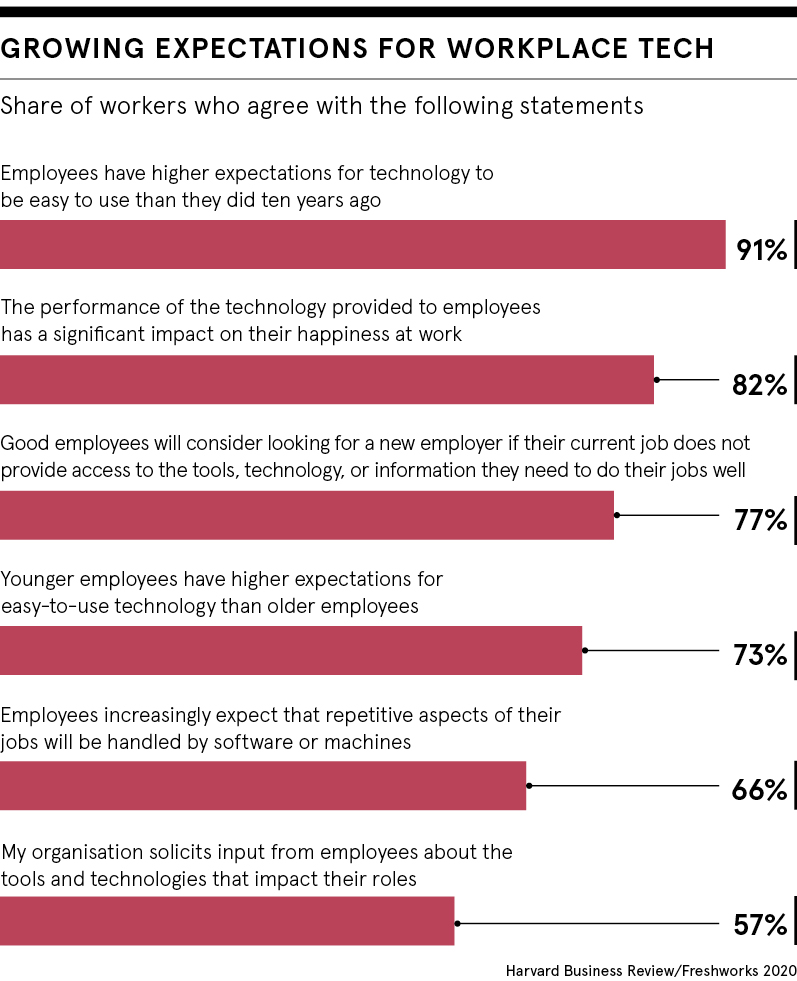
Having the right tech is paramount for workers’ happiness. In a new Freshworks study, some 82 per cent of business leaders around the world acknowledge that how their workplace tech performs is imperative to engage employees. “This is especially true now in the time of home working,” says Arun Mani, president of Freshworks Europe. “Not having the necessary IT services on hand in the same building means businesses need to ensure their technology works and provides a flawless experience for users.”

Alarmingly, the Freshworks research also found 77 per cent of employees will look for a new employer if their current job does not provide the tools, technology or information they need to perform.

Workplace tech

It’s not all about tech, though. A balance must be struck and leaders have to understand what motivates individuals. “You have to foster a culture where employees feel comfortable talking about what they need and want,” says Nabila Salem, president at Revolent Group, who recommends holding regular one-to-one meetings.

Organisations unprepared for mass remote working when lockdown was enforced in March are playing catch up in terms of engaging staff, particularly new hires, says Charlie Johnson, founder and chief executive of BrighterBox, a London-based recruitment firm. “A lack of contact time or on-the-fly coaching has left a few joiners feeling lost, unable to ask simple questions,” he says.

Creating the best environment for employee success

Janine Chamberlin, director at LinkedIn, agrees and points to her company’s research that shows 75 per cent of UK C-level executives say workers now expect greater availability and transparency from leaders. “This closer connection is a great way to engage employees, motivate them to achieve their potential and keep them focused on business goals,” she says.

You have to foster a culture where employees feel comfortable talking about what they need and want

“Great employers recognise the importance of change and present opportunities for internal mobility and skills development so employees can benefit from a new experience and progress in their career.”

This chimes with Erica Brescia, chief operating officer of leading software development platform GitHub. “Forward-thinking companies have found new ways to drive employee engagement beyond activities and modes of working that are tied to physical offices,” she says. “They adapt how they operate to support a distributed team, from changing how they communicate to how they track, manage and report on projects.

“They move from highly synchronous ways of working to more asynchronous and collaborative work. And they encourage team camaraderie through virtual activities, such as quizzes, scavenger hunts, cooking classes and happy hours.”

Looking ahead, Brescia concludes: “The new future of work is not dependent on office locations or physical workspaces, but rather on adapting to new ways of getting work done to provide employees with the best environment for their success.”

The article was first published in Raconteur’s Future of Work and Collaboration report in September 2020

Is London still king in post-Brexit banking?

The EU referendum may be a distant memory, but as the end of the transition period approaches, global banking hubs are gearing up for a post-Brexit world

Will it be a happy new year for the UK banking sector? When the transition period of Britain’s exit from the European Union ends on January 1, business leaders and bankers alike will tiptoe into a post-Brexit reality. Enmeshed by confusing and in some cases yet-to-be-determined rules, they will be entering a new global banking landscape.

But given that financial institutions inside and outside Europe have been preparing for this day since the EU referendum on June 23, 2016, will things be markedly different?

Whatever happens, British banks and their European counterparts have had enough time to ready themselves for post-Brexit life. Admittedly, some details still need to be finalised, though Bank of England governor Andrew Bailey has been warning the largest UK lenders to plan for a no-deal Brexit since June.

Legally, there will be changes, if only slight to begin with, on a global scale. “As of January 1, banks located in the EU and the UK will have to operate in two separate regulatory and supervisory environments,” says Yves Mersch, a member of the European Central Bank’s executive board. “Providers of financial services between the EU and the UK will no longer enjoy the benefits of the single market.

“Many euro-area banks doing business across the Channel, as well as UK banks operating in the euro area, have made considerable progress in view of this event.” Mersh adds that most are “on track to finish their preparations” this year, but others “have much work to do”.

For the latter, the coronavirus fallout has disrupted post-Brexit plans. “Broadly speaking, the main priority for banks over the past few months has been tackling the multi-faceted consequences of the pandemic,” he says.

No excuse for banks to be unprepared

Indeed, the “C” word has obscured the “B” word since March, and although COVID-19 may provide a reason for the sluggish progress of Brexit negotiations, it is not a just excuse for banks to be ill-equipped. Many big players lined up their moves long ago.

EY calculates that banks and fund managers have committed to moving £1 trillion of assets out of the UK and into the EU because of Brexit. US lender JPMorgan Chase & Co., for 

instance, is expected to shift around £180 million in assets to Germany. Further, it has ordered 200 staff to move out of London to other European cities including Paris, Milan, Madrid and Frankfurt, in the expectation that the UK and the EU will not firm up an agreement on financial services.

The UK has always been, and continues to be at least for now, a world leader in financial services

Considering the UK exports more than £26 billion in financial services to the EU, according to the Office for National Statistics, perhaps the global post-Brexit banking landscape may transform quicker if no deal is reached.

However, James Butland, vice president of global banking at cross-border fintech Airwallex, argues the “mass exodus” from London “has not happened to the extent so many were sure it would”. He says: “London remains an attractive place where people want to live and work. Equally, the ecosystem in London is truly global, like New York or Hong Kong, and has always been regarded as a crucial financial hub.

“The UK has always been, and continues to be at least for now, a world leader in financial services, eclipsing many of its EU rivals across the sector. And despite uncertainty around Brexit, one thing is clear: Europe will remain a leader within the global banking industry, mainly due to the strength of the euro as a currency.”

London has critical role to play

But Butland says ”a new leader needs to take London’s crown” within the region. He continues: “The European banking community may start to face geographical fragmentation, as the position to become the epicentre of the eurozone opens up. The race to become the financial capital of the EU seems to be between Paris, Frankfurt, Brussels and Amsterdam, with no winner yet in sight. Wherever this location may be, it should look to London to continue Europe’s legacy as a leader within the global banking economy.”

Alastair Holt, financial regulations partner at global law firm Linklaters, agrees. “Other European cities will not be as influential as London, at least in the short to medium term,” he adds. “London can play a critical role in bridging the East and the West, particularly given the increasing tensions we have seen between the world superpowers in those regions.

Brexit and London

“The UK will still be a leading global financial centre, boosted by its language, time zone, the legal system, and the pre-existing ecosystem of financial institutions and suppliers, the vast majority of which will remain in the UK.”

Professor Brian Scott-Quinn, director of banking programmes at Henley Business School, is more cautious and believes the global banking landscape has been fragmented since the 2008 financial crash.

“Just as trading relationships between the major blocs – the United States, Europe and China – have been damaged in recent years, as well as the relationship between the UK and the rest of Europe, so globalisation of banking and finance has been in low gear now since the financial crisis,” he says. “Most UK banks that had plans for internationalisation or for building up their investment banking capabilities have since abandoned such plans.”

Contingency plans needed for uncertain year

Regardless, Holt argues that coronavirus is more of a threat to the banking sector’s future. “COVID-19 is clearly a worry, more so than Brexit,” he says.

Chris Ganje, chief executive and co-founder of Cardiff-based fintech AMPLYFI, which focuses on developing artificial intelligence for banking, expands upon this theme. “The banking sector should have already dealt with Brexit over the past two years with robust models in place to move on,” he says. “The fallout of COVID-19 is a major unknown. For example, any FCA Section 166 notice into how a bank handled crisis-related loan applications could cost it tens of millions of pounds to review.”

Additionally, Alessandro Hatami, co-author of Reinventing Banking and Finance, says it is hard to quantify the effect of Brexit at the moment. And he points out: “The impact of leaving the EU financial passporting scheme, making it harder for UK fintechs to serve European customers from the UK, is also not clear and won’t be until the final deal is negotiated.”

Butland at Airwallex concurs that 2021 will be pivotal in shaping the global banking landscape. “The next 12 months will certainly be interesting, as both the pandemic continues and the repercussions of a potential Brexit deal loom ahead,” he concludes. 

“Whatever happens over the coming year, disruption lies ahead. Financial institutions will be making contingency plans for every possible eventuality.”

This article was first published in Raconteur’s Future of Banking report in November 2020

What’s holding the 5G rollout back?

A quotation attributed to American-Canadian science-fiction writer William Gibson surges to mind when assessing the scarcity of active use-cases of the fifth-generation mobile network and the associated technologies and industries required to enable 5G at scale. “The future is already here; it’s just not evenly distributed,” the father of cyberpunk commented decades ago.

Evangelists promise 5G will provide super-speed broadband connections, up to a hundred times faster than 4G, and flash the green light for autonomous vehicles, among a panoply of other pluses. It will start the internet of things (IoT) revolution and make cities truly smart, finally. What needs to happen, then, to improve the distribution and adoption of 5G?

“The opportunity to take advantage of advanced cellular technologies to drive digital transformation across the board – industrial and robotics, automotive, aerospace and defence, smart cities and more – is unprecedented,” says Rob Jones, the UK-based strategic alliances regional director at multinational software and services provider PTC. “Advanced cellular capabilities have the potential to fuel the fourth industrial revolution, but only if the ecosystem co-operates to enable 5G.”

It’s a sizeable “if”, given there remain concerns around the readiness and reliability of supporting industries and services, including collocation, big data, cybersecurity and edge computing, to deliver and enable 5G en masse. Indeed, the financial and ecological cost to build the necessary infrastructure is colossal, says Thomas Spencer, telecoms lead at software firm R3.

“Mobile network operators (MNOs) face an uphill battle to enable 5G,” he says. “It is estimated they need to invest up to $1 trillion in upgrading network infrastructure for 5G, while already having to manage sprawling networks of towers, cables and switches just to support their ongoing operations.”

No ‘big-bang’ moment for 5G

There are further complexities. “The challenge of how to finance and optimise infrastructure usage extends to MNO plans for 5G rollout and in particular how to roll out small cell sites,” says Spencer. Next year in the United States alone, there will be some 400,000 small cell sites located on public infrastructure, restaurants, offices and homes. “Determining who owns, operates and finances these sites poses a significant and operational challenge,” he adds, hinting that blockchain might provide a solution.

Richard Carwana, Dell Technologies’ UK telco and service provider director, is similarly ambivalent about what must happen to enable 5G. “We are still joining the dots on how this will be built out,” he concedes. “There won’t be a ‘big bang’ of 5G that some had expected, rather a gradual introduction of services and operators moving into the telco space. Partnership and collaboration will be pivotal to make significant progress and drive implementation.”

He points out that “5G requires dense fibre connectivity to underpin use-cases, whereas 4G and 3G did not” and calls for “telecoms providers, industry leaders and governments to come together to understand requirements and build solutions for specific use-cases”. As an example, Carwana notes how the German government is collaborating with telco providers to build new motorways with autonomous-only lanes.

Partnership and collaboration will be pivotal to make significant progress and drive implementation

Closer to home, the UK government has acknowledged the ban of China’s trailblazer Huawei is likely to delay widespread 5G rollout by at least two years, notes Robert Pocknell, intellectual property partner at Keystone Law in London. “European Union research shows Huawei is the number-one leader for patents that are fundamental to 5G rollout,” he says.

Strong cybersecurity measures needed to enable 5G

Politics aside, cybersecurity readiness is one of the fundamental issues holding up the advancement of 5G. Is it any wonder, when achieving 5G’s lofty goals relies on billions of interconnected devices, remote workers and the growth of cloud infrastructure? “Add to this the increasingly heavy compute and network infrastructure that is needed to support 5G applications, devices, data and services,” says Martin Rudd, chief technology officer at Telesoft Technologies. “Security, 5G and IoT are inextricably linked.”

The recent AT&T Cybersecurity Insights Report: Security at the Speed of 5G highlights the considerations that stakeholders must address. “A key takeaway is that 76 per cent of the respondents expect wholly new threats to emerge as a result of 5G and the increased attack surface,” says Theresa Lanowitz, head of evangelism and communications at AT&T Cybersecurity. “The remaining 24 per cent of participants expect a volumetric increase in existing threats.”

Shahzad Nadeem, head of smart cities at design and engineering consultancy Plextek, agrees and says: “On top of security, there are concerns around the ownership of data, along with compatibility and interoperability with existing systems.”

Security and trust issues – spooking investors?

Additionally, erroneous claims that 5G is connected to the spread of the coronavirus has further hampered its progress, says Amelia Westerberg, associate strategist at R/GA London. “Conspiracy theorists are the biggest threat to the uptake of 5G,” she argues. “Anti-5G attacks on phone masts and general national security and health concerns have caused 5G rollout to be delayed in most markets.”

As of mid-September, just shy of 300,000 people and organisations from 220 nations had signed the Stop 5G on Earth and in Space appeal, and investors might be getting spooked. It’s a tricky sell in the first place, with all the moving parts. As Nadeem says: “Because the technology is still evolving and its value potential split across its different uses in different domains, there are difficulties in justifying the business case and return on investment.”

Also in September, it was reported that in Grenoble, France’s answer to Silicon Valley, mayor Éric Piolle, a rising star in The Greens political party, is in no rush to provide access to 5G, questioning the impact it will have on the environment, especially if millions of new handsets are required.

While it is evident that to maximise 5G’s vast potential there is a reliance on a confluence of upgrade technologies, as well as multi-stakeholder collaboration and enormous investment, could it be there are more basic hurdles to overcome first? “For people to adapt and trust 5G,” Westerberg concludes, “it needs to establish itself as a positive contribution to culture as well as the economy.”

This article was first published in Raconteur’s Future of 5G report in September 2020

Lockdown II: A tech-powered survival kit

Lockdown II, the sequel, is here. From today, November 5, for at least four weeks those of us in England will once again play hermit to prevent a “medical and moral disaster” for the National Health Service, according to Boris Johnson.

Legally this latest lockdown, designed to halt the spread of the second wave of COVID-19, will last until December 2. But considering the original lockdown lasted from March 23 until restrictions were eased in early July, three-and-a-bit months later, I’m not holding my breath (well, only if I have to take public transport). And that Rishi Sunak has just extended the furlough scheme to March is a telltale sign, methinks.

Without wishing to come across too much like a “prepper” – you know, those people who dash to their underground bunker armed with guns and tins of baked beans at the first hint of the apocalypse – I would like to recommend a handful of products that might help you survive the next month(s) at home. These five objects have certainly supercharged my home-working setup and made the days much more bearable.

Technology has enabled organisations to switch (almost) seamlessly to mass remote working at the drop of a shutter, so it follows that all but one of the items listed below is a new tech product. (As an aside I was amused when Eric Yuan, the now mega-mega-rich Founder and Chief Executive of Zoom, admitted that he, too, suffers from videoconferencing fatigue and, as a tonic, watches The Great British Bake Off. The message is clear: we all need our escape, and especially so in these strange times.)

Xellence wireless noise-cancelling in-ear earphones from X by Kygo (€199 / £180)

Because the first lockdown afforded me the time to further indulge in my new hobby of DJing – which I wrote about for The Arbuturian earlier this year – my music listening has been dialled up quite a few notches. Now, while tapping away at my desk, “working”, I spend many hours a day searching for audio gems to embroider my next mix. However, with family members scuttling around, it can be tricky to focus entirely – on either work or videoconferencing or music listening – without these quite incredible new noise-cancelling earbuds.

I’ve owned many a wireless earbud – including some three-times as expensive – and I’m thrilled to report these are by far the best. For one, they are wireless – no cable around your neck – and as X by Kygo is a dedicated Norwegian headphone specialist with DJ, songwriter and producer Kygo at the helm, the performance is superb. Available in either black or white, they look the business, too. Just in case you need it, the earbuds have a 10-hour battery life, and you can download the X app if you want to personalise the sound further.

OWC Thunderbolt 3 Pro Dock (£285)

Granted, a docking station that transforms your laptop into a desktop computer (monitor sold separately), and much more, might not arouse interest in many people. Still, perhaps they haven’t met the right docking station. For OWC’s Thunderbolt 3 Pro Dock has all you could wish for to upgrade your home-working experience – primarily if you work in a creative industry.

Now for the science. The Thunderbolt 3 Pro Dock provides lightning-fast 40Gb/s transfer speeds; features a 10Gb Ethernet connection; has three USB ports and frontside CFast 2.0 and SD 4.0 card readers; and with 60W of pass-through charging it will ensure your laptop battery is never empty. It truly is the next level.

Belkin 3-in-1 Wireless Charger (£99.99)

If, like me, most of the devices you own are made by Apple, this multi-charger is a revelation. With Belkin’s new 3-in-1 Wireless Charger you don’t have to root around for your iPhone cable, or try and locate your Apple Watch charger, or remember to power-up your AirPods (but of course, ahem, with your new Xellence earbuds this is a redundant point). This clever bit of kit stands, discretely, on your desk and you can charge your three devices whenever you want – and, indeed, all at the same time.

Oculus Quest 2 (£299) (main picture)

When your work for the day is over, or perhaps just when you want a break and need to get away from it all – without resorting to watching The Great British Bake Off – reach for this. The latest virtual reality headset from market leaders Oculus only launched a couple of weeks ago, and blimey it is sensational. I’ve played around with many a VR headset, but this could – and should – be the one that breaks into the mainstream.

The Oculus Quest 2 is the most advanced, all-in-one VR system currently on the market. Every detail has been designed to make virtual worlds adapt to your movements, enabling you to explore awe-inspiring games and experiences with incredible freedom. Even before I bought any games, I’d walked up Everest, hung out with lion cubs, and danced with a groovy robot. Lockdown II will allow me to spend more time with this fantastic product, and I can’t wait. This VR headset and music will be my escape. And why not, when the tech is increasingly good, and the outside reality is increasingly bad?

One thing to note is that to use this bad boy you will need to link it to your Facebook account, if you have one. (Facebook owns Oculus, in case you didn’t know.)

S6L Brompton Bike (£1,190)

It’s not tech (at least not in the modern sense) but I’m throwing this one in here because it ticks an important box in the lockdown portfolio.

Admittedly, it’s hard to get your hands on a Brompton Bike right now, given the demand for two-wheeled bicycles, but we all know how important exercise is for your physical and mental health, particularly when locked down. Brompton still makes the best folding bikes on the market, and with the Brexit transition period coming to an end on January 1, perhaps you could treat yourself to a Christmas present and buy British?

After all, we’ll probably still be in lockdown when the turkey is carved.

This article first appeared in The Arbuturian in November, 2020

Educating children for the jobs of the future

In an uncertain world, the only certainty is change, so young people should be taught how to adapt in a constantly changing working environment

By 2030, robots, artificial intelligence, automatons, call them what you like, will have displaced up to 800 million workers or one fifth of the global workforce, according to McKinsey Global Institute. The inexorable and exponential march of technology will create new jobs, experts assure us, but what are those roles likely to be and how should we prepare?

It’s important to equip young people with foundational skills that will stand them in good stead regardless of what jobs they end up taking on

The World Economic Forum’s Future of Jobs Report 2018, estimates that by 2022 “no less than 54 per cent of all employees will require significant reskilling and upskilling”. The report adds: “Human skills, such as creativity, originality and initiative, critical thinking, persuasion and negotiation will retain or increase their value, as will attention to detail, resilience, flexibility and complex problem-solving.”

What skills should we be teaching children in schools? 

How about in 2032, or 2042, and beyond? What tools should we be arming today’s children with so they stand a chance of surviving the world or work in one or two decades from now? “Many pedagogical experts argue that schools should switch to teaching ‘the four Cs’ – critical thinking, communication, collaboration and creativity,” Yuval Noah Harari writes in his new book, 21 Lessons for the 21st Century.

In a chapter entitled Education: Change is the only constant, Professor Harari continues: “More broadly, schools should downplay technical skills and emphasise general-purpose life skills. Most important of all will be the ability to deal with change, to learn new things and to preserve your mental balance in unfamiliar situations.”

Lord Jim Knight, chief education adviser at Tes Global, a network for educational professionals, strongly believes traditional curricula need to be overhauled in the UK. Moreover, young people should be allowed to play for as many years as possible because they will learn and develop skills that will be essential to flourish at work and home in the coming years.

“In Scandinavia, children attend school from the age of six and in many ways I think that is the sensible thing to do,” he says. “In Britain, we have a parental expectation for our children to be taught formal skills, such as reading and writing, earlier.”

Lord Knight contends that many secondary schools “are stuck in formal pedagogies” and must introduce more play-based learning, through projects. He asks: “Why wouldn’t we want kids to learn by building stuff, making things and being assessed by exhibiting work, rather than doing everything through formal desk-based exams?”

New schools teaching children to be ready for change 

Attitudes are changing, albeit slowly. Lord Knight welcomes the opening of two free schools, in Bournemouth and west London, that are the brainchild of Ian Livingstone, co-founder of Games Workshop and the inventor of Lara Croft of the video game franchise Tomb Raider. They offer “a groundbreaking curriculum relevant to the digital age,” according to the Livingston Academy’s website. Elsewhere, Gever Tulley’s Brightworks in San Francisco is a school that “reimagines education by taking the best practices from both early-childhood education and hands-on, project-based experiential learning”.

“We can’t know for sure what skills children will require for the future, but what we can be confident of is that change, and thus the need to adapt, will be an ongoing and increasingly important aspect,” says Peter Twining, professor of education futures at The Open University.

“Flexibility and resilience, and learning to learn will all be critical. Therefore, play – an important element of how humans, and other mammals, learn – is vital. Digital technology can be a powerful tool to support children’s learning if used appropriately, too.”

The amount of device screen time youngsters should be afforded for learning is hotly debated, however. “In Silicon Valley, there are boutique schools attended by the princes and princesses of tech giants that keep the children away from anything digital,” says Sir Nigel Shadbolt, co-founder and chairman of the Open Data Institute.

Tech and play could be the secret to equipping children for future jobs

Efforts have been made to gamify learning for digital natives in recent times, with varying degrees of success, but one standout triumph is Raspberry Pi Foundation, which has developed a series of small, single-board computers to promote teaching of basic computer science, as well as innovation in schools and developing countries.

Eben Upton, Raspberry Pi’s Cambridge University-educated chief executive, believes introducing children to tech, ideally through play, is critical to their future success. “You don’t make a concert pianist by sitting someone down at a piano at the age of 18,” he argues. “It’s important to reach children as early as possible, while their brains are still flexible.

“At school, the emphasis needs to be on foundational skills: numeracy, literacy and critical thinking. We advocate for computing education in part because it’s a great way for students to gain those foundational skills in an enjoyable, relevant way.

“It’s absolutely not about trying to guess which programming language is going to be required by employers in 20 years’ time and drilling children in that; cross-training to specific technology is down to employers and employees.

“It’s a truism that in the future workers will have to be prepared for roles to change radically over the course of a career. The days of a job for life, and of a single programme of education and training that fits you for that job, are gone. This is why it’s important to equip young people with foundational skills that will stand them in good stead regardless of what jobs they end up taking on.”

Learning through play

It is not just children who learn through play; adults do as well. In this period of seismic workforce transformation, wrought by technology’s unstoppable progression, retraining and mastering new skills will be imperative – and not just in the future, but now.

Indeed, data literacy is fast becoming a desirable facet for members of the C-suite and business leaders of the near future. “Half of the world’s data to ever exist was created in 2017 and only 0.8 per cent of it was analysed,” says Amanda Clack, head of strategic consulting at real estate group CBRE. “The potential is huge. We are only limited by our imagination.”

The Open Data Institute (ODI) has created an educational strategy board game to help people, old and young, better understand data and open their minds to data-driven innovation. Datopolis is the brainchild of ODI chief executive Jeni Tennison and former ODI colleague Ellen Broad.

“We wanted to build a game about data and data infrastructure, and help people understand their roles in making the most of data,” Dr Tennison says. “Players need to work together in Datopolis – negotiate whether to open or close data – to achieve common and individual goals. In addition to learning about data, players are encouraged to collaborate and communicate – both essential skills for the future. It’s great fun, too.”

Dr Tennison spent 18 months fine-tuning the game with her team, which included the ODI’s ex-head of learning Simon Bullmore, before launching in 2016. Mr Bullmore has since founded a data literacy and digital marketing organisation, Mission Drive, and regularly uses Datopolis as a learning tool.

“Whether it’s travelling to work or analysing sales performance, we rely on data to get answers to complex problems and make better decisions,” he says. “To thrive in an increasingly data-driven world, leaders need to understand important concepts like data strategy and data infrastructure. But these concepts are abstract, difficult to grasp, let alone take action on.

Datopolis gives people the experience of creating economic, social and environmental value with data. Participants of all ages and all levels of experience tell us it has helped them understand data concepts they had previously had difficulty grasping, for example that data infrastructure is about the data itself, not the cables and computers that connect data together.”

Stressing how learning through play is effective for everyone, he concludes: “Research shows that, at any age, games do a better job of activating the cognitive functions that help us learn than standard approaches to training. This gets people engaged and ready to learn, which in itself is valuable, but for data literacy it’s essential, because getting value from data requires people to think and do things differently.”

This article was first published in Raconteur’s Future of Work report in December 2018

Six steps to building a strong ethics and compliance programme

In today’s globalised business world, organisations are under increasing pressure to comply with an ever-growing framework of regulations – or risk the substantial threats to revenue, operations and reputation that compliance failures can lead to.

At the same time, investors, employees and customers are now looking beyond traditional measures of corporate success, placing increased emphasis on issues of sustainability, ethics and social responsibility.

As global enforcement of regulations increases, punitive fines continue to swell and public demand for ethical business grows, the question of whether to develop an integrated ethics and compliance programme is an easy one to answer. 

In short, it’s not a question; it’s an imperative strategic decision that offers numerous benefits: a better reputation, greater transparency, a stronger legal defence, more robust processes and better use of data, for starters.

Yet we are navigating strange and challenging times, and implementing an ethics and compliance programme can be an intimidating, if not overwhelming, experience – especially if starting from scratch.

“The coronavirus pandemic has helped to build a strong case for compliance and ethics,” says Vera Cherepanova, ethics and compliance consultant at Studio Etica and the lead author of NAVEX Global’s Definitive Guide to Ethics and Compliance. “Our wellbeing, and the wellbeing of others, depends on how compliant we all are. In the same way, the wellbeing of organisations depends on our individual and collective conduct.”

Ahead of the launch of the new guide, which will help organisations develop and implement their own ethics and compliance programme, here are the six key steps to consider as you pursue your own plan.

1. Get board buy-in

The first step lies in gaining support from organisational leadership; admittedly, no easy task. “This step is the most important,” says Cherepanova. “Without leadership buy-in, the other steps probably won’t happen.”

Those seeking to implement an ethics and compliance programme must push for time with the C-suite and stress the vital role it can play within the business, from growing the organisation’s reputation to facilitating transparency and mitigating risks posed by both internal actors and external third parties.

Equally, paint the alternate reality: without a robust programme, the organisation is playing a high-risk game likely to end with costly fines, ongoing legal and remediation fees, unhappy employees and a reputation forever tarnished in the eyes of prospective customers and the wider public. 

Ultimately, align the programme with the board’s overarching business strategy and you’ll stand a better chance of piquing their interest. Gaining this top-down support will help mitigate potential challenges that surround participation, engagement and understanding of the compliance programme down the line.

2. Create the right framework

Once that critical first step has been taken, project leaders need to create a suitable framework for the ethics and compliance programme. Take the time to consult with stakeholders across the business to better understand how compliance relates to different functions because not everyone will understand its value right away. 

“Depending on how the organisation is structured – how many offices it has, in which countries and so on – the decision must be taken where the compliance function will sit, where it will report to and what status it will have in the organisational hierarchy,” says Cherepanova.

Jon Green, company secretary and general counsel of Essentra, a global provider of essential components and solutions serving 34 countries, agrees. “Compliance needs to be embedded as part of everyday business management and thinking. It’s not a standalone box-ticking exercise, which doesn’t add or preserve any value,” he says.

Alongside such internal considerations, you should also factor in the jurisdictions your organisation operates within, as well as the relevant legislation to abide by, as this will impact regional implementation of the programme.

Understand how compliance relates to the daily life of the business internally and externally, and you’ll be better able to identify the most suitable framework for your programme, whether centralised, decentralised or independent.

3. Establish governance structures

When establishing your compliance programme framework, you’ll engage with a wide range of stakeholders across the business, including representatives from legal, risk management, human resources, procurement departments and even further afield. 

During these conversations, it’s important to discuss the potential programme framework and listen to feedback. In the long run this will result in a much smoother process. The more key people who understand and want to contribute to the vision, the better.

Cherepanova explains: “There are many compliance and ethics-related risks facing a modern organisation. Obviously, the compliance function can’t have expertise in every area and that’s why collaboration with other functions is key for a holistic coverage of all risks.”

As part of these collaborative discussions, look to clarify and define each stakeholder’s role and responsibilities. Establishing clear procedures and timelines will ensure a more robust governance structure, minimising crossed wires and mixed messages, which will be central to the programme’s long-term success.

4. Conduct a risk assessment

The successful completion of a risk assessment depends upon both the business-wide participation and appropriate oversight granted by departmental stakeholders, as well as a coherent plan of execution. Leveraging the expertise of individual functions will quickly highlight the specific risks facing the business.

“There is no one-size-fits-all programme,” says Essentra’s Green. “It is important to have something that works in the context of your business, your risks and your people, otherwise the investment is wasted.”

This is precisely why risk assessments are so essential. To underline their value, NAVEX Global’s 2020 Definitive Risk & Compliance Benchmark Report shows industry professionals responsible for the most advanced ethics and compliance programmes use the results of risk assessments to aid decision-making more frequently than any other information source.

Embrace a position of utmost scrutiny when assessing the risks and you will ultimately create a more robust programme that offers better protection against the unique threats your organisation faces.

5. Implement appropriate compliance controls

Once the organisation’s risks have been identified, either through the initial assessment or as part of an ongoing review, they must be mitigated through the implementation of appropriate internal and external compliance controls. 

This will typically include establishing rules and policies for employees and stakeholders, training employees on the rules and regulations they must adhere to, providing a means of reporting breaches of those rules, and putting procedures in place to measure and mitigate external risks, such as those posed by third parties.

It’s also critical to bear in mind that with the actions you take, you can demonstrate the “how” and the “why” to regulators, should you be required to. This means leveraging accessible, easy-to-use technology and embracing clarity when communicating the programme across the organisation. Being able to demonstrate appropriate controls can lead to greater leniency from law-enforcement agencies should the worst happen. 

6. Establish effective integration, reporting and measurement

With legislation continuously being updated and refreshed, it is vital to keep abreast of changes while also ensuring the compliance programme you’ve developed is respected and adhered to across the organisation. This may present challenges if the value of compliance is not fully understood, but the new programme must be integrated into all business units, even those that may perceive it as a hindrance.

Therefore, building relationships to combat those perceptions is essential. Knowing how to tailor the narrative to each stakeholder and business unit will help you to gain support more quickly, making it easier to establish effective monitoring and review processes. 

Yet this is only the first step. Once results start coming in, you must impose effective tracking of the programme, and the data insights it generates. This will not only justify its level of efficacy, but also identify areas of opportunity. 

“Implementation was simple,” says Green. “Our current challenge is continuing to develop [our tools and programme] to keep up with the pace of change in compliance thinking and working practices. Technology plays a major role in helping us to do that.”

Do the right thing

Ultimately, most employees want to do the right thing. The goal of any ethics and compliance programme should be to enable them to do just that. Much of the time, compliance isn’t difficult; it’s simply common sense. 

Green concurs: “Don’t burden or confuse people with what they don’t need to know. Tell them in simple terms what they need to know and how they should react if they spot a red flag or are otherwise uncertain.”

Organisations need not be intimidated by the prospect of creating and establishing an ethics and compliance programme. By breaking it down into a series of key steps, you too can implement a manageable and effective programme that will protect your people, reputation and bottom line. 

This article was first published by Raconteur in September 2020

Hippies head for Noah’s Ark: Queue here for rescue aboard alien spaceship

A mountain looming over a French commune with a population of just 200 is being touted as a modern Noah’s Ark when doomsday arrives – supposedly less than nine months from now.

A rapidly increasing stream of New Age believers – or esoterics, as locals call them – have descended in their camper van-loads on the usually picturesque and tranquil Pyrenean village of Bugarach. They believe that when apocalypse strikes on 21 December this year, the aliens waiting in their spacecraft inside Pic de Bugarach will save all the humans near by and beam them off to the next age.

As the cataclysmic date – which, according to eschatological beliefs and predicted astrological alignments, concludes a 5,125-year cycle in the Mesoamerican Long Count calendar – nears, the goings-on around the peak have become more bizarre and ritualistic.

For decades, there has been a belief that Pic de Bugarach, which, at 1,230 metres, is the highest in the Corbières mountain range, possesses an eery power. Often called the “upside-down mountain” – geologists think that it exploded after its formation and the top landed the wrong way up – it is thought to have inspired Jules Verne’s Journey to the Centre of the Earth and Steven Spielberg’s Close Encounters of the Third Kind. Since the 1960s, it has attracted New Agers, who insist that it emits special magnetic waves.

Further, rumours persist that the country’s late president François Mitterrand was transported by helicopter on to the peak, while the Nazis, and, later, Israel’s Mossad, performed mysterious digs there. Now the nearby village is awash with New Agers, who have boosted the local economy, though their naked group climbs up to the peak have raised concerns as well as eyebrows. Among other oddities, some hikers have been spotted scaling the mountain carrying a ball with a golden ring, strung together by a single thread.

A grizzled man wearing a white linen smock, who calls himself Jean, set up a yurt in the forest a couple of years ago to prepare for the earth’s demise. “The apocalypse we believe in is the end of a certain world and the beginning of another,” he offers. “A new spiritual world. The year 2012 is the end of a cycle of suffering. Bugarach is one of the major chakras of the earth, a place devoted to welcoming the energies of tomorrow.”

Upwards of 100,000 people are thought to be planning a trip to the mountain, 30 miles west of Perpignan, in time for 21 December, and opportunistic entrepreneurs are shamelessly cashing in on the phenomenon. While American travel agents have been offering special, one-way deals to witness the end of the world, a neighbouring village, Saint-Paul de Fenouillet, has produced a wine to celebrate the occasion.

Jean-Pierre Delord, the perplexed mayor of Bugarach, has flagged up the situation to the French authorities, requesting they scramble the army to the tiny village for fear of a mass suicide. It has also caught the attention of France’s sect watchdog, Miviludes.

A genial sexagenarian, Mr Delord says: “We’ve seen a huge rise in visitors. Already this year more than 20,000 people have climbed right to the top, and last year we had 10,000 hikers, which was a significant rise on the previous 12 months. They think Pic de Bugarach is ‘un garage à ovnis’ [an alien garage]. The villagers are exasperated: the exaggerated importance of something which they see as completely removed from reality is bewildering. After 21 December, this will surely return to normal.”

Masking his fears of what might happen on 21 December, Mr Delord jokes that he will throw a party and supply vin chaud and cheese. “I’m sure we’ll have a little fete to celebrate that we’re still alive,” he smiles. “I suppose it’s up to each of us to find our own way.”

This article was first published in The Independent in March 2012

Matthew Halsall: the trumpet virtuoso is striving to bring jazz music into a contemporary realm

Matthew Halsall takes to the stage in the open-air amphitheatre on a blissful Mediterranean evening. It’s July in the south of France and behind the young trumpeter, whose trademark worker’s cap is pulled over his eyes, the ochre sunset oozes into the sea as fishing boats rock lazily to shore.

Armed with a plastic cup of rosé in hand, conditions are perfect to hear to one of the most pioneering jazz musicians of his generation. Halsall needs little time to float the audience away. His tunes are soulful and spiritual, deep and subtle, yet bob along pleasingly, melodically.

Twenty-three years after first blowing his favoured instrument at the age of six, he has developed a playful and haunting style which has the potency to elevate jazz back in to the public consciousness. After a spellbinding 90 minutes he takes a coy bow and grins. “It’s magical to be here, thanks for listening,” he says before we rise from our stone seats to applaud, feeling privileged to witness such precocious mastery.

After his performance at Worldwide Festival in Sète, near Montpellier, the Manchester-based maestro sips a Dark ‘n’ Stormy and tells us: “That was one of the most special gigs I’ve played. I don’t play that many, so are all important in a way, but that was something else.”

Six-year-old Matthew had decided he wanted to throw all his energy into mastering the trumpet after his parents took him to a jazz gig to watch the big band he would eventually star in, the Wigan Youth Jazz Orchestra. And after realising his calling Halsall found school a struggle – “it was a diversion for me and I got quite irritated and angry” – and became close to veering off the rails.

“I was in with a bad bunch of kids and got in to a lot of trouble. Combined with hanging around with big northerners in a brass band, it was a lethal cocktail.”

His potential was spotted early and following two years in the Wigan Youth Jazz Orchestra, aged 14 he first toured the world with the big band. He was the youngest by five years. “I had to learn how to cope with drinking, and fast,” he says.

However, through music and after moving, at 15, to the Maharishi Free School in west Lancashire, which encouraged meditation and taught Eastern philosophy, he turned his fortunes around. “After going from E and F grades, I actually gained six GCSEs.”

The northerner, who turned 29 in September and is due to release his fourth solo album in mid-October, is also an established DJ and founded his own record label in 2007. Arguably his biggest challenge, however, is making jazz accessible and popular with the current generation of listeners.

After moving to Liverpool to live alone aged 17, Halsall started to mature and studied sound engineering at Liverpool Institute for Performing Arts. By his mid-20s, now in Manchester, he had cut back on his partying and, as he says, “started to really focus on my production and the creativity side. I felt as though I needed to play music for my generation and the generations just above me. The time was right to make my own jazz music.”

Showing impressive acumen he established Gondwana Records, which he still runs from an office in his house, and did not need to compromise his sound. Calling in favours and the help of his graphic designer brother Daniel, who does all his album artwork, Halsall brought out his debut record, Sending My Love, in 2008. It immediately grabbed the attention, and was soon followed by Colour Yes and On The Go.

His latest release is Fletcher Moss Park (named after the place he spends most of his time composing), and as his star continues its impressive ascent Halsall reveals his “dream goal”. He says: “I want do an amazing album that has solo piano tunes, orchestra tunes, jazz tunes. The task will be trying to make it sound like an album. I want to take my time and put my heart, personality and soul in to it.

“The problem is saying you are a jazz trumpet player to the younger, student generation – it’s probably the kiss of death. Immediately they think of cheesy cabaret-esque quartets who are very self-indulgent. I just have to try and make it as current as possible.”

This youthful talent, in his humble way, has the potential, ambition and backing to scale new heights in the genre, and possibly become one of the standout jazz heroes of his time.

This article first appeared in Crack in October 2012

Gilles Peterson’s Worldwide Awards 2012 – as it happened

Gilles Peterson has been a tireless champion of music of a left-field bent for over twenty years now. From being the main exponent of the acid jazz scene through pirate radio in the 80’s to his weekly Worldwide show on Radio 1, Gilles has been a constant presence at the forefront of world music for over two decades.

Fittingly then, Gilles has taken it upon himself to helm the Worldwide Awards, celebrating the music he has worked so tirelessly to champion. Here we have a minute by minute, blow by blow account of how the day panned out for the man himself.

9am Pressed snooze on the alarm clock. The Worldwide Awards warm-up party at XOYO had been a bit too lively! It had featured Toronto-based jazzers BADBADNOTGOOD, local group 2Morrows Victory, out-there German Flako / Dirg Gerner and Lefto, the Brussels DJ with impeccable style. Pass the Alka-Seltzer!

Meanwhile at Koko, Gilles’s team rock up at the venue and begin sound checking – with six live performances and seven DJs to please it’s a long old day.

5pm With less than two hours before the first act, Southampton-based twiddler Gang Colours begins and Gilles arrives at Koko for a quick run-through.

6pm Wearing a Roger Federer-esque white blazer he is happy with the preparations and, with Lefto and long-time east London buddy Earl Zinger, hops into neighbouring Japanese restaurant Asakusa and tucks into some eel – but no booze. “Just green tea; I know there will be plenty of time for alcohol later. I need to pace myself,” he jokes with Mixmag.

7.30-8.15pm Peterson catches the end of Gang Colours and welcomes on stage, “a colourful Swiss lad who loves hiking”, Dimlite, whose new album Grimm Reality has received critical acclaim, largely thanks to the BBC Radio1 DJ bigging up his countryman. Later he tells Mixmag: “Dimlite was the highlight of the night, for me.” 

Hudson

8.15-9.15pm DJs Zane Lowe, Hudson Mohawke and Lefto spin the crowd, which is beginning to fill the old theatre to capacity, in to a lather while Peterson cracks open a couple of beers and greets guests, introducing those that haven’t met before to one another. “This is what it is all about: the fusion of generations. Problem is it’s always the oldies who make the most of the champagne, and it was the same again this year with The Pyramids!”

9.15pm The Ohio-based psychedelic jazz quintet wow the crowd with a magical performance, and show no signs of the bubbles they have been quaffing down as they snake through the crowd. 

ThePyramids

10.15pm After a quick set change, accompanied by DJ Kutmah showcasing his talents, the newly crowned BBC’s Sound of 2012, Michael Kiwanuka is welcomed on stage by Peterson. He slows the pace of the evening down, but his soulful lyrics and acoustic guitar are soon replaced and cranked up by another Lefto set before the Awards presentation.

11.15pm Peterson, having managed to pinch a swig or two of champers, takes centre stage announcing the winners, which included Kiwanuka (best session); SBTRKT (album); Matthew Halsall (jazz album) and Adele whose ‘Rollin’ In The Deep’ (Jamie XX remix) wins track of the year.

11.45pm Thundercat, who just missed out to SBTRKT in the best album category, was up next. By now, following the formalities, the crowd are ready to truly dance, and with Jamie XX wowing with a half-hour DJ set before SBTRKT takes to the stage the party is in full swing. 

BashmoreWorldwide

1.15am Julio Bashmore plays a 45-minute set and by now it’s beginning to get a little messy. Just in time for the band who Peterson has been bigging up most in recent weeks, BADBADNOTGOOD, to take the stage. “It was pretty funny – they are so young and extravagantly talented that two of their group had to head back to Canada and be in school on the Monday morning,” Peterson jokes. The crowd, still nearly at capacity, gave suitable encouragement.

2.30pm Koreless ended the night’s music, and Peterson heading homeward knowing that the Worldwide Awards had been a great success once again. Game, set and match!

This article was first published in Mixmag in February 2012

‘Peanut butter and a lot of sex’ – the secret to anti-ageing, according to Roy Ayers

Everybody loves Everybody Loves the Sunshine, with its warm, sexy, feel-good vibraphone vibes, falsetto synth and uplifting piano. And the man who released it 37 years years ago, Roy Ayers, is still basking in the heat from that 1976 mega hit. 

For inquisitive listeners, though, Sunshine is simply the gateway track into Ayers’ funky world, and it’s a richly mystical and rewarding voyage. His vast back catalogue offers songs which are all sun-dappled and brimming with free love, almost without exception. He’s a happy, cool cat from Los Angeles and an evening with him live, a hand-held stroll through his sunshine paradise, is bliss.

Last week Ayers, at the grand age of 72, revisited his favourite London haunt, Camden’s Jazz Cafe, for a glowing three-night sell-out run. When we last saw him at the intimate venue – ideal for a man who loves to interact with his audience, as Ayers does – a couple of years ago, he said: “Admit it ladies, I don’t look any older than 50. You know what the secret is? Peanut butter, only the crunchy kind though. And a LOT of sex.”

Once again, he played the unscrupulous seducer, the LA Lothario, and there’s no signs of him wanting to slow down, on or off stage. It’s an utter delight to watch. Much like 007 fans leave the cinema after Skyfall feeling very Bond, all intense, darting eyes and pumping testosterone, Ayers casts his magic over the audience, though with a rather more amourous outcome.

On this occasion, wearing a black shirt, yellow pinstripe blazer, an African kufi cap and narrow sunglasses, the spiritual showman’s songs – more about love gained than lost – were punctuated by a playful, flirty narrative, with a reflective undertone. “Most of you out there are not my age, but let me tell you it’s good to be on the planet aged 72,” he beamed. “I first toured here in 1976, and now it feels like I live in the UK. I’m grateful for your acceptance. Britain is my number one market in the world.”

While you might think “I bet he says that to all the crowds” he followed it up with: “I want to thank Holiday Inn for their service over the years. Thanks for the lice! No, seriously, it’s been a wonderful trip. I’m enjoying the hell out of it!”

He then spoke about his two wives, before amusingly kicking into I Wanna Touch You Baby. And as his 90-minute set neared its end he showed off his incredibly high energy levels for a septuagenarian, performing a quick-paced medley of three of his biggest tunes: Can’t You See MeRunning Away; and Evolution.

There was the odd reminder that the world has spun a few times since the 1970s, when Ayers’ star was skyrocketed by his distinctive sound. At one point, for example, he accidentally turned off his MalletKAT Pro vibraphone midway though a song, but he had the calm charisma to breeze through, and all with a winning smile. For those lucky enough to see him live at Jazz Cafe this was a real, rare treat, made all the more precious as the shadows on this fantastic musician’s life grow longer.

This article was first published in Crack in January 2013